
ICE HOCKEY, a game dating probably from the i8th cen tury. In the mid-Victorian age the players, four or five a side, used curved hockey sticks and a bung.
From stick and bung the game evolved to "bandy" or hockey-stick and ball, usually the lacrosse ball of solid rubber, mainly through the agency of the Bury Fen team and the brothers Tebbutt, rivals of the famous Virginia Water club founded in 1873 by H. Blackett. In 1891 the Bandy Association was formed and the game fairly established as a national pastime. International matches, II a side, were also started with the Dutch in 1891, a Bury Fen team captained by C. G. Tebbutt defeating Haarlem by 14 goals to I, while in 1893 the latter turned the tables by defeating the English 7-1. The Tebbutts introduced the game into Scandinavia, visiting Norway, Sweden and Denmark. Mean while Switzerland was the scene of annual matches among the fast increasing British visitors, especially at the two oldest centres. Davos and St. Moritz.
Such games were played on large grounds up to 200 x iooyd. with any-number from 7 to II players. Meanwhile the combined influence of the Niagara club in Westminster, of Prince's club at Prince's skating rink, Knightsbridge, and the Oxford Canadians— the fickleness of the British climate, making regular bandy almost impossible except at the favoured Swiss resorts with the conse quent multiplication of indoor rinks—and finally the immense development of the game in Canada and America (see below) in preference to bandy were causing a rapid revolution in favour of the more popular form of the game known as ice hockey.
The essential difference is that this game is played with a "puck" or flat solid circular disk of vulcanized rubber, Sin. (7.62cm.) in diameter by sin. (2- S4cm.) thick, weighing about 5-6oz. (141.5 17ogr.), and with no more than six players a side. Further, the "field of play" is enclosed by wooden barriers, often 4oin. high from the ice, the "goal-cage" enclosed with netting 4f t. (1.22 metres) in height with posts 6ft. (1.83 metres) apart being placed metres from the end of the ice so that it is possible to skate round behind the goals. The result is that in contradistinction to other ball games the puck is very seldom out of play, and this added to the lightning speed at which the game is played has given rise to the claim that ice hockey is the fastest of all games, as well as the most strenuous and exhausting. The limits of the arena are fixed at a maximum of 8o x 4o metres, usually 6o x 25 metres, a convenient size for most indoor rinks. That of the new Ice club in London, for instance, is 17o by 90 ft., enclosed by netting to protect spectators, while the Richmond Ice Rink club, opened in 1928, with its surface of 286 x 85ft., is even larger.
The rules of play emanated from Canada and have been drawn up by an International Ice Hockey League, to which the following 16 nations belong: Great Britain, Canada, United States, Belgium, France, Germany, Austria, Italy, Switzerland, Finland, Poland, Hungary, Rumania, Sweden, Spain and Czechoslovakia.
In 1927 the championship of Europe was won by Austria in Vienna, and the double championship of Switzerland by Davos, but the outstanding feature of the season was the victorious tour of the Victoria Ice Hockey club of Montreal, representing Canada. Their victories included Stockholm, Viborg, Djurgarden (cham pions of Sweden), Soedertaelja, Berlin, Czechoslovakia, Vienna, Wiener Eislauf-Verein, Milan, Switzerland, Davos and St. Moritz, Cortina d'Ampezzo, without a single defeat, their goal total being 171-10, while they concluded with a 14-1 victory in London over an England side drawn from the London Lions, the universities, Prince's and Manchester clubs—a remarkable record.
In Feb. 1928 ice hockey matches were played in the Olympic Games at St. Moritz, with the following final placings: 1—Canada; 2-Sweden; 3—Switzerland; 4—Great Britain. Eleven nations entered, Canada, the winners of the previous Olympic matches at Chamonix in 1924, being required to play only the winners of three groups. Canada repeated her success in the 1932 games at Lake Placid, N. Y. ; but in 1936, at Garmisch-Partenkirchen, Great Britain was victorious by a nar row margin.
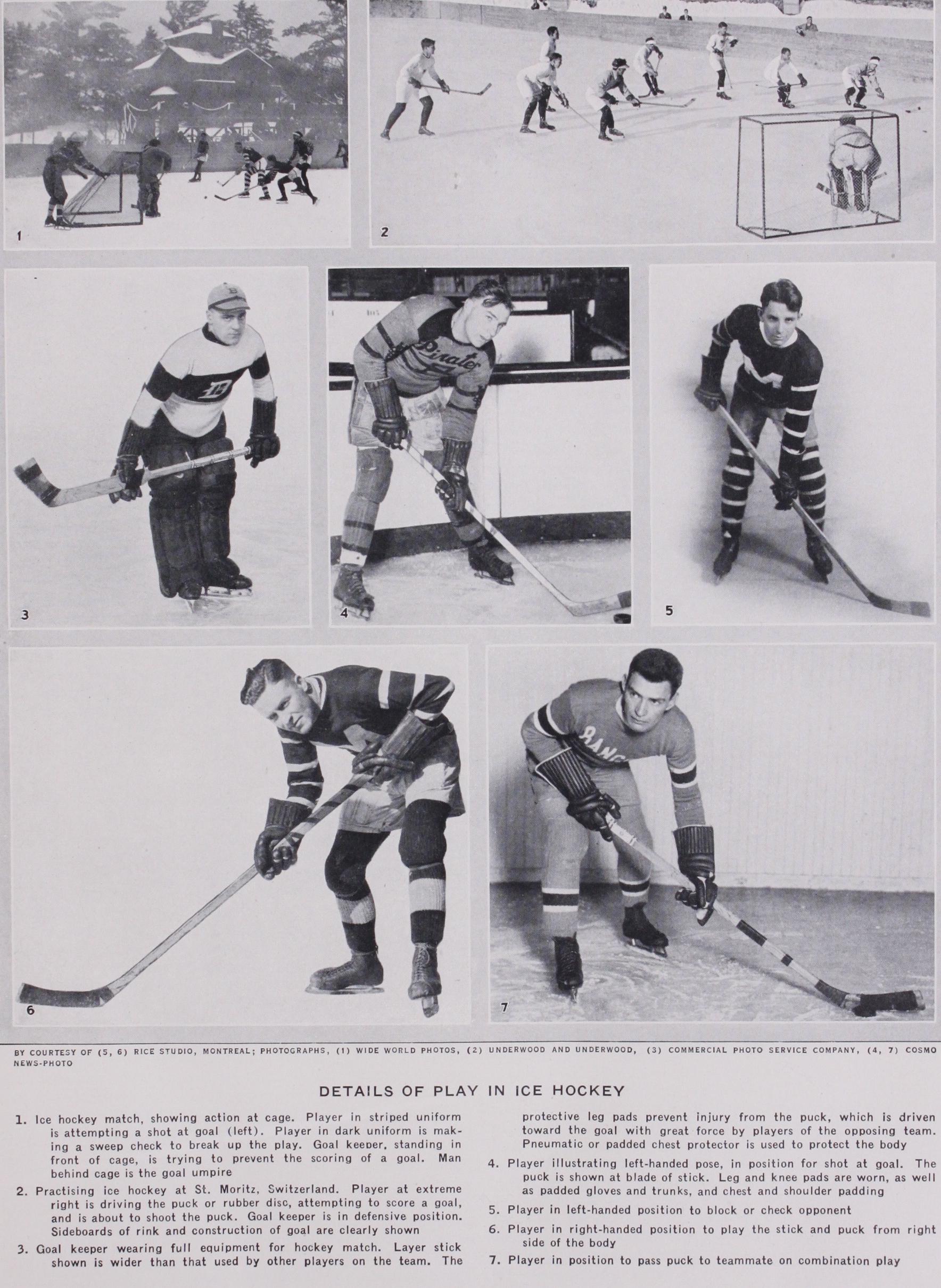
There are six players to a team, the positions being goal, left defence, right defence, centre, left wing and right wing (forwards). The centre of the rink is marked and the teams take positions on either side of this centre point, nearest the goal they are defending. The goal-keeper takes a position directly between the posts of the goal net. The defence men take positions to the right and left of the goal net about 25 ft. towards the centre of the ice from the net. The forwards take positions on a line close to the centre of the ice. The game is started by a referee dropping the puck between the opposing centres in centre ice. This puts the puck in play, and, the opposing teams must keep "onside," or behind the puck, when pushing or passing it from one player to another in combination play. The passing between members of the same teams may be intercepted at any time by an opponent.
There is some difference between the professional and amateur rules, but the usual play is for three 20 min. periods with I o min. intermissions between periods. Substitutes may enter the play at any time, but no substitution may be made unless the player being replaced leaves the ice. A goal is scored by the puck being driven fairly into the net or across the goal line by a stick. The team scoring the most goals in the three periods of play is declared the winner. In the event of a tie when the regulation number of periods is completed, overtime sessions are played. The present professional rules call for two "sudden death" periods of 5 min. each. If either team scores in these overtime sessions, the game is immediately over, but if neither team is able to score, the con test is declared a draw. Penalties are imposed by the referee for tripping a player, slashing with the stick, checking a player bodily with undue roughness, or by unfair use of the stick. The player penalized is sent to the sidelines, and takes no part in the game for such time as the referee sees fit to penalize him. A minor penalty is 2 min., a major penalty is 5 minutes. The penalized player's team continues to play short of his services until the expiration of the time of his penalty.
The National Hockey League is the major professional league. The teams comprising this circuit represent the following cities: two teams from New York, two from Montreal and one team each from Toronto, Boston, Chicago and Detroit. The amount paid for admissions for the season 6 at National Hockey League games was $1,745,931. Players are purchased by the teams, prices ranging from $5,000 to over $30,000. The average salary of a major league player is approximately $4,500 per season.
There are five minor professional leagues, each circuit having five or more teams which represent smaller cities in the United States and Canada. All of the Canadian universities and colleges, and the more important of these institutions in the United States have organized hockey teams, and in many of them hockey is ranked as a major sport.
In Canada there are over 1,200 organized amateur teams. During the past few years hockey has spread rapidly into the northern sections of the United States. This has become possible through the more extensive use of ice in rinks prepared by arti ficial means in the larger arenas and auditoriums. The game being played at night in the winter, it is not dependent upon weather conditions. Furthermore, it is played at a season of the year when the great outdoor sports are not engaging the attention of sport lovers. (J. S. HA. ; F. CR.) Ordinary pleasure-skating, figure-skating and speed-skating count for little in ice hockey. The recruit must practise hours, days and months to master the "stop-turn-and-start." Ice-hockey is played in a series of short dashes,—dodging, shifting, side-step ping and even hurdling being parts of the puck-chaser's routine. The game of tag on the ice is good practice, and intensive training may be obtained in skating rounds of I o or 20 yd. dashes, swing ing the body into sharp left or right turns or even making a corn plete about-face at the end of the dash. The next point is to con fine the skating-stride to as narrow a path of ice as possible. The professional player rushes a puck in a path as narrow as 3 ft., using a foot-over-foot stride and offering his opponents little in the way of legs, feet, stick and body to reach for. The close, choppy stride is the proper skating form to carry a player and his puck safely through an opposing team.
Many mediocre skaters have held positions in good teams through their knowledge of handling a hockey stick,—pushing the rubber puck along the ice with the 4 ft. hickory war-club, for ward, sideways left to right ; holding it steady with a sudden stopping or "feinting" motion and varying the whole routine with such tricky manipulations of the feet and body as completely to baffle opponents who attempt to steal the puck and thereby check the play. Years of constant practise are necessary to crown the efforts of the expert stick-handler. Professional players in the big leagues "stick-handle" the 3 in. rubber puck in a manner that is uncanny,—pushing and tossing the small rubber pellet about the ice between a maze of sticks and skates with a speed and accu racy too bewildering for the human eye to follow.
Methods of rushing, or "carrying," a puck along the ice vary. Some push the disc ahead at stick's length when the play is open ; others play the puck from side to side and close to their feet at all times. Some flip the rubber against the sideboards, depending on the rebound for recovery of the disc, while others attempt to poke the puck between the opponents' feet and skate their man to regain possession of the disc while the opponents are off balance or too befuddled to hamper the play effectively. Stick-checking calls for quick thinking and clever action on the part of the checker. The poke, sweep and hook checks are effective means of stopping opposing forwards in their rush toward the goal. The body-check in hockey is the same exhibition of brute strength, superior weight and sheer roughness that is used in football and other sports.
With skating and stick-handling perfected to a point where they are combined into one mechanical operation, the player can direct his whole attention to playing the game. A good hockey player never looks at his feet, stick or puck during the progress of the play. His eyes must be focused on his opponents at all times. Once he comes into possession of the puck he has three forwards, two defence-men and a goal-tender to beat before he can register a score by shooting the rubber disc into the 4 by 6 ft. goal-net guarded by the opposing team.
Left wing, centre and right wing, commonly known as "the forward line," should practise passing the puck from one to the other across the ice, while skating at top speed, until their combi nation-play is perfected to a point which enables them to beat the opposing forwards, swoop in on the opposing defence, and leave the odd man in position for a shot at the net. Individual rushes by self-styled stars seldom result in tallies being marked on the scoreboard. Left and right wing players should at all times play their positions in their respective alleys and leave the centre alley or mid-ice section to the centre player. Members of the forward-line are supposed to score goals when the opportunity is presented and never at the cost of allowing the opposing forwards to break away for a two- or three-man combination attack on the home team's net.
Defence-men, working within a 2o-yd. radius of the goal-net, should never leave their goal-tender unguarded. The good defence player must hold, at all times, a position between his goal-tender and the opposing forwards who attempt to carry the puck close enough to the net for a shot that may mean a score. Defence players adopt various forms of checking the forward line attack. Some use a stick or body check or a combination of the two; others crowd the incoming forwards to the sideboards or sand wich their man between their bodies for what is known as a "hoist"—anything to spoil the forwards' shots, keep them out of shooting range of the goal-net or force them to shoot from impossi ble angles.
A goal-tender has 4 by 6 ft. of open net to protect and must study the shots from all angles and positions on the ice. He must cover as much of his net as possible with his body and shift his position between the posts continuously to hamper the vision of the opposing sharp-shooters. If an opposing left-winger or right winger gets through the defence for a shot the net-guardian crowds the corner of the goal nearest to the winger, who is delivering the shot from the left-wing or right-wing "alley." When a forward skates through the defence and looms up directly in front of the net for a shot, there is little the goal-tender can do but attempt to anticipate the direction of his opponent's shot, as good for wards always shoot for the top or lower corners of the net.
(J. F1.)