
IGUANA, the name strictly applicable to the lizards of the family Iguanidae ; the same name, or its corruption "goanna," is sometimes misapplied to the monitors (family Varanidae). With three exceptions all the genera (numbering about 5o and containing over 40o species) belong to the New World; the ex ceptional genera are Brachylophus in the Fiji islands and Hoplurus and Chalarodon in Madagascar. The family can be regarded as the New World analogue of the Old World Agamidae, which family it closely resembles in its structure and in the modifica tions which its members have undergone. The only absolute dis tinction between the two families is in the position of the teeth; in the Agamidae they are fused to the crest of the jaw bones and in the Iguanidae attached to the inner slope below this crest. In many, however, the teeth are peculiar in being blade- or spear shaped, with the upper cutting edges strongly serrated. As a rule the iguanas are clothed with small scales and have a large dewlap, a pouch situated beneath the head and neck, and often a crest from the nape of the neck to the extremity of the tail; this crest is composed of narrow, elongate scales which gradu ally diminish in size posteriorly. The tongue is short and not protractile.
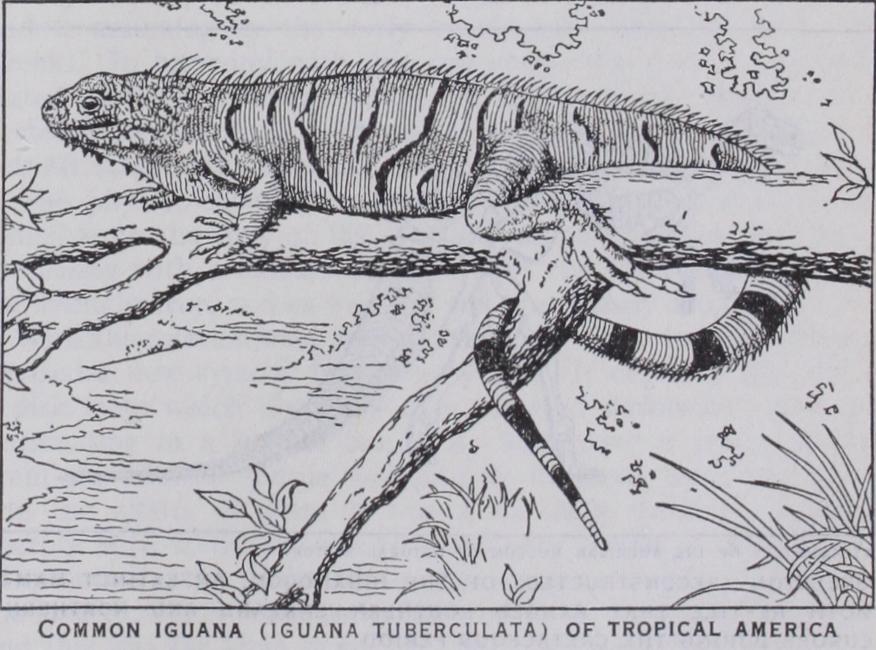
Perhaps the best known species is the common iguana (Iguana tuberculate) which occurs throughout tropical Central and South America. Reaching a length of as much as 6 f t., this animal is much sought for as an article. of diet, the flesh being greatly esteemed ; in habits it is arboreal, its favourite haunts being trees which overhang water, into which it will unhesitatingly plunge if disturbed. Like most of the arboreal species, the ground colour is greenish, relieved in this particular case by brown bands which, though indistinct on the body, form regular annuli on the tail. The food consists largely of tender leaves and fruits but the lizards are by no means averse to a mixed diet and will readily eat small birds and mammals. Another semi-arboreal genus is the likewise tropical American Basiliscus, whose mem bers exhibit some curious modifications. The body is compressed from side to side, the tail very long and whip-like, the hinder part of the head produced into a flat lobe like a cock's comb and the outer edges of the toes provided with a wide fringe of elongate scales; the males of all species have a crest along the back but in two species (B. basiliscus and B. plumi f rons) this is enormously developed, being as deep as the body, supported by rays like the fins of a fish, and covered with very thin scales. In addition to these structural peculiarities they have the power, shared only by a few other forms of this family, of being able to run across the surface of water; if disturbed near the water they scutter across it on their hind-limbs, the body being held almost upright with the tail raised as a counterpoise and the fore-limbs folded against their sides. Basiliscus itself does not dive, but the related Derioptyx of Cuba rushes across the sur face in the same way and in some quiet corner dives to the bottom, where it remains until the alarm has passed. Arnbly rhynchus has achieved fame as the only marine lizard. Its aquatic nature has usually been exaggerated, however, and actually it seldom takes to the water. Large herds of these lizards used to frequent the rocky shores of the Galapagos islands feeding on the sea-weeds between tide-marks.
The terrestrial species of the family are usually duller in colour than the arboreal ones and the body is, as a rule, depressed rather than compressed ; this depression has been carried to an extreme in the so-called horned toads (Phrynosoma) of the deserts of the United States and Mexico. As well as being depressed, they have, like many desert dwelling animals, developed an armour of spines the largest of which occur on the back of the head and neck and are relatively huge. This lizard offers a very close analogy to the Australian moloch lizard, an agamid which under similar conditions has developed a very similar appearance. An unique characteristic of the members of this genus is their ability to squirt a fine jet of blood from the eye; this extraordinary phenomenon, which has never been satisfactorily explained, only occurs under stress of great emotion, fright or anger. The lizard puffs itself up until the eyes bulge and then a very fine stream of blood is shot out of the eye, sometimes to a distance of five feet. No special mechanism for this discharge has been found and the eye does not appear to be injured.
Another peculiarly modified genus is Anolis which occurs throughout the warmer districts of both North and South America and which is particularly abundant among the West Indian islands. Many of the lizards of this genus have the basal joints of their fingers and toes dilated and covered with transverse lamellae like those of a gecko and these adhesive pads, together with the powerful claws, render the animals excellent climbers. They have wonderful powers of changing colour, rivalling in this respect the chamaeleons; in fact they are frequently called "American chamaeleons." The males often have enormously de veloped dewlaps which may be brilliantly coloured and can be expanded and contracted at will, like a fan.
Most iguanids reproduce by means of eggs though a few species are ovoviviparous. (H. W. P.)