
ILLINOIS or il'i-noiz), the Prairie State, one of the north central group of the United States of America, situated between 37° and 42° 30' N. lat. and 35' and 91° 31' W. longitude. It is bounded on the north by Wisconsin, east by Lake Michigan and Indiana, south-east and south by the Ohio river, which separates it from Kentucky, and south-west and west by the Mississippi river, which separates it from Missouri and Iowa. The enabling act of Congress, which provided for the organ ization of Illinois territory into a State, extended its jurisdiction to the middle of Lake Michigan and the Mississippi river. The State's greatest length is 3791m. and its extreme width is 211 miles. The total area of the State, exclusive of its Lake Michigan jurisdiction, is 56,665sq.m. of which 56,o43sq.m. are land.
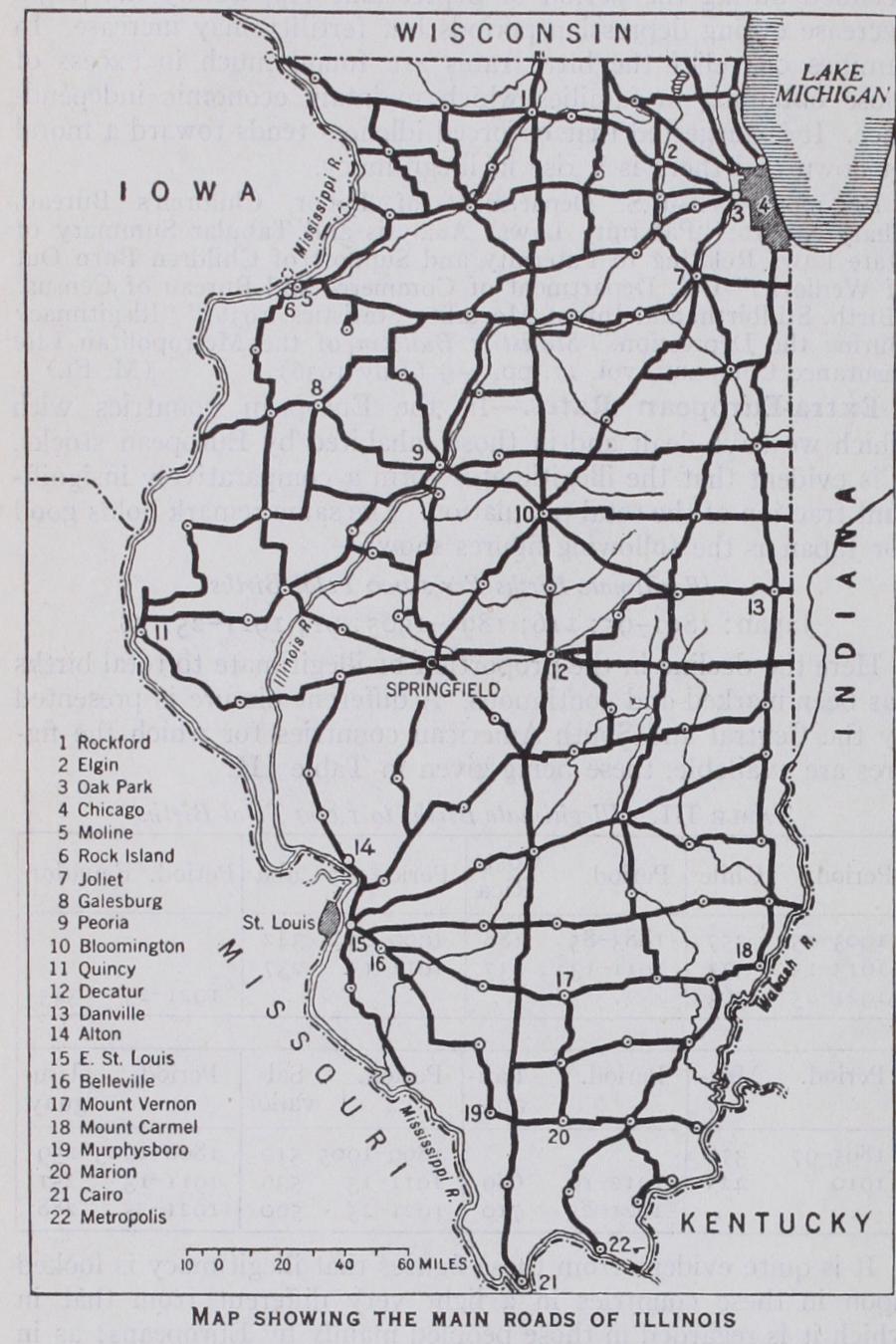
The drainage of Illinois is far better than its low elevation and comparatively level surface would suggest. There are nearly soo streams in the State, grouped in two river systems, one having the Mississippi, which receives three-fourths of the waters of Illinois, as outlet, the other being tributary to the Wabash or the Ohio river. The most important river is the Illinois which is formed by the junction of the Des Plaines and the Kankakee in the north-western part of Grundy county. It has a course of nearly 5oom., crossing the north-central and western portions of the State, draining 24,726 square miles. At some points, notably at Lake Peoria, it broadens into wide expanses resembling lakes. The Kaskaskia, in the south, notable for its variations in volume, and the Rock, in the north, are the other important rivers empty ing into the Mississippi ; the Embarrass and Little Wabash, the Saline and Cache in the cast, are the important tributaries of the Wabash and Ohio rivers. The Chicago river naturally flowed into Lake Michigan, but by the construction of the drainage canal it was turned in 'goo so that it flows into the Mississippi.
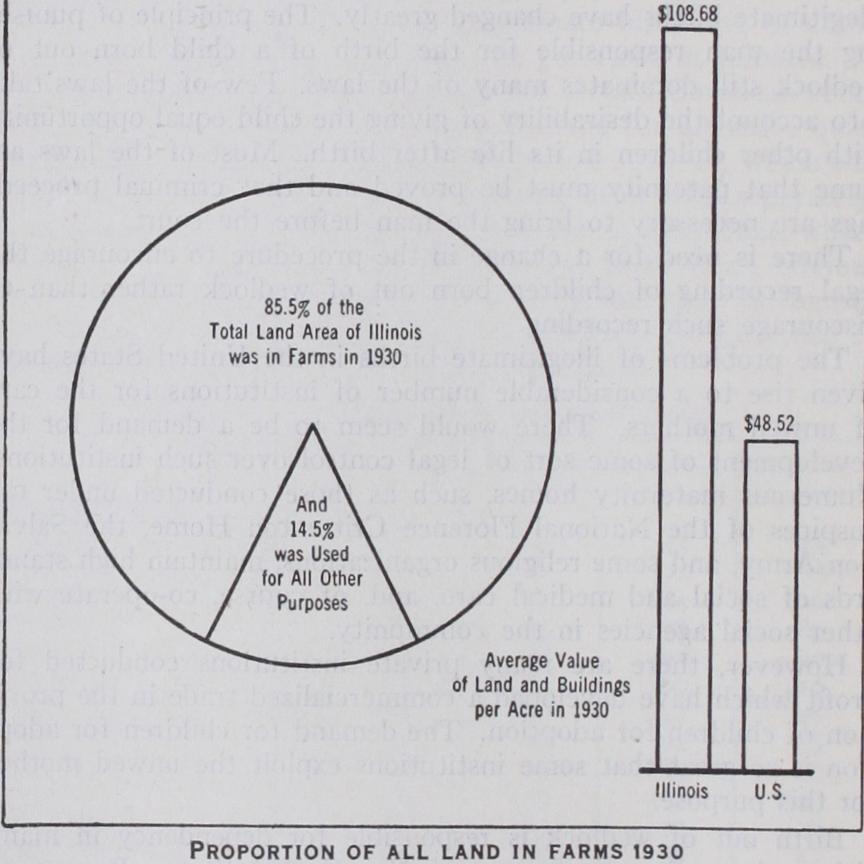
The soil of Illinois is remarkable for its fertility. The surface soils are largely composed of drift deposits, varying from 2 to i oof t. in depth ; they are often overlaid with a dark coloured loam loin. or more deep, and in a large portion of the State there is a subsoil of mottled clay. The soil of the prairies is darker and more granular than that of the forests, but all differences dis appear with cultivation. The soil of the river valleys is alluvial and especially fertile, the "American Bottom," extending along the Mississippi from Alton to Chester, having been in cultivation for more than 200 years. Along the river bluffs there is a deposit of loess, well suited to the cultivation of fruits and vegetables.
Drainage has proved an important feature in the agricultural development of Illinois. Of the State's 214,497 farms in 193o covering 9,331,153 acres, were reported as provided with drainage. The greatest portion of the land in drainage enter prises was in the eastern and the northern parts of the State, though there were many projects in the central and south-eastern parts and along the Mississippi. The organized drainage under takings within the State in 193o controlled 5,996.4m. of ditch and 3,825.6m. of tile drains.
Climate.—The climate of Illinois is notable for its extremes of temperature. The warm winds which sweep up the Mississippi valley from the Gulf of Mexico are responsible for the extremes of heat, and the arctic winds of the north, which find no moun tain range to break their strength, cause the extremes of cold. The mean annual temperature of Winnebago, near the northern border, is 47°F, and it increases to the southward at the rate of about 2° for every degree of latitude, being 5 2 ° F at Springfield, and 58°F in Cairo, at the southern extremity. The lowest tem perature ever recorded in the State was —3 2 °F in Feb. 1905, at Ashton in the north-west and the highest was ii5°F in July 19oi, at Centralia, in the south, making a maximum range of 147 de grees. The range of extreme is somewhat greater in the north than in the south. The mean annual precipitation is about 43in. in the southern counties, but this decreases to the northward, being about 36in. in the central counties and 34in. along the northern border. The mean annual snowfall increases from 17.5in. at the southern extremity to more than 32in. in the northern counties. In the north the precipitation is 44.8% greater in spring and sum mer than it is in autumn and winter, but in the south only 36.17% greater. At Cairo the prevailing winds are southerly during all months except February, and as far north as Springfield they are southerly from April to January ; but throughout the northern half of the State, except along the shore of Lake Michigan, where they vary from north-east to south-west, the winds are mostly from the west or north-west from October to March and are variable for the remainder of the year. Tornadoes are not un known to Illinois, one of the most severe on record having visited southern Illinois on March 18, 1925. The property loss was esti mated at $16,500,00o and 742 persons were killed and 2,756 were injured.
Government.—Illinois has been governed under two terri torial acts of Congress and three Constitutions, the Territorial Constitution Acts of 1809 and 1812, and the three State Con stitutions of 1818, 1848 and 1870 (subsequently amended). A new Constitution, submitted to the people on Dec. 12, 1922, was de feated by a vote of 921,398 to 185,298. Amendments may be made by a Constitutional Convention or a two-thirds vote of all members elected by each house of the legislature, ratification by the people being required in either instance. A Constitutional Convention may be called by the general assembly when two-thirds of the members of each house concur and their action, when sub mitted to the people, is approved by a majority of the votes cast.
The Constitution provides for an executive department con sisting of a governor, lieutenant-governor, secretary of State, auditor of public accounts, treasurer, attorney-general and super intendent of public instruction, all elected for four years, with the exception of the treasurer, whose term of service is two years. Despite the difficulty of modifying long-established laws, far-reaching changes have been made. By the Consolidation Act of 1917, over zoo State boards, bureaux and offices, paid and unpaid, created to execute various acts or to supervise the various State debt institutions, were consolidated into nine departments— finance, agriculture, labour, mines and minerals, public works and buildings, public welfare, trade and commerce, registration and education and public health. Reorganization of governmental machinery was begun in 1909 with the abolition of separate boards for the various State charitable institutions and the estab lishment of one central board of control possessing also certain powers over private charitable institutions. In addition to this board a supervisory State charities commission was created. In 1925, the legislature created a department of purchases and con struction and a department of conservation. The heads of these various departments, who are appointed by the governor and senate, have acted as a cabinet for the governor.
Changes in the *tate's system of appointments were effected by the Act of 1911, which extended the civil service system to the greater part of the State's employees. Civil service now covers all State appointees except those appointed by the governor and confirmed by the senate, the scientific and academic staff of the University of Illinois and the normal schools, and a few others. All examinations are competitive, although for some scientific posts "unassembled examinations" are given which consist of questions as to training and experience. By an amendment of 1917 all appointees may be removed by the appointing authority, but are allowed an appeal to the State civil service commission on allegation that the removal is due to race, politics or religion.
Members of the legislature are chosen by districts, three repre sentatives and one senator from each of the 51 districts, 18 of which are in Cook county. Regular sessions of the legislature meet on the first Wednesday after the first Monday in January in odd-numbered years. The term of senators is four years, that of representatives two years; and in the election of representatives since 187o there has been a provision for "minority" representa tion, under which by cumulative voting each voter may cast as many votes for one candidate as there are representatives to be chosen, or he may distribute his votes (giving three votes to one candidate, or one and one-half votes each to two candidates, or one vote each to three candidates), the candidate or candidates receiving the highest number of votes being elected. A similar system of cumulative voting for aldermen may be provided for by ordinance of councils in cities organized under the general State law of 1872. Special legislation is prohibited when general laws are applicable, and special and local legislation is forbidden in any of 23 enumerated cases, among which are divorce, changing of an individual's name or the name of a place, and the grant to a cor poration of the right to the name of a place. The general assem bly may pass an act over the governor's veto by a two-thirds vote of all the members elected to each house.
The judicial powers are vested in a supreme court, appellate courts, circuit courts, county courts, justices of the peace, police magistrates, and such courts as may be created by law in and for cities and incorporated towns. The supreme court is com posed of seven members elected from districts for a term of nine years. The four appellate courts are distributed one for Cook county (which has also two branch appellate courts, both the court and the branches being presided over by three judges appointed by the supreme court) and three other districts, each with three judges appointed in a like manner. The State outside of Cook county is divided into 17 circuits in each of which three judges are elected for a term of six years. The Constitution pro vides for separate courts in Cook county. The county has a su perior court consisting of 29 judges elected for six years, a circuit court consisting of 20 judges elected for a like term, a criminal court, a county court and a probate court. The City of Chicago has a municipal court composed of 36 judges and a city court con sisting of 27 members. Each county has a county court consisting of one judge who serves for four years ; in some counties probate courts have been established, and in counties of more than 500,000 population juvenile courts for the trial and care of delinquent chil dren are provided for. Each county has a State attorney elected for a term of four years.
The local government of Illinois includes both county and town ship systems. The earliest American settlers came from the South ern States and naturally introduced the county system ; but the increase of population from the New England and Middle States led to a recognition of township organization in the Constitution of 1848, and this form of government, at first prevalent only in the northern counties, is now found in most of the middle and southern counties. Cook county, although it has a township sys tem, is governed, like those counties in which townships are not found, by a board of commissioners, elected by the townships and the City of Chicago. A general law of 1872 provides for the or ganization of municipalities, only cities and villages being recog nized, though there are still some "towns" which have failed to reorganize under the new law. In 193o there were 232 cities, 29 towns and 839 villages in the State. City charters are granted only to such municipalities as have a population of at least i,000. Re quirements for suffrage are age of 21 years or more, citizenship in the United States, and residence in the State for one year, in the county 90 days, and in the election precinct 3o days preceding the exercise of suffrage. Disfranchisement is brought about by conviction for bribery, felony or infamous crime, and an attempt to vote after such conviction is a felony.
The relation of the State to corporations and industrial prob lems has been a subject of important legislation. The Constitu tion declares that the State's rights of eminent domain shall never be so abridged as to prevent the legislature from taking the property and franchises of incorporated companies and subjecting them to the public necessity in a way similar to the treatment of individuals. In 1903 the legislature authorized the municipal ownership of public service corporations. Railways organized or doing business in the State are required by the Constitution to have a public office where books for public inspection are kept, showing the amount of stock, its owners, and the amount of the road's liabilities and assets. No railway company may now issue stock except for money, labour, or property actually received and applied to purposes for which the corporation was organized.
An anti-trust law of 1893 exempted from the definition of trust combinations those formed by producers of agricultural products and live-stock, but the United States Supreme Court in 1902 declared the statute unconstitutional as class legislation. Accord ing to a revised mining law of 1899 (subsequently amended), all mines are required to be in charge of certified mine managers, mine examiners, and hoisting engineers, when the services of the engineers are necessary ; and every mine must have an escape ment shaft distinct from the hoisting shaft. The employment of children under 14 years of age in factories or mines, as well as working employees under 16 years of age for more than 48 hours a week, is forbidden by statute.
individual, and from constructing internal improvements, and the counties, townships and other political units cannot incur in debtedness in excess of 5% of their assessed property valuation, The legislature may not contract a debt of more than $25o,00c except to suppress treason, war or invasion unless approved by a vote of the people. The State's outstanding bonded indebted ness on Jan. i, 1936 was $217,822,411.
All general banking laws must be submitted to the people for ratification. The northern part of Illinois lies in the 7th Federal Reserve district and the southern part in the 8th, with headquar ters respectively in Chicago and St. Louis. In 1927 there were national banks in Illinois with aggregate capital stock of aggregate surplus of $72,6oi,000 and total resources of $I,839,00i,000. Of these banks 35 are located in Chicago, hav ing resources amounting to $I,2o1,548,000. Side by side with the national banks is the system of State banks created by the Act of 1887, and operating under the supervision of the auditor of pub lic accounts. In 1927. there were 1,353 State banks with a total capital of $173,57o,5oo, and aggregate resources of Of the State banks 188 were in Chicago, having resources amount ing to $1,997,593,629. In 1936 Illinois had 299 national and 588 State banks, with a total capital of $220,474,391 and aggregate resources of $3,982,651,891.
The public schools of the State are free to all between the ages of six and 21 years, and school attendance is compulsory for all children from seven to 16 years of age. Of the population of school age (5-17) in 1932, 1,415,553• or 78.9%, were enrolled in the public schools. In addition to the public schools there were, in 1932, 1,036 private schools with 280,568 pupils. The distribu tion of public school enrolment was I,o77,755 in the kindergarten and elementary schools, and 337,798 in high schools. The total number of teachers in 1932 was 47,472 in public elementary and secondary schools. School revenue is derived chiefly from local taxation. The expenditures, including new buildings as well as operation and equipment expenditures, in 1932 were $14o, 7 5 5,000, or a per Caput, based on total population, of $1,812. This is an increase of $71,397,000 over the $69,358,000 expended in 192o. The average day's attendance per year per pupil enrolled in 1932 was 163.2 days. A notable development in the public educational system was the growth in the number of township high schools, and the number of community high schools following the legisla tion of 1917. Under the township high school law some 200 high schools were organized. Acts of 1913 and 1915 directed the pay ment by local school authorities of tuition for children who wished to attend high school elsewhere when there was none in their dis trict. With the rapid growth in the number of high school gradu ates there was a corresponding increase in the enrolment in the universities and colleges of the State; by 1932 this had reached 67,218.

The State provides for higher education in the University of Illinois at Urbana and five teachers' colleges situated. at Normal, Carbondale, Charleston, De Kalb, and Macomb. The university was founded in 1867, through the U.S. land grant of 1862, as the Illinois Industrial university, and received its present name in 1885 ; since 187o it has been co-educational. The expansion of the university through the acquisition or organization of new col leges and schools began in 1896 when the Chicago College of Pharmacy became the University of Illinois School of Pharmacy. Since that date important changes have been made. The university in 1936 consisted of a college of liberal arts and sciences, a college of commerce and business administration, a college of education, a college of engineering, a college of agriculture, a college of law, the graduate schools, a library school, a school of journalism, and a school of music at Urbana, and a college of medicine, a college of dentistry and a school of pharmacy at Chicago. An agricul tural experiment station, an engineering experiment station and the bureaux of educational research and of business research are connected with the university. The faculty in 1935-36 numbered 1,705 and the total enrolment of students for that academic year was 14,036. The nine public and private teachers' colleges in 1932 had an enrolment of 8,048.
In 1932 there were 59 universities, colleges, and professional schools. The most important of these are the University of Chi cago, Northwestern university at Evanston, Illinois Wesleyan university at Bloomington, Knox college at Galesburg, Illinois college at Jacksonville, Lake Forest college at Lake Forest. De Paul university at Chicago, Loyola university at Chicago, and Augustana college and theological seminary at Rock Island. Charities and Corrections.—The department of public wel fare is charged with the administration of all charitable and penal institutions in the State. To accomplish this purpose the depart ment has been separated into a number of divisions and in turn each institution is under a manager appointed by and under the direction of the department. In 1936 there were 27 State institu tions under the department's supervision. Of these, nine were hospitals for the insane located at Elgin, Kankakee, Jacksonville, Anna, East Moline, Peoria, Menard, Chicago, Alton and Manteno. There were two institutions for the feeble-minded, the Lincoln State school and colony at Lincoln and a State hospital at Dixon. The State maintained a school for the blind and a school for the deaf at Jacksonville, an industrial home for the blind at Chicago, a training school for girls at Geneva and a like institution for boys at St. Charles. Charitable institutions included a home for soldiers and sailors at Quincy, a soldiers' orphans' home at Nor mal, a home for soldiers' widows at Wilmington, a research and educational hospital connected with the college of medicine of the University of Illinois, and an eye and ear infirmary at Chicago. The State's penal institutions were: a State penitentiary and a women's prison at Joliet, a reformatory at Pontiac, a State farm at Vandalia and the Southern Illinois penitentiary at Menard. The division of child welfare exercises supervision over all or phanages situated within the State. Poor relief is administered by the counties usually through the maintenance of alms-houses. By a law of i 905 all employees in State institutions were put on a civil service basis. In 1936 the total population of State wards was 49, i o3.
The growth of manufacturing in Illinois, due largely to the development of her exceptional transportation facilities, was the most rapid and remarkable in the industrial history of the United States. In 1850 the State ranked fifteenth, in 1870 sixth, and in 188o fourth, the same relative position it held in 1923. In 1905 the product of the manufactures was valued at $1,410,342, 129, in 1919 the value was $3,366,452,969, and in 1923 the total value had risen to $5,041,113,314. The manufactures in employed 645,627 wage-earners, working in 14,345 establishments. The most important industry was wholesale slaughtering and the packing of meats, which yielded 12.27% of the total manufac tured product of the State in 1923. Illinois has long held first rank in this industry; the product for 1923 exceeded more than twice that of any other State. The manufacture of iron and steel products, and of products depending upon iron and steel as raw material, is second in importance. The iron for these industries is secured from the Lake Superior region, the coal and limestone from mines within the State. The position of Illinois in the heart of the agricultural section and her bountiful supply of iron has caused the State to become the chief producer of agricultural implements. The ten most important industries with the values of their respective products in 1923 were as follows :—slaughter ing and meat packing (wholesale) $606,320,553; foundry and machine shops, $275,955,o47; iron and steel, steel works and rolling mills, $213,671,552 ; electrical machinery and supplies, $211,366,2o6; clothing, men's, $186,683,333; cars, steam road (not built in repair shop), $159,364,227; printing and pub lishing, book and job, $138,227,215; printing, publishing, newspaper, etc., $132,288,355 ; cars and general construction, steam, $118,604,362; bread and other bakery products, $105, 289,516. During the depression, however, 10,740 establishments employed 420,334 wage-earners, according to the 1933 census of manufactures. The value of the product of certain leading indus tries was as follows:—meat packing (wholesale), $310,160,000, foundry and machine shops, $79,267,000; electrical machinery and supplies, $55,977,000; clothing, men's, $37,748,000; cars, electric and steam railroad, $9,310,000; printing and publishing, book, music and job, $81,865,000; printing and publishing, news papers and periodicals, $93,386,000.
Chicago, with its tributary manufacturing suburbs of Maywood, Harvey, Cicero, Blue Island, Chicago Heights, and, in Indiana, Hammond and Gary, is the greatest manufacturing centre of the State. A lesser manufacturing centre has grown up in the net of railways that centre at East St. Louis, Collinsville, Granite City and Edwardsville. The third centre is formed by Moline and Rock Island with Davenport, Iowa. Rockford is best known for its furniture manufactures, Kewanee for boilers, Elgin for watches, Moline for farm implements and automobiles.
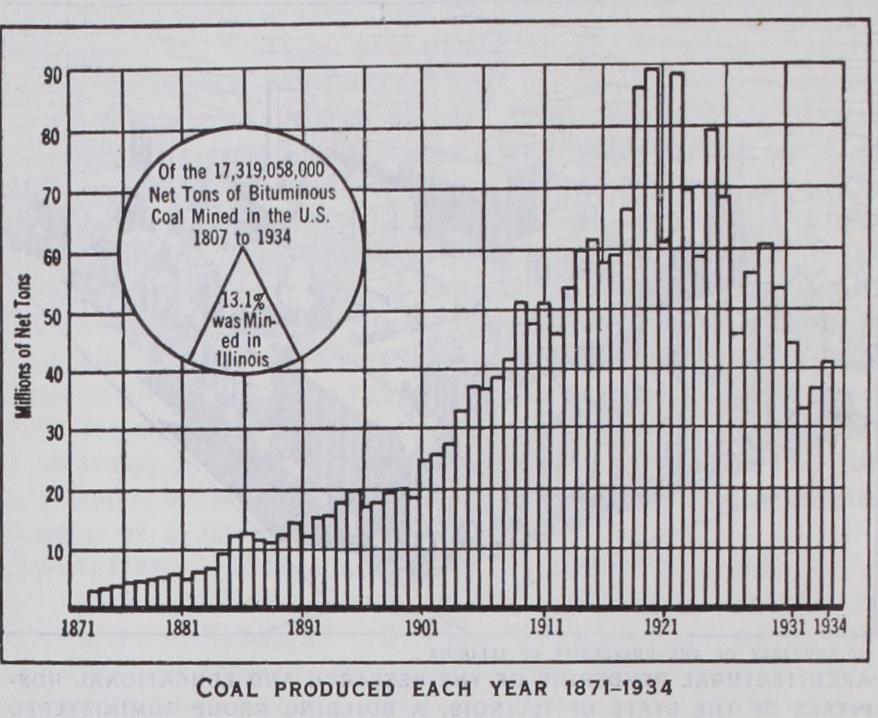
In mining and allied interests Illinois occupies an important place. In 1919 the State ranked third in the total number of per sons engaged in the mining industries and fourth among the States in the value of products. In the total value of products for 1925 ($231,658,6o4), the State ranked seventh, the relative de cline in importance being due chiefly to increased petroleum pro duction in other States. In 1933 the mineral production of the State was valued at only $74,837,000. Coal constitutes the State's chief product. The great central coal-field of North America extends into Illinois from Indiana as far north as a line from Grundy county to Rock Island, west from Rock Island to Hen derson county, then southwest to the southern part of Jackson county, where it runs south into Kentucky, including S4 counties and approximately 35,000sq.m. of the land surface of the State. During 1926, 69,813,255 short tons were mined with a value equal to 57% of the State's total mineral product. This amount was exceeded only by Pennsylvania and by West Virginia. The peak year of production was 1920 when 78,255,000 short tons of coal were mined; by 1932 this production had declined to 33,4 7 5,000. Clay products were second in importance with an output valued at $33,591,368 in 1926 and $2,8o3,000 in 1933. Petroleum, the mineral third in importance, was long known to exist within the State but was not seriously exploited until 1906 when the annual production (4,397,o5obbl.) for the first time exceeded 1,000,000 barrels. In 1924 the production was 8,081,000bbl. valued at $14,220,000, and in 4,479,000bbl. The peak period of pro duction was 1911 to 1915, when an average of were produced each year. The producing area covers about 4,5oosq.m. in 16 counties in the southeastern part of the State. Limestone, sandstone, sand, fluorspar, lead, and zinc were other leading products. The quarrying industries were well distributed throughout the State and furnished not only stone for construc tion work, but also limestone for the iron industry, and sandstone from which a large part of the U.S. silica supply is derived. Illi nois has ranked as the leading State in the Union since 1842 in the production of fluorspar.
Transportation facilities have been an important factor in the economic development of Illinois. The first settlers used the waterways, some coming by way of the Great Lakes while others used the Ohio river. The first improved transportation facilities were the turnpikes and canals, undertaken in whole or part by the State. The task of connecting Lake Michigan and the Mississippi river was accomplished by the State's building the Illinois and Michigan canal to La Salle, at the head of the navigation on the Illinois river, a work begun in 1836 and completed in 1848. In 1890 the sanitary district of Chicago undertook the construction of a canal between Chicago and Lockport, where the new canal joins the Illinois and Michigan canal. This work was opened in 1900, providing a waterway with a depth of 2oft. for navigation between the above places; but from Lockport to Utica, on the Illinois river, a distance of 62m. there was no adequate means of water transportation. A legislative Act of 1919 provided for the issue of bonds to the amount of $20,000,000 for the construction of an 8ft. channel, "The Illinois Waterway," connecting the points mentioned. The Federal Government completed in Oct. 1907 the construction of a new canal, the Illinois and Mississippi, from Hennepin to Roce river. It had a channel 7ft. deep, 52ft. wide at the bottom and Soft. wide at the water-line. These water ways are not extensively used today, Illinois' most important water transportation system is that of the Great Lakes.
Steam railways are by far the State's chief means of trans portation. With 12,262m. of main line she was in second only to Texas. For over 3o years little new main line road has been built. The important extension has been in double-tracking and improvement of the right-of-way and terminals. The field of passenger and light freight and coal transport, since 1900, has been invaded by the electric lines. The Illinois traction system operates a ramification of electric lines across the State from Danville to East St. Louis and radiating throughout central Illi nois; on certain runs it uses sleeping and parlor cars.
The improvement of roads in the State of Illinois has been given marked attention. A State highway commission was created in 1905, and in 1914 State appropriations for hard roads were made from the proceeds of automobile licence fees. Actual con struction was begun in 1914. Road building in Illinois is carried on under four distinct systems—the township, the State aid, the State bond issue and the Federal aid systems. There is an over lapping of mileage among these. Acts of Congress in 1916 and 1919, apportioning Federal aid in behalf of roads, allotted to Illi nois $3,300,00o and $8,700,000 respectively. The question of issuing $6o,000,000 in bonds based on automobile licence fees for the construction of 4,800m. of hard roads was submitted to the voters of the State in Nov. 1918 and was approved by them. A bond issue of $1 oo,000,000 providing for the continuance of a State-wide system of hard surface roads was approved by the people at the general election of 1924.
During 1933-35 a total of $196,395,095 was made available for highway construction, more than $25,000,000 of this amount hav ing been allotted by the Federal government through the Na tional Recovery, Emergency Relief Appropriation, and Hayden Cartwright Road acts. The total net paved mileage in the State under all four systems of construction, excluding city streets, on Jan. 1, 1934 was 1 o,o99m. of which 9,584m. were concrete.
In 1712 the Illinois river was made the northern boundary of the French province of Louisiana, which was granted to Antoine Crozat (1655-1738), and in 1721 the seventh civil and military district of that province was named Illinois, which included more than one half of the present State, the country between the Arkan sas river and the line 43° N. lat., as well as the country between the Rocky mountains and the Mississippi; but in 1723 the region around the Wabash river was formed into a separate district. The trade of the Illinois country was now diverted to the settle ments in the lower Mississippi river, but the French, although they were successful in gaining the confidence and friendship of the Indians, failed to develop the resources of the country. By the Treaty of Paris, 1763, France ceded to Great Britain her claims to the country between the Ohio and Mississippi rivers, but on account of the resistance of Pontiac, a chief of the Ottawas, who drew into conspiracy most of the tribes between the Ottawa river and the lower Mississippi, the English were not able to take possession of the country until 1765, when the French flag was finally lowered at Ft. Chartres.
The policy of the British Government was not favourable to the economic development of the newly acquired country, since it was feared that its prosperity might react against the trade and industry of Great Britain. But in 1769 and the succeeding years of English control, this policy was relaxed, and immigration from the seaboard colonies, especially from Virginia, began. In 1771 the people of the Illinois country, through a meeting at Kaskaskia, demanded a form of self-government similar to that of Connecticut. The petition was rejected by Gen. Thomas Gage; and Thomas Legge, earl of Dartmouth (1731-1801), secretary of State for plantations and president of the Board of Trade, drew up a plan of government for Illinois in which all officials were appointed by the Crown. This, however, was never operative, for in 1774, by the famous Quebec Act, the Illinois country was annexed to the Province of Quebec, and at the same time the jurisdiction of the French civil law was recognized. These facts explain the considerable sympathy in Illinois for the colonial cause in the War of Independence. Most of the inhabitants, however, were French, and these were loyalists. The English authorities instigated the Indians to make attacks upon the frontiers of the American colonies, and this led to one of the most important events in the history of the Illinois country, the capture of the British posts of Cahokia and Kaskaskia in 1778, and in the following year of Vincennes, Ind., by George Rogers Clark (q.v.), who acted under orders of Patrick Henry, governor of Virginia. These conquests had much to do with the securing by the United States of the country west of the Alleghanies and north of the Ohio in the Treaty of Paris, 1783.
The Virginia house of delegates, in 1778, extended the civil jurisdiction of Virginia to the north-west, and appointed Capt. John Todd (1750-82), of Kentucky, governor of the entire ter ritory north of the Ohio, organized as "The County of Illinois." This government was confined to the old French settlements and was entirely inefficient. In 1787, Virginia and the other States having relinquished their claims to the country west of the Alle ghanies, the North-west Territory was organized by Congress by the famous ordinance of 1787. Two years later St. Clair county was formed out of the south-west part of the Illinois country, while the eastern portion and the settlements around Vincennes, Ind., were united into the county of Knox, and in 1795 the southern part of St. Clair county was organized into Randolph county, with Kaskaskia as the seat of administration. In 1800 the Illinois country was included in the Territory of Indiana, and in 1809 the western part of Indiana from Vincennes north to Canada was organized as the Territory of Illinois; it included, be sides the present State, all of Wisconsin except the northern part of the Green bay peninsula, a large part of Michigan, and all of Minnesota east of the Mississippi. In 1812, by permission of Congress, a representative assembly was chosen, a territorial con stitution was adopted, and the territorial delegate in Congress was elected directly by the people.
In 1818 Illinois became a State of the American Union, the en, abling act fixing the line 42° 3o' as the northern boundary, in. stead of that provided by the ordinance of 1787, which passed through the south bend of Lake Michigan. The reason given for this change was that if the Mississippi and Ohio rivers were the only outlets of Illinois trade, the interests of the State would become identified with those of the Southern States ; but if an outlet by Lake Michigan were provided, closer relations would be established with the Northern and Middle States, and so "addi tional security for the perpetuity of the Union" would be afforded.
Throughout the territorial period there was conflict between French and English land claims. In i8o4 Congress established land offices at Kaskaskia and Vincennes to examine existing claims and to eliminate conflict with future grants; in 1812 new offices were established at Shawneetown and Edwardsville for the sale of public lands; and in 1816 more than 50o,000ac. were sold. In 1818, however, many citizens were in debt for their lands, and "squatters" invaded the rights of settlers. Congress therefore reduced the price of land from $2 to $1.25 per acre and adopted the policy of pre-emption, preference being given to the claims of existing settlers. The Indians, however, resisted measures look ing toward the extinguishment of their claims to the country. Their dissatisfaction with the treaties signed in 1795 and 1804 caused them to espouse the British cause in the war of 1812, and in 1812 they overpowered a body of soldiers and settlers who had abandoned Ft. Dearborn (see CHICAGO). For a number of years after the end of the conflict, the Indians were comparatively peaceful; but in 1831 the delay of the Sacs and Foxes in with drawing from the lands in northern Illinois caused Governor John Reynolds (17 88-186 5) to call out the militia. The following year Black Hawk, a Sac leader, opened an unsuccessful war in northern Illinois and Wisconsin (the Black Hawk War) ; and by 1833 all Indians in Illinois had been removed from the State.
The financial and industrial policy of the State was unfortunate. Money being scarce, the legislature in 1819 chartered a State bank which was authorized to do business on the credit of the State. This bank never operated and a second was chartered in 182o. In a few years the bank failed, and the State in 1831 borrowed money to redeem the depreciated notes issued by the bank. A second State bank was chartered in 1835; two years later it sus pended payment, and in 1843 the legislature provided for its liquidation. The State also undertook to establish a system of internal improvements, granting a loan for the construction of the Illinois and Michigan canal in 1836, and in 1837 appropriating $IO,000,000 for the building of railroads and other improvements. The experiment proved unsuccessful; the State's credit declined and a heavy debt was incurred, and in 184o the policy of aiding public improvements was abandoned. Through the efforts of Governor Thomas Ford (1800-5o) a movement to repudiate the debt was defeated, and a plan was adopted by which the entire debt could be reduced without excessive taxation, and by 188o practically the entire debt was extinguished.
A notable incident in the history of the State was the immi gration of the Mormons from Missouri, about 184o. Their prin cipal settlements were in Hancock county. They succeeded in securing favours from the legislature, and their city of Nauvoo had courts and a military organization that was independent of State control. Political intrigue and claims of independence from the State, as well as charges of polygamy and lawless conduct, aroused such intense opposition to the sect that in 1844 a civil war broke out in Hancock county which resulted in the murder of Joseph Smith and the removal of the Mormons from Illinois in 1846.
The slavery question, however, was the problem of lasting po litical importance. Slaves had been brought into the Illinois country by the French, and Governor Arthur St. Clair 1818) interpreted the article of the ordinance of 1787, which for bade slavery in the North-west Territory, as a prohibition of the introduction of slaves into the territory, not an interference with existing conditions. The idea arose that negroes could be held as indentured servants, and such servitude was recognized in the Indiana code of 1803, the Illinois Constitution of 1818, and statutes of 1819; indeed, there would probably have been a recog nition of slavery in the Constitution of 1818 had it not been feared that such recognition would have prevented the admission of the State to the Union. In 1823 the legislature referred to the people a resolution for a Constitutional Convention to amend the Con stitution. The aim, not expressed, was the legalization of slavery. Although a majority of the public men of the State, indeed prob ably a majority of the entire population, was either born in the Southern States or descended from Southern people, the resolu tion of the legislature was rejected, the leader of the opposition being Governor Edward Coles (1786-1868), a Virginia slave holder, who had freed his slaves on coming to Illinois. The oppo sition to slavery, however, was at first economic, not philan thropic. In 1837 there was only one abolition society in the State, but chiefly through the agitation of Elijah P. Lovejoy (see ALTON), the abolition sentiment grew. In 1842 the moral issue had become political, and the Liberty Party was organized, which in 1848 united with the Free Soil Party; but as the Whig Party approved the policy of non-extension of slavery, these parties did not succeed so well united as under separate existence. In however, the Liberty and Free Soil Parties, the Democrats op posed to the Kansas-Nebraska bill, and some Whigs united, se cured a majority in the legislature, and elected Lyman Trumbull U.S. senator. Two years later these elements formally organized as the Republican Party and elected their candidates for State offices. This was the first time that the Democratic Party had been defeated, its organization having been in control since the admission of Illinois to the Union. An important influence in this political revolution was a change in the character of the popula tion. Until 1848 the Southern element predominated in the popu lation, but after that year the immigration from the Northern States was greater than that from the South, and the foreign ele ment also increased. The influence of immigration and section alism upon Illinois politics is well illustrated by the fact that the first six governors (1818-38) were born in the Southern States, six of the eight U.S. senators of that period were also Southern born, and all of the representatives, with one exception, also came to Illinois from the Southern States. After 1838 the Eastern States began to be represented among the governors, but until 1901 no governor was elected who was a native of Illinois. See E. B. Greene, Sectional Forces in the History of Illinois (Publica tions of the Historical Library of Illinois, no. 8, 1903).
The opposition to slavery continued to be political and eco nomic rather than philanthropic. The Constitution of 1848, which abolished slavery, also forbade the immigration of slaves into the State. In 1858 occurred the famous contest for the office of U.S. senator between Stephen A. Douglas (Democrat) and Abraham Lincoln (Republican). Douglas was elected, but the vote showed that Illinois was becoming more Northern in sympathy, and two years later Uncoln, then candidate for the presidency, carried the State. The policy of Illinois in the early period of secession was one of marked loyalty to the Union; even in the southern part of the State the majority of the people had no sympathy with the pro-slavery men in their efforts to dissolve the Union. The legis lature of 1861 provided for a war fund of $2,000,000; and Capt. James H. Stokes of Chicago transferred a large amount of munitions of war from St. Louis, where the secession sentiment was strong, to Alton. The State contributed 2S5,o92 men to the Federal armies. From 1862-64, however, there was some oppo sition to a continuance of the war. This was at first political; the legislature of 1862 was Democratic, and for political purposes that body adopted resolutions against further conflict, and recom mended an armistice, and a national convention to conclude peace.
From the close of the Civil War until the end of the 19th cen tury the Republican Party was generally dominant, but the trend of political development was not without interest. In 1872 many prominent men of the State joined the Liberal Republican Party, among them Governor John M. Palmer, Senator Lyman Trum bull and Gustavus Koerner (1809-96), one of the most prominent representatives of the German element in Illinois. Economic de pression gave the Granger movement considerable popularity, and an outgrowth of the Granger organization was the Inde pendent Reform Party of 1874, which advocated retrenchment of expenses, the State regulation of railways and a tariff for revenue only. A Democratic Liberal Party was organized in the same year, one of its leaders being Governor Palmer; consequently, no party had a majority in the legislature elected in 1874. In 1876 the Greenback Party, the successor in Illinois of the Independent Reform Party, secured a strong following; although its candidate for governor was endorsed by the Democrats, the Republicans regained control of the State Administration.
In 1912, as a result of the Progressive secession, the Republican Party for the first time in 16 years lost control of the State, the Democratic presidential electors winning by a vote of 405,038, as against 386,478 for the Progressives and 253,593 for the Repub licans. By 1914 the normal Republican majority in Illinois re asserted itself, and two years later President Wilson lost the electoral vote of the State. At the same time the Republicans recaptured the governorship, to hold without interruption for the next 16 years. But in 1932 the people of the Commonwealth, re acting with the rest of the nation against Republican leadership, cast their vote heavily for Mr. Roosevelt and also elected a Dem ocratic governor. This political shift was confirmed in 1934 when 2 2 of the State's 27 seats in the House of Representatives were filled by Democrats and again in 1936 when President Roosevelt carried the State with its 29 electoral votes by a heavy majority.
The relations between capital and labour have at times resulted in serious conditions, the number of strikes and lockouts from 1916 to 1926 having been 1,671. The most noted instance of mili tary interference was in 1894, when President Grover Cleveland sent U.S. troops to Chicago to prevent strikers and rioters from interfering with the transmission of the U.S. mails.
The most comprehensive history of the State is the Centennzal History of Illinois (published by the State, 1918-2o) . Older standard histories are J. Moses, Illinois Historical and Statistical (1889) and H. Davidson and B. Stuve, Complete History of Illinois Edward G. Mason's, Chapters from Illinois History (19o1) is of interest for the French explorations and the colonial period. C. E. Boyd in "The Country of Illinois" (American Historical Review, vol. iv.), "Record Book and Papers of John Todd" (Chicago Historical Society, Collections, iv.) ; R. L. Schuyler, The Transition of Illinois to American Government (1909) ; W. H. Smith. The St. Clair Papers (1882) ; Solon J. Buck, Illinois in 1818 (1917) and the Territorial Records of Illinois ("Publications of the State Historical Library," no. 3) are important for the period until 1818. Works on special subjects are C. H. Garnett, State Banks of Issue in Illinois (1898) ; N. G. Harris, History of Negro Servitude in Illinois (19o4) ; W. W. Lusk, Politics and Politicians of Illinois, the Illinois Consti tutional Convention (1862) ; The Granger Movement in Illinois, and Illinois Railway Legislation and Commission Control (Univ. of I11., Studies) . See also the Illinois Historical Collections and the Journal of the Illinois State Historical Society.
Constitutional and administrative problems are discussed in Elliott Anthony, Constitutional History of Illinois; E. B. Greene, The Govern ment of Illinois (1904) ; Walter F. and S. H. Dodd, Government in Illinois (1923) ; John A. Fairlie, "Government Reorganization in Illinois" (American Political Science Review, vol. ix., no. 21) ; Reports of the Efficiency and Economic Commission (1914-15) ; and the publications of the legislative reference bureau. The Blue Book of the State of Illinois is the best source of current information about officials and administrative organization.
Information concerning population, economic conditions, etc., may be found in the Fifteenth Census of the United States, State Com pendiunt; Illinois. Consult also the reports of the various State departments and officials and the Bulletins of the Illinois Geological Survey. (D. K.)