ILLITERACY. In the more restricted and technical sense of the term an illiterate person is one who is unable to read and write his own language. The tests of this ability vary greatly, but all are so simple that a person could easily pass them and yet be illiterate in the wider sense.
It has been estimated very roughly that about 6o% (820, 000,000 persons) of the world's population over io years of age cannot read or write. For large parts of Africa, Asia and the Pacific Islands only rough guesses at the population can be made, and illiteracy is considered absolute. In some Catholic countries and in all Mohammedan and Asiatic countries the illiteracy of the female population greatly exceeds that of the male. In some Asiatic countries it is almost complete. The least illiteracy in the world is to be found in the countries to the west and north of Europe, and in countries settled by them. A reason often given for their low percentage of illiteracy is that the Protestant Ref ormation emphasized the reading of the Bible and thus gave the first incentive to the education of all classes. Church schools initiated such teaching and for a long time retained control of education.
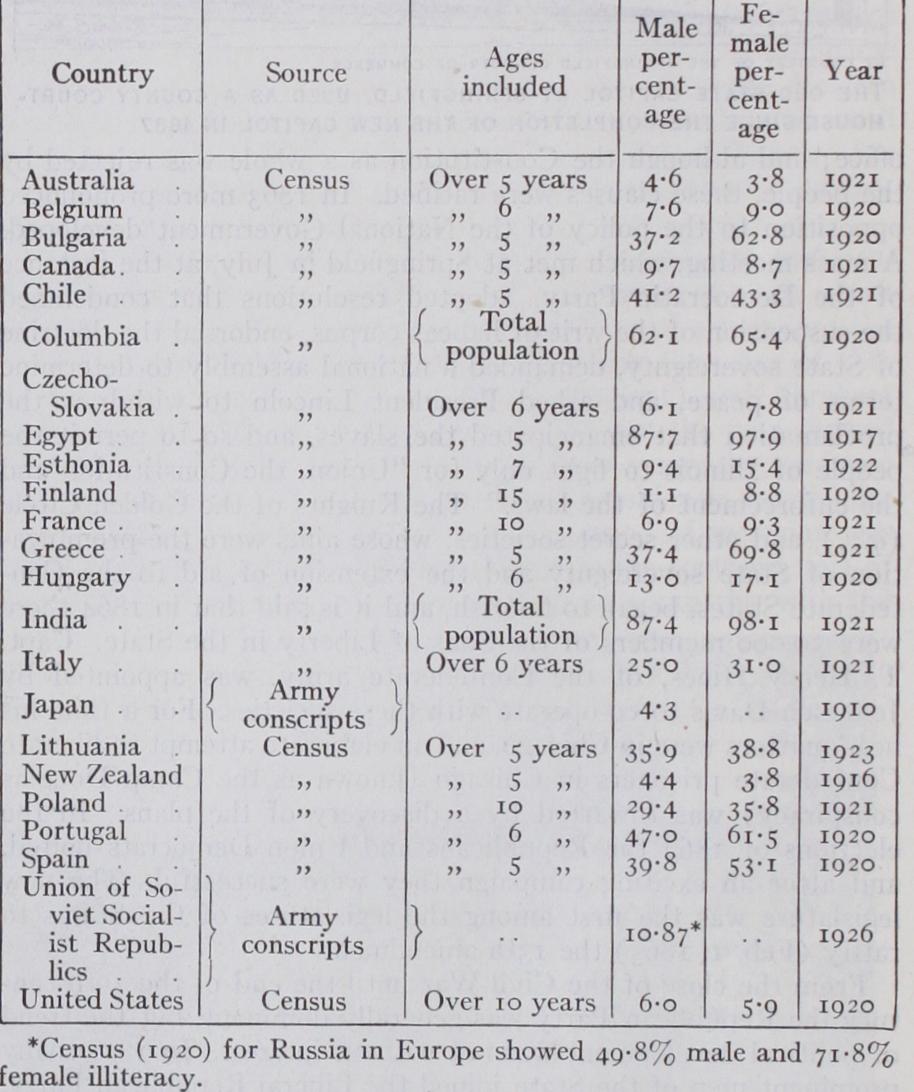
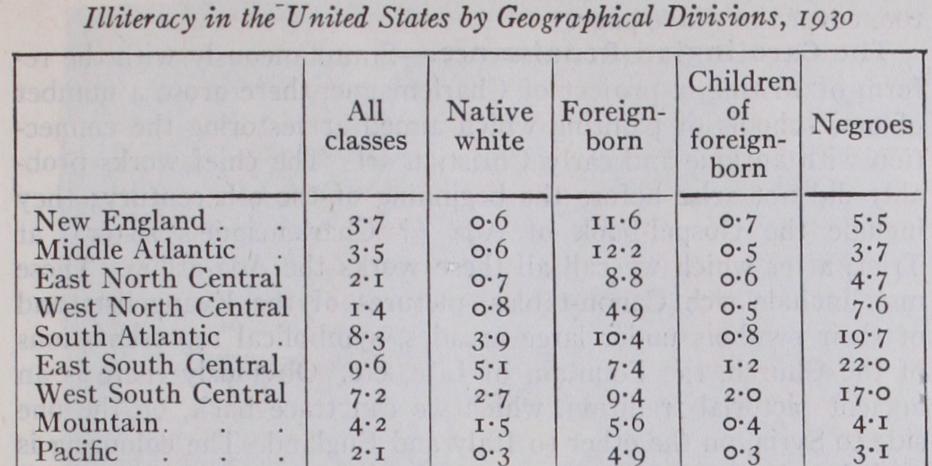
Unfortunately statistics of illiteracy are not collected in a uniform manner in various countries, nor do given figures repre sent the same age groups, so that much of their value for com parative purposes is lost. To intelligently reveal conditions illiteracy should also be classified as to sex, nationality and race. Only the first is possible in the table given below. Norway, Sweden, Germany and Switzerland claim a negligible amount of illiteracy. Germany ceased keeping statistics in 1913 when her male percentage as revealed by army recruits was .05. Illiteracy statistics for Great Britain were based upon the proportion of those signing their names in the marriage register with a mark, but even these ceased to be included in the Registrar-general's annual report in 1914 when the percentages stood at o.8% for males and 1.0% for females. In 1841-45 the figures had been 32.6% and 48.9% respectively. For other important countries the percentages are given in the following table :— Illiteracy statistics are most complete in the United States. (See UNITED STATES : Population and Social Conditions.) The comparatively high percentage of illiteracy there where education is compulsory was due chiefly to the adult negro and foreign-born populations. The illiteracy of native whites in 1930 was 2.7%, of foreign-born whites 9.9%, of children of foreign parents o.6% and of negroes 16.3%. The low percentage of illiteracy among children of the foreign-born reveals how eagerly the for eign-born take advantage of free education. Negro illiteracy was reduced from 30.4 in 1910 to 16.3% in 1930. The illiteracy among native whites was found chiefly in the isolated rural districts of the older states and in the newer states where the demands of the frontier had prevented an older generation from receiving their educational inheritance. Illiterates among arriving immigrants decreased from 23.5% in 1900-09 to o.9% in 1926 due to new immigration laws.