
INCOME TAX: IN PRACTICE. War provides a fertile soil for the roots of taxation. Perhaps the earliest income tax in England is to be found in the old land tax. After the Revolution the war with France led to a considerable sum of revenue being raised on the land. The land tax imposed in 1692 continued to draw supplies from this source, but in addition it imposed a tax of "4 sh. in the f according to the true yearly value" of any "estate in goods, wares, merchandise, or other chattels, or personal estate whatsoever within this realm." In addition, it imposed a similar tax upon the profits and salaries of all persons having any office or employment of profit, except naval and military officers. It is not known how the duty on personal estate was levied, or what was its proportion in the quotas of the total land tax raised. All that is known is that over the course of years the yield of the tax on personalty dwindled almost to nothing.
When war was resumed in 1803 a new income tax act was en acted, framed on lines which were so soundly based as to remain, in essence, the framework of the modern law. Not only were the sources of income divided into the five great classes which remain with us to-day as schedules A, B, C, D and E, but the principle of collection of the tax at the source was introduced. The former statements of total income were abandoned ; in their place were required statements of income from particular sources. So potent was the new principle of collection at the source that the yield of the tax, notwithstanding the reduction of the rate from the io% of 1799 to a rate of 5%, was almost equal to that under the earlier act. During the century and a quarter that has since elapsed, this principle has continued to be the mainstay of the productivity of the tax.
Apart from the exclusion of Ireland from the scope of the tax, an omission which was rectified in 1857, the tax as set out in Peel's act was not seriously modified until quite modern times. In 1842 the exemption limit was raised to 1 15o, but when in 1853 the tax was made effective throughout the United Kingdom it was re duced to L1oo. In 1876 the old limit of £i5o was restored and increased in 1894 to f i 6o, at which figure it remained until the outbreak of the World War led to its reduction in 1915 to f 130. The rate of tax has varied greatly. At the date of its repeal in 1815 it was 2S. in the pound. In the second half of the 19th century its general level may be said to have been from 6d. to 8d., although it was as low as 2d. in 1874 and 1875. The South African War brought the rate beyond the one shilling mark, while the World War pushed it up to a maximum of six shillings. Ten years of peace have brought it back to four shillings.
In 1918 all the numerous income tax enactments were con solidated into one statute in the Income Tax Act, 1918, which came into force on April 6, 1919. A comprehensive examination of the whole income tax system was conducted by the Royal Commission on the Income Tax in 192o. Following its recom mendations changes were made in the method of granting the differentiation relief and in applying the principle of graduation. The relief introduced in 1916 in respect of double taxation, so far as it arose from dominion income taxes, was put upon a permanent footing. The commission also made recommendations in a number of minor matters, some of which have been duly incorporated into the law and others of which, including a resolute attempt to deal with the evils of evasion, still remain to be fully implemented.
The British tax has been developed gradually in detail, reflecting at various stages in its history the growth of opinion, equality and justice, until to-day it is a financial instrument of great intricacy, subtlety and power. None the less the broad scheme of the law has remained unchanged in many essential characteristics for nearly a century. Flexibility is provided by the annual re-enact ment of the whole income tax code through the medium of the continuation clauses in the yearly Finance Act, which serves also as the medium for amendments, extensions and declarations of the construction of the law.
The salient characteristics of the tax may be grouped under nine heads.
Administratively, the tax is levied under five separate categories or schedules of income. But this is a matter of machinery only, and the tax borne by individuals is in reality only one tax on the total income of the individual, and not, as is often thought, a series of taxes on the separate sources of his income.
In respect of the profits on occupation of land in the United Kingdom (schedule B), the measure of profit is made on a con ventional basis, which assumes profits bearing, in the case of land used mainly for the purposes of husbandry, a fixed relation of equality to the annual value of the land occupied. In other cases it is a relation of one-third of the annual value.
No definition is necessary in the case of interest on public funds (schedule C). Income (schedule D) from dominion and foreign securities (other than public debts) or from foreign and dominion stocks, shares and rents is normally liable on the full amount of the income, less charges which must necessarily be met abroad.
There remain the two main classes : income from trades or pro fessions (schedule D) and income from employments (schedule E). Here the broad rule is that the income to be charged is the excess of the gross receipts over the expenses incurred wholly, necessarily and exclusively in earning the profits or income in question.
The British income tax, in the words of one of the judges, "is a tax on income," and this is strictly construed by the exclusion from the scope of the tax of profits which are in the nature of capital gains; in this respect the British system is strikingly dif ferent from that in force in the United States of America. In consequence, the law prohibits, in arriving at profits for income tax purposes, any deductions in respect of capital charges, lost income or losses unconnected with the business. Provision is, however, made for a deduction from the statutory profits liable to tax of an allowance in respect of the depreciation of machinery or plant.
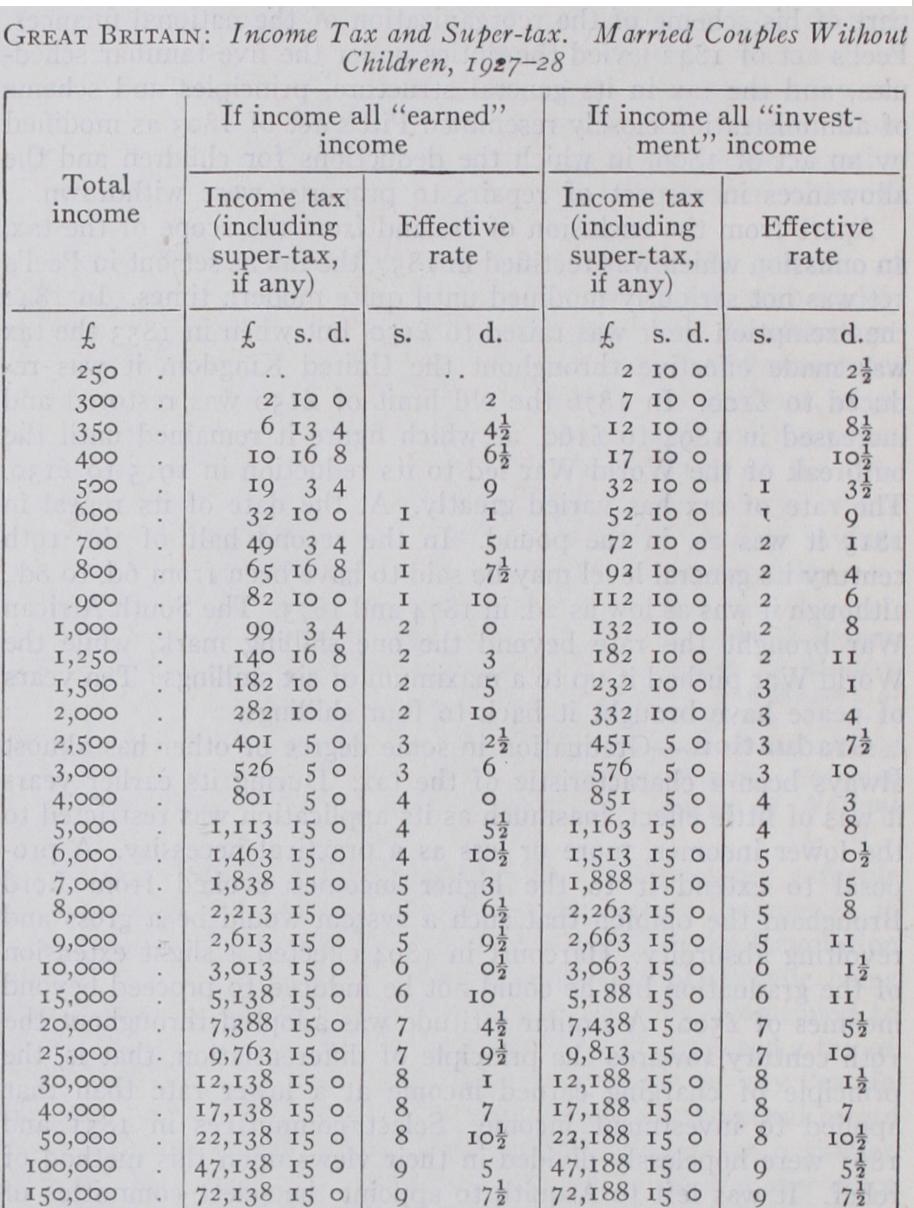
If the system of graduation stopped at this point, the relevant curve would rise steeply until incomes in the neighbourhood of £2,000 were reached, but after that point it would flatten rapidly. To continue the graduation, rates of sur-tax (before 1928-29 the name was super-tax) are charged on sections of income above £2,000 in the case of individuals. Sur-tax is expressed to be a deferred instalment of income tax. It is normally payable on or before Jan. 1 following the end of the year of assessment for which it is payable. For administrative reasons, sur-tax is as sessed and collected, under the aegis of the special commissioners of income tax, separately from the income tax. The effect of this system as a whole is to levy an effective rate of tax on each £ of the total statutory income of an individual, rising gradually from a fraction of a penny in the £ until the rate closely approaches a maximum rate represented by the sum of the standard rate of income tax and the highest rate of sur-tax.
The following table of the amount of income tax and super tax and the effective rate of tax per £ of income on specimen in comes clearly illustrates the graduation of the tax in the case of married couples without children for the year 1927-28. It shows how the effective rate rises in the case of earned income from 2d. in the £ for a total income of £30o by gradual stages up to 9s. 7 d. in the £ on an earned income of £i5o,000. The rate for investment income rises from 23d. for an income of £25o to 9s. 7 2d. for one of £ 15o,000. Plotted on a graph, these effective rates fall upon a very smooth line unbroken by any abrupt jumps.
With the exception of tax collected at the source on interest on public debts, and on income from foreign dividends, etc., which is paid at or shortly after the time of payment of the in come from which the tax is deducted, income tax contained in the main assessments for the year is due and payable on or before Jan. i in the year of assessment; tax contained in additional ' assessments signed after that date is payable on the day after the date of signature. To this general rule there are, however, some other important exceptions. The tax charged on any indi vidual or firm in respect of lands occupied for husbandry, or in respect of a trade, profession or vocation, and of most employ ments, is payable in two equal instalments, the first on or before Jan. i in the year of assessment and the second on or before the following July 1. Manual wage earners assessed half-yearly pay tax in respect of each half-year. Tax in respect of employments under the Crown is deducted (usually quarterly) at the source.
This broad scheme is honeycombed with exceptions. There are the special commissioners of income tax, each of whom, still in dependent of the revenue authority, is appointed by the Treasury. Then there are commissioners for the various public departments of State. The Bank of England and the National Debt Commis sioners also act as commissioners. Again, all assessments on man ual weekly wage earners which are for a half year only are made by H.M. inspector of taxes. The taxpayer normally charged by the district commissioners may, if he wishes, elect to be dealt with by the special commissioners, and even if he allows his as sessment to be made by the district commissioners he may take an appeal against that assessment to the special commissioners.
During the past 5o years income tax has grown so much in im portance and complexity that its efficient administration has com pelled a considerable development of the methods of administra tion. In practice, the inspector of taxes carries out, with the full concurrence of the various bodies of commissioners, most of the duties that are vitally essential to the smooth-working efficiency of the machinery of administration. Nevertheless, the key func tions of the district commissioners have been preserved through out. In the absence of any detailed accounts or other evidence, it is the additional commissioners who determine the amount of the assessment upon business profits ; even more important, the general commissioners retain their appellate functions and so stand in an independent and impartial position between the tax payer and the representative of the revenue.
The standard rate of tax for the three years 1925-26 to 1927 a8 was four shillings in the pound. For 1925-26 the total statu tory income of persons liable to the tax for the new United King dom of Great Britain and Northern Ireland was estimated at £2,375,000,000. In 1926-27 the Exchequer receipt was 717,000 and it was estimated that the collection in 1927-28 would amount to 1247,000,00o.
The preceding figures relate to income tax alone and do not include the yield of the super-tax. The point at which liability to this tax commences is £2,000. The scale of rates of tax in force since 1925-26 is given below. In 1925-26 the number of indi Taxation according to faculty, that is, direct taxation, based upon the principle of ability to pay, so early established in Great Britain, was naturally carried overseas to the various British pos sessions. It is not therefore surprising to find income taxes firmly established to-day in South Africa, in the provinces and pro tectorates there as well as in the Union, in Canada, where also there are provincial income taxes as well as the Dominion tax, Australia, where a similar widespread use of the tax is made, New Zealand, India and in most of the West Indies. Naturally also there is a strong family resemblance between the various in come tax systems, most of them having been strongly influenced by British law. Income is usually defined broadly but com prehensively, but there is a general absence of the schedular arrangement of the British tax. Broadly speaking, the year pre ceding the year of assessment is favoured as the basis of compu tation of the income to be charged. The minimum amount of income exempted from tax varies, but personal allowances to the taxpayer, his wife and children are general. Graduation of the tax is a common feature, and the device of an additional tax, or super-tax, is freely adopted. In some dominions, gradua tion is extended also to companies. The methods of graduation range from simplicity to formulae of great complexity. Differ entiation in favour of earned income is found, but is not widely favoured. Taxation at the source is a frequent feature, especially in respect of dividends paid by companies. The rates of tax vary widely, as may be expected from the range of budget re quirements of communities of different populations and varying degrees of wealth. As a rule, the income tax in the British dominions overseas is one tax levied upon the base of the total income, irrespective of the nature of the components of that income. In this respect, the British tradition is followed.
BIBLIOGRAPHY.--J. C. Stamp, British Incomes and Property (1916) ; Bibliography.--J. C. Stamp, British Incomes and Property (1916) ; S. Dowell, The Acts Relating to the Income Tax (9th ed., rev. P. M. Smyth, 1926) ; E. R. A. Seligman, Public Finance (1926). See also "Report of Departmental Committee on the Income Tax," with Appendix, Cmd. 2,575 and 2,576 (5 905) ; "Report of the Select Committee on the Income Tax," no. 365 (1906) ; "Report of Royal Commission on the Income Tax," Cmd. 615 (192o) ; "Finance Act," pt. 2, Income Tax (1925) ; Commissioners of Inland Revenue (Annual Reports) ; "Financial Statements presented to the House of Commons by the Chancellor of the Exchequer" (Annual) .