
INDIAN ARCHITECTURE, like Indian sculpture, is essentially of native origin, belonging to the Dravidian rather than the Aryan race. The Vedic ritual required neither images nor temples, but the non-Vedic cults, such as those of the dragons (Nagas), the tree-spirits (Yaksas) and the goddesses, may have had permanent shrines with images and wooden temples. Refer ences to images and temples begin to appear in the literature from about the 4th century B.C. onwards, and numerous types are represented in the reliefs from the 2nd century B.C. In Hindu worship (puja, the service of a personal deity with offerings of food, lights, incense, etc., as distinguished from yajna, the Vedic sacrificial ritual) the first essential is an altar, with or without a symbol or image, serving to receive offerings of flowers. Such an altar beneath a sacred tree, for example, constitutes a Yaksa caitya. The term caitya denotes a shrine of any kind, but has often been used (erroneously) to designate exclusively the stupa. The next step is a god's house (devdlaya, devdgdra, dyatana, etc.), a simple roofed enclosure containing the altar and symbol or image.
Origins.—The fundamental elements of temple architecture are indigenous and of great antiquity. Early Indian architecture was almost entirely of wooden construction, and the forms thus established were later closely imitated in brick and stone. The various forms of domed and barrel-vaulted roofs, gabled windows and roof ends, pillars and cornices are developed from wooden prototypes; the Toda hut, for example, even at the present day presents a striking likeness to a barrel-vaulted gable-ended temple.

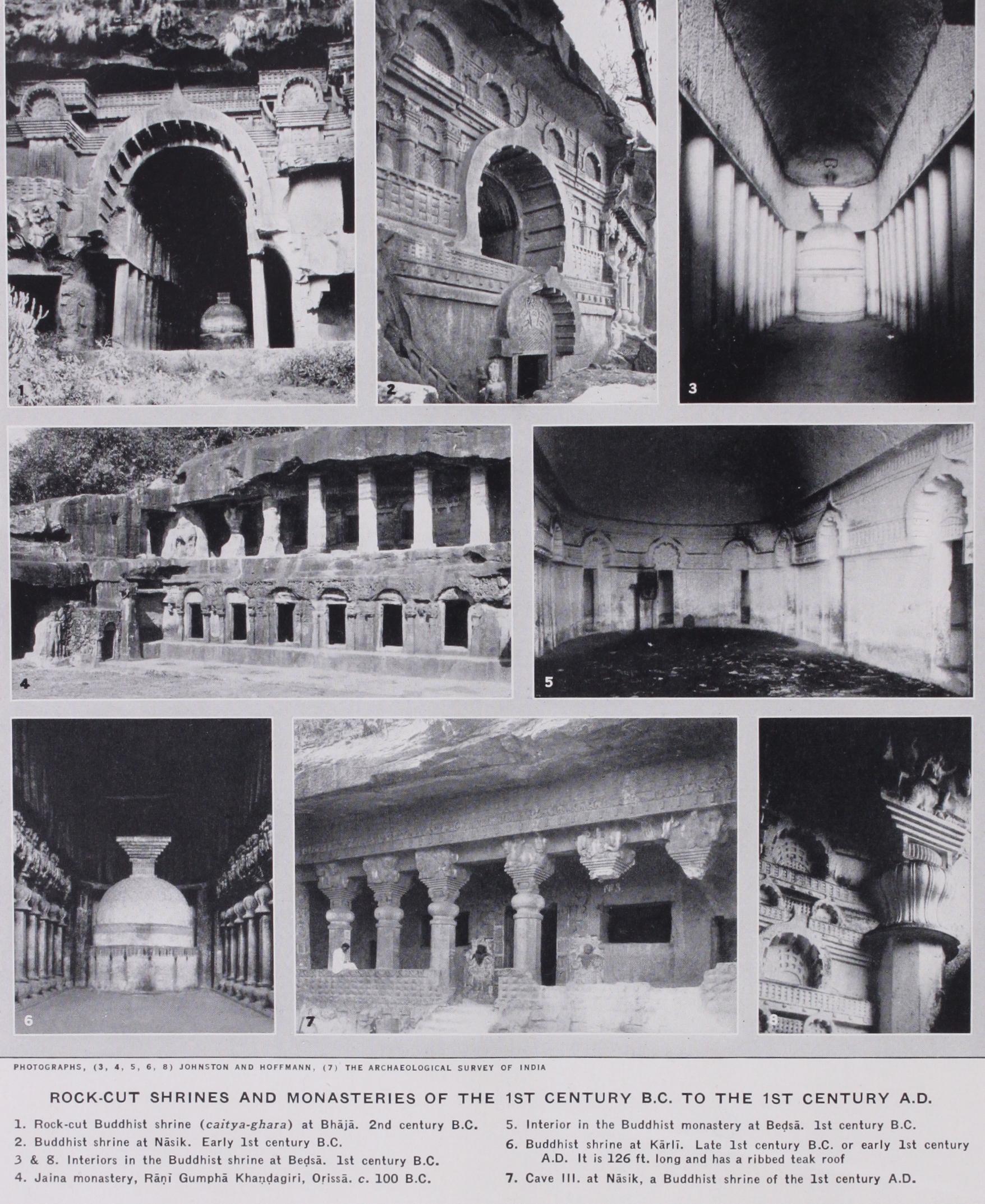
A part of Indian architecture, especially at an early period when the use of impermanent building material was otherwise still general, may be described as monolithic; that is to say, the shrine is excavated in solid rock, either by hollowing out the necessary chambers (so that only the internal architecture is brought into being), or by cutting away the exterior rock so as to leave an entire temple of solid rock. Very remarkable works of both kinds exist. The former, the cave temple type, is best illustrated by the early Buddhist caitya halls (Karli, Nasik, Ajanta, Bagh, etc.), in which the interior of an apsidal temple of wooden con struction is reproduced in stone in every detail, and by such great Hindu excavations as those of Elephanta, near Bombay; the latter by the famous Kailasanatha at Elura, near Aurangabad, the Masrur temple in Kangra, the "Seven Pagodas" at Mamalla puram south of Madras and the Vettuvankoyil at Kalugamalai in the far south.
Highly characteristic, also, are the aisled apsidal churches best known from the early Buddhist rock-cut "caitya halls," but also represented by structural examples in brick or stone of Gupta and later date (Ter, Chezarla, Aihole ; and in Pallava and later Dravida architecture, where the number of storeys is increased, as the crowning member of a tower).
Another special form peculiar to India is that of the hypaethral tree temple, usually a pillared hall, square or circular, with a gallery and vaulted roof, but open in the centre, and surrounding a sacred tree; nearly a dozen examples are represented in Buddhist reliefs, where the tree is the Bodhi-tree, the symbol of the Buddha's Great Enlightenment, but there is every reason to suppose that the type was a very ancient one, developed in connection with the worship of Yaksas (q.v.), or tree-spirits.
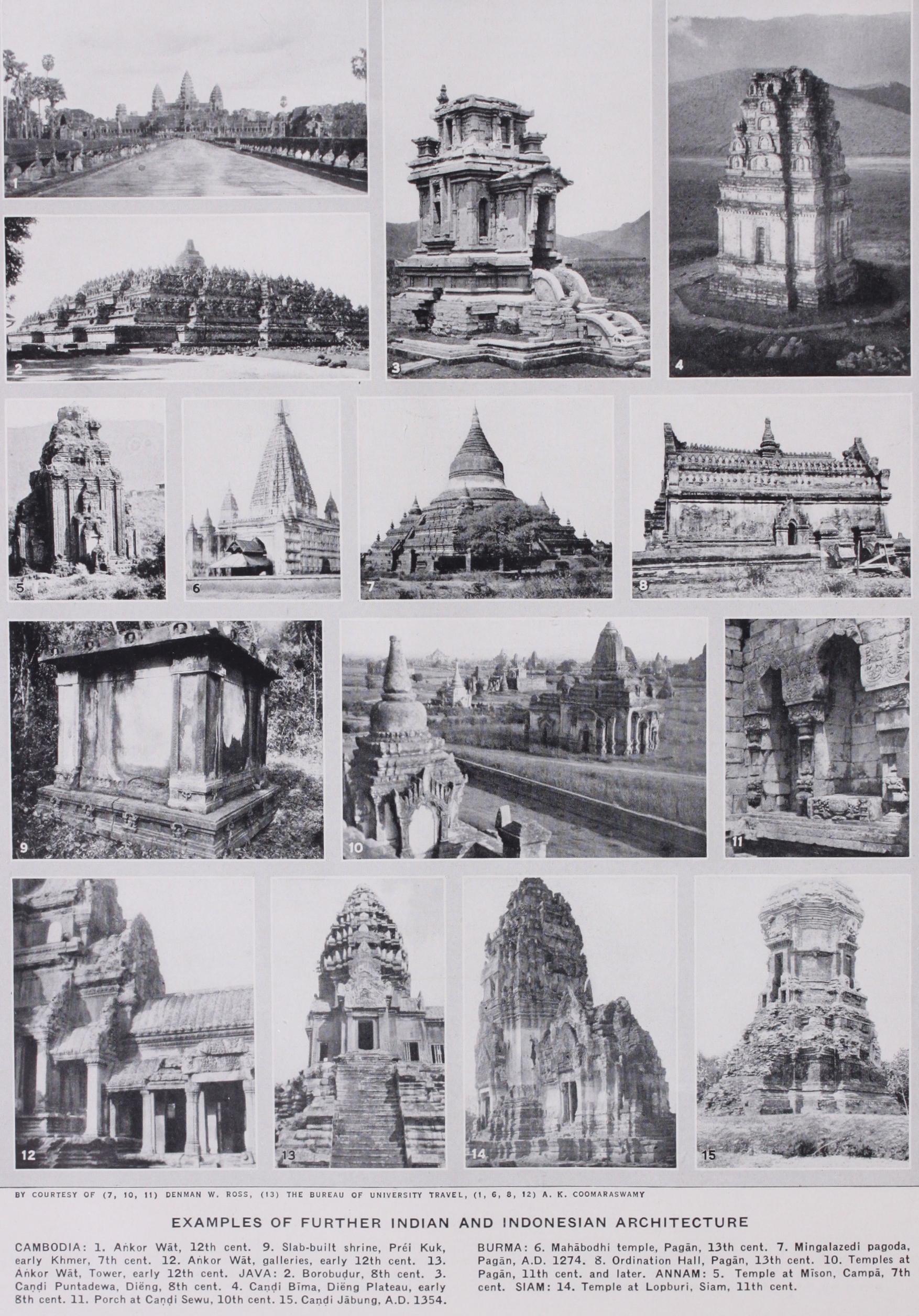
The gable or dormer windows (Gavaksa, Kiidu) which are found to be most characteristic as constructional elements in the early architecture, and as ornament in the later, have been commonly designated "horseshoe arch," from the form, and "caitya window," from the large and conspicuous examples that pierce the façades of the early excavated churches. In many cases the two ends of the arch spring from a pair of makaras (croco diles), situated immediately over the capitals of the supporting pilasters, and constituting a makara torana. The summit of the arch is pointed, making it an ogee arch. This dormer arch is not confined to India, but reappears in the earlier architecture of Cambodia and Java. Cusped forms are early developed and sur vive in Muhammadan usage.
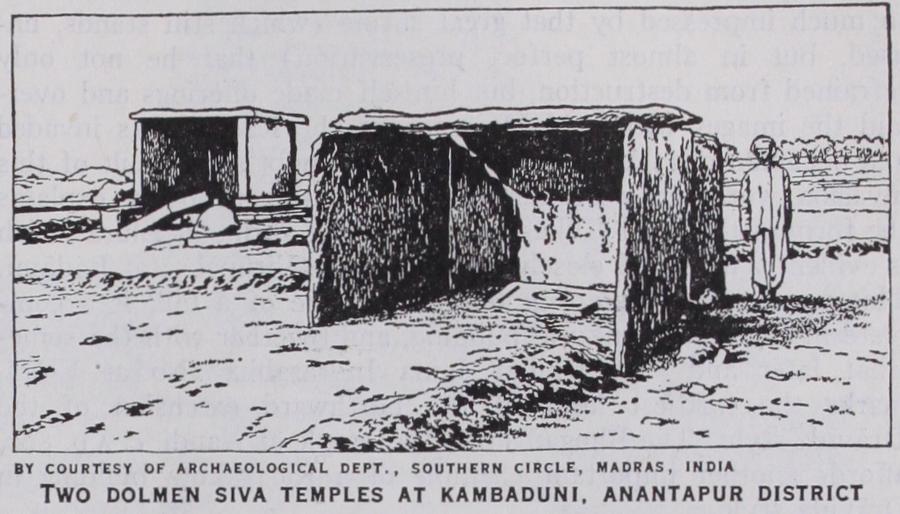
The only surviving monuments that have been attributed to the Vedic period and culture are the burial mounds at Lauriya-Nan dangarh, the source of the gold plaque of the nude goddess; and certain very ancient rock-cut tombs in Malabar. The Cyclopean walls of old Rajagrha are certainly pre-Maurya, but there is no reason to connect them with the Vedas or the Aryans; their character is rather Polynesian than typically Indian.
As with design, so in the case of architecture, there is every reason to suppose that the same forms which are represented so admirably in the reliefs of Bharhut, Sanci, and Amaravati were already current during many centuries before the Maurya period. The special forms, indeed, are nearer to those of western Asia of the sixth or seventh century B.C., than they are to those of con temporary Persia, and it can hardly be doubted that they repre sent the Indian development of a widespread early Asiatic tradi tion. The forms include storied buildings supported on pillars with volute capitals resting on addorsed animals (bulls or lions), often with pot-shaped bases, and having barrel-vaulted roofs with gabled or arched ends and windows ; battlemented brick walls; circular shrines with double-domed roofs ; pillared barred-vaulted apsidal temples ; hypaethral tree-temples ; monasteries, of cells opening onto a central court ; burial or memorial mounds (stupas) on platforms ; monolithic pillars ; and walls and railings.
The remains of Asoka's capital at Pataliputra (Patna) have a rather special character, and perhaps reflect contemporary Per sian influences. There have been excavated here parts of a very massive wooden city wall; a timbered flooring extending for three hundred and fifty feet ; a series of wooden platforms apparently intended to support a stupendous superstructure; evidences of a pillared hall with eighty polished stone columns; a magnificent stone capital, a stone voussoir from an arch, a stone griffin bracket, and other fragments. It is thought that the plan of the palace was identical with that of the Achaemenid palaces at Per sepolis ; Arrian speaks of Asoka's palace as no less magnificent than those of Susa and Ecbatana.
A famous structure often referred to at a later date by the Chinese pilgrims was the "stfipa" of Kaniska near Peshawar. From the foundations of this great building has been recovered an inscribed silver reliquary made for Kaniska himself, and contain ing relics purporting to be those of the Buddha. According to the Chinese account the basement rose in five stages to a height of a hundred and fifty feet, the wooden superstructure to four hun dred more, and the iron mast with twenty-five copper umbrellas eighty-eight feet more.
The northern sikhara shrines, usually brick towers with stone doorways, are beginning to appear. For the most part the earliest examples are straight-edged, or nearly so, and with angle dmalakas at every course, or every second or third course. The example at Deogarh is entirely of stone ; not less important is the brick tower at Bhitargaon, with a recessed frieze of carved brick, and terra cotta panels of Brahmanical subjects. A little later than the Gupta period, but suitably mentioned here, is the brick tower at Sirpur, probably the most exquisite example of a richly decorated brick structure to be found in all India. The monastic university of Nalanda was found by Baladitya at the close of the fifth century. Hsuan Tsang saw there a great brick temple over three hundred feet in height ; and at Bodhgaya, the temple above referred to as of Kusana date. The great Hindu temple at Konch, very near Bodhgaya and similar in many details, though the spire is curvilinear, may well be of Gupta date.
From the Gupta period onwards it is convenient to describe the architecture in terms of the three great styles, Nagara (northern or "Indo-Aryan"), Vesara (later Calukya, Hoysala and Solanki, of the Dekkhan, Mysore and Gujarat), and Dravida (southern Dravidian) with separate mention of Kasmir, and of the civil architecture of Rajputana.

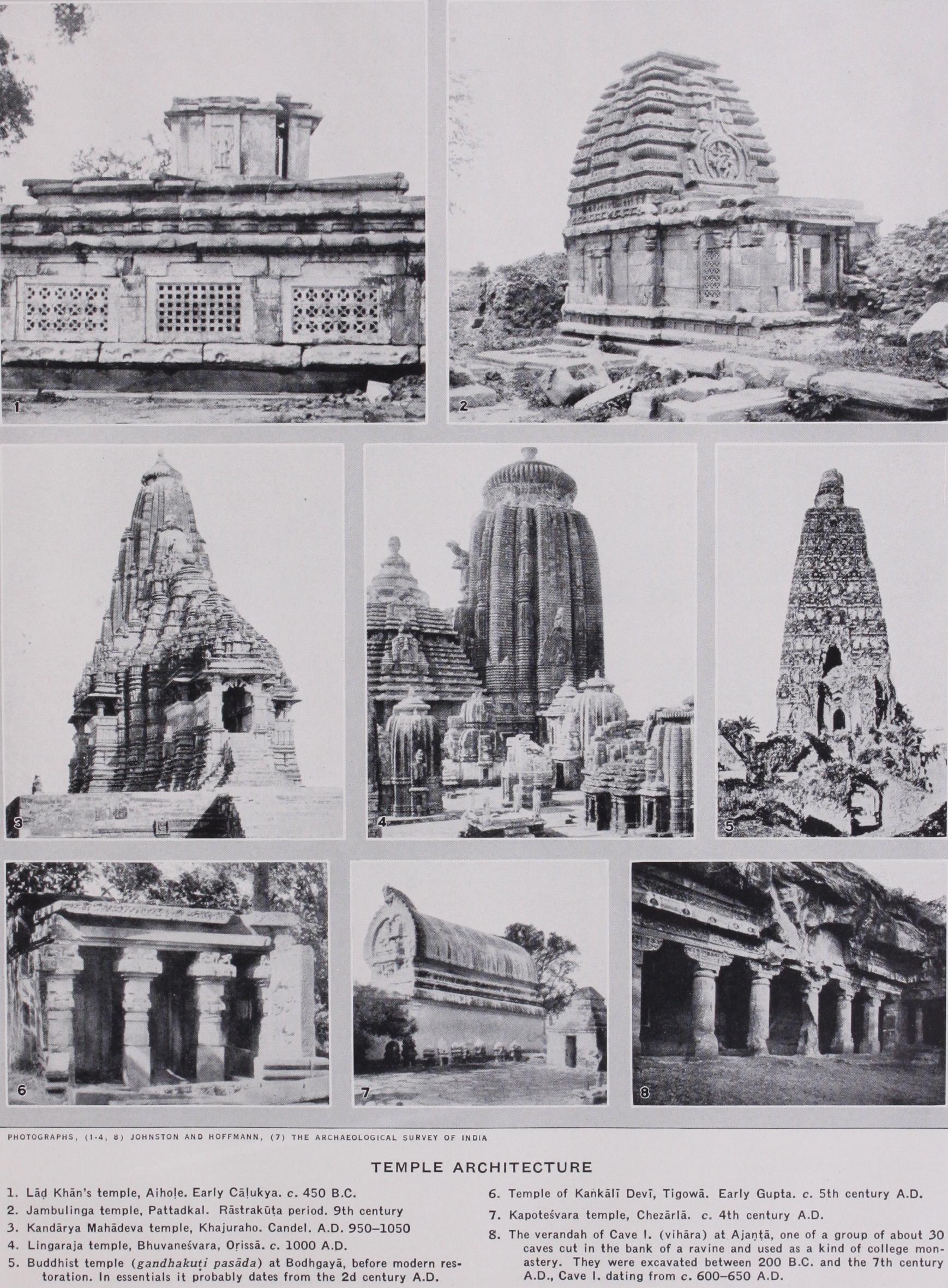
The most southerly extension of the style is found at Badami, where the apsidal Durga temple, perhaps of Gupta date, has al ready a northern siklzara. Here, and in several other places, the two styles can be seen side by side. It is however in Orissa, Bun delkhand and Rajputana that the finest and most continuous series is to be found. In Orissa the series shows a continuous develop ment from the 8th to the 13th century ; the Parasuramesvara and Lingaraja temples at Bhuvanesvara, the Sun temple at Konarak, and the Jagannatha at Puri are most remarkable, and the beauty and grandeur of most of these it would be difficult to exaggerate. At Khajuraho in Bundelkhand there is another magnificent series, dating between 95o and 1050, e.g., the Kandarya Mahadeva tem ple is the finest ; the effect of height, actually 116 feet over all, is increased by the great depth of the basement, and by the vertical lines of the reduplications of the main form upon itself. Here, as well as in Orissa, and elsewhere, the temples are covered with figure sculpture.
From Bengal and Bundelkhand the style extends through Raj putana (where the Siddhesvara at Nemawar, Indore State, is of prime importance and one of the best preserved mediaeval monu ments extant) to the Panjab (Amb and Kafir Kot), Kangra and Kula (Baijnath, Masrur, and Bajaura). Modern temples in the Nagara\ style include the at Benares, the funeral chapels at Gwalior, the Jugal Kisor and Madan Mohan at Brinda ban, and amongst the many alms-halls, ghats, wells and temples built by Queen Ahalya Bai (1765-95), the Grstanesvara temple at Elura.
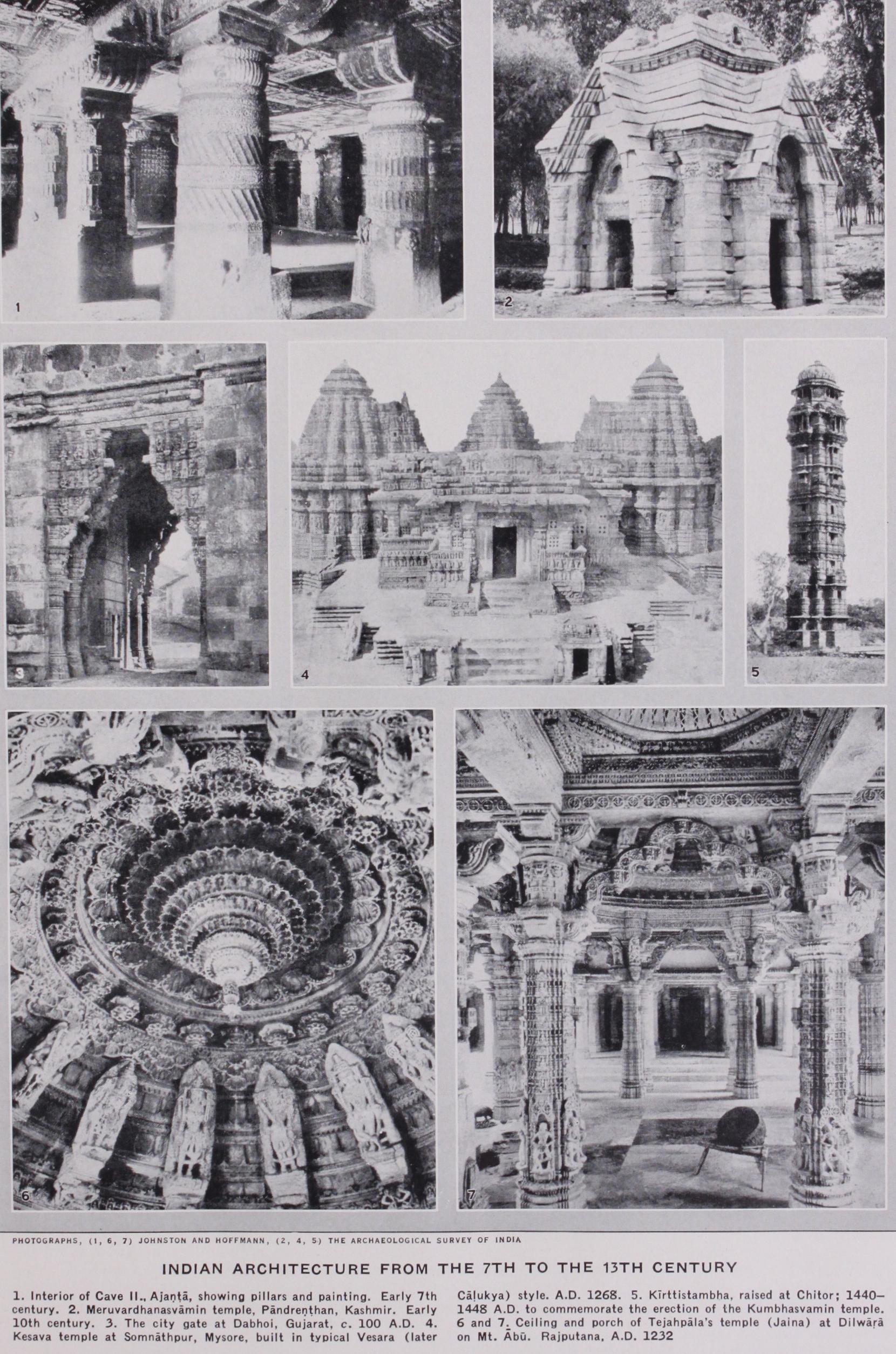
In Gujarat the most famous temple was that of Somnath (Kathiawar), wrecked by Mahmud of Ghazni in 1024. At Anahilpattana the greatest royal builder was Siddha-raj 1143). Here as at Vadnagar and Mudhera are the ruins of impor tant shrines. A special characteristic of the local style is the erection of kirttistambhas, or "Towers of Glory"; the finest of these, in the Chitor Fort, was built in 1440-48, to commemorate the erection of the Kumbhasvami temple.
More famous are the Jaina temples at Mt. Abu in Rajputana, particularly those of Vimala Shhah and Tejahpala respectively, A.D. 1032 and 1232. These are domed shrines with pillared halls, built entirely of white marble, carried up the mountain with infinite labour from the plains below. The most remarkable features are the domed ceilings, with deeply undercut, fretted marble which has been compared to "frozen lace," with a central pendant.
Deservedly famous too are the Jaina temple cities of Girnar and 8atrunjaya, with buildings ranging from the 13th to the 19th century. These cities of temples built on hill-tops were exclusively places of pilgrimage, never otherwise inhabited. Of ordinary cities there are well preserved remains at Dabhoi and Jhinjuvad. At the somewhat later capital of Ahmadabad the architecture is almost entirely Mohammedan; but it was executed in the same style and by the local craftsmen, adapted only to Muslim necessities by omission of figure work from the niches.
The early Dravidian style (Pallava and early Calukya) is admirably illustrated in the Pallava temples of Mamallapuram (the "Seven Pagodas") and Conjeevaram in the east and early Calukya shrines at Badami, Aihole and Pattadkal in the west. The visitor should make every effort to visit the "Seven Pagodas" at Mamallapuram, which are easily accessible from Madras. The earliest monuments are cave temples at Undavalli ; then come the Seven Pagodas and cave temples in the seventh century, and in the eighth, the structural temples of Conjeevaram, and the "Shore temple" at Mamallapuram, after which the style passes gradually into that of the Cola period. In the west, at Badami and Aihole, there are six cave temples, two Jaina and four Brahmanical, one dated 578. The structural Malegitti c. 625, magnifi cently situated on the summit of a hill, is perhaps the purest and best example of the style; it is small and massive, but finely pro portioned. Much larger, and magnificent both in design and exe cution are the two great temples due to the queens of Vikrama ditya II., datable about 740. Of these the Virupaksa, still very massive, was probably built by workmen brought from Con jeevaram, where the Rajasimhesvara (or Kailasanatha) temple had been built not long before the city fell to the Calukyan invaders; we know from an inscription that Vikramaditya was so much impressed by that great shrine (which still stands, un used, but in almost perfect preservation) that he not only refrained from destruction, but himself made offerings and over laid the images with gold. In A.D. 753 the Rastrakutas invaded and occupied the Calukya territory. No doubt as a result of this invasion workmen were carried off, and this probably explains the form of the great Kailasanatha rock-cut shrine at Elura which is evidently modelled closely on that of the Virupaksa at Badami. This wonderful temple, cut out of the side of a hill, is a com plete model of a structural building, and together with the some what later and very similar Jaina Indrasabha also at Elura, marks the farthest limit of the northward extension of the Dravida style. The Bhoganandiivara temple at Nandi, c. A.D. 800, affords another important example of a Rastrakuta building in Dravida style.
Kasmir.—In which had been a dependency of the Kusana empire, and later an independent kingdom, the prolific building period extended from the 8th to the i3th century. The style has local peculiarities; the double pointed pyramidal roof, pediments enclosing a trefoil niche, lantern ceilings, fluted columns with Doric or Ionian capitals, and large peristyles are very characteristic. The architecture here preserves a certain quasi-classical character derived from Gandhara, and not seen in the rest of India, though often recognizable in Central Asia. At Parihasapura a large Buddhist stupa with a double platform, and stairways on each side is contemporary with the Javanese Boro budur; and there are temples of extraordinarily massive con struction, one flooring stone consisting of a single block 14X 12X 6 feet. Two great temples at Avantipur are due to Avantivarman. The court of the Martanda Sun temple is about 220 x 142 feet ; that of the Pandu-kund in Jammu about 191X 121 feet. Related architectural forms are found at Malot in the Punjab, and at Gop and some other places in Kathiawar. But the trefoil arch, derived from the section of a caitya-hall, while con fined to Kasmir as an important architectural form, occurs also at Sarnath, Sirpur and elsewhere.
The earliest well preserved palaces are those of Chitor and Gwalior, the latter magnificently situated on the edge of a great flat-topped hill, with several great gateways guarding the approach, and a small palace, the Gujari Mahall at the foot of the hill. Begun under Man Singh in the i 5th century it was completed during the Mughal occupation in the i 7th. Bir Singh Deva's I7th century palaces at Datia and Orcha are almost equally splen did. The palace at Amber, 17th century, is more nearly like Mughal work, and so too the lovely marble pavilions by the lake at Ajmere. The whole city, palaces and island palaces of Udaipur (c. 1600-174o) are of romantic beauty. The Jodhpur palace, 17th century, is situated on the top of a rock dominating the city below, and guarded by bastions of tremendous size. The modern city of Jaipur, the Benares ghats (with buildings mainly of the 18th century), the ghats at Mahesvar and Ujjain, the mod ern work at Bulandshahr, Mathura, etc. (see Growse, and Sander son, in Bibliography) and the cenotaphs of Rajput princes in many capitals, are all evidences of an architecture by no means lost, but still practised. The little modern railway station at Alwar shows how this tradition can be adapted to present day requirements ; the new city at Delhi is a monument of the neglect of indigenous resources. (See DELHI; NEW DELHI.) The earliest buildings in Ceylon are dagabas or stupas, those of Tissamaharama dating from the 3d or 2d century B.C., the Yatthala Dagaba being the most important of the series. At Anuradhapura, the capital from the middle of the 3d century B.C. to the end of the 8th A.D., the Thuparama was the first dagaba to be erected, and like the Maha Seya at Mihintale it was built by the great Devanampiyatissa, the contemporary of Asoka, and recipient from him of the branch of the Bodhi-tree which was planted with great ceremony at Anuradhapura, and may now be called the oldest living historical tree in the world. To Duttha Gamani, early in the 1st century B.C. are due the Ruanweli and Miriswetiya Dagabas, and to Watta Gamani in the same century the Abhayagiri Dagaba, later confused with the Jetavana built by Mahasena at the end of the third century A.D. All these dagabas can be seen at the present day, but they have suffered both from ruin and from restoration. The famous Lohapasada, the Brazen Mansion, built by Duttha Gamani as a monastery is now represented only by the monolithic pillars of the basement, twelve feet high and covering an area 250 feet square; the pyra midal superstructure was of wood with a brazen roof ; originally of nine storeys, it was later burnt and rebuilt with only five.
The natural fortress of Sigiriya was occupied in the 5th century by a parricide king who built a palace on the summit, and a remarkable walled gallery, still usable, as a means of access. As a result of the Tamil invasions the capital was removed to Polonnaruva which became the capital from 781 to 129o, which period includes a short interlude of Cola occupation. The most remarkable and important buildings are due to Parakrama Bahu in the 12th century (1153-86). The Thuparama is a rectangular brick temple in Dravidian style, but with vaulted arches and narrow triangular windows like the early towers in northern India. The Northern Temple (so-called Demala Maha Seya) contained frescoes (Jdtaka subjects). In the Jetavana group at the other end of the city, the Lankatilaka is the largest Buddhist temple in Ceylon. The Potgul Vihara is a circular building in which Para krama Bahu used to sit and listen to the reading of the Jatakas by his chaplain. The Sat Mahal Pasada is a solid pyramidal seven storeyed brick structure like the traditional representations of Mt. Meru; on each storey are niches with brick and stucco images. To the next king, Nissanka Malla (1198-120 7) are at tributed the Nissanka Malla Mandapaya, a railed enclosure con taining eight graceful curvilinear lotus pillars which originally sup ported a roof, forming a pavilion; and the Wata-da-ge, a terraced circular shrine which is perhaps the most beautiful example of Buddhist stone architecture in Ceylon. The Hindu temples (devales) were built in the time of Cola occupation, and so too the Gedige at Nalanda, c. in gajapystha style, and of mixed Hindu-Buddhist dedication.

Later, the capital had to be moved again, and finally to the last site, Kandy, where an independent Sinhalese kingdom survived till 1815. The beautiful buildings there still in use are due to the last kings, especially Kirtti Sri Raja Sithha. The style is mainly a wooden one, but some use is made of stone. The Dalada Maligawa, the Temple of the Tooth Relic, is familiar to all visi tors. Near Kandy there are fine temples at Lankatilaka (stone foundations, brick structure and a very handsome roof), and Gadaladeniya (a porch with old stone pillars, and a stupa with a roof supported by four pillars, making a veritable cetiya-ghara).
(See CEYLON.) (See also ARCHITECTURE; INDIAN AND SINHALESE ART AND ARCHAEOLOGY.) BIBLIOGRAPHY.-P. K. Acharya, Indian architecture according to Bibliography.-P. K. Acharya, Indian architecture according to the Manasara (1927) ; A Dictionary of Hindu architecture (1927) ; Architecture of Manasara (1928) ; (these are the most valuable books yet published on Indian architectural science, but they are not illus trated, and embody some errors, see review in I.A.O.S., vol. xlviii.) . J. Burgess, The Archaeological Survey of India, New Imperial Series (1874-1883), 9 vols. ; The Buddhist stupas of Amaravati and Jagayyapeta (1887) ; The Ancient monuments, temples and sculp tures of India (1897) ; A. K. Coomaraswamy, History of Indian and Indonesian Art, with a good bibliography (1927) ; H. Cousens, Archi tectural Antiquities of Western India (1926) ; A. Cunningham, Stupa of Bharhut (1879) , Mahabodhi (1892) , "Archaeological Survey of India, Reports 1862-85" (1871-86) ; B. B. Dutt, Town Planning in Ancient India (1925) ; J. Fergusson, History of Indian and Eastern Architecture (2nd ed., 191o), the only book covering the whole ground, but quite out of date, and the sectarian classification is unsatisfactory; J. Burgess, Cave Temples of India (188o) ; A. Foucher, L'Art grecobouddhique du Gandhara (1900-23) ; H. V. Glasenapp, Heilige Stiitten Indiens (1925) ; F. S. Growse, Indian Architecture of To-day (1885, 1886) ; E. B. Havell, Indian Architecture, Its Psy chology, Structure and History; Ancient and Mediaeval Architecture of India (1915) ; India Society, The Bagh Caves (1927) ; Jouveau Dubreuil, Archeologie du Sod de l'Inde (1914), Pallava antiquites (1916-18) ; Dravidian Architecture (1917) ; S. S. Jacob, Jeypore Portfolio of Architectural Details (London, 1890-98) ; R. C. Kak, "Ancient and Mediaeval Architecture of Kashmir," Rupam No. 24 (Oct. 1925) ; O. Reuther, Indische Paldste and Wohnhduser (1924) ; A. H. Longhurst, "Pallava Architecture," Mem. A.S.1., No. 24 (1914) , Hampi Ruins (1917) ; E. La Roche, Indische Baukunst (1921-22) ; F. C. Maisey, Sanchi and its Remains (1842) ; Sir J. H. Marshall, Guide to Sanchi (1918), Guide to Taxila (1918) and many articles in the Annual Reports of the Archaeological Survey; R. Mitra, Buddha Gaya (1878) ; Pulle, "Riflessi Indiani nell'arte Romaica," Congr. Int. Scienze Storiche; A. Rea, Chalukyan Architecture (1896) ; R. Rivoira, Musulman Architecture (1918) ; Ram Raz, Essay on the Architecture of the Hindus (1834) ; D. R. Sahni, Guide to the Buddhist Ruins of Sarnath (2nd ed., 1926) ; G. Sanderson and T. Begg, Types of Modern Indian Building ) A. Sewell, A Forgotten Empire (Vijayanagar) (1900) ; J. G. Smither, Architectural Remains, Anuradhapura (Ceylon, 1894) ; S. Taki, "The Indian Type in the Building of North Wei," Kokka Magazine, No. 356, 357. See also Marshall, Vogel, Spooner, Longhurst, Rea, Strzygowski, etc., as listed in Coomaraswamy, History (ut supra), bibliography ; and Reports and Memoirs of the Archaeological Surveys of India, Hyderabad, Mysore and Ceylon.