
INDONESIAN AND FURTHER INDIAN ART. To a certain extent, and in a broad historical survey, all of Further India or Indo-China (Burma, Siam, Malay peninsula, Cambodia, Campa and Indonesia [Sumatra, Java, and Bali]) may be treated as a unit. Throughout this area the population consists essentially of Sino-Tibetan races who have occupied the river valleys (Irawadi, Salween, Menam, Mekong) and islands by successive migra tions from prehistoric times to the i4th century; throughout this area Indian cultural influences began to be felt before or about the beginning of the Christian era, and by the 4th century A.D. or even earlier, Hindu kingdoms had been established in each area, using Sanskrit as an official language and a south Indian alphabet as official script. Sculpture and architecture, Hindu or Buddhist, of 5th to 7th or 8th century date are closely related to contemporary or slightly earlier Indian types, especially those of eastern, central, and western India in the Gupta period ; Indian s`ilpasastras must have been in use, and Indian master-craf tsmen at work, though local characteristics are already recognizable. After this period there develops in each area a local national culture, with an art somewhat less closely dependent on that of India ; these sev eral classical arts, in the period A.D. 800 to the i3th century, have so much stylistic originality as to make the designation "Indian Colonial" inappropriate. Finally after 130o the culture and art in each area are either undermined by political disturbances, in vasion, etc., or develop a provincial character; so far as it has survived to the present day, typically, for example, in Bali, the art becomes a folk-art, and as such deserves high respect and ad miration, though it lacks some of the force and monumental quali ties of earlier periods. Except in Burma, hardly any trace of painting has survived, so that our account of the most important artistic developments in each area will be essentially a study of the sculpture, the architecture having been treated in another article.
Burma.—The northern area, extending southward as far as Old Prome (riksetra) was originally occupied by Pyus, the far south (Thaton) by Talaings, relatives of the Mon-Khmers. In dian colonies had been established in Arakan, Prome, Thaton, and other places; Pali inscriptions in a south Indian character and gold and silver Buddha images in Gupta style have been dis covered, and together with other remains, partly Hindu and partly Buddhist, afford evidence of early and strong Indian influ ence. Burma, however, has always been predominantly Buddhist; Mahayanist in the north, Hinayanist in the south. In the 9th century the Talaings captured Prome and established a capital at old Pagan, farther north. Shan-Thai invasions followed, introduc ing the ancestors of the true modern Burmese, who have gradually replaced the Pyus and absorbed the Talaings. Pagan became an independent cultural centre, but very few of its countless temples and stupas date before the II th century.
It is only with the unification of Burma under Anawrata (I o40 77) that the great building era was initiated, which covered the Pagan plain with some 5,000 pagodas, as the Buddhist temples and stupas are commonly called. Anawrata conquered Thaton and brought Hinayana traditions to the north. The quantity of sculp ture extant is not very great, and all that is of real importance dates from the IIth to the i3th century. The finest is the great series of 81 reliefs depicting the life of Buddha according to the Avidura Nidana, set up in the Ananda Pagoda (I ith century) ; ani mated and exceedingly elegant, they exhibit already the develop ment of a definitely Burmese style, distinct from the earlier, almost purely Gupta tradition. The Brahmanical reliefs of the Nat Hlaung Gyaung are somewhat more Indian. Most of the smaller bronzes and stone reliefs are very closely related to examples of the Pala school of Bihar and Bengal, and some may have been direct importations. A noteworthy phase of Burmese sculpture is represented by the large series of high relief glazed terracotta plaques, which decorate the Schwezigon, Petleik, Ananda and other pagodas, and illustrate Jatakas; the art seems to have been introduced from the south.
Several of the Pagan temples contain contemporary paintings. Those of the Kubezatpaya and Kubyaukkyi, illustrating Jatakas, consist of small square panels closely grouped, but here and else where there are separate representations of Buddhas and Bodhis attvas on a larger scale. The Minnanthu frescoes illustrate the Tantrik Buddhism of the Ari sects, a mixture of Buddhism and Hinduism, often quite erotic in its symbolism. Frescoes in the Kyanzitthu cave temple represent undoubted Mongols, who in vaded Burma at the end of the i3th century. The stylistic affini ties of Burmese paintings are with Bengal and Nepal, as exempli fied in well known manuscripts of i ith and I 2th century date; the outline is wiry and nervous, the hair above the brow descends in a central point, the eyebrows and eyelids are doubly curved ; the three-quarter face is often seen, and the markedly projecting farther eye recalls an Indian mannerism that appears already at Elura and survives in the Gujarati painting of the 15th-16th centuries.
After the i3th century the political conditions are more dis turbed, the connection with India is not so intimate, and the sculp ture and painting become more rigidly stylistic, until an art of purely folk character is developed, and this has survived into the 19th century. Much of the best work in this kind has been done in wood ; wood-carving, indeed, became the dominant art of Burma in later times; some of the best examples occur in the elaborate decoration of the wooden monasteries of Mandalay and Amarapura, and also in the ornament of river boats.
Of the minor arts, Burma is famous for its lacquer, applied either architecturally or to small objects for personal or monastic use, the latter including books and book-covers. The smaller ob jects, baskets, etc., are made of finely plaited bamboo or horse hair; this foundation is varnished black, other colours are super posed, and by engraving revealed in the required designs. Much of the work is restricted to black and gold ; other colours em ployed are red, green, and yellow. The designs may be geometrical or floral, or when more elaborate, may include figures of divini ties or scenes from Jatakas.
The designation "School of Dvaravati" applies to remains, mainly of 6th century, found at Brah Pathama (Prapathom), Labapuri, Phong Tuk and other sites around the north-west angle of the gulf of Siam, an area which constituted the Mon kingdom known to the Chinese as Kan To Li and Dvaravati. Among the sculptures are a finely decorated wheel (Dharmacakra) and stand ing and seated Buddha figures in stone and bronze, all in a style related to that of the Gupta period in India, as seen at Sarnath, Mathura, and Ajanta. Brahmanical figures include stat ues of Visnu with the cylindrical head-dress. All these types cor respond in style and date with the "Khmer primitif" or pre Khmer art of Cambodia. These early sculptures are usually made in a hard bluish limestone. The tradition of the school of Dvar avati must have persisted until the Khmer invasions of the nth century, and can perhaps be traced even in the earliest works of the southern Siamese kingdom of Ayuthia.
The sculptures from Ligor and Jaiya, in the northern Malay peninsula, a part of the Siamese territory, are now preserved in the museum at Bangkok, but they are rightfully classified as be longing to the school of rivijaya, and will be referred to below under Sumatra.
Khmer influence is not felt until the beginning of the Ilth cen tury, with the foundation of a Khmer kingdom at Labapuri; to the Labapuri school belong the characteristic "Siamese" sculp tures of Khmer type, dating from the nth th and I 2th centuries. Most of these are executed, as in Cambodia, in sandstone; they are almost entirely Buddhist. The majority are somewhat inferior to the actual Cambodian works, but three at least (Coedes, Col lections du Musee National, Plates XVII.–XXI.) are of superb quality, the most remarkable being the royal portrait said to be that of the legendary king Brahmadatta. In the sculpture of the Labapuri school the classical Khmer type with level brows and eyes, large mouth, and impassable serenity, is easily recognizable, but a certain provincial differentiation can be distinguished, for ex ample in the rather longer and sharper nose, due perhaps already to a certain mixture with native or northern elements. Later Siamese art is in part founded on this Labapuri tradition, as modified by the northern Thai formulae. At this time, however, and up to the 13th century, Larimbun in the north remained under Mon rule, as is proved by inscriptions.
Meanwhile Siamese (Thai) Buddhist art had been developing in the extreme north at Xieng Sen, to some extent under Indian Pala influences passing through Burma. Almost all the northern works are in bronze. The main characteristics are the bulky form, producing an almost feminine type, the arched brows, small mouth, and fleshy chin. About the same time a similar type appears in the far south at Ligor, a fact similarly referable to the widespread Pala influences exerted at this time.
The classical Thai (Siamese) type was created by the inde pendent kingdom of Sukhodaya (Sukothai-Sawankalok), which came into being only in the middle of the 13th century. It exag gerates the Xieng Sen formulae, but is more refined ; it is in every way the opposite of the old Khmer type of Labapuri. The Siamese type established at Sukhodaya is characterized by mark edly arched brows, doubly curving upwardly inclined eyelids, an aquiline or even hooked nose, and delicate sharply moulded lips. To this Sukhodaya school and its earliest southern prolongations belong all the finest examples of Siamese art properly so called. Siricohalese influence can also be recognized, confirming literary evidences and tradition ; for example, the terminal flame of the usnisa, characteristic in Siamese art from this time onwards, is of Sirimhalese origin, and the engraved Jataka illustrations of Wat Si Jum at Sukhodaya, of high decorative beauty, but really draw ings on stone rather than sculpture, show a decided affinity with the contemporary painting at Polonnaruwa in Ceylon.
The Siamese formula extended rapidly to the lower Menam valley with the Thai advance, overlying and profoundly changing the Khmer art of Labapuri. The main developments are repre sented by the early transitional school of U Thong (late 13th early 14th century) and the later school of Ayuthia from the mid dle of the 14th century. By this time, too, the Siamese formula is beginning to exert its influence even in Cambodia. Ayuthia re mained the capital until 1757, the year of the foundation of Bangkok.
The art of the Ayuthia period, often fine in technique and ele gant in form, is on the whole that of a period of decadence; the plastic quality is gradually lost, the forms of the features are accentuated by outlines, and the modelling becomes at last in sensitive. But the bronze seated Buddha at Brat' Mongkol Bopitr, Ayuthia, cast probably in the r6th century, and still in situ, is a magnificent figure, the largest bronze Buddha in the world, after the Dai Butsu in Japan. Somewhat less interesting, dating from the early i6th century, are the large brass statues of Siva and Visnu recently rediscovered at Kampeng Brej (Kampeng Phet) ; these illustrate an occasional tendency to "Khmerism" which ap pears sporadically even in true Siamese art.
Siamese painting on walls and in illustrated manuscripts is hardly known by extant examples of earlier than 17th or i8th century date, but has a very definite ethnic character, and may be considered of high merit, regarded as a folk rather than as a classic art. Closely related to this painting is the excellent gold lacquer work applied to temple doors and windows, book covers and book chests (fine examples in the royal library, Bangkok). Siamese porcelain is mainly of Chinese origin, that is to say made in China, but in Siamese designs and for the Siamese market ; it is gaily enamelled in five colours, and the wares of this type range in date from the 16th century to about 1868. Earlier, about the 13th century, the manufacture of celadon and crackled wares had been established at Sawankalok with good results, and pro duction continued for some time. Of other Siamese arts and crafts, the silverware (filigree, repousse and niello), jewellery and damascening on steel all maintained a high standard of ex cellence up to quite modern times. Another craft deserving men tion is that of preparing the cut leather figures used in shadow plays.
Comparatively little sculpture can be assigned to the disturbed period of the 8th century. With the 9th, we reach what is known as the classical period of Cambodian (Khmer) art, covering nearly five centuries. While cult and mythology are still essen tially Indian, a local ethnic type, very definite and unmistakable, is developed, characterized by broadness and straightness of the features. Two special cults are strongly developed, the one that of the worship of deified royal ancestors, represented by images in the form of their patron deity, the other that of the "royal divinity" (Devaraja), represented by a lingam. Apart from these, almost the entire Brahmanical and Buddhist pantheon is repre sented. Highly characteristic of the later, but not the latest phase of Khmer classical art is the representation of immense faces in relief on the towers of temples and city gateways ; these most • typically in the Bayon of Arikor Thom, the city to which the seat of government was removed from the adjacent Prah Khan about A.D. 900. The Bayon, c. A.D. 1050, is in many respects the most remarkable, as the later Arikor Wat, c. A.D. I I25, is the most beau tiful, of all Khmer buildings. All the great towers have masks on four sides. Besides this, the various chapels held images of Bud dhist and Hindu deities, deified ancestors, and the Devaraja. Few of these remain in situ, but in addition to those, and to rich floral decorations, the walls of the lower galleries are covered with re liefs representing divinities, epic legends, processions, naval com bats, and scenes from contemporary industrial life, as though the founders of Ankor had wished to perpetuate a record of the glory of their state. Bronzes of the classical period have also been found in considerable numbers. Towers with masks crown the triple gateways of the city, and the causeways leading across a moat to these entrances are flanked with parapets consisting of Devas and Yaksas of colossal proportions supporting the body of a gigantic Naga, which takes the place of a railing. These Naga parapets, with or without giant supporters, and terminating in elevated many-hooded heads, are most characteristic of Khmer art. Within the city, the retaining wall of the great terrace, which ran along one side of the public square and in front of the palace, is covered with a continuous series of reliefs representing lions, horses, elephants, Garuda caryatides, games and hunting and battle scenes; at one end there is a kind of belvedere, with a re taining wall decorated with successive tiers of seated royal or divine figures; and upon it there still remains in situ the nude figure known as the "Leper King," who may have been Yasovar man, the first ruler of the city.
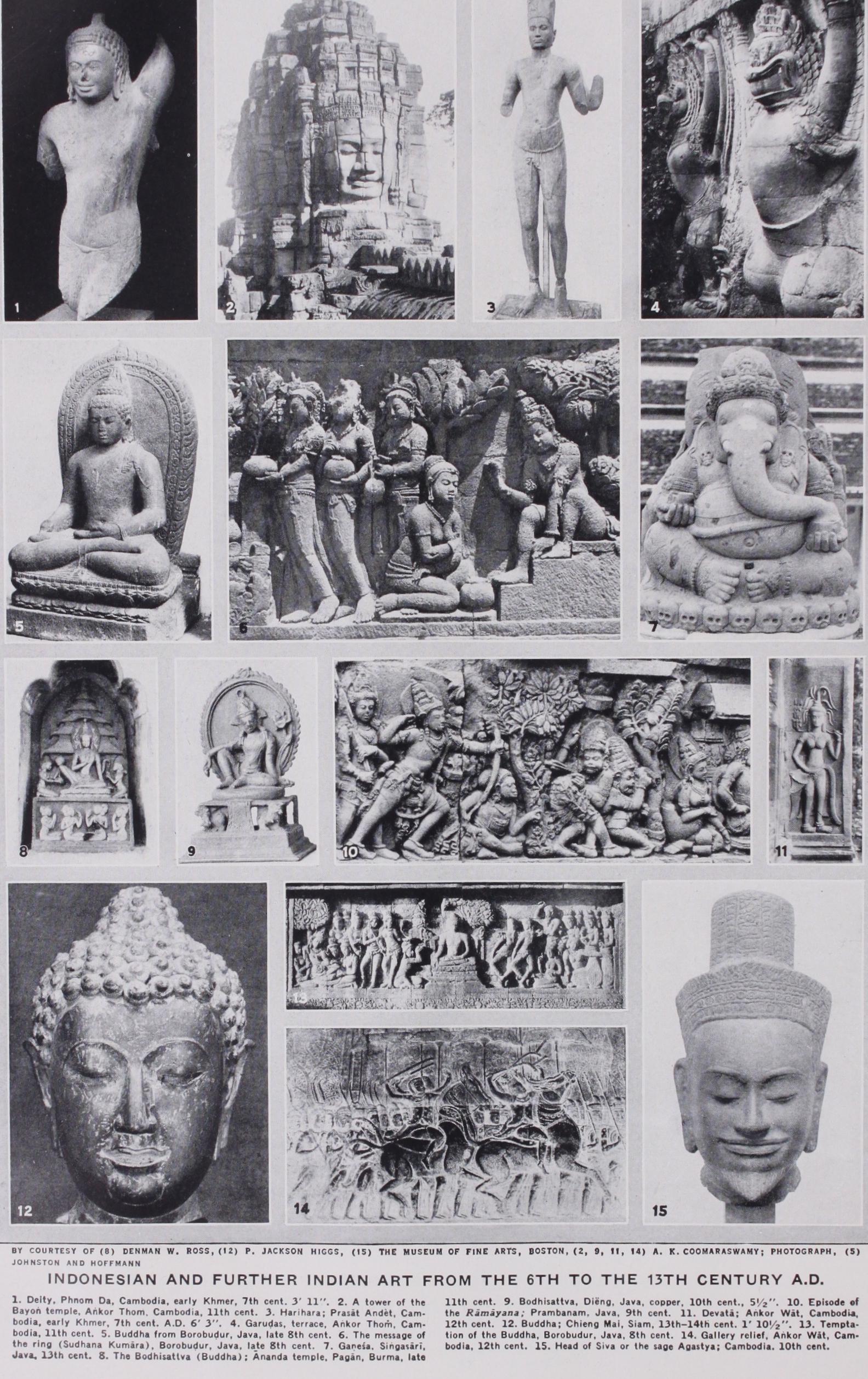
In the vast number of extant Cambodian temples, and in the museum at Phnoth Pen as well as in French and American mu seums, there survive innumerable examples of classical Khmer sculpture; amongst the few of the latter which can be localized may be mentioned the seated figure, probably of Suryavarman I., from Phnoth Chisor. The perfect application of the classical art, however, is reached at Ankor Wat, the later name of the most famous Cambodian temple, a Brahmanical erection of the first half of the r 2th century, due to Suryavarman II. Most of the Buddhist images now to be seen here are of much later date; the sculptural importance of the temple depends on the two great series of reliefs, one widely distributed and decorating wall and pilaster surfaces, the other along the inner wall of the lower gal leries surrounding the central mass. Of the former, the most en chanting are the figures of Devatas, often described as dancing girls, though in reality the descendants of the Yaksis of early Indian art. In the words of a later Cambodian poet (Fang), "one cannot see them thus, so beautifully made, and in the flower of their youth, without adoring them. The eye does not tire, the soul is delighted, the heart is never satisfied. One cannot make up one's mind to leave them. They are no longer figures made by human hands; they are living women, beautiful and gracious." On the other hand the gallery reliefs are heroic, dealing with the battle scenes of the Rnmmyaia and Mahabhdrata, cosmic events like the Churning of the Ocean, and images of heaven and hell. In their superb vitality these reliefs are superior to the more ex quisite and lovely sculptures of Borobudur. That Khmer sculp ture maintained a high level of achievement much later is proved by the remains of the temple of Isvarapura at Bantay Srei, distant 13 m. from Ankor Thoth, and of r 4th century date. After this, the Khmer regime was altogether broken down by the Siamese conquerors; all that survives to the present day is the great tradi tion of the theatre and of the sumptuary arts. Cambodian weavers still excel in the weaving of silks in which the threads are parti-dyed before the warp is laid (chine or ikat technique), and their productions are amongst the finest textiles still made in the East. Fine work on traditional lines in gold and silver is done, and there exist craftsmen able to cast bronze figures in admirable re production of ancient types.
At Borobudur, sculpture in the round is represented by a great series of seated Buddha figures, placed in niches and in the hol low dagabas on the upper terrace. Varying somewhat in quality, the forms are full and serene rather than strongly energized. Most remarkable is the great series of reliefs illustrating the life of Buddha according to the Lalita Vistara, and edifying legends from the Divyavadnn, Gwzdavyu/ia, and Jatakaniln, all of which are reproduced and described in the magnificent publications by Krom and Erp. These reliefs are found along the inner sides of the terraced procession paths, and if placed end to end would extend for nearly three miles. The untroubled richness of the forms, the absence of dramatic emphasis, reflect the enormous wealth and security of the Sailendra culture; devotion itself ap pears rather as culture than as passion ; yet the beauty of these reliefs once realized can never be forgotten.
The return of the Javanese kings to Central Java at the end of the 9th century accounts for the great Brahmanical temple complex of Candi Loro Jongran at Prambanam. Most remarkable here are the reliefs of the terrace of the Siva temple, illustrating the Ramsyayia; fundamentally in the same style as those of Boro budur, they are more animated and more dramatic, as is perhaps natural having regard to their heroic theme. After 915 Central Java was for long completely deserted, and the continuation of the art history must be sought in the east, under the kings of Kediri, Singasari and Majapahit.
A remarkable "portrait" figure of Erlanga (A.D. ror(3-42) near Belahan takes the form of a representation of Visnu riding on Garuda, a true masterpiece of vigorous sculpture. Singasari in the r3th century has yielded numerous magnificent sculptures, in cluding figures of Ganesa, Durga, Manjusri and the goddess Praj naparimita; the last, now in Leyden, is one of the most famous pieces of Javanese sculpture, though in reality somewhat lacking in vitality and over-refined. Really more significant, though already remote from the classic tradition, are the wayang (leather puppet-like) reliefs of Candi Jago, illustrating the Krsnayatia, a rather unexpected theme in a Buddhist temple, but exemplifying the profound intermixture of Brahmanical and Buddhist cult which had already taken place in Java, as in Nepal and Cambodia, and as still surviving in Bali. Here, and more conspicuously in the later (14th to 15th century) reliefs of Panataran, illustrating the same theme and the Ramayana, there becomes apparent a passing over of the classical tradition into a purely folk art, and the emergence of an indigenous Malay-Polynesian ethnic factor in which the stylistic inheritance of India is almost overwhelmed. After the 15th century, when almost all Java had accepted Islam, this later folk art continued to flourish in Bali, and has survived there up to the present day.
The iconography of the images is a little confused, and their style somewhat provincial, but the best examples are of really fine quality. The bronze Buddha shows clear traces of the Indian Gupta style. Taken all together, the sculptures show a close stylistic connection with those of the Dieng plateau and Boro budur in Java, and they may be regarded as the products of a local school in Borneo, dating from the 8ailendra epoch in Java, and for the most part referable to the 7th or 8th century. (See also