
INSECTIVOROUS PLANTS. Insectivorous or, as they are sometimes more correctly termed, carnivorous plants are, like the parasites, the climbers or the succulents, a physiological assemblage belonging to a number of distinct natural orders. They agree in the extraordinary habit of adding to the supplies of nitrogenous material, afforded them in common with other plants by the soil and atmosphere, by the capture and consumption of insects and other small animals. The curious and varied me chanical arrangements by which these supplies of animal food are obtained and utilized are described under the headings of the more important plants.
The best known and most important family of insectivorous plants—Droseraceae--includes six genera : Byblis, Roridula, Drosera, Drosophyllum, Aldrovanda and Dionaea, of which the last three are monotypic, i.e., include only one species. The Sarraceniaceae contain the genera Sarracenia, Darlingtonia, Hell amphora, while the true pitcher plants or Nepenthaceae consist of the single large genus Nepenthes. These three families are closely allied and form the series Sarraceniales of the free-petalled section (Choripetalae) of Dicotyledons. The curious pitcher plant, Cephalotus follicularis, comprises a separate family, Ceph alotaceae, closely allied to the Saxifragaceae. Finally the genera Pinguicula, Utricularia, Genlisea and Polypompholix belong to the gamopetalous family Lentibulariaceae.
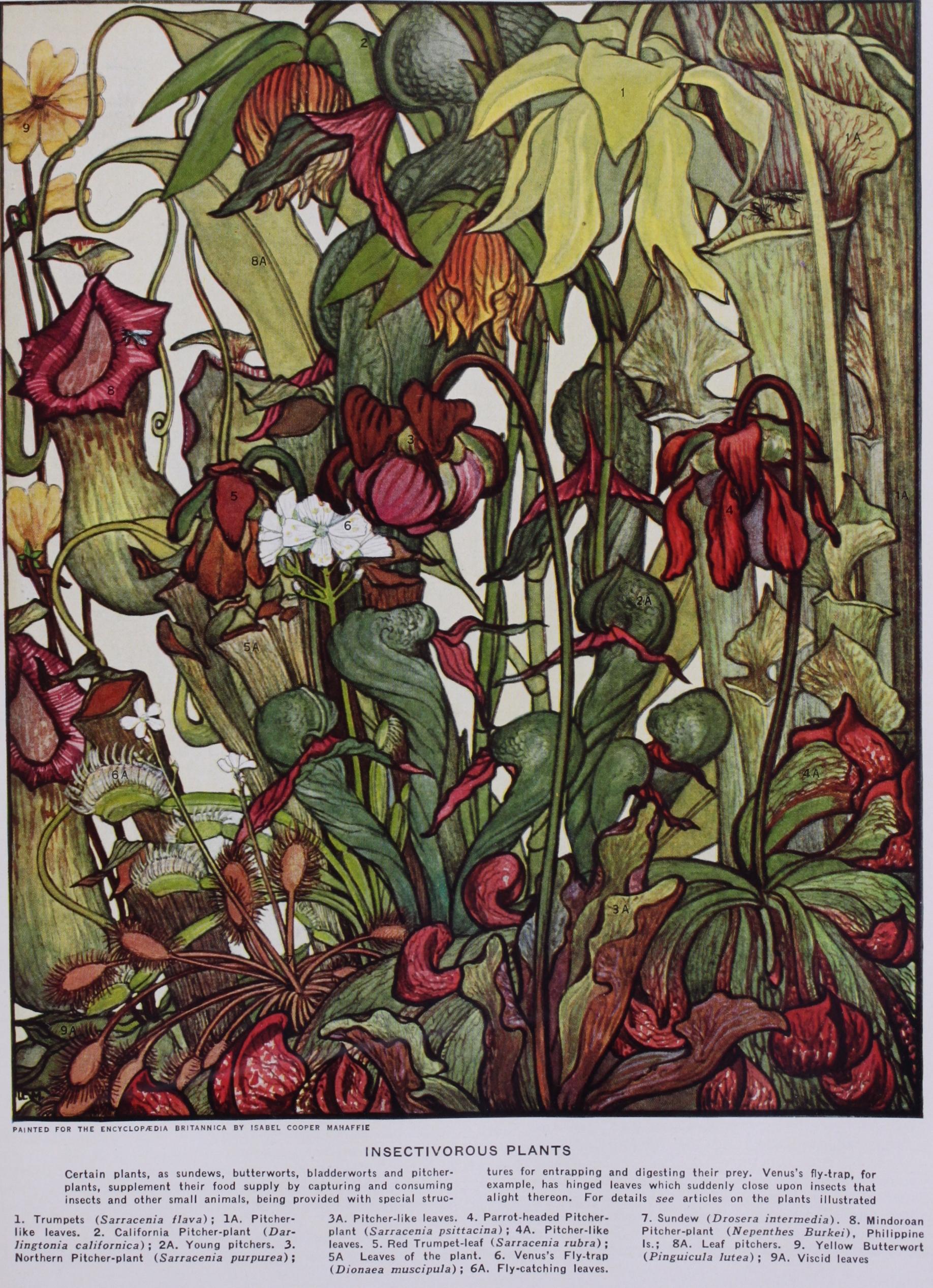
While the large genus Drosera has an all but world-wide dis tribution, its congeners are restricted to well-defined and usually comparatively small areas. Thus Droso phylluyn occurs only in Portugal and Morocco, Byblis in tropical Australia, and, although Aldrovanda is found in Queensland, in Bengal and in Europe, a j wide distribution explained by its aquatic habit, Dionaea is re stricted to a few localities in North and South Carolina. Ceph alotus occurs only near Albany in Western Australia, Heliam phora on the Roraima Mountains in Venezuela, Darlingtonia on the Sierra Nevada of California, and these three genera too are as yet monotypic ; of Sarracenia, however, there are seven known species scattered over eastern North America but mostly in the south-eastern United States. The 6o species of Nepenthes are mostly natives of the hotter parts of the Indian Archipelago, but a few range into Ceylon, Bengal, Cochin China, and some even occur in tropical Australia on the one hand, and in the Seychelles and Madagascar on the other. Pinguicula is abundant in the north temperate zone, and ranges down the Andes as far as Patagonia; the 210 species of Utricularia are mostly aquatic, and some are found in all save polar regions; their unimportant congeners, Genlisea and Polypompholix, occur in tropical America and south western Australia respectively. It is remarkable that all the in sectivorous plants agree in inhabiting damp heaths, bogs, marshes and similar situations where water is abundant, but where they are not brought into contact with the plenteous supply of in organic food as are the roots of most terrestrial plants.