
LIGHT OIL (OR PETROL) ENGINES Few inventions in the short space of a single generation have effected such profound changes in human life as the small high speed light oil internal combustion engine, more familiarly known as the "petrol motor." Not only has it completely revolutionized land transport, but it has also rendered popular flight by heavier than-air machines, and in marine, submarine, industrial, agricul tural, and even in domestic life has wrought important and far reaching changes.
In fig. 13 a simple type of float-feed carburetter is indicated, but in the earlier Daimler motors a surface carburetter was used in which warmed air was drawn through a constant thickness of petrol during the suction stroke of the engine.
Thus Daimler's great achievements were (I) The successful employment of high revolution speeds enabling bulk and weight to be greatly lessened and power increased, and (2) The successful and safe employment of mixtures of volatile liquid hydrocarbons or "petrols" as fuel. The first Daimler motor-bicycle ran in 1886, and the first Daimler-engined car in 1887. It is curious at the present day to learn that he did not regard favourably the appli cation of his little engine to road vehicles, and that he devoted his attention later to their use in propelling launches and canal boats, in which services they were largely used from 1887 on wards.
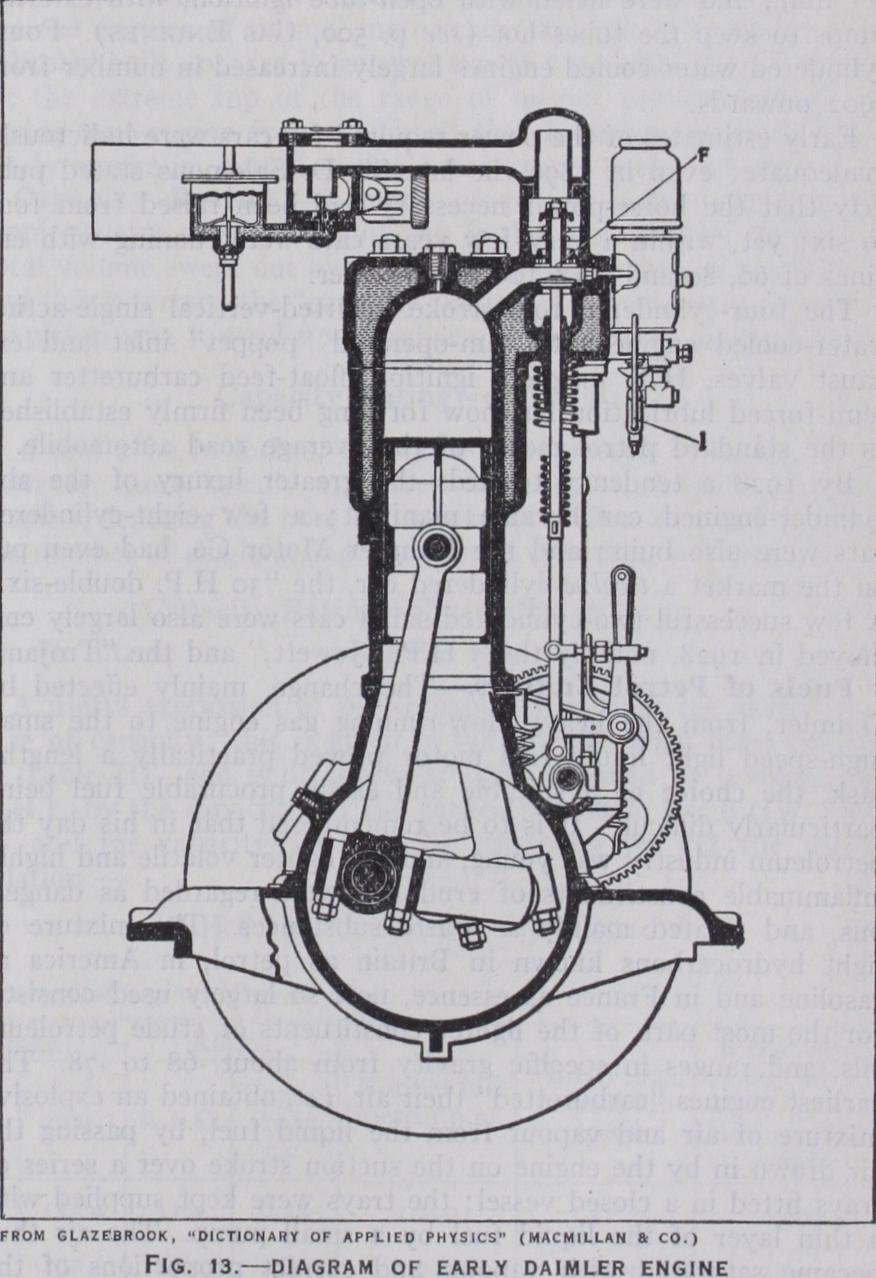
But in 1889 Panhard and Levassor arranged for the manufac ture of Daimler's engines in France, and progress in automobilism quickly became apparent. Contemporaneously with Daimler, Benz of Mannheim had devoted much attention to the produc tion of a small I.C. engine for road vehicles, and achieved con siderable success; as early as 1878 Charles Benz fitted a tricycle with a horse-power motor, and obtained a speed of 7 miles per hour. The early Benz cars, belt-driven by a horizontal f our stroke single- or double-cylindered rather slow-running engine located in the rear of the vehicle, for some years enjoyed a de servedly high reputation; at the 1889 Paris exhibition a Benz car was the sole representative of automobilism! Among the early pioneers must also be mentioned de Dion Bouton, who effected substantial advances in motor-car engines from 1895 onwards; these little engines—fitted even then with high tension ignition with non-trembling coil and dry battery— ran very fast and had a notably high power output. The early de Dion 14 and 2* horse-power motor tricycles were widely used for several years. Their original engine was air-cooled with the now long familiar finned cylinder and aluminium crank-case, splash lubrication, automatic inlet valve, high tension electric ignition, and ran at 1,500-1,80O rev. per min. The early heavier type cars of Daimler and Panhard were usually driven by two cylindered engines of about 34 in. bore X 5 in. stroke X 7OO rev. per min., and were fitted with open-tube ignition, with external lamps to keep the tubes hot (see p. zoo, GAS ENGINES). Four cylindered water-cooled engines largely increased in number from 1902 onwards.
Early estimates of the power required for cars were ludicrously inadequate; even in 1896 the late Sir D. Salomons stated pub licly that the horse-power necessary had been raised from four to six ; yet, within a very few years cars were running with en gines of 6o, 8o and even 10o horse-power.
The four-cylindered four-stroke inverted-vertical single-acting water-cooled engine with cam-operated "poppet" inlet and ex haust valves, H.T. magneto ignition, float-feed carburetter and semi-forced lubrication has now for long been firmly established as the standard petrol motor of the average road automobile.
By 1928 a tendency towards the greater luxury of the six cylinder-engined car became manifest ; a few eight-cylindered cars were also built ; and the Daimler Motor Co. had even put on the market a twelve-cylindered car, the "3o H.P. double-six." A few successful two-cylindered small cars were also largely em ployed in 1928, notably the 7 H.P. "Jowett," and the "Trojan." Fuels of Petrol Engines.—The change, mainly effected by Daimler, from the heavy slow-running gas engine to the small high-speed light liquid fuel motor proved practically a lengthy task, the choice of a suitable and easily procurable fuel being particularly difficult. It is to be remembered that in his day the petroleum industry was young, and the lighter volatile and highly inflammable constituents of crude oil were regarded as danger ous, and treated mainly as waste substances. The mixture of light hydrocarbons known in Britain as petrol, in America as gasoline and in France as essence, now so largely used consists, for the most part, of the lighter constituents of crude petroleum oils, and ranges in specific gravity from about .68 to •78. The earliest engines "carburetted" their air, i.e., obtained an explosive mixture of air and vapour from the liquid fuel, by passing the air drawn in by the engine on the suction stroke over a series of trays fitted in a closed vessel ; the trays were kept supplied with a thin layer of the liquid fuel by a small pump. The air thus became saturated with vapour, and correct proportions of the mixture were obtained before reaching the engine by regulated admission of an additional quantity of fresh air. This was the general principle of the surface carburetter, which survived in a few cases (as, e.g., the Lanchester) even as late as 1910. The in superable objections to the type were (I) The difficulty of obtain ing a correct mixture at varying speeds and temperatures, (2) The lighter constituents of the fuel usually evaporated first, leav ing a heavier and relatively non-volatile residuum which was wasted. Hence arose a great demand for a practically homo geneous petrol of about .68 sp.gr., but the rapid growth in the world consumption soon exhausted available supplies of this very light spirit.
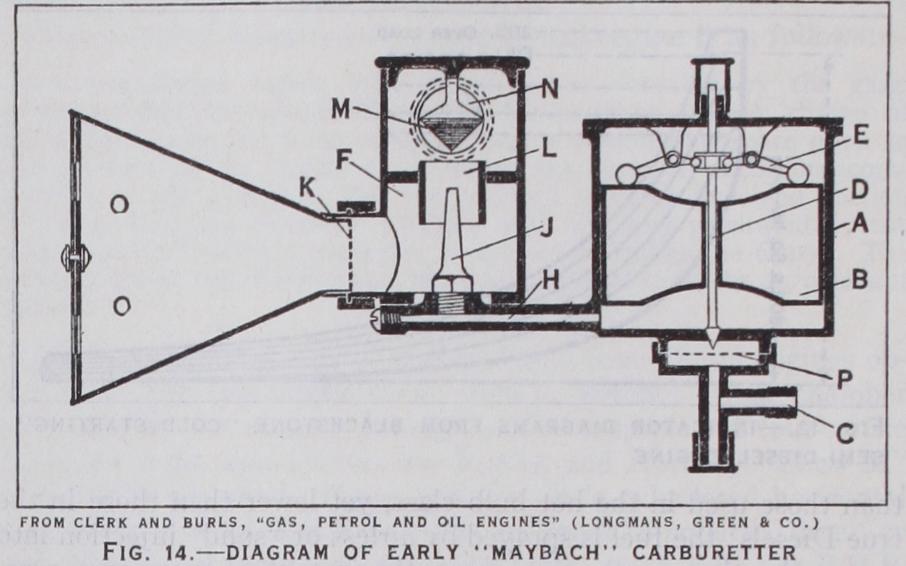
Maybach's famous "float-feed" carburetter, invented in was, however, found to supply a completely satisfactory practical solution of the problem of using successfully much heavier grades of petrol, and this, in numerous improved forms, is in universal use at the present time. A diagrammatic illustration of this cele brated device is given in fig. 14. Within the chamber A is a light brass or copper cylindrical float B which maintains at a con stant level the petrol supplied through C by its action on the central needle valve D through the weighted levers E. A small duct H maintains constant communication between the float chamber and the spray chamber F which contains the spray noz zle J within which the petrol rises nearly to the top when the engine is at rest. During the suction stroke air is drawn through the funnel-shaped intake 00 and gauze screen K, and passes up the Vend contracta or choke tube L surrounding the spray nozzle; in the choke tube the air velocity is great and its pressure in con sequence small ; the petrol accordingly issues from the nozzle in a very fine stream and, mingling with the air, is broken up into spray. This "atomization" and the subsequent vapourizing are assisted by impact upon a corrugated cone M, above the jet ; the mixture then passes on to the engine along an inlet pipe N, being usually adjusted on its way by admission of a regulated further quantity of fresh air. It is clear that by use of the spray nozzle all the fuel is used, and no selection of the more volatile constit uents is possible.
The specific gravity of commercial "petrols" has risen stead ily from .68 to •78, the usual range being however from about .72 to • 76. Increasingly large supplies are obtained by the "crack ing" of heavier petroleum oils. (See PETROLEUM ; Low TEMPERA TURE CARBONIZATION ; GASOLENE ; ALCOHOL : In Industry.) Two essentials of a motor spirit for every-day use are :—(I ) Easy starting, and (2) "Anti-knock" properties. Some heavier petrols do not vapourize at (British) winter temperatures and recourse must be had to carburetter warming to enable , a start from cold to be effected. The possession of "anti-knocking" properties is of the greatest value in the fuel ; detonation is an almost instantaneous automatic explosion of the mixture as a whole, and is evidenced by the "pinking" or "knocking" of the engine ; it causes an immediate reduction in power and rapid overheating which sets up pre-ignition of the mixture. More over an easily detonating fuel restricts the compression ratio that may be used in the engine, and so reduces its thermal effi ciency. (See p. zoo under GAS ENGINES.) Certain substances, as the liquid hydrocarbon toluene the coal tar product benzol, ethyl alcohol, lead tetra-ethyl, etc., when added to ordinary "petrols" in suitable proportions possess the property of reducing the tendency of the fuel to detonate, and are accordingly often termed "anti-knock dopes." Modern petrols are carefully prepared mixtures designed to possess rea sonable anti-knock and easy-starting qualities. Exhaustive in vestigations relating to the various liquid fuels for motors were carried out by the Empire Motor Fuels Committee, whose Report 1923-4 is of great value.