
SOCIAL INSECTS.) Order XI. Psocoptera (Corrodentia) .—Very small sof t bodied insects, winged or wingless : wings membranous with few veins, anterior pair the larger with extensive stigma. Mouth parts for biting: tarsi two- or three-jointed: cerci wanting. In cludes the book-lice and their allies. The small recently discov ered group Zoraptera are sometimes included here.
Division II.: ENDOPTERYGOTA Wings developed inside the body until the pupal stage, meta morphosis complete.
Some individual insects are almost cosmopolitan and possess great capacity for migration and of adaptation to changed condi tions. Examples of such species include the hawk-moth Celerio lineata, and the butterflies Pyrameis cardui and Anosia plexippus. The extensive distribution of the spring-tail Hypogastrura armata has been accounted for on the basis of former land-connections between certain of the great continents, as already alluded to. Other cosmopolitan insects such as the house-fly and many beetles affecting grain and other stored products have attained their wide dispersal through human agencies.
The spring-tails have the widest range of any group of insects and have adapted themselves to the greatest diversity of sur roundings, while ants approach them very closely in these two respects. Ants, as W. M. Wheeler remarks, are found "from the Arctic regions to the Tropics, from timber line on the loftiest mountains to the shifting sands of the dunes and sea-shores, and from the dampest forests to the driest deserts." More detailed facts relative to insect distribution are given in the separate arti cles devoted to the principal orders.
The study of fossilized remains indicates that no undisputed in sect has been found earlier than Upper Carboniferous times and even these very ancient insects were already highly evolved, af fording little information as to the ancestry of the class as a whole. The oldest known insects are all Exopterygota and comprise totally extinct orders, some of which are allied to the existing Orthoptera and others (Palaeodictyoptera) exhibit the combined characters of several of the most generalized living orders; in cluded among these fossils are also ancestral dragon-flies of gigantic size. The only still existing insects represented in Car boniferous times are the cockroaches, which have persisted with relatively little modification through the intervening ages to the present day. In Lower Permian times the first true dragon-flies appear, with Ephemeroptera, Hemiptera and some anomalous insects (Protohymenoptera), which are regarded as the far-off an cestors of the Hymenoptera. In rocks of this age there are also found the earliest remains of the Endopterygota which are repre sented by some small species of Mecoptera. In the Upper Permian are found the first recorded Coleoptera and Neuroptera together with some remarkable insects (Paramecoptera) which are held to be the ancestors of Lepidoptera, Trichoptera and Diptera. It is not until Jurassic times that true Diptera and Trichoptera appear, while Hymenoptera are first found in the Cretaceous and the oldest Lepidoptera are of Oligocene age. In rocks of later date the insect remains are very like those of living forms and those found in Baltic amber even belong to existing genera.
A survey of fossil insects shows that the Exopterygota appeared first and though no remains of the most primitive insects (Thysa nura) have been found till Tertiary times, it is probable that their delicate organization has not favoured their preservation through the great periods of time when they presumably were existing. Although the Endopterygota are of great antiquity, those orders which are most specialized and exhibit the greatest differences between the larva and the imago were the last to appear. Further details respecting fossil insects will be found in separate articles dealing with the principal orders.
Some insects such as the Cotton Boll Weevil may pass through as many as eight generations in the year, while on the other hand, the click beetle (Agriotes obscurus) requires about five years to complete a single generation, most of that period being spent as a larva. The house-fly under favourable conditions of food, tem perature and moisture can complete its life-cycle in ten days, but the shortest cycle is found in some minute Chalcid wasps whose larvae live as parasites in the eggs of other insects, and require only seven days from when their eggs are laid till the perfect insects appear.
The relationship between insects and flowers is mutually bene ficial: insects obtain nectar and pollen and in return ensure cross pollination by transferring the pollen from the stamens of one flower to the stigma of another. Flower-haunting insects often ex hibit special structural modifications enabling them to suck nectar from deeply seated nectaries, and bees are provided with organs for pollen-collecting. Flowers in their turn are coloured or other wise ornamented to attract insect-visitors and their scents are be lieved to serve the same purpose. Most flowers are also so con structed that insects inevitably pollinate them, and many such as orchids, iris, yucca, etc., are formed so that pollination is effected in a particular manner.
Among the lower plants affected by insects, fungi of various kinds afford sustenance and shelter to many small beetles and their larvae, along with those of fungus-midges and other flies. Certain of the primitive fungi are pathogenic to insects, entering and spreading within their bodies and ultimately killing them. Mention needs also to be made of species of ants and termites which cultivate fungi within special recesses of their nests where they serve to feed the brood. Lichens are fed upon by various moth larvae, but liverworts, mosses and ferns support compara tively few insects.
All aquatic insects are believed to have been derived from terres trial ancestors and have become adapted in diverse ways to their special mode of life : these adap tations mainly concern locomo tion and respiration. Among beetles and water-bugs the swim ming legs are flattened and oar like, often fringed with closely set hairs, and form efficient paddles.
Respiratory modifications are numerous and in pond-skaters the body is clothed with a dense vel vety pile which renders them in capable of being wetted, and also serves to retain a coating of air around the insect when sub merged : in this manner a supply of oxygen is provided for breathing and the insect can remain im mersed till it is used up. Some beetles carry a supply of air be neath the elytra when submerged, while others descend with a bubble of air at the apex of the abdomen. Water-scorpions are provided with a kind of caudal respiratory tube and, when neces sary, protrude the apex of this siphon through the surface film: air passes down this channel to enter a pair of spiracles situated at its base. Mosquito larvae breathe by means of a caudal siphon of a different character : it bears a pair of spiracles at its apex and air enters the tracheal system directly, when the siphon breaks the sur face film. Many other insects breathe the oxygen dissolved in the water: such insects either possess gills or respire cutaneously. Gills are outgrowths of the integument containing tracheae or more rarely only blood. In may-fly nymphs (fig. 4o) they are commonly in the form of lamellae attached to the sides of the abdomen, while in many dragon-fly nymphs they lie within the terminal chamber of the gut, water being inhaled and exhaled through the anus. The so-called bloodworms or larvae of certain midges (Chironomidae) are remarkable in that the blood contains haemoglobin and respira tion takes place through the skin.
The open sea is almost devoid of insect life excepting for a few midge larvae that have been dredged from tolerably deep water and the Hemipterous genus Halobates which frequents the surface of warm oceans often far from land. Between tide levels the shore is inhabited by the spring-tail Anurida maritima, a few beetles and their larvae and certain flies. These insects, or at least their larvae, are immersed during each tide when they retreat under stones or in the sand, while some midge larvae remain continuously sub merged. Those of the European genus Clunio occur in rock pools along with the curious wingless females, while the males, which are winged, skim over the water surface. Loss of wings is a common feature of marine insects and it has been explained as an advan tage which prevents such insects being blown out to sea.
Parasitic insects exhibit varying degrees of adaptation to their mode of life : some ectoparasites are very little modified except that their claws are specially developed for clinging to their hosts and wings are totally absent. Among endoparasites all traces of limbs and sense organs are wanting, these degenerative changes being adaptations to a life in which the necessity to seek out food is no longer present. The tracheal system is often totally absent but, on the other hand, the integument is unusually thin so as to allow of the passage of oxygen contained in the blood of the host, at whose expense such parasites feed and respire. During most of their life endoparasites avoid the vital organs of their hosts and feed largely upon the blood and fat-body, since their own death would speedily follow that of the insects they parasitize : for the same reason such parasites do not void the contents of the gut till the last moult. One of the most advanced types of parasitism is found in the stylops and its allies where the female, after issuing from the egg, spends its whole life as an endoparasite in the body of a bee or a leafhopper. The adult is a degenerate sac-like creature specially adapted for this mode of life. The male stylops is a para site only as a larva and finally emerges as an active winged insect.
Larvae of the hover flies (Volucella) live in the nests of bumble bees and wasps, where they feed on waste organic material. The curious bristle-tail Atelura occurs in ants' nests and is stated to live by imbibing the food which is being actually regurgitated from one ant to another. There are again other insects which benefit their hosts in return for their keep. Thus, certain beetles obtain food and shelter in ants' nests and provide the ants in return with cutaneous secretions that are much sought after by their hosts. In extreme cases the association is even more intimate, the guest beetles being actually fed by the ants in return for the secretions provided, thus affording an example of symbiosis or mutual benefit.
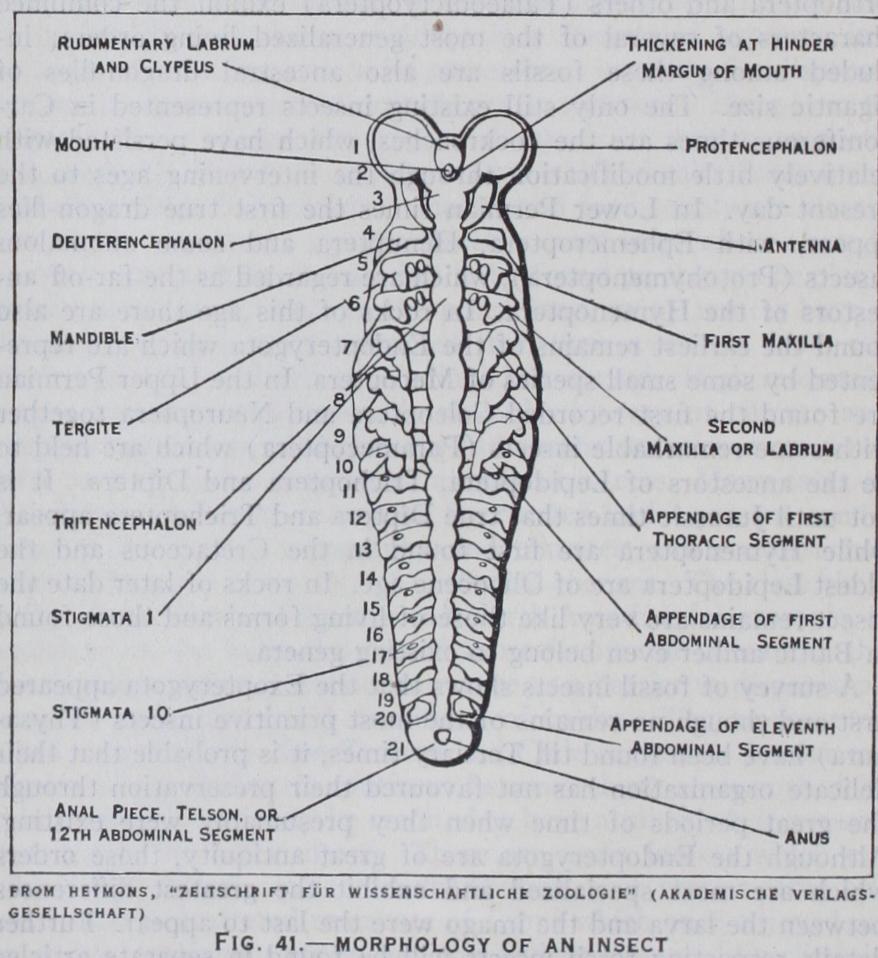
(See SOCIAL INSECTS.) Gregariousness and Social Life.—Although the vast ma jority of insects are solitary in habit, individuals of certain species associate together collectively and are said to be gregarious. Whirligig beetles, for example, associate in companies on the sur face of the water : locusts and some butterflies become gregarious when migrating and ladybirds at times congregate in masses. Some caterpillars are gregarious and members of a brood live in a com mon web spun over the food-plant : such companies usually dis perse, as the food becomes used up, and its members live inde pendently. There are again other insects such as the earwig and the mole cricket in which the female guards the eggs and the young brood. A solitary bee of the genus Halictus constructs its cells in a group around a common entrance tunnel in the ground : these cells are provisioned and guarded by the parent, who may even survive till the daughter bees emerge. Examples of this kind where the parent guards and tends the offspring, at least during their early life, foreshadow the beginnings of social life. The lat ter exhibits its own peculiar features in different groups of insects which have developed the social habit, but in all cases each society is a family consisting of two parent insects, or at least the fecun dated female, and the offspring, and the members of the two gen erations live together in a common abode or nest in mutual co-op eration. True social insects include several groups of wasps and bees, together with the ants and termites. In the highest grades of social life specialization of certain individuals to perform specific functions for the common good is attained and a system which exhibits striking parallels in behaviour with human society has been developed. (See SOCIAL INSECTS.) Ancestry of Insects.—It is conceded that the most primitive insects are the bristle-tails (Thysanura) and these lowly creatures betray certain characters which are to be regarded as inheritances from an ancestral stock. The embryonic development of insects also reveals primordial characters : the evanescent appendages just behind the antennae and those borne on the abdominal seg ments in generalized insect embryos, indicate that the ancestors of insects carried five pairs of head appendages and had a body of I s segments, all of which except the last bore limbs. Those car ried on the first three body segments (legs of insects) and on the i4th segment (cerci) were evidently more important than the in tervening pairs, of which traces only remain in some larvae and in the Apterygota. It seems clear, therefore, that the ancestors of insects were many-legged animals and the nearest approach to such progenitors is to be found in certain small, white creatures living in moist earth and represented by Scolopendrella and its allies. They form the class Symphyla which is related to the Chilopoda (centipedes) and Diplopoda (millipedes). Structurally the Symphyla have so many features in common with such bristle tails as Campodea and Anajapyx as to justify affinity between the two groups. Other Thysanura, such as Machilis and its allies, show features in common with the higher crustacea particularly with regard to the mouth-parts. It must also be remembered that the small evanescent appendages found behind the antennae in some insect embryos, are to be regarded as relics of the second pair of feelers only found in Crustacea. The foregoing remarks indicate very briefly that it is probable that the ancestors of insects had features in common with the Symphyla and through them with the Chilopoda and Diplopoda, but at the same time, these ancestors were derived from a stock from which the Crustacea also arose. The Arachnida, or spiders and scorpions, are only very remotely related to insects and evidently diverged very early in their evolu tion from the primordial arthropod stock. (See also ARTHROPODA.) Origin of Wings.—The Thysanura are eminently terrestrial insects, devoid of wings, and undergo no metamorphosis. Since they are the most primitive known insects and the majority of that class are winged creatures, the derivation of the latter from the Thysanura is largely involved in the origin of wings. Many authorities believe that wings first arose as small lateral expansions of the tergal region of the thoracic segments. During their evolu tion these expansions became sufficiently large to function after the fashion of parachutes in insects which possessed a tendency to leap. At a later stage they acquired direct articulation with the thorax, became supplied with tracheae and developed the power of independent motion. By others it is contended that wings were derived from plate-like thoracic tracheal gills which had lost their original function and became adapted for purposes of flight. Such gills, it is maintained, resemble those found in many may-fly nymphs, and the theory implies that the ancestors of winged in sects became temporarily aquatic and thus acquired gills, which developed into wings when their possessors resorted to the land for a second time.
See the articles COLEOPTERA; DIPTERA; HEMIPTERA; HYMEN OPTERA ; LEPIDOPTERA ; NEUROPTERA ; ORTHOPTERA ; PLECOPTERA ; THYSANURA ; TRICHOPTERA.
BIBLIOGRAPHY.-The literature on insects has assumed enormous Bibliography.-The literature on insects has assumed enormous proportions and at least 2,000 scientific books, memoirs and separate articles appear each year in various languages, apart from writings of a popular character.
General Text-books.—Among the best elementary manuals to be found on the subject are: J. W. Folsom, Entomology with special reference to its Ecological Aspects (1923) ; G. H. Carpenter, Insects: their Structure and Life (1924) ; W. H. Wellhouse, How Insects Live (1926) . For a larger book, D. Sharp, "Insects" in the Cambridge Natural History (vols. v., vi., 189S, 1898) is important.
General text-books of a more advanced character include: L. F. Henneguy, Les Insectes (1904) ; the great work of A. Berlese, Gli Insetti (Milan, 1909-25) ; C. Schroder, Handbuch der Entomologie (Jena, 1912-28) ; J. H. Comstock, Introduction to Entomology (192o) ; A. D. Imms, General Text-book of Entomology (1925) ; all these works contain copious bibliographies.
There are also a number of books which, although containing general