
THE LETTER I OF THE ALPHABET. This letter corresponds to Semitic 9 (yod) and Greek I (iota) . Early Greek forms from the island of Thera were S and S, which obviously more closely resemble the Semitic than the later single vertical stroke. In Attic inscriptions also the form fp appears, while in early Corinthian inscriptions the forms , , (7 are found. The Chalcidic alphabet had the form and this was the form in all the Italic alphabets including the Etruscan. The Lydian alphabet besides the form i also shows a form a (written from right to left) .
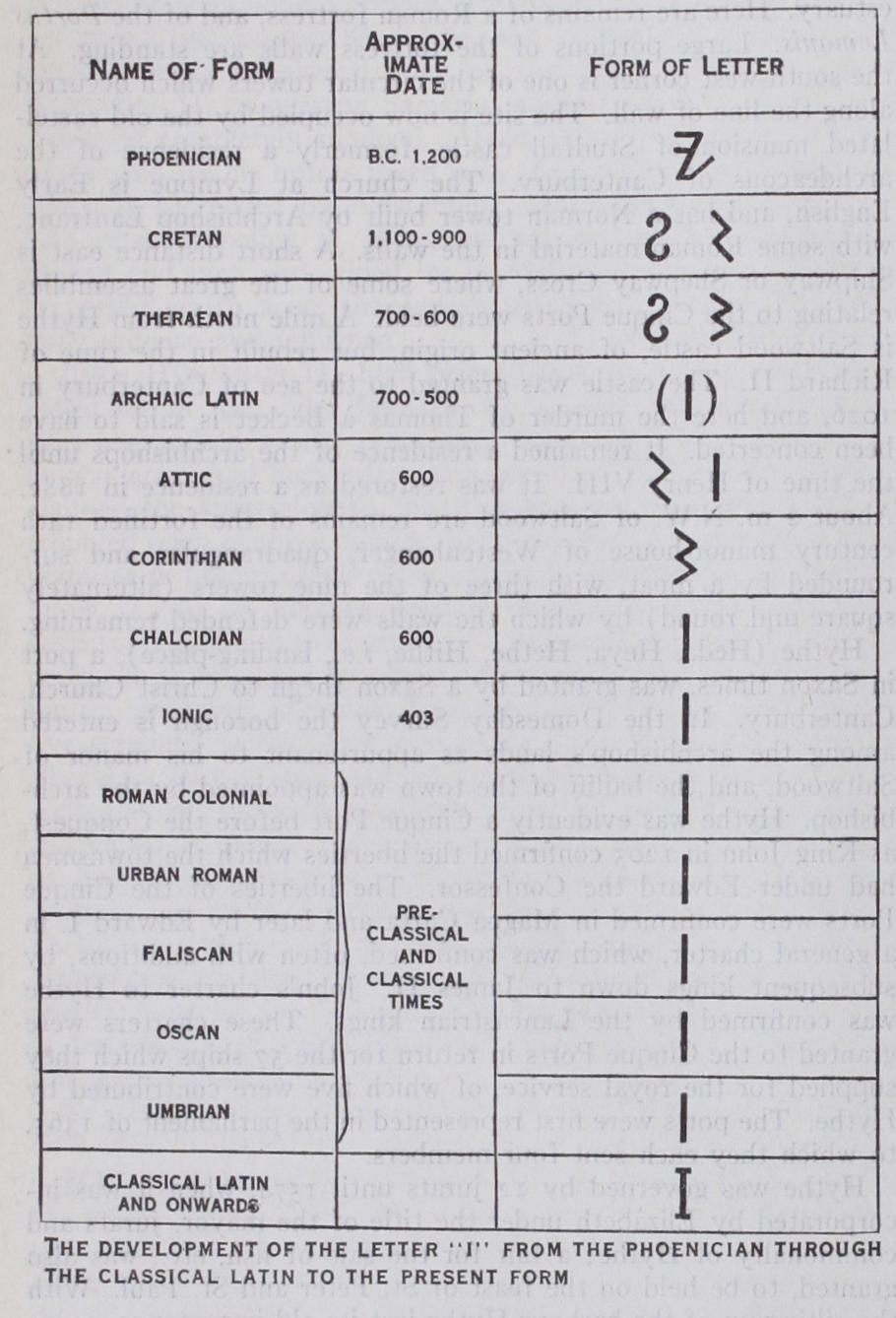
The minuscule letter is merely a shortened form of the majus cule. The dot first appears in mss. of about the i ith century and was used to distinguish the letter and assist reading in words in which it was in close proximity to letters such as n or m (inimicis, for example) . The dot frequently took the form of a dash, e.g., L . It became the custom in mediaeval mss. to distinguish an initial or otherwise prominent i by continuing it below the line, and it was from this habit that the differentiation of the letters i and j arose. The initial letter, nearly always lengthened, had most fre quently a consonantal force, and this led to j representing the consonant, i the vowel. The two letters were not considered as separate until the i 7th century, In Semitic the letter represented a spirant akin to the sound of English consonantal y. In Greek, Latin and the Romance languages it has represented a high front vowel similar to English long e. In Latin short i represented a considerably more open sound than long i, as is evidenced by the fact that in late Latin it ran together with long e. In modern English the sound of short i is almost identical with what it was in Latin (e.g., in the word pit). Long i has become a diphthong (ai/Ti, e.g., in the words ice, hire), the sound formerly represented by long e (i.e., that heard in French tete) having shifted forwards and upwards till it has become that formerly represented by long i.
In words such as fir the letter represents the neutral vowel, while in certain foreign words it retains its continental sound, identical with that it represented in Middle English and pre viously (e.g., in the words pique, emir). (B. F. C. A.)