
INDIAN DESERT, THE. Between the ancient Aravalli mountains and the wall-like front of the recently folded arcs which carry the Indo-Baluchistan frontier, and from the shores of the Arabian sea to within an average distance of c. 8o m. from the Himalayas, extends a lowland exceeding 200,000 sq.m., with an annual rainfall of less than 15 in. and a population of about 15 million. At one extremity it touches the northern tropic ; at the other it passes beyond 32° N. lat. It includes most of that part of the Punjab which constitutes "The Land of the Five Rivers," together with the adjoining trans-Indus districts of Dera Ghazi Khan and Dera Ismail Khan; the whole of Sind and, to the imme diate north, Kachhi (Kalat). The western hem of south-east Pun jab must be added also. Native States territory constitutes a solid block extending from the Sutlej-Indus line, east of Sind, to the Aravallis, including Bahawalpur (q.v.), and to the south the Raj putana States of Bikaner, Jaisalmer, and Jodhpur (qq.v.). Native territory touches the Indus again for a short distance below Sukkur where Khairpur State, hinging on to the west of Jaisalmer, breaks across Sind to the river. Finally Cutch State passes down from Jodhpur to the seaboard south of Sind.
A range of 10° of lat. implies considerable climatic diversity, and the area embraced leaves room for topographical variety. Yet it remains a major natural entity, the character of which is con veyed in the title "Arid Lowland." The tract has a general slope from the Himalayas to the Arabian sea, i.e., north-east to south west. Along its inner margin, in Punjab, the land between the rivers (doabs) rises to c. 700 ft.; but the western portions of the doabs and south of the Sutlej, almost all Bahawalpur, lie below the Soo ft. contour line. The 25o ft. contour line cuts the Indus river as it enters Sind, the heart of which province is well below this ; the rest, with the conspicuous exception of the Kohistan, not much above it. To the south-east towards the Aravallis, the low land attains a general level of over i,000 ft. whence it grades down north-westwards, i.e., traversing the prevailing slope at right angles. Except for a fringe of Jaisalmer, and the basin of the Luni river draining south-east to the Runn of Cutch, all Rajputana stands well above Soo f t. and betrays its physical "betweenness." Its deep mantle of aeolian deposits allies Rajputana superficially with the alluvial expanse upon which it encroaches. But it is not so completely destitute of solid rocks, and these, rising as low heights above the sandy surface, indicate a deep-seated unity with peninsular India as a coastal margin shelving from the Aravallis towards the seas, persisting to the north until late geological time.
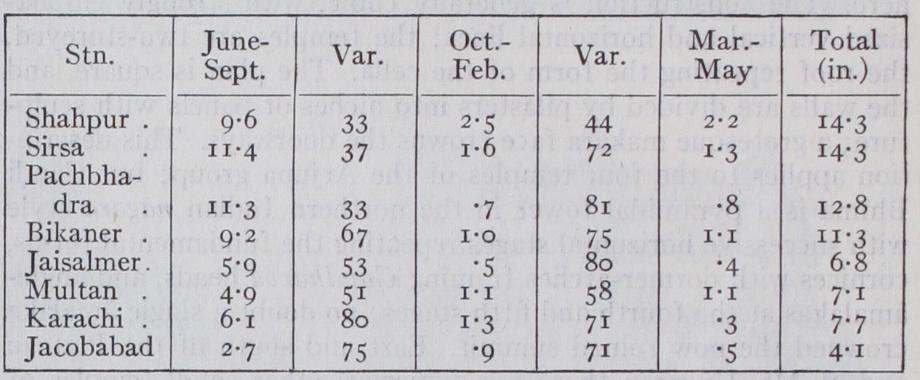
Winds from the west and south-west are well established by April and persist until October, blowing with increasing strength as the depression deepens over the land until they reach their final expression in the south-west monsoon proper. But the air currents now entering the lowland on this side emanate from the dry land belt about the head of the Arabian sea. Hence they are not sat urated like those, which, originating over a broad ocean, impinge on the Bombay coast but only "stray" just north of the Aravallis. They confer even scant benefit to the immediate coast fringe; beyond, they desiccate. Since also the Bay of Bengal branch of the advancing monsoon, which enters the lowland from the east on a downhill journey to its barometric goal, has already served the whole Gangetic plain, its remaining moisture is soon exhausted. Thus of the 213,110 sq.m. actually under review 47,590 receives less than 5 in. per annum; 95,56o 5 to 10 in., 69,96o 10 to 15 inches. The following illustrates briefly the salient features of distribution, and how precipitation shrinks north, south and east towards Upper Sind and Kachhi : Var. (variability) indicates departure from average seasonal rain fall as registered in half the years during 189o-1923, expressed in percentage. It is one way of illustrating the violently fluctuating regime. In general, March to May returns are insignificant.
Deserted by a "westering" parent, the feeble monsoon streams which struggle across south-east Punjab, between the Sutlej and Jamna rivers, succumb before the sand ere the Rajputana border is reached. The Luni river is the only significant watercourse within the area. It receives several Aravalli streams from the south-east and is at least a support to the subsoil water within its bend ; but it loses itself in sand at the head of the Runn.
Gypsum, also occurring on the margins of some of the lakes, may prove more important in the future. In Sind and Khairpur, where the floor of alluvial clay remains uncovered or only thinly mantled with sand, shallow though often large expanses of water known as dhands are common in the hollows (talis) between the sandhills. They are fed by rain water percolating through the sand and emerging as a spring (sim) above the clay. Prior to the con trolling of the Nara river many dhands were replenished by its flood spills, but these have now mostly dried up. Sim water is often sweet, and gives rise to fresh pools close to where it emerges and lying a few feet above the dhand proper, which is either alkaline or saline, rarely fresh, its particular nature being recog nizable from its fringe of vegetation. All dhands shrink seriously after rain ; the smaller ones dry up. The mineral trona, from the alkaline dhands, supports the soda (cizaniho) industry of Khaipur State and Nawabshah district (Sind). Saline dhands yield salt and gypsum.
When rain is propitious, millets (principally bajra) are raised and husbanded to eke out a milk diet supplemented otherwise only by such imported grain as the profits of the pastoral industry and associated crafts, such as the making of blankets, felts, lohis (coarse shawls), ropes, bags, brushes and leather goods render possible. Typical desert talukas of Sind show a population density per square mile of less than 20 (cf. Diplo. 12; Chachro 18); Jaisalmer the "core" of the desert has an over-all density of 4 per sq.m. ; Bikaner gives 28 (Bikaner city 85,927) ; Jodhpur 53 (Jodh par city 94,736), but a heavy allowance must be made for that part of the State outside the essential desert. Roughly, Thar car ried c. 21 millions, largely marginal.
Lying in a belt liable to pronounced seismic disturbance, the Runn suffered severe displacement in 1819 ; depression increased the "rann" proper, but aeolian deposits have diminished it since. It is a range for wild asses. The impoverishment of the Runn and much of what is now Thar reflects the "westering" of the Indus and associated Punjab rivers. A map shows that the streams mak ing for Rajputana across the low Sutlej-Jumna watershed con verge towards a large dry water course (the Ghaggar), which runs parallel to the Sutlej and is traceable beyond through Sind to the Runn, roughly via the east Nara and Puran. This is the Hakra, or "Lost River," fed formerly by the Sutlej (possibly at one time by other Punjab rivers), and in its lower course (as the Mihran of Sind), by the Indus. Such was the known condition in the 8th century A.D. Subsequent probably to phenomenal flooding in north Punjab, placed in the 14th century, a rearrangement of drainage initiated the decline of the Hakra. First a "westering' Indus ceased to feed its lower reach; eventually the Sutlej completely deserted it and passed to the Indus via the Beas. By 1790 the Hakra was dead. The tapping by bunds of the waters latterly feeding the Puran from an Indus distributary assisted to complete the dereliction of the abandoned delta (the Runn).
The following gives the area now being served ; canals marked* lie entirely in the arid zone, the others affect its margins (average annual acreage 1923-24 to 1925-26) : Lower Chenab*, 2,478,210; Lower Jhelum*, 868,064; Upper Jhelum, 326,786; Upper Bari doab ; Lower Bari doab* 1,165,109. The Sutlej valley project, now in hand, will convert certain inundation canals de pendent on that river into perennial, and assure the flood supply of the rest, while extending irrigation into the Bahawalpur and Bik aner fringes of Thar. When complete it will irrigate 5,108,00o ac., including 2,07 5,00o perennial and 2,033,00o non-perennial; 3 a mil lion acres at present waste, will be available for colonization. Rep resentation by the Bombay Government has led the Government of India to hold up further undertakings by Punjab pending in vestigations into Indus river supplies ; the position is difficult and a Central Indus Board is mooted.
The recession of the western mountain wall enables the Indus, after receiving the united volume of the Punjab rivers, to enter Sind as a south-west flowing river. Near Schwan it turns south in the presence of the Laki range but manifests its "westering" tendency again in its final struggle seaward. The bifurcation of the Ochito and Haidari is quoted as the head of the delta; but, of course, throughout Sind the river is really deltaic, flowing on a ridge above the land on either side, restrained in parts by embank ments, but requiring more to curb its devastating moods, while the lower part of the province is riddled with its dead channels. Only in the gorge between Sukkur and Rohri, where it traverses a gap at the north extremity of low hills running for 4o m. south from its left bank, and in the Kotri neighbourhood is its channel con stant. Its sphere of influence, between the mountains on the west and Thar on the east, defines settled Sind. The cultivable area commanded by canals dependent on it approaches nine million acres of which, in 1924-25, 2,168,682 ac. were irrigated under the right bank systems and 1, 5 5 7, 201 under the left. As the Indus is not yet weir-controlled, technically all its irrigation is by inun dation, its canals functioning only during the flood season (June to early October) . One or two, however, receive a little water in the "cold" season, and the Jamrao canal, weir-controlled and fed from the east Nara supply channel (linked with the Indus but not weir-controlled itself), is truly perennial. In order to afford an assured supply at all times, the Sukkur Barrage project, after long years of discussion, has recently been undertaken. The barrage is to be placed 3 m. below the Sukkur gorge. Briefly, four canals will take off the left bank and three (one a purely rice canal) off the right bank. They will take up the area south of Sukkur at present under inundation irrigation, and in addition will enable a consid erable area of waste to be cultivated. Actually 62 million acres of cultivable land will be commanded, and it is hoped to feed 53 mil lion acres annually, of which two million represents existing inun dation irrigation to be given an assured supply. Of improved cotton alone 700,00o ac. per annum are anticipated. The project will take c. 4o years to complete, but big developments are expected in ten years' time.
Westwards beyond the sphere of the Indus, the desert landscape is at once established, and the irrigated patches of daman (clayey soil) created and sustained by flood torrents searing the mountain wall, only throw the naked hideousness of the limestone rampart into bolder relief.