Battle of Wry
WRY, BATTLE OF (1590). The battle of Ivry (Eure, France) was fought between the Huguenots under Henry IV. of France and the Catholics under the duke of Mayenne on March 14, 159o. On Aug. I, 1589 Henry III. was assassinated, and Henry IV., of Navarre, ascended the French throne, and at the battle of Arques, won by him on Sept. 28, 1589, he, through his energy, gallantry and resourcefulness, established himself as the national hero. The next year the duke of Mayenne laid siege to Melun, but fell back on the approach of Henry. No sooner had the king withdrawn than he was recalled to confront Mayenne who, reinforced by the Spaniards, had returned. The two forces, the duke's numbering about 13,000 and the king's somewhat less, met on the plain of Ivry. The following brief account of the battle which then took place will give some idea of the desultory tactics in vogue at this date.
Henry first drew up his army, prayed and then adjusted his helmet on the crest of which floated three white plumes. Before lowering his visor he said to his companions : "I will conquer or die. Keep well your ranks, and if the heat of the battle compels you to leave them, always rally, it is the one thing to remember in war. This you should do by the three pear-trees you see yon der on my right. If you lose your banners and your standards do not, however, lose sight of my white plume, for you will always find it on the road of honour and pointing towards victory." Colonel Schomberg, a captain of mercenaries, rode up to the king and demanded that his men should be paid. Henry in a rage rebuked him, and then throwing his arms about him kissed him, whereupon Schomberg with tears in his eyes replied, "Oh ! Sire, in giving me back the honour you took from me you take away my life." The charge was sounded, and "Schomberg part comme un trait; fond sur l'ennemi comme un lion furieux, et meurt les armes a la main," (Schomberg sped forward like an arrow, hurled himself like a furious lion on the enemy, and died sword in hand). With shouts of "Vine le Roil" battalions and squadrons followed him. The two sides clinched, and for several hours attacks were made and repulsed without any decided advantage being gained. A page bearing a white plume in his helmet being killed, a panic seized upon some of Henry's squadrons. At the moment he was busily engaged in a hand to hand fight, lost to sight in a mêlée. Cutting his way out, his white plumes were once again seen, whereupon his soldiers wild with joy charged forward, and the enemy was routed. A pursuit to the bridge of Ivry then followed, at which most of the foreign troops in Mayenne's pay were butchered, the French and Swiss alone receiving quarter.
The prestige won at Ivry was Henry's true gain and victory. He was accepted by France, and then as an act of political wis dom, in July 1593, he became a Catholic, and two years later brought about the collapse of all opposition.
See A. Poirson, Histoire du regne de Henry IV., 1862-1867; P. F. Willett, Henry of Navarre; The Cambridge Modern History, vol.
iii., 1904. (J. F. C. F.) a suburb of Paris, in the department of Seine, arrondissement of Sceaux, near the left bank of the Seine, 6 kilometres from Notre Dame cathedral. Pop. (1931) 46,64o. It manufactures organs, earthenware, rubber and chocolates, and has engineering works, and oil-works, its trade being facilitated by a port on the Seine.
IVY,
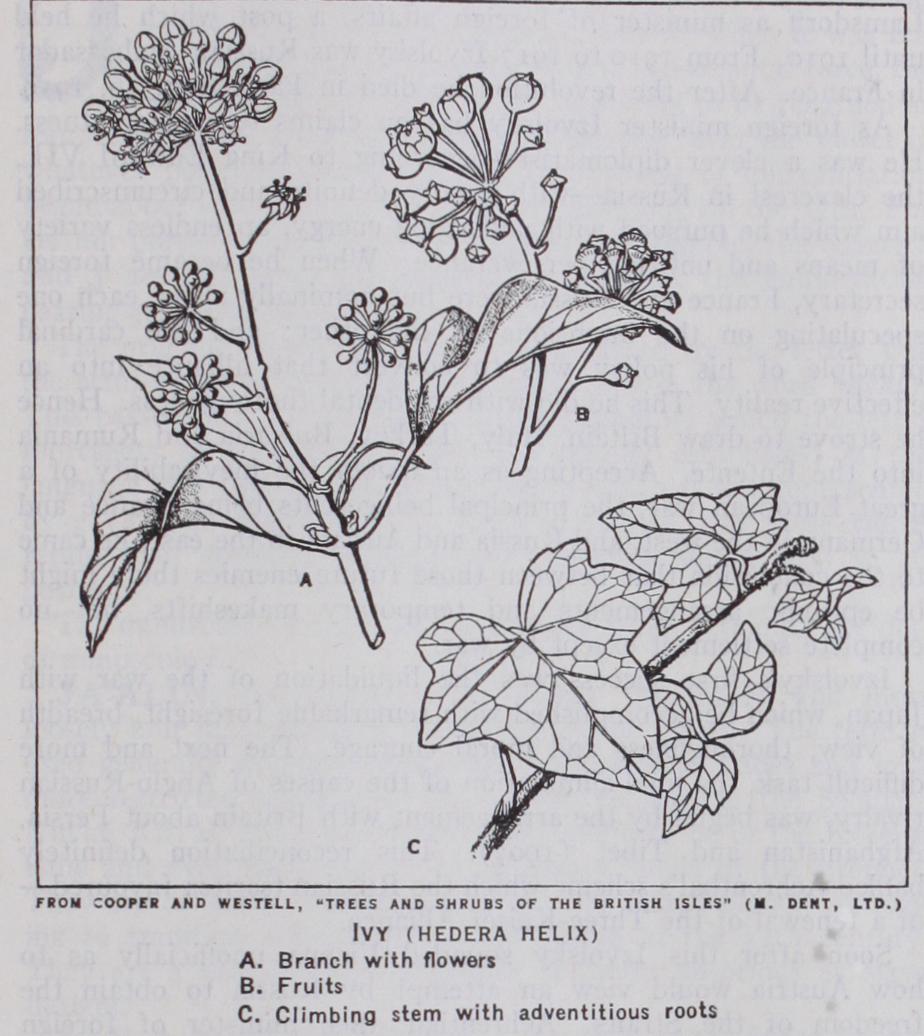
the collective designation of certain species and varieties of Hedera, a member of the family Araliaceae. There are fifty species of ivy recorded in modern books, but they may be reduced to two, or at the most, three. The European ivy, Hedera Helix, is a plant subject to infinite variety in the forms and colours of its leaves, but the tendency of which is always to a three- to five lobed form when climbing and a regular ovate form of leaf when producing flower and fruit. The African ivy, H. canariensis, often regarded as a variety of H. Helix and known as the Irish ivy, is a native of North Africa and the adjacent islands. It is the common large-leaved climbing ivy, and also varies, but in a less degree than H. Helix, from which its leaves differ in their larger size, rich deep green colour, and a prevailing tendency to a five-lobed outline. When in fruit the leaves are usually three-lobed, but they are sometimes entire and broadly ovate. The Asiatic ivy, H. colchica, now considered to be a form of H. Helix, has ovate, obscurely three-lobed leaves of a coriaceous texture and a deep green colour; in the tree or fruiting form the leaves are narrower than in the climbing form, and without any trace of lobes. Distinctive characters are also to be found in the appendages of the pedicels and calyx, H. Helix having six-rayed stellate hairs, H. canariensis fifteen-rayed hairs and H. colchica yellowish two-lobed scales.
The Australian ivy, H. australiana, is a small glabrous shrub with pinnate leaves. It is a native of Queensland, and is practically unknown in cultivation.
It is important to note the difference of characters of the same species of ivy in its two conditions of climbing and fruiting. The first stage of growth, which we will suppose to be from the seed, is essentially scandent, and the leaves are lobed more or less. This stage is accompanied with a plentiful production of the claspers or modified roots by means of which the plant becomes attached and obtains support. When it has reached the summit of the tree or tower, the stems, being no longer able to maintain a perpen dicular attitude, fall over and become horizontal or pendent.
Coincidently with this change they cease to produce claspers, and the leaves are strikingly modified in form, being now narrower and less lobed than on the ascending stems. In due time this tree like growth produces terminal umbels of greenish flowers, which have the parts in fives, with the styles united into a very short one. These flowers are succeeded by smooth black or yellow berries, containing two to five seeds. The yellow-berried ivy is met with in northern India and in Italy, but in northern Europe it is known only as a curiosity of the garden, where, if sufficiently sheltered and nourished, it becomes an exceedingly beautiful and fruitful tree.
A question of practical importance is the relation of the plant to its means of support. A moderate growth of ivy is not injurious to trees; still the tendency is from the first inimical to the pros perity of the tree, and at a certain stage it becomes deadly. There fore the growth of ivy on trees should be kept within reasonable bounds, more especially in the case of trees that are of special value for their beauty, history, or the quality of their timber. In regard to buildings clothed with ivy, there is nothing to be feared so long as the plant does not penetrate the substance of the wall by means of any fissure. Should it thrust its way in, the natural and continuous expansion of its several parts will necessarily hasten the decay of the edifice. But a fair growth of ivy on sound walls that afford no entrance beyond the superficial attachment of the claspers is, without any exception whatever, beneficial. It promotes dryness and warmth, reduces to a minimum the corrosive action of the atmosphere, and is altogether as conservative as it is beautiful.
Many varieties are cultivated in gardens and to grow these is an extremely simple matter, as they will thrive in a poor soil and endure a considerable depth of shade, so that they may with advantage be planted under trees. The common Irish ivy is often to be seen clothing the ground beneath large yew trees where grass would not live, and it is occasionally planted in graveyards in Lon don to form an imitation of grass turf, for which purpose it is admirably suited.
The ivy, though long cultivated in mild, moist districts, is, on the whole, a scarce plant on the American continent. In the north ern United States and southern Canada the winters are not more severe than the ivy can endure, but the summers are too hot and dry. In districts where native ferns abound the ivy will usually thrive, and the varieties of Hedera Helix should have the prefer ence. But in the drier districts ivies should be planted on the north side of buildings, and encouraged with water and careful training for three or four years. A strong light is detrimental to the growth of ivy, but there are no hardy plants that may be com pared with it for variety and beauty that will endure shade equally well.
The North American poison ivy (poison oak), Rhus Toxico dendron (Anacardiaceae), is a climber with three-foliolate leaves, which are very attractive in their autumn colour.
The ground ivy, Nepeta hederacea (family Labiatae), is a small creeping plant with rounded crenate leaves and small blue-purple flowers, occurring in hedges and thickets in Great Britain and widely in North America.