Climate
CLIMATE The large extension of the Japanese islands in a northerly and southerly direction causes great varieties of climate. General characteristics are hot and humid though short summers, and long, cold and clear winters. The equatorial currents produce con ditions differing from those existing at corresponding latitudes on the neighbouring continent. In Kyushiu, Shikoku and the southern half of the main island, the months of July and August alone are marked by oppressive heat at the sea-level, while elevated districts a cool and even bracing temperature may always be found, though the direct rays of the sun retain distressing power. Winter in these districts does not last more than two months, from the end of December to the beginning of March; for, although the latter month is not free from frost and even snow, the balminess of spring makes itself plainly perceptible. In the northern half of the main island, in Yezo and in the Kuriles, the cold is severe during the winter, which lasts for at least four months, and snow falls sometimes to great depths. Whereas in TOkyo the number of frosty nights during a year does not average much over 6o, the corresponding number in Sapporo on the north-west of Yezo is 145. But the variation of the ther mometer in winter and summer being considerable—as much as 7 2 ° F in TOkyO—the climate proves somewhat trying to persons of weak constitution. On the other hand, the mean daily variation is in general less than that in other countries having the same latitude: it is greatest in January, when it reaches 18° F. and least in July, when it barely exceeds 9° F. The monthly variation is very great in March, when it usually reaches F.
Meteorology.—There are 19 meteorological stations in the Japanese dominions, including one at Dairen in South Manchuria and one at Paras in the mandated islands; and reports are con stantly forwarded from them by telegraph to the central observa tory in Tokyo, which issues daily statements of the climatic con ditions during the previous twenty-four hours, as well as f ore casts for the next twenty-four. The whole country is divided into districts for meteorological purposes, and storm-warnings ere is sued when necessary. At the most important stations observations are taken every hour ; at the less important, six observations daily; and at the least important, three observations. The following is a record of the mean annual temperature, which was in most cases a few fractions of a degree below the average, in 1926: F° Nemuro (HokkaidO) . 40•8 Hiroshima (Main Island) Sapporo (HokkaidO) . Kochi (Shikokes) . . 59.1 Aomori (HokkaidO) . 48.5 Nagasaki (KyOshii) . . 59.3 Tokyo (Main Island) . 56.4 Naha (Luchu Is.) . . 60.7 Niigata (Main Island) . 53.9 Seoul (Korea) . . . 51•I Nojano (Main Island) .50o Taipeh (Formosa) . . 60•7 Nagoya (Main Island) . 56.3 Odomari (Saghalin) . 36.8Kyoto (Main Island) . 55.9 Darien (S. Manchuria) . 50.3 Osaka (Main Island) . 58.4 Parao (Mandated Is.) . 80•2 Sakai (Main Island) . 56.8 Rainfall and Wind.—There are three wet seasons in Japan: the first, from the middle of April to the beginning of May; the second, from the middle of June to the beginning of July ; and the third, from early in September to early in October. The dog days (doy5) are from the middle of July till the second half of August. September is the wettest month ; January the driest. During the four months from November to February, inclusive, only about 18% of the whole rain for the year falls. In the dis trict on the east of the main island the snowfall is insignificant, seldom attaining a depth of more than four or five inches and generally melting in a few days, while bright, sunny skies are usual. But in the mountainous provinces of the interior and in those along the western coast, deep snow covers the ground throughout the whole winter, and the sky is usually wrapped in a veil of clouds. These differences are due to the action of the north westerly wind that blows over Japan from Siberia. The interven ing sea being comparatively warm, this wind arrives in Japan hav ing its temperature increased and carrying moisture which it de posits as snow on the western faces of the Japanese mountains. Crossing the mountains and descending their eastern slopes, the wind becomes less saturated and warmer, so that the formation of clouds ceases. Japan is emphatically a wet country so far as quantity of rainfall is concerned, the average for the whole coun try being 1,57o mm. per annum. Still there are about four sunny days for every three on which rain or snow falls, the actual figures being i so days of snow or rain and 215 days of sunshine.
During the cold season, which begins in October and ends in April, northerly and westerly winds prevail throughout Japan. They come from the adjacent continent of Asia, and they develop considerable strength owing to the fact that there is an average difference of some 22 mm. between the atmospheric pressure (750 mm.) in the Pacific and that (772 mm.) in the Japanese islands. But during the warm season, from May to September, these conditions of atmospheric pressure are reversed, that in the Pacific rising to 767 mm. and that in Japan falling to 75o mm. Hence throughout this season the prevailing winds are light breezes from the west and south. A calamitous atmospheric feature is the periodical arrival of storms called "typhoons" (Japanese tai-fu or "great wind"). These have their origin, for the most part, in the China sea, especially in the vicinity of Luzon. Their season is from June to October, September being generally the month when they are most frequent. But they occur in other months also, and they develop a velocity of 5 to 75 m. an hour. It is particularly unfortunate that September should be the season of greatest typhoon frequency, for the earlier varieties of rice flower in that month and a heavy storm does much damage not only to crops but also to life and property.
In actual wealth of blossom the Japanese islands cannot claim any special distinction. The spectacles most admired by all classes are the tints of the foliage in autumn and the glory of flowering trees in the spring. Oaks and wild prunus, wild vines and sumachs, various kinds of maple, the dodan (Enkianthus japo nicus Hook.), birches and other trees, all add multitudinous col ours to the brilliancy of a spectacle which is further enriched by masses of feathery bamboo. The one defect is lack of green sward. The grass used for Japanese lawns loses its verdure in autumn and remains from November to March a greyish-brown blot upon the scene. Spring is supposed to begin in February ; but the only flow ers then in bloom are the Camellia japonica, the narcissus, and some kinds of daphne. The first—called by the Japanese tsubaki —may often be seen glowing fiery red amid snow, but the pink (otome tsubaki), white (shiro-tsubaki) and variegated (shibori no-tsubaki) kinds do not bloom until March or April. The queen of spring flowers is the plum (ume), the pure white or rose-red blossoms of which are regarded with special favour and accounted the symbol of unassuming hardihood. The cherry (sakura) is even more esteemed. It will not suffer any training, nor does it, like the plum, improve by pruning; but the sunshine that attends its brief period of bloom in April, the magnificence of its flower-laden boughs and the picturesque flutter of its falling petals, inspired an ancient poet to liken it to the "soul of Yamato" (Japan), and it has ever since been thus regarded. The wild peach (momo) blooms at the same time, but attracts little attention. All these trees—the plum, the cherry and the peach—bear no fruit worthy of the name, nor do they excel their Occidental representatives in wealth of blossom ; but the admiring affection they inspire in Japan is unique. Scarcely has the cherry season passed when that of the wistaria (fuji) comes, followed by the azalea (tsutsuji) and the iris (shdbu), the last being almost contempora neous with the peony (botan), which is regarded by many Japanese as the king of flowers and is cultivated assiduously. Summer sees the lotus (renge) convert wide expanses of lake and river into sheets of white and red blossoms ; a comparatively flowerless interval ensues until, in October and November the chrysanthemum arrives to furnish an excuse for fashionable gatherings. With the exception of the dog-days and the dead of winter, there is no season when flowers cease to be an object of attention to the Japanese, nor does any class fail to participate in the sentiment. There is similar enthusiasm in the matter of gardens. From the loth century onwards the art of landscape gardening steadily grew into a science, with esoteric as well as exoteric aspects and with a special vocabulary. The underlying principle is to reproduce nature's scenic beauties, all the features being drawn to scale, so that however restricted the space, there shall be no violation of proportion. But it has to be clearly under stood that the flower-garden in the Occidental sense of the term scarcely exists in Japan. Flowers are cultivated, but for their own sakes, not as a feature of the landscape garden. If they are present, it is only as an incident. This of course does not apply to shrubs which blossom at their seasons and fall always into the general scheme of the landscape. There is another remarkable feature of the Japanese gardener's art. He dwarfs trees so that they remain measurable only by inches after their age has reached scores, even hundreds, of years, and the proportions of leaf, branch and stem are preserved with fidelity. The pots in which these wonders of patient skill are grown have to be themselves fine specimens of the keramist's craft, and hundreds of pounds are sometimes paid for a notably well trained tree.
There exists among many foreign observers an impression that Japan is comparatively poor in wild-flowers; an impression prob ably due to the fact that there are no flowery meadows or lanes. Besides, the flowers are curiously wanting in fragrance. Almost the only notable exceptions are the mokusei (Osmanthus fragrans), the daphne and the magnolia. But if some familiar European flowers are absent, they are replaced by others strange to Western eyes—a wealth of Lespedeza and lndigofera; a vast variety of lilies; graceful grasses like the eulalia and the ominameshi (Pa trina scabioesaefolia); the richly-hued Pyrus japonica; azaleas, diervillas and deutzias; the kikyo (Platycodon grandiflorum), the giboshi (Funkia ovata), and many another. The same is true of Japanese forests. It has been well said that "to enumerate the constituents and inhabitants of the Japanese mountain-forests would be to name at least half the entire flora." According to a statement in the Japan Year Book (1928) the flora of Japan con sists of about 17,087 species, classified as follows :—Flowering plants (9,000) ; Ferns (70o) ; Mosses (2,000) ; Fungi (3,50o) ; Lichens (70o) ; Marine algae (691) ; Fresh-water algae (323) ; and Mycetozoa (173).
While there can be no doubt that the luxuriance of Japan's flora is due to rich soil, to high temperature and to rainfall not only plentiful but well distributed over the whole year, the wealth and variety of her trees and shrubs must be largely the result of immigration. Japan has four insular chains which link her to the neighbouring continent. In the south, the Luchu Islands bring her within reach of Formosa and the Malayan archipelago; on the west, Oki, Iki, and Tsushima bridge the sea between her and Korea; on the north-west Sakhalin connects her with the Amur region; and on the north, the Kuriles form an almost continuous route to Kamstchatka. By these paths the germs of Asiatic plants were carried over to join the endemic flora of the country, and all found suitable homes amid greatly varying conditions of climate and physiography.
Japan is an exception to the general rule that continents are richer in fauna than are their neighbouring islands. It has been said with truth that "an industrious collector of beetles, butter flies, neuroptera, etc., finds a greater number of species in a cir cuit of some miles near Tokyo than are exhibited by the whole British Isles." Of mammals 5o species have been identified and catalogued. Neither the lion nor the tiger is found. The true Camivora are three only, the bear, the dog and the marten. The wolf is now extinct. Three species of bears are scientifically recognized, but one of them, the ice-bear (Ursus maritimus), is only an accidental visitor, carried down by the Arctic current. In the main island the black bear (kuma, Ursus japonicus) alone has its habitation, but the island of Yezo has the great brown bear (called shi-guma, oki-kuma or aka-kuma), the "grizzly" of North America. The bear does not attract much popular interest in Japan. Tradition centres rather in the fox (kitsune) and the badger (mujina), which are credited with supernatural powers. Next to these comes the monkey (saru), which dwells equally among the snows of the north and in the mountainous regions of the south. There are ten species of bat (komori) and seven of insect-eaters, and promi nent in this class are the mole (mugura) and the hedgehog (hari nezumi). There is a weasel (itachi), a river-otter (kawauso), and a sea-otter (rakko). The rodents are represented by an abun dance of rats, with comparatively few mice, and by the ordinary squirrel (ki-nezumi), as well as the flying squirrel (momodori, or bantori). There are no rabbits, but hares (usagi) are to be found in very varying numbers, and those of one species put on a white coat during winter. The wild boar (shishi or i-no-shishi) does not differ appreciably from its European congener. A very beautiful stag (shika), with eight-branched antlers, inhabits the remote woodlands, and there is a species of antelope (kamo shika) which is found in the highest and least accessible parts of the mountains. All the European domestic animals are also represented.
Although so-called singing birds exist in tolerable numbers, those worthy of the name of songster are few. Eminently first is a species of nightingale (uguisu), which, though smaller than its congener of the West, is gifted with exquisitely modulated flute like notes of considerable range. A variety of the cuckoo called hototogisu (Cuculus poliocephalus) in imitation of the sound of its voice, is heard as an accompaniment of the uguisu, and there are also three other species, the kakkodori (Cuculus canorus), the tsutsu-dori (C. himalayamcs), and the masuhakari, or juichi (C.
hyperythrus). To these the lark, hibari (Alauda japonica), joins its voice, and the cooing of the pigeon (hato) is supplemented by the twittering of the ubiquitous sparrow (suzume), while over all are heard the raucous caw of the raven (karasu) and the harsh scream of the kite (tombi). There are also several varieties of falcon ; but the eagle is comparatively rare. Two English ornithol ogists, Blakiston and Pryer, are the recognized authorities on the birds of Japan, and in a contribution to the Transactions of the Asiatic Society of Japan (vol. x.) they have enumerated 359 species. Starlings (muku-dori) are numerous, and so are the wag tail (sekirei), the swallow (tsubame) the martin (ten), the shrike (mozu) and the jay (kakesu or kashi-dori). Blackbirds and sing ing thrushes are absent ; the other members of the species Turdus are common. So too are the wren (miso-sazai), various kinds of finches (hiwa), and warblers (Kara) as well as the water-ouzel (kawagarasu), the wood-pecker (kitataki), the kingfisher (kawa semi), and the brown-eared bulbul (kiyodori). Among game-birds there are the quail uzura), the willow-grouse (ezo-raicho), the ptarmigan (raicho), the woodcock (hodoshigi), the snipe (ta shigi)—with two special species, the solitary snipe (yamashigi) and the painted snipe (tama-shigi)—and the pheasant (kiji). Of the last there are two species, the kiji proper, a bird presenting no re markable features, and the copper pheasant (yamadori), a magnif icent bird with plumage of dazzling beauty. Of cranes there are seven species, the Grus japonensis (tancho or tancho-zuru), the de moiselle crane (anewa-zuru), the black crane (kuro-zuru or nezurni zuru, i.e., Grus cinerea), the Grus leucauchen (mana-zuru), the Grus monachus (nabe-zuru), and the white crane (shiro-zuru). The little egret (shira-sagi) is a familiar feature of the Japanese land scape; so is the night-heron (goi-sagi). Besides these waders there are plover (chidori) ; golden (muna-guro or aiguro); gray (daizen); ringed (shiro-chidori) ; spur-winged (keri) and Harting's sand plover (ikaru-chidori) ; sand-pipers--green (ashiro-shigi) and spoon-billed (hera-shigi)—and water-hens (ban). Among swim ming birds the most numerous are the gull (kamome), of which many varieties are found; the cormorant (u)—which is trained by the Japanese for fishing purposes—and multitudinous flocks of wild-geese (gan) and wild-ducks (kamo), from the beautiful mandarin-duck (oshi-dori), to teal (kogamo), pintail (onaga); dusky mallard (karugamo), widgeon (akagashira) and sea-ducks of various species.
Of reptiles Japan has 90 species, and among them is included the marine turtle (umi-game) which is however seen only at rare intervals on the southern coast. Even rarer is the larger species (shogakubo, i.e., Chelonia cephalo). Both are highly valued for the sake of the shell. Of the fresh-water tortoise there are two kinds, the suppon (Trionyx japonica) and the kame-no-ko (Emys vulgaris japonica), one of the Japanese emblems of longevity.
Sea-snakes occasionally make their way to Japan, being carried thither by the Black Current (Kuro Shiwo) and the monsoon, but they must be regarded as merely fortuitous visitors. There are ro species of land-snakes (hebi), among which only two (the mamushi, or Trigonoceplialus blomhoffi) and the Labu are veno mous reptiles. The largest snake is the aodaisho (Elaphis virga tus), which sometimes attains a length of 5 ft., but is quite harm less. Lizards (tokage), frogs (kawazu or kaeru), toads (ebo gayeru) and newts (imori) are plentiful, and much curiosity at taches to a giant salamander (sansho-uwo, called also hazekai and other names according to localities), which reaches to a length of 5 ft., and (according to Rein) is closely related to the Andrias scheuchzeri of the Oeningen strata.
The seas surrounding the Japanese islands may be called a resort of fishes, for, in addition to numerous species which abide there permanently, there are migratory kinds, coming and going with the monsoons and with the great ocean streams that set to and from the shores. In winter, for example, when the northern monsoon begins to blow, numbers of denizens of the Sea of Okhotsk swim southward to the more genial waters of north Japan; and in summer the Indian Ocean and the Malayan archi pelago send to her southern coasts a crowd of emigrants which turn homeward again at the approach of winter. It thus falls out that in spite of the enormous quantity of fish consumed as food or used as fertilizers year after year by the Japanese, the seas remain as richly stocked as ever. Nine orders of fishes have been distinguished as the piscifauna of Japanese waters. They may be found carefully catalogued with all their included species in Rein's Japan, and highly interesting researches by Japanese physiographists are recorded in the Journal of the College of Science of the Imperial University of Tokyo. Briefly, the chief fish of Japan are the porgy (tai), the suzuki (Percalabeax japoni cus), the mullet (bora), the rock-fish (hatatate), the grunter (oni-o-koze), the mackerel (saba), the goby (kaze), the sword fish (tachi-uwo), the wrasse (kusabi), the cod-fish (ta,a), the flounder (karei), and its congeners the sole (Izirarne) and the turbot (ishi-garei), the shad (namazu), the salmon (shake), the masu, the carp (koi), the funa (Carassius auratus), the gold-fish (kingyo), the gold carp (higoi), the coach (dojo), the herring (nishin), the sardine (iwashi), the eel (unagi), the conger eel (anago), the coffer-fish (hako-uwo), the fugu (Tetrodon), the ayu (Plecoglossus altivelis), the sayori (Hemiramphus sayori), the shark (same), the dogfish (manuka-zame), the ray (e), the bonito (katsuo), the maguro (Thynnus sibi) and two forms of trout, the yamame and the iwana. The American brook trout (Salvelinus fontinalis) and the rainbow trout have been introduced from the United States.
The insect life of Japan broadly corresponds with that of temperate regions in Europe. But there are also a number of tropical species, notably among butterflies and beetles. The latter —for which the generic term in Japan is mushi or kaichis—in dude some beautiful species, from the "jewel beetle" (tama mushi), the "gold beetle" (kogane-mushi) and the Chrysochroa fulgidissima, which glow and sparkle with the brilliancy of gold and precious stones, to the jet black Melanauster chinensis, which seems to have been fashioned out of lacquer spotted with white. There is also a giant nasicornous beetle. Among butterflies (ch5cho) Rein gives prominence to the broad-winged kind (Pa pilio), which recall tropical brilliancy. One (Papilio macilentus) is peculiar to Japan. Many others seem to be practically identical with European species. That is especially true of the moths (yach5), loo species of which have been identified with English types. There are seven large silk-moths, of which two only (Bombyx more and Antheraea yama-mai) are employed in pro ducing silk. Fishing lines are manufactured from the cocoons of the genjiki-mushi (Caligula japonica), which is one of the commonest moths in the islands. Wasps, bees and hornets, generi cally known as hachi, differ little from their European types, except that they are somewhat larger and more sluggish. The gad-fly (abu), the housefly (hai), the mosquito (ka), the flea (nomi) and occasionally the bedbug (called by the Japanese kara mushi because it is believed to be imported from China) , are all fully represented, and the dragon-fly (tomb5) presents itself in immense numbers at certain seasons. Grasshoppers (batta) are abundant, and one kind (inago), which frequent the rice-fields when the cereal is ripening are caught and fried in oil as an article of food. On the moors in late summer the mantis (kama kiri-mushi) is commonly met with, and the cricket (kurogi), and the cockroach abound. Particularly obtrusive in the summer is the cicada (semi), of which there are many species. Spiders abound, from a giant species to one of the minutest dimensions, and ticks are very common in the long bamboo grass.
Japanese rivers and lakes are the habitation of several—seven or eight—species of freshwater crab (kani), which live in holes on the shore and emerge in the day-time, often moving to con siderable distances from their homes. Cray-fish (kawa-ebi) also are found in the rivers and rice-fields. These, as well as a large species of crab—mokuzo-gani—serve the people as an article of food; but the small crabs which live in holes have no recognized raison d' etre. In Japan, as elsewhere, the principal crustacea are found in the sea. Flocks of lupa and other species swim in the wake of the tropical fishes which move towards Japan at certain seasons. Naturally these migratory crabs are not limited to Japanese waters. Milne Edwards has identified ten species which occur in Australian seas also, and Rein mentions, as belonging to the same category, the "helmet-crab" or "horse-shoe crab" (kabuto-gani; Limulus longispina Hoeven). Very remarkable is the giant Taka-ashi—long legs (Macrocheirus kaempferi), which has legs r-1- metres long and is found in the seas of Japan and the Malay archipelago. There is no lobster on the coasts of Japan, but there are various species of cray-fish (Palinurus and Scyllarus) the principal of which, under the names of ise-ebi (Palinurus japonicus) and kuruma-ebi (Penaeus canaliculatus) are greatly prized as an article of diet.
Already in 1882, Dunker in his Index Molluscorum Maris Japonici enumerated nearly 1,200 species of marine molluscs found in the Japanese archipelago, and several others have since been added to the list. As for the land and fresh-water molluscs, some 200 of which are known, they are mainly kindred with those of China and Siberia, tropical and Indian forms being exceptional. There are 57 species of Helix (maimaitsuburi, dedemushi, katat sumuri or kwagyis) and 25 of Clausilia (kiseru-gai or pipe-snail), including the two largest snails in Japan, namely the Cl. mar tensi and the Cl. yokohamensis, which attain to a length of 58 mm. and 44 mm. respectively. The mussel (i-no-kai) is well represented by the species numa-gai (marsh-mussel), karasu-gai (raven-mussel), kamisori-gai (razor-mussel), shijimi-nokai (Cor bicula), of which there are nine species, etc. Unlike the land molluscs, the great majority of Japanese sea-molluscs are akin to those of the Indian Ocean and the Malay archipelago. Some of them extend westward as far as the Red Sea. The best known and most frequent forms are the asari (Tapes philippinarum), the hanuzguri (Meretrix lusoria), the baka (Mactral sulcataria), the aka-gai (Scapharca inflata), the kaki (oyster), the awabi (Haliotis japonica), the sazae (Turbo cornutus), the hora-gai (Tritonium tritonius), etc. Among the cephalopods several are of great value as articles of food, e.g., the surume (Onychotheu this banksii), the tako (octopus), the shidako (Eledone), the ika (Sepia), the tako-fune (Argonauta), and the Opistizoteuthis a remarkable flat octopus looking like a badly poached egg.
Greeff enumerates, as denizens of Japanese seas, 26 kinds of sea-urchins (gaze or uni) and 12 of starfish (hitode or tako-no makura). These, like the mollusca, indicate the influence of the Kuro Shiwo and the south-west monsoon, for they have close affinity with species found in the Indian and Pacific Oceans. For edible purposes the most valuable of the Japanese echinoderms is the sea-slug or beche de mer (namako), which is greatly appre ciated and forms an important staple of export to China.
Japan is not rich in corals and sponges. Her most interesting contributions are crust-corals (Gorgonidae, Corallium, Isis, etc.), and especially flint-sponges, called by the Japanese hoshi-gai and known as "glass-coral" (Hyalonema sieboldi). These last have not been found anywhere except at the entrance of the Bay of TOkyo at a depth of some 2oo fathoms.
Population.—The population of the Empire on the ist of October, 1930, when the last census was taken, was as follows :— According to the "Japan Year Book" the density of population, as shown by the census of 1925 was 6o.6 per sq. mile or 374.1 per sq. mile of cultivated area.
The following comparative tables may be of interest as show ing the rate at which the population has increased in recent years. It should be borne in mind that the term population in Japan proper includes all persons having registered domicile in Japan.
According to quasi-historical records, the population of the empire in the year A.D. 610 was 4,988,842, and in 736 it had grown to 8,631,770. It is impossible to say how much reliance may be placed on these figures, but from the 18th century, when the name of every subject had to be inscribed on the roll of a temple as a measure against his adoption of Christianity, a toler ably trustworthy census could always be taken. The returns thus obtained show that from the year 1723 until 1846 the popu lation remained almost stationary, the figure in the former year being 26,065,422, and that in the latter year 26,907,625. But after 1872, when the census showed a total of 33,110,825, the population grew steadily, its increment between 1872 and 1898, inclusive, a period of 27 years, being 10,649.990. The annual rate of increase is now estimated at something over 700,000, a figure which naturally invests the question of subsistence with great importance. It was hoped at one time that colonization in Man churia and Korea would materially help to solve the problem of over population; but the Japanese does not like extremes of climate, as is shown by the slowness with which the Hokkaido is being developed, nor does he thrive in countries, such as Man churia, in which the standard of living is lower than his own. Colonization therefore will not solve the population problem, nor will emigration, for reasons which it is unnecessary to discuss here. It is true that in Japan itself there is still a certain amount of waste land, probably about 5,000,00o acres, of which about 1,700,000 acres can be used for the cultivation of rice. The size of the crops can also be increased by the intensive use of fertil izers, and by these two methods the difficulties attending over population can be postponed for the moment. The question has already been the subject of discussion in many quarters, and Japanese authorities suggest three remedies,—(a) the expansion of industry, (b) the increase of the foreign trade, and (c) the advancement of agriculture. Birth-control is advocated in some quarters, but has not been seriously considered, nor is it likely to be. The birth-rate during the last 20 years has been about 3.05% of the population and the death-rate about 2.05%. Infant mortality is still heavy. The male birth-rate is about 4% in excess of the female. As compared with the inhabitants of Western Europe the Japanese are of low stature; but the rise in the standard of living and the cultivation of the physique in schools and colleges has resulted in a marked improvement in this direction in recent years.
Towns.—According to the figures of the census of 1930 there are in Japan 3o cities with a population of over ioo,000 inhabit ants. The only two cities with over a million are Tokyo with 4,970,839 and Osaka with 2,453,573. Kioto, Nagoya, Kobe and Yokohama come next with populations exceeding half a million.
The number of households in Japan proper when the census of 1930 was taken were 12,705,896 and the average number in each household was slightly over five.
Physical Characteristics.—The best authorities are agreed that the Japanese people do not differ physically from their Korean and Chinese neighbours as much as the inhabitants of northern Europe differ from those of southern Europe. It is true that the Japanese are shorter in stature than either the Chinese or the Koreans. Thus the average height of the Japanese male is only 5 feet 31 in., and that of the female 4 ft. 1o2 in., whereas in the case of the Koreans and the northern Chinese the corre sponding figures for males are 5 ft. 5-1 in. and 5 f t. 7 in., re spectively. Yet in other physical characteristics the Japanese, the Koreans and the Chinese resemble each other so closely that, under similar conditions as to costume and coiffure, no appre ciable difference is apparent. The late Dr. E. Baelz (Emeritus Professor of Medicine in the Imperial University of Tokyo), who made an exhaustive anthropological study of the Japanese, divides the race inhabiting the Japanese islands into three dis tinct types :—(a) Manchu-Korean, (b) Mongol, and (c) Malay or Indonesian.
The first is more common among the upper classes, and its characteristics are exceptional tallness combined with slenderness, a face somewhat long and having more or less oblique eyes, an aquiline nose, a slightly receding chin and delicately shaped hands. The most plausible hypothesis is that men of this type are de scendants of Korean colonists who, in prehistoric times, settled in the province of Izumo, on the west coast of Japan, having made their way thither from the Korean peninsula by the island of Oki. The second type is the Mongol. It is not very frequently found in Japan, perhaps because, under favourable social con ditions, it tends to pass into the Manchu-Korean type. Its repre sentative has a broad face, with prominent cheek-bones, oblique eyes, a nose more or less flat and a wide mouth. The figure is strongly and square built ; but this last characteristic can scarcely be called typical. There is no satisfactory theory as to the route by which the Mongols reached Japan, but it is scarcely possible to doubt that they found their way thither at one time. More im portant than either of these types as an element of the Japanese nation is the Malay or Indonesian. Small in stature, with a well knit frame, the cheek-bones prominent, the face generally round, the nose and neck short, a marked tendency to prognathism, the chest broad and well developed, the trunk long, the hands small and delicate—this type is found in nearly all the islands along the east coast of the Asiatic continent as well as in southern China and in the extreme south-west of the Korean peninsula. Carried northward by the warm current known as the Kuro Shiwo, this type seems to have landed in Kyushu—the most southerly of the main Japanese islands—whence it ultimately pushed northward and conquered its Manchu-Korean predecessors, the Izumo colo nists. None of the above three, however, can be regarded as the earliest settlers in Japan. Before them all was a tribe of immi grants who appear to have crossed from north-eastern Asia at an epoch when the sea had not yet dug broad channels between the continent and the adjacent islands. These people—the Ainu are usually spoken of as the aborigines of Japan. They once occupied the whole country, but were gradually driven north ward by the Manchu-Koreans and the Malays or Indonesians, until only a mere handful of them survived in the northern island of Yezo. Like the second and third types they are short and thickly built, but unlike either they have prominent brows, bushy locks, round deep-set eyes, long divergent lashes, straight noses and much hair on the face and the body. In short, the Ainu suggest much closer affinity with Europeans than does any other of the types that go to make up the population of Japan. It is not to be supposed, however, that these traces of different ele ments indicate any lack of homogeneity in the Japanese race. Amalgamation has been completely effected in the course of long centuries, and even the Ainu, though the small surviving remnant of them now live apart, have left distinct traces upon their conquerors.
The typical Japanese of the present day has certain marked physical peculiarities. In the first place, the ratio of the height of his head to the length of his body is greater than it is in Europeans. The Englishman's head is often one-eighth of the length of his body or even less, and in continental Europeans, as a rule, the ratio does not amount to one-seventh; but in the Japanese it exceeds the latter figure. Another striking feature is shortness of legs relatively to length of trunk. This special feature has been attributed to the Japanese habit of kneeling instead of sitting, but investigation shows that it is equally marked in the working classes who pass most of their time standing. In Europe the same physical traits—relative length of head and shortness of legs—distinguish the central race (Alpine) from the Teutonic, and seem to indicate an affinity between the former and the Mongols. It is in the face, however, that we find specially dis tinctive traits, namely, in the eyes, the eyelashes, the cheekbones and the beard. Not that the eyeball itself differs from that of an Occidental. The difference consists in the fact that "the socket of the eye is comparatively small and shallow, and the osseous ridges at the brows being little marked, the eye is less deeply set than in the European. In fact, seen in profile, forehead and upper lip often form an unbroken line." Then, again, the shape of the eye, as modelled by the lids, shows a striking peculiarity. For whereas. the open eye is almost invariably horizontal in the European, it is often oblique in the Japanese on account of the higher level of the upper corner. "But even apart from oblique ness, the shape of the corners is peculiar in the Mongolian eye. The inner corner is partly or entirely covered by a fold of the upper lid continuing more or less into the lower lid. This fold often covers also the whole free rim of the upper lid, so that the insertion of the eyelashes is hidden" and the opening between the lids is so narrowed as to disappear altogether at the moment of laughter. As for the eye-lashes, not only are they comparatively short and sparse, but also they converge instead of diverging, so that whereas in a European the free ends of the lashes are further distant from each other than their roots, in a Japanese they are nearer together. Prominence of cheekbones is another special feature ; but it is much commoner in the lower than in the upper classes. Finally, there is marked paucity of hair on the face of the average Japanese—apart from the Ainu—and what hair there is is nearly always straight.
Moral Characteristics.—The Japanese are essentially a kindly-hearted, laughter-loving people, taking life easily and not allowing its petty ills unnecessarily to disturb their equanimity. Suicide is, it is true, by no means uncommon; but by far its most frequent victims are students and lovers. The latter take refuge in it because circumstances prevent their being united in this world, and they go therefore to what they believe to be a union beyond the grave; in the case of the students the cause is generally to be found in the stress of modern conditions and the unduly heavy mental and physical strain imposed upon them by the existing system of education. Neither of these types, how ever, is normal ; and the average Japanese, while lacking that sense of humour which is conspicuous among some other races, is nevertheless a light-hearted and buoyant individual. It is rare to see a grown-up person, particularly among the educated classes, indulge in displays of temper. The Japanese is imperturbable in the face of provocation or trouble and, as a rule, completely stoical in the face of pain or death. This faculty of self-control is in a sense hereditary, the result of long centuries of rigid train ing and example. It has also been driven into him that personal cowardice is the most despicable of vices and loyalty, particularly loyalty to the Throne and to his country, the supreme virtue. The finished product of these teachings is a person imbued with a pride of race and a patriotism so intense that it not infrequently verges on fanaticism. There is a limit, too, to imperturbability, and when that limit is reached the resulting passion is corre spondingly violent. It will therefore easily be realized from this description of the Japanese character how formidable are the potentialities of this people as an enemy. Kaempfer, that most acute of observers, wrote of the Japanese that "their pride and warlike humour being set aside," they are "as civil, as polite and as curious a nation as any in the world, naturally inclined to commerce and familiarity with foreigners, and desirous, to excess, to be informed of their histories, arts and sciences," and what Kaempfer wrote in the Dutch factory at Nagasaki more than 200 years ago is almost equally true to-day. Contact with a ruder outside world may perchance since have blunted a little the fine edge of the national courtesy; but, if so, it is hardly perceptible; the intellectual curiosity to which he refers remains as strong as ever. Pride of race can naturally be carried to excess, and there have not been wanting critics, not necessarily biassed, to charge the Japanese with excessive self-confidence and self esteem ; others too have noted a certain fickleness of temperament, a tendency to quick enthusiasms easily dropped, and considerable secretiveness. But no nation is free from failings, and when due account has been taken of those of the Japanese, there still re mains a people of remarkable energy and intelligence, of mar vellous achievement, and of great attractiveness. It must not be inferred from the remark made above with regard to suicide among lovers that love as a prelude to marriage plays an impor tant part in Japanese ethics. As a matter of fact in the vast majority of cases marriages are arranged by the parents or in the family councils of the parties concerned without any par ticular regard to the feelings of the two people most directly interested. It might be supposed that conjugal fidelity would suffer from such a custom, and in the case of the husband it undoubtedly does ; but in the case of the wife it emphatically does not. Even though she be cognizant—as she often is—of her husband's extra-marital relations, she abates nothing of the duty which she has been taught to regard as the first canon of female ethics. From many points of view, indeed, there is no more beautiful type of character than that of the Japanese woman. She is entirely unselfish; exquisitely modest without being any thing of a prude ; abounding in intelligence which is never ob scured by egoism; patient in the hour of suffering; strong in time of affliction ; a faithful wife ; a loving mother ; a good daughter; and capable, as history shows, of heroism rivalling that of the stronger sex. As to the question of sexual virtue and morality in Japan, grounds for a conclusive verdict are hard to find. In the interests of hygiene prostitution is licensed, and that fact is by many critics construed as proof of tolerance ; but licensing is associated with strict segregation, and the result is that the great cities are conspicuously free from evidences of vice. The ratio of marriages is approximately 8.31 per thousand units of the population, and the ratio of divorces is 0.83 per thousand. Divorces take place chiefly among the lower orders, who frequently treat marriage merely as a test of a couple's suitability to be helpmates in the struggles of life.
Concerning the virtues of truth and probity, extremely con flicting opinions have been expressed. The Japanese samurai always prided himself on having "no second word." He never drew his sword without using it ; he never gave his word without keeping it. Yet it may be doubted whether the value attached in Japan to the abstract quality, truth, is as high as the value attached to it in England, or whether the consciousness of having told a falsehood weighs as heavily on the heart. Much depends upon the motive. Whatever may be said of the upper class, it is probably true that the average Japanese will not sacrifice ex pediency on the altar of truth. He will be veracious only so long as the consequences are not seriously injurious. In the matter of probity, however, it is possible to speak with more assurance. There are undoubtedly among the merchants and tradesmen a large number of persons whose standard of commercial morality is defective. They are relics of the feudal days when the mer chant and the tradesman, being despised, lost their self-respect. But this blemish is in gradual process of correction, and there are now many merchant houses in Japan which maintain as high a standard of probity as can be found anywhere.
There is no reliable information regarding the state of com munications in very early times in Japan; but in the Taika period (A.D. 645-650, the first great era of Japanese reform, a system of post-stations was established, provision was made for post horses along the great roads, which doubtless has long been in existence in the more populous districts, and a system of bells and checks was devised for distinguishing official carriers. In those days ordinary travellers were required to carry passports, nor had they any share in the benefits of the official organization, which was entirely under the control of the minister of war. Great difficulties attended the movements of private persons. Even the task of transmitting to the central government provincial taxes paid in kind had to be discharged by specially organized parties, and this journey from the north-eastern districts to the capital generally occupied three months. Owing to the anarchy which prevailed during the loth, iith and i 2th centuries, facilities of communication disappeared almost entirely; even for men of rank a long journey involved danger of starvation or fatal ex posure, and the pains and perils of travel became a household word among the people. Not until the Tokugawa family obtained military control of the whole empire (1603), and, fixing its capital at Yedo, required the feudal chiefs to reside there every second year, did the problem of roads and post-stations force itself once more on official attention. Regulations were now strictly enforced, fixing the number of horses and carriers available at each station, the loads to be carried by them and their charges, as well as the transport services that each feudal chief was entitled to demand and the fees he had to pay in return. Tolerable hostelries now came into existence ; but they furnished only shelter, fuel and the coarsest kind of food. By degrees, however, the progresses of the feudal chiefs to and from Yedo, which at first were simple and economical, developed features of competitive magnificence, and the importance of good roads and suitable accommodation re ceived increased attention.
It is not too much to say, indeed, that when Japan opened her doors to foreigners in the middle of the i9th century, she pos sessed a system of roads, some of which bore a striking testimony to her mediaeval greatness. The most remarkable was the Tokaido (eastern-sea way), so called because it ran eastward along the coast from KiOto. This great highway, 345 m. long, connected Osaka and KiOto with Yedo. The date of its construction is not recorded ; but it certainly underwent signal improvement in the I 2th and 13th centuries, and during the two and a half centuries of Tokugawa sway in Yedo. A wide, well-made and well-kept avenue, it was lined throughout the greater part of its length by giant pine-trees, rendering it the most picturesque highway in the world. Second only to the Takaido is the NakasendO (mid mountain road), which also was constructed to join KiOto with Yedo, but follows an inland course through the provinces of Yamashiro, Omi, Mino, Shinshu, Katzuke and Musashi. Its length is 34o m., and though not flanked by trees or possessing so good a bed as the TokaidO, it is nevertheless a sufficiently re markable highway. A third road, the OshilkaidO, runs northward from Yedo (now TokyO) to Aomori on the extreme north of the main island, a distance of 445 m., and several lesser highways give access to other regions.
Modern Superintendence of Roads.
The question of road superintendence received early attention from the government of the restoration. At a general assembly of local prefects held at Tokyo in June 1875 it was decided to classify the different roads throughout the empire, and to determine the several sources from which the sums necessary for their maintenance and repair should be drawn. As a result of the discussions which then took place it was decided that all roads should be divided into three classes: --national, prefectural and village—and that the first should be maintained at the national expense, the second by joint contribu tions from the government and the particular prefecture con cerned, and the third by the districts through which the roads ran. The width of national roads was determined at 42 ft. for class 1, 36 ft. for class 2 and 3o ft. for class 3; the prefectural roads were to be from 24 to 3o ft., and the dimensions of the village roads were optional, according to the necessity of the case.
Vehicles.
The vehicles chiefly employed in ante-Meiji days were ox-carriages, norimono, kago and carts drawn by hand. Ox carriages, beautifully made and decorated, were used only by people of the highest rank. The norimono resembled a miniature house slung by its roof-ridge from a massive pole which projected at either end sufficiently to admit the shoulders of a carrier. It, too, was frequently of very ornamental nature and served to carry aristocrats or officials of high position. The kago was the humblest of all conveyances recognized as usable by the upper classes. It was an open palanquin, V-shaped in cross section, slung from a pole which rested on the shoulders of two bearers. Extraor dinary skill and endurance were shown by the men who carried the norimono and the kago; but none the less these vehicles were both profoundly uncomfortable. They have now been relegated to the warehouses of undertakers, where they serve as bearers for folks too poor to employ catafalques, their place on the roads and in the streets having been completely taken by the jinrikisha, a two-wheeled vehicle pulled by one or two men who think nothing of running 20 m. at the rate of 6 m. an hour. The jinrikisha is, however, fast disappearing and its place is being taken, both in the towns and in the country, by the motor-car, though it must be confessed that Japanese roads are not yet by any means suitable for motor traffic. Luggage, of course, could not be carried by norimono or kago. It was necessary to have recourse to pack men, packhorses or baggage-carts drawn by men or horses. All these still exist and are as useful as ever within certain limits. In the cities and towns horses used as beasts of burden are now shod with iron, but in rural or mountainous districts straw shoes are substituted, a device which enables the animals to traverse rocky or precipitous roads with safety.
Railways.
It is easy to understand that an enterprise like railway construction, requiring a great outlay of capital with returns long delayed, did not at first commend itself to the Jap anese, who were almost entirely ignorant of co-operation as a factor of business organization. Moreover, long habituated to snail-like modes of travel, the people did not rapidly appreciate the celerity of the locomotive. Neither the ox-cart, the norimono, nor the kago covered a daily distance of over 20 m. on the average, and the packhorse was even slower. Amid such conditions the idea of railways would have been slow to germinate had not a catastrophe furnished some impetus. In 1869, a rice-famine occurred in the southern island, Kyfisha, and while the cereal was procurable abundantly in the northern provinces, people in the south perished of hunger owing to lack of transport facilities. Sir Harry Parkes, British representative in Tokyo, seized this occasion to urge the construction of railways. Ito and Okuma, then influential members of the government, at once recognized the wisdom of his advice. Arrangements were made for a loan of a million sterling in London on the security of the customs revenue, and English engineers were engaged to lay a line be tween Tokyo and Yokohama (18 m.) Vehement voices of opposi tion were at once raised in private and official circles alike, all persons engaged in transport business imagined themselves threat ened with ruin, and conservative patriots detected loss of national independence in a foreign loan. So fierce was the antagonism that the military authorities refused to permit operations of survey in the southern suburb of TOkyO, and the road had to be laid on an embankment constructed in the sea. Ito and Okuma, how ever, never flinched, and they were ably supported by Marquis M. Inouye and M. Mayejima.
September 1872 saw the first official opening of a railway (the Tokyo-Yokohama line) in Japan, the ceremony being performed by the emperor himself, a measure which effectually silenced all further opposition. Eight years from the time of turning the first sod saw 71 m. of road open to traffic, the northern section being that between 'Faye, and Yokohama, and the southern that be tween Kyoto and Kobe. A period of interruption now ensued, owing to domestic troubles and foreign complications, and when, in 1878, the government was able to devote attention once again to railway problems, it found the treasury empty. Then for the first time a public works loan was floated in the home market, and about £300,000 of the total thus obtained passed into the hands of the railway bureau, which at once undertook the building of a road from Kyoto to the shore of Lake Biwa, a work memorable as the first line built in Japan without foreign assistance, save for advisers. During all this time private enter prise had remained wholly inactive in the matter of railways, and it became a matter of importance to rouse the people from this apathetic attitude. For the ordinary process of organizing a joint-stock company and raising share-capital the nation was not yet prepared. But shortly after the abolition of feudalism there had come into the possession of the former feudatories state loan bonds amounting to some 18 millions sterling, which represented the sum granted by the treasury in commutation of the revenues formerly accruing to these men from their fiefs. Already events had shown that the feudatories, quite devoid of business ex perience, were not unlikely to dispose of these bonds and devote the proceeds to unsound enterprises. Prince Iwakura, one of the leaders of the Meiji statesmen, persuaded the feudatories to employ a part of the bonds as capital for railway construction, and thus the first private railway company was formed in Japan under the name Nippon tetsudo kaisha (Japan railway company), the treasury guaranteeing 8% on the paid-up capital for a period of 15 years. Some time elapsed before this example found fol lowers, but ultimately a programme was elaborated and carried out having for its basis a grand trunk line extending the whole length of the main island from Aomori on the north to Shimono seki on the south, a distance of 1,153 m. ; and a continuation of the same line throughout the length of the southern isiand of Kyushu, from Moji on the north—which lies on the opposite side of the strait from Shimonoseki—to Kagoshima on the south, a distance of 2324 m.; as well as a line from Moji to Nagasaki, a distance of 1631 m. Of this main road the state undertook to build the central section (376 m.), between TOkyo and Kobe (via Kyoto) ; the Japan railway company undertook the portion (457 m.) northward of TOkyo to Aomori; the Sanyo railway company undertook the portion (320 m.) southward of Tokyo to Shimono seki; and the Kyushu railway company undertook the lines in Kyilshil The first project was to carry the TOkyo-Kyato line through the interior of the island so as to secure it against enter prises on the part of a maritime enemy. Such engineering difficul ties presented themselves, however, that the coast route was ultimately chosen, and though the line through the interior was subsequently constructed, strategical considerations were not allowed completely to govern its direction.
When this building of railways began in Japan, much discussion was taking place in England and India as to the relative ad vantages of the wide and narrow gauges, and so strongly did the arguments in favour of the latter appeal to the English advisers of the Japanese government that the metre gauge was chosen. Some fitful efforts made in later years to change the system proved unsuccessful. The lines are single, for the most part ; and as the embankments, the cuttings, the culverts and the bridge piers have not been constructed for a double line, any change now would be very costly. The average speed of passenger trains in Japan is 18 m. an hour, the corresponding figure over the metre-gauge roads in India being 16 m., and the figure for English parliamentary trains from 19 to 28 m. British engineers surveyed the routes for the first lines and superintended the work of con struction, but within a few years the Japanese were able to dis pense with foreign aid altogether, both in building and operating their railways. They also now construct carriages, wagons and locomotives, and therefore are entirely independent in the matter of railway construction.
Nationalization of Private Railways.
The total length of lines open for traffic in March 1906 was 4,746 m. Of these 1,470 m. had been built by the State at a cost of sixteen million pounds sterling, and 3,276 m. by private companies at a cost of twenty five millions. The difference in cost is explained by the fact that the state lines frequently ran through very difficult country and that portions of them were built before experience indicated cheaper methods. Private companies, coming later into the field, naturally avoided districts presenting great engineering difficulties, and had the additional advantage of being able to profit from the experience bought at a price by the state. When the fiscal year 1906-07 opened, the number of private companies was no less than 36, owning and operating 3,276 m. of railway. Anything like efficient co-operation, an important matter in time of war, was impossible in such circumstances, and constant complaints were heard about delays in transit and undue expense. The de fects of divided ownership had long suggested the expediency of nationalization; but not until 1906 could the Diet be induced to give its consent. On March 31 of that year, a railway nationaliza tion law was promulgated. It enacted that, within a period of io years from 1906 to 1915, the state should purchase the 17 prin cipal private roads, which had a length of 2,812 m., and whose cost of construction and equipment had been 231 millions sterling. The original scheme included 15 other railways, with an aggregate mileage of only 353 m. ; but these were eliminated as being lines of local interest only. The actual purchase price of the 17 lines was calculated at 43 millions sterling (about double their cost price), and the Government agreed to hand over the purchase money within 5 years from the date of the acquisition of the lines, in public loan-bonds bearing 5% interest calculated at their face value; the bonds to be redeemed out of the net profits accruing from the purchased railways. The accounts for the state railways figure as a separate account independent of the budget.
South Manchuria Railways.
As a result of the war of 1904-05 Japan, with the acquiescence of China, took over from Russia the lease of the portion of the Chinese Eastern Railway between Kwang-cheng-tzu (Changchun) in the north and Dairen (Dalny), Port Arthur and Newchwang in the south. China at the same time agreed to lease to Japan the line between Mukden and Antung, which the latter had laid temporarily for military purposes during the war, but now proposed to convert into an ordinary commercial railway. A company called the South Man churia Railway was formed with a capital of 20 million yen, half of which was contributed by the Japanese Government in the shape of the road itself and its associated properties, the other half thrown open for subscription to Japanese and Chinese sub jects, and to it the railway was handed over. Debentures, the interest on which was guaranteed by the Japanese Government, were also issued in London to the amount of 8 million pounds sterling. The capital has since been raised to 44 million pounds and the amount of debentures increased till they now stand at 22 million. The total length of the railway with its various branches is 693 miles. The company's activities are not limited to its lines only. It works extensive coal mines at Fushun and Yentai, has a line of steamers plying between Dairen and Shanghai and an iron foundry at Anshan, and engages in enterprises con nected with warehousing, electricity, hotels, hospitals, schools and the general management of houses and lands within the rail way zone. Under the terms of a treaty made with China in 1915 the lease of the Changchun-Dairen section has been extended to A.D. 2002 and that of the Mukden-Antung section to A.D. 2007. Construction work has been well maintained since 1907 when nationalization took place. In 1917 the total railway mileage was 7,690 m., of which 5,856 m. represented State railways and m. private lines. In 1927 the total was 10,884 m., of which m. were state-owned and 3,047 m. the property of private com panies. No recent figures are available of the cost of construc tion of state lines; but the total given in 1927 for the private lines was close on 4o million pounds sterling. The total receipts in that year for both state and private lines from passenger traffic was over 26 million pounds and from freight 22 millions.
Electric Railways.—The first electric railway in Japan was a short one, 8 miles long, built in Kyoto for the purposes of a domestic exhibition held in that city. This class of enterprise has since rapidly grown in favour, and in 1926 io8, belonging either to municipalities or private companies, were in operation. Their total authorized capital is estimated at about i68 million pounds, their net earnings in 1926 about 14 million pounds, and the number of passengers carried about 18 hundred millions. Dividends varied from 7 to 14 per cent.
Maritime Communications.—The traditional story of pre historic Japan indicates that the first recorded emperor was an over-sea invader, whose followers must therefore have pos sessed some knowledge of ship-building and navigation, and historical records in fact show that the Japanese of the earliest era navigated the high sea with some skill. At later dates down to mediaeval times they are found occasionally sending forces to Korea and constantly visiting China in vessels which seem to have experienced no difficulty in making the voyage, while in the 16th century maritime activity was so marked that, had not artificial checks been applied, the Japanese, in all probability, would have , obtained partial command of Far-Eastern waters. They invaded Korea; their corsairs harried the coast of China; two hundred of their vessels, sailing under authority of the Taiko's vermilion seal, visited Siam, Luzon, Cochin China and Annam, and they built ships in European style which crossed the Pacific to Acapulco. But this spirit of adventure was chilled at the close of the 16th century and early in the 17th, when events connected with the propagation of Christianity taught the Jap anese to believe that national safety could not be secured without international isolation. In 1638 the ports were closed to all foreign ships except those flying the flag of Holland or of China, and a strictly enforced edict forbade the building of any vessel having a capacity of more than soo koku (15o tons) or constructed for purposes of ocean navigation. Thenceforth, with rare exceptions, Japanese craft confined themselves to the coastwise trade. Ocean going enterprise ceased altogether.
Things remained thus until the middle of the 19th century, when a growing knowledge of the conditions existing in the West warned the Tokugawa administration that continued isolation would be suicidal. In 1853 the law prohibiting the construction of sea-going ships was revoked and the Yedo government built at Uraga a sailing vessel of European type aptly called the "Phoenix" ("Hoo Maru"). In the same year Commodore Perry made his appearance, and thenceforth everything conspired to push Japan along the new path. The Dutch, who had been proxi mately responsible for the adoption of the seclusion policy in the 17th century, now took a prominent part in promoting a liberal view. They sent to the Tokugawa a present of a man-of-war and urged the vital necessity of equipping the country with a navy. Then followed the establishment of a naval college at Tsukiji in Yedo, the building of iron-works at Nagasaki, and the construction at Yokosuka of a dockyard destined to become one of the greatest enterprises of its kind in the East. The policy thus initiated by the Tokugawa was continued with increased energy after their downfall in 1867 and the restoration of the emperor to real power.
The various maritime carriers which had come into existence were made to amalgamate into one association called the Nippon koku yubin jokisen kaisha (Mail SS. Company of Japan), to which were transferred, free of charge, the steamers, previously the property of the Tokugawa or the feudatories, and a substantial subsidy was granted by the state. This, the first steamship com pany ever organized in Japan remained in existence only four years. Defective management and incapacity to compete with foreign-owned vessels plying between the open ports caused its downfall (1875). Already, however, an independent company had appeared upon the scene. Organized and controlled by a man (Iwasaki Yataro) of exceptional enterprise and business faculty, this Mitsubishi kaisha (three diamonds company, so called from the design on its flag), working with steamers char tered from the former feudatory of Tosa, to which clan Iwasaki belonged, proved a success from the outset, and grew with each vicissitude of the state. For when (1874) the Meiji government's first complications with a foreign country necessitated the des patch of a military expedition to Formosa, the administration had to purchase 63 foreign steamers for transport purposes, and these were subsequently transferred to the Mitsubishi company together with all the vessels (i7) hitherto in the possession of the Mail SS. Company, the Treasury further granting to the Mitsubishi a subsidy of £50,000 annually. Shortly afterwards it was decided to purchase a service maintained by the Pacific Mail SS. Company with 4 steamers between Yokohama and Shanghai, and money for the purpose having been lent by the state to the Mitsubishi, Japan's first line of steamers to a foreign country was firmly established, just 20 years after the law inter dicting the construction of ocean-going vessels had been rescinded.
A further purchase of foreign steamers was made in 1877 in connection with the suppression of the Satsuma rebellion, and these vessels, io in number, were handed over to the Mitsubishi, which, in 188o, found itself possessed of 32 ships aggregating 25,600 tons, whereas all the other vessels of foreign type in the country totalled only 27 with a tonnage of 6,5oo. In the follow ing year the formation of a new company was officially promoted. It had the name of the ky5do unyu kaisha (Union Transport Com pany) its capital was about a million sterling; it received a large subsidy from the state, and its chief purpose was to provide vessels for military uses and as commerce-carriers. Japan had now definitely embraced the policy of entrusting to private com panies rather than to the state the duty of acquiring a fleet of vessels capable of serving as transports or auxiliary cruisers in time of war. But there was now seen the curious spectacle of two companies (the Mitsubishi and the Union Transport) competing in the same waters and both subsidized by the treasury. After this had gone on for four years, the two companies were amalgamated (1885) into the Nippon yusen kaisha (Japan Mail SS. Company) with a capital of £i,ioo,000 and an annual subsidy of .i88,000, fixed on the basis of 8% of the capital. Another com pany had come into existence a few months earlier. Its fleet con sisted of 1 oo small steamers, totalling 1 o,000 tons, which had hitherto been competing in the Inland Sea.
Japan now possessed a substantial mercantile marine, the rate of whose development is indicated by the following figures :— Nevertheless, only 23% of the exports and imports was trans ported in Japanese bottoms in 1892, whereas foreign steamers took 77%. This discrepancy was one of the subjects discussed in the first session of the Diet, but a bill presented by the govern ment for encouraging navigation failed to obtain parliamentary consent, and in 1893 the Japan Mail SS. Company, without wait ing for state assistance, opened a regular service to Bombay mainly for the purpose of carrying raw cotton from India to supply the spinning industry which had now assumed great im portance in Japan. Thus the rising sun flag flew for the first time outside Far-Eastern waters. Almost immediately after the estab lishment of this line, Japan had to engage in war with China, which entailed the despatch of some two hundred thousand men to the neighbouring continent and their maintenance there for more than a year. All the country's available shipping resources did not suffice for this task. Additional vessels had to be purchased or chartered, and thus, by the beginning of 1896, the mercantile marine of Japan had grown to 899 steamers of 373,588 tons, while the sailing vessels had diminished to 644 of 44,00o tons. In the same year the Government, awake to the increasing menace of conflict with Russia on the mainland of Asia and determined in that event to be adequately supplied with transport facilities, passed, with the consent of the Diet, laws for the liberal en couragement of ship-building and navigation. The law for the encouragement of ship-building was abolished in 1920; that for navigation, after having been twice amended, still exists. Accord ing to this certain Japanese steamship companies are given mail subsidies for maintaining regular services to various parts of the world on a 5 year contract. Ships entitled to this subsidy must be of over 3,00o tons, with a speed of 12 knots or more, and not over 15 years old. The subsidy itself is at the rate of a maximum of 5o sen (is.) per 1,000 miles for a vessel of 12 knots speed and an additional io% for every knot in excess of that limit. The effect of the legislation alluded to above was marked. In the period of six years ended 1902, no less than 835 vessels of 455,000 tons were added to the mercantile marine, and the treasury found itself paying encouragement money which totalled six hundred thousand pounds annually. Ship-building underwent remarkable development. Thus, while in 1870 only 2 steamers aggregating 57 tons had been constructed in Japanese yards, 53 steamers totalling 5,38o tons and 193 sailing vessels of 17,873 tons were launched in 1900. By the year 1907 Japan had 216 private shipyards and 42 private docks, and while the government yards were able to build first-class line-of-battle ships of the largest size, the private docks were turning out steamers of 9,00o tons burden. When war broke out with Russia in 2904, Japan had 567,000 tons of steam shipping, but that stupendous struggle obliged her to materially augment even this great total. In operations connected with the war she lost 72,00o tons, but on the other hand, she built 27,000 tons at home and bought 177,000 abroad, so that the net increase to her mercantile fleet of steamers was 133,000 tons. At that time Japan was practically still in her infancy as a maritime carrying power; but she has since then made great strides, and in 2927 the gross total of her steamer tonnage was well over 3 million tons and that of her sailing-ship tonnage over a million tons. During the Great War her shipping was able, thanks to her remoteness from the scene of conflict and to the preoccupation of the Allied Powers, to reap a very rich harvest. The following table shows the growth of the mercantile marine during the last 20 years: These figures do not include steam-vessels which are not registered or sailing-ships of "koku" burden.
The principal shipping companies are the Nippon Yusen Kaisha (605,548 tons gross), the Osaka Shosen Kaisha tons gross), the Kukusui Kisen Kaisha (259,85o tons gross), the Toy6 Kisen Kaisha (58,367 tons gross), now run by the Nippon Yusen Kaisha, the Kawasaki Steamship Co. (211,166 tons gross), the Mitsui Bussan Kaisha (101,844 tons gross) and the Kinkai Yusen Kaisha (104,415 tons gross).
The total number of seamen in 1925 was of whom 3,496,066 were employed on steamships and 883,549 on sailing vessels. The number of Japanese qualified officers in the same year was 56,813. Originally quite a number of foreigners, mostly British subjects, were employed by Japanese steamship com panies either as navigating officers or engineers; but in 1925 there were only 132-all engineers.
In accordance with a resolution passed at the International Labour Congress of 1926 a Japan Shipping Union was established in the winter of that year to act as a seamen's employment agency and generally to attend to their interests. This took the place of the former Japan Seamen's Relief Society, and the expense of its maintenance is borne in suitable proportions by the Government, shipowners and seamen themselves.
Maritime Administration.-The
duty of overseeing all matters relating to the maritime carrying trade devolves on the Ministry of State for Communications, and is delegated by the latter to one of its bureaus (the Kwansen-kyoku, or ships super intendence bureau), which, again, is divided into three sections: one for inspecting vessels, one for examining mariners and one for the general control of all shipping in Japanese waters. For the better discharge of its duties this bureau parcels out the empire into 4 districts, having their headquarters at Tokyo, Osaka, Nagasaki and Hakodate ; and these f our districts are in turn subdivided into 18 sections, each having an office of marine affairs (kwaiji-kyoku).
Japan now stands third on the list of the principal maritime countries of the world.
Open Ports.-There
are 41 ports in Japan open as places of call for foreign ships. The principal of these (with the dates of their opening in brackets) are Yokohama (1859), Kobe (i868), Osaka (1899), Dairen (1906), Nagasaki (1859), Shimonoseki (1899), Moji (1899), Otaru (1899), Muroran (1899), Hakodate (1865), Yokkaichi (1899), Tsuruga (1899), Karatsu (1899), Kuchinotsu (1899), Keelung (1899), Tamsui (1899), Niigata (1867), Aomori (1906), Kushiro (1899), Takow (1899), and Anping (1899), Chemulpho (1883), and Fusan (1883).
Emigration.-Although
the Japanese are by nature an ad venturous race it can hardly be said that they make perfect material as colonists. There are wide spaces in their own North Island which have long been awaiting development ; but it appears singularly difficult to find settlers to migrate to them. Hopes too were expressed after the Russo-Japanese war that South Man churia would become an attractive field for the colonist. But this has not proved to be the case. Small traders have certainly flocked there in numbers ; but agriculturists practically not at all. There are various explanations for this phenomenon. In the first place while the Japanese thrives in countries in which the standard of living is higher than his own he cannot do so in countries in which it is lower. In Manchuria in consequence he is quite unable to compete with the hardy Northern Chinese. Again, to the vast majority of Japanese farming means the culti vation of rice,-a cereal for which neither Manchuria nor the Hokkaido is really suited. Moreover, the Japanese does not like extremes of temperature, for which reason neither the bitter cold of the Hokkaido and Manchuria in the north nor the moist heat of Formosa in the south is really to his taste. He flourishes best in temperature of moderately warm regions,-North America for instance. But in such places a disposition to exclude him frequently manifests itself, in the form of legislation or other wise. For this racial prejudice is partly responsible, the Japanese being for various reasons not easily assimilable; but economic causes are an equally important factor. Native labour looks at him with an unfriendly eye because it fears that his superior industry and his lower standard of living will work to its own prejudice. Whatever the causes, there is no question that the result is a blow to Japanese pride; but since one nation cannot force its society on another at the point of the sword, this anti Asiatic prejudice has to be respected.
The following figures show the number of Japanese living abroad in 1926: Liaotung leased territory . . ...... 93,354 China . . . . . ....... 147,263 Straits Settlements . . . . ..... 6,964 Philippine Islands . . . . . . . . . 9,807 Dutch East Indies . . . ...... 4,533 Europe . . . . . . . . . . . 3,36o United States . . . . . . . . . . 233,605 Canada . . . . . . . . . . . 19,885 Mexico . . . . . . . . . . . 4,018 Brazil . . . . . . . 55,481 Peru . . . . . . . . 11,786 Argentine ..... . . . . . . 2,731 Australia . . . . . . ..... 3,752 Sandwich Islands . . . . • • . • . 127,951 Other countries . . . ..... . 15,609 Total . . 640,099Foreign Residents.-The total number of foreigners residing in Japan in 1926 was 31,140, of whom 22,272 were Chinese. The chief other nationalities represented were British (including British Indians) . . . . . . 2,460 U.S. citizens ....... . . . • Germans ...... . . . . . . 1,139 French ........ . . . 461 There are also small numbers of Dutch, Swiss, Italians, Danes, Portuguese, Norwegians, etc.
Posts and Telegraphs.-The
government of the Restoration did not wait for the complete abolition of feudalism before organizing a new system of posts in accordance with modern needs. At first, letters only were carried, but before the close of 1871 the service was extended so as to incline newspapers, printed matter, books and commercial samples, while the area was extended so as to embrace all important towns between Hakodate in the northern island of Yezo and Nagasaki in the southern island of Kyushu. Two years later this field was closed to private enterprise, the state assuming sole charge of the business. A few years iater saw Japan possession of an ization comparable in every respect with the systems existing in Europe. In 1892 a foreign service was added. In 1871 the number of post-offices throughout the empire was only 579; but by 1927 it had increased to 8,784. In that year the number of letters dis tributed was over 3,906 millions, of parcels nearly 56,000,00o, and of telegrams delivered nearly 7o millions. The number of paid postal officials was 56,317. Japan labours under special difficulties for postal purposes, owing to the great number of islands included in the empire, the exceptionally mountainous nature of the country, and the wide areas covered by the cities in proportion to the number of their inhabitants. It is not sur prising to find, therefore, that the means of distribution are varied. The gross revenue from postal, telegraph and telephone services in 1926 was about 23 million pounds.
Postal Savings Banks.
The Postal Savings Bank came into existence in 1875. The minimum deposit was fixed at Io sen (24d) and the maximum at 5o sen (is), ridiculously small amounts. Nevertheless about f 1,50o were deposited during the first year. Subsequently deposits were taken in postage stamps, and arrangements were made enabling depositors to pay money to distant creditors by merely stating the destination and the amount to the nearest post-office. In 1908 the number of depositors in the Postal Savings Bank was 8,217, with deposits exceeding 10 millions sterling, but in 1926 the system had become so popu lar that the number of depositors had increased to over 31 millions and the deposits to about 114 million pounds. At present the limit for individual deposits is 2,000 yen (12m). Should this amount be exceeded the post-office may, at the request of the depositor purchase Government stock or bonds with the excess and keep them in custody for him. Close on a third of the depositors are farmers; school children comprise about one-sixth, then come tradesfolk, and last members of the labouring classes. Rapid communication by means of beacons was not unknown in ancient Japan, but code-signalling by the aid of flags was not introduced until the 17th century and was probably suggested by observing the practice of foreign merchantmen. Its use however, was peculiar. The central office stood at Osaka, between which city and many of the principal provincial towns rudely constructed towers were placed at long distances, and from one to another of these intelligence as to the market price of rice was flashed by flag-shaking, the signals being read with telescopes. The Japanese saw a telegraph for the first time in 1854, when Commodore Perry presented a set of apparatus to the ShOgun, and f our years later the feudal chief of Satsuma caused wires to be erected within the enclosure of his castle. The true value of electric telegraphy was first demonstrated to the Japanese in connection with the Satsuma Rebellion in 1877. Before that time, however, a line of telegraph had been put up between Tokyo and Yokohama (18 m.) and a code of regulations had been enacted ; but, when, in 1886, the postal and telegraph offices were amalgamated both systems underwent large development. In 1907, a network of 95,623 miles of telegraph wires were laid, and the messages carried over them in that year numbered 25 millions. In 1927 the cables had increased to 124,065 miles and the number of messages transmitted to over 138 millions. Wireless telegraphy is in general use. At present 12 government and 3 private shore installations are in operation, besides stations in the Liaotung leased territory, Formosa, Saghalin, Korea and 7 in the mandated islands. The Iwaki wireless station, with antennae poles 66o ft. high, a capacity of 400 k.w. and a transmission power of over 4.000 miles, claims to be the largest installation in the Far East. All Japanese vessels of over 2,000 tons gross and a crew exceeding 5o are obliged by law to be equipped with wireless apparatus.
Telephones.
The introduction of the telephone into Japan took place in 1877, but it served official purposes solely during 13 years, and even when (1890) it was placed at the disposal of the general public its utilities found at first few appreciators. But this apathy soon yielded to a mood of eager employment, and the resources of the government (which monopolized the enter prise) proved, and still prove, entirely inadequate to satisfy public demand. Automatic telephones were ultimately set up at many places in the principal towns and along the most frequented high ways. The longest distance covered was from TOkyo to Osaka (348 m.). In 1927 Japan had 2,189,000 miles of telephone wires, 2,262 telephone exchanges, while the number of telephone sub scribers was 552,557 and the approximate number of messages sent, nearly 2,000 millions.
Agriculture.
The gross area of land in Japan proper, that is, excluding Korea, Formosa, Sakhalin and the Pescadores is about 96,289,000 acres, three-fifths of which represents Crown, State and commune property and the rest that of private indi viduals. Of this total a little over 14 million acres are arable land, 7,268,634 acres being devoted to the cultivation of rice and 6,765,430 acres to other crops. It is estimated that of the waste land which forms so large a proportion of the total area of Japan another 5,000,000 acres could be brought under cultivation and that of this at least 1,700,000 acres could be devoted to rice. It is believed also that by the judicious use of fertilizers, etc., the crop could be raised from 36 bushels the acre to 40, and, as the average annual consumption per head of this cereal is about 5 bushels, that in one way and another an additional popu lation of 13,000,000 could be supported. As things now are the production of rice is insufficient for the national requirements and considerable quantities are imported from abroad, though it must be added that the Japanese do not take kindly to any grains but their own.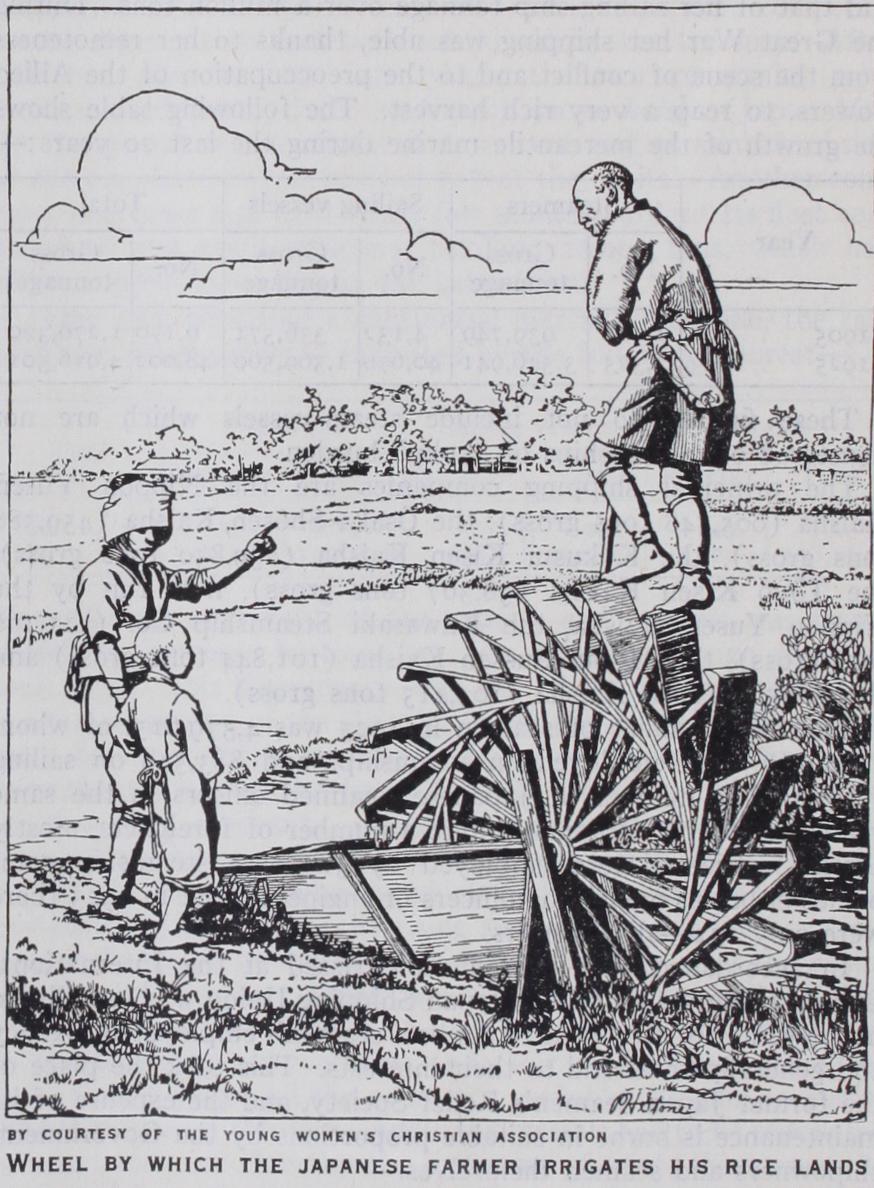
Rice.
Paddy fields are to be seen in every valley or dell where farming is practicable; they are divided into square, oblong or triangular plots by grass-grown ridges a few inches in height and on an average a foot in breadth—the rice being planted in the soft mud thus enclosed. Narrow pathways intersect these rice-valleys at intervals, and rivulets (generally flowing between low banks covered with clumps of bamboo) feed ditches cut for purposes of irrigation. The fields are generally kept under water to a depth of a few inches while the crops are young, but are drained immediately before harvesting. They are then dug up, and again flooded before the second crop is planted out. The rising grounds which skirt the rice-land are tilled by the hoe, and produce Indian corn, millet and edible roots. The well-wooded slopes supply the peasants with timber and firewood. Thirty-six per cent. of the rice-fields yield two crops yearly. The seed is sown in small beds, and the seedlings are planted out in the fields after attaining the height of about 4 in. The finest rice is pro duced in the fertile plains watered by the Tonegawa in the prov ince of Shimosa, but the grain of Kaga and of the two central provinces of Settsu and Harima is also very good. The price of rice was about 7s. 4d. the bushel in 1927.
Not only does rice form the chief food of the Japanese but also the national beverage, called sake, is brewed from it. In colour the best sake resembles very pale sherry ; the taste is rather acid. There are many varieties, from the best quality down to shiro-sake or "white sake," and the turbid sort, drunk only in the poorer districts, known as nigori-sake; there is also a sweet sort, called mirin.
The various cereal and other crops cultivated in Japan, the areas devoted to them and the annual production in 1906 and 1926, twenty years later, are shown in the following table:— Silk and Tea.—Scarcely less important to Japan than the cereals she raises are her silk and tea, both of which find markets abroad. The only foreign consumer of Japanese tea, however, is the United States. The amount exported in 1906 was about 58 million lb. and in 1926, twenty years later, 84 million pounds. The increase is due to the development of the export from Formosa.
Sericulture, on the contrary, shows steady development year by year. The demand of European and American markets has very elastic limits, and if Japanese growers are content with moderate, but still substantial, gains they can find an almost unrestricted sale in the West. The following figures will show how great the development has been during the last decade.
The chief silk-producing prefectures in Japan, according to the order of production, are Nagano, Gumma, Yamanashi, Fuku shima, Aichi and Saitama. At the close of 1925 there were 3,223 filatures throughout the country, and the number of families engaged in sericulture was 185,361.
Lacquer, vegetable wax and tobacco are also important staples of production. While the quantity of certain products increases, the number of filatures and factories diminishes, the inference being that industries are coming to be conducted on a larger scale than was formerly the case. The number of silk filatures, for instance, has decreased from 4,723 in 1897 to 3,009 in 1925. The same phenomenon is noticeable in other industries.
It is generally said that whereas about 6o% of Japan's popu lation is engaged in agriculture, she remains far behind the progressive nations of Europe in the application of scientific principles to farming. Nevertheless, thanks to the industry of the people themselves and to state encouragement in various forms, the average yield per hectare of land still remains considerably higher in Japan than in most other countries. The state has indeed been most active in its encouragement of agriculture,— by making known the use of artificial fertilizers, by furnishing capital for the establishment of agricultural banks, by the pro motion of co-operative societies, by the establishment of agri cultural experimental stations and of sericultural training stations, and in numerous other ways. The Agrarian problem in Japan has caused some anxiety to the authorities in recent years. The ma jority of the holdings are farmed by small peasant proprietors or by tenant farmers, and the conditions of life, even with the general rise in the standard of living, are very hard. How hard they are can be seen on reference to The Foundations of Japan, an illuminating book written by W. J. L. Robertson Scott some years ago. These conditions on the growth of industrialism and the unhappy relations which frequently exist between landlord and tenant, have caused a considerable migration of rural popu lation to the towns, with the result that landlords are experiencing increasing difficulty in finding tenants. Tenancy disputes in fact are becoming of such frequent occurrence,—there were 2,713 in 1926 involving over 39,000 landlords and 150,000 tenants,—that a special commission has been appointed to elaborate legislation to deal with the situation.
Notwithstanding the growing taste for beef, stock-breeding makes slow progress. In 1897 the total number of cattle was 1,214,163 and in 1926 it had only increased to 1,465,149. In the case of sheep, goats and pigs the increase is more perceptible; but the goat is kept only for milking purposes, and, although pork is becoming more popular as an article of diet, mutton is disliked because of its flavour. Moreover, lack of proper pas turage practically makes the acclimatization of the sheep an impossibility. The government has done much towards the im provement of cattle and horses by importing bulls and sires, and there are three cattle farms under the control of the Ministry of Agriculture and Forestry which either lend or sell stud animals to livestock guilds and private persons for breeding purposes The experience of the Russo-Japanese War proved that the mixed breed of horses then used by the Japanese army was not heavy enough, and large importations of Australian, American and European horses are in consequence now made. The organization of race-clubs is also encouraged.
Forests.
Forests occupy an area of over 45 million acres, and of that expanse a little more than 26 million acres belong to the Crown, the State, public bodies, and temples, and 19 million to private individuals. It cannot be said that any very practical attempt has yet been made to develop this source of wealth ; but it must also be admitted that many of the forests are very diffi cult of access for development purposes. The gross revenue from State forests in 1925 was estimated at close on 4 million pounds and from those owned by private individuals at a little over one and a half million pounds. It is impossible to ascertain what the net revenue amounted to in the latter case ; but in the former it was estimated at rather less than two millions. The more impor tant trees are the Cryptomeria japonica, the Chamaecyparis obtusa, pine, fir, silver fir, oak and the Tsuga Sieboldii. The ad ministration is empowered by law to prevent the destruction of forests and to cause the planting of plains or waste lands or the replanting of denuded areas, and plans have long been in existence for systematically turning the state forests to valuable account, while, at the same time, providing for their conservation.
Fisheries.—From ancient times the Japanese have been great fishermen. The seas that encircle their many-coasted islands teem with fish and aquatic products, which have always constituted an essential article of diet. Early in the 18th century, the Tokugawa administration, in pursuance of a policy of isolation, interdicted the construction of ocean-going ships, and the people's enterprise in the matter of deep-sea fishing suffered a severe check. But shortly after the Restoration in 1867, not only was this veto rescinded, but also the government, organizing a marine bureau and a marine products examination office, took vigorous measures to promote pelagic industry. Then followed the formation of the marine products association under the presidency of an imperial prince. Fishery training schools were the next step ; then period ical exhibitions of fishery and marine products ; then the intro duction and improvement of fishing implements ; and then by rapid strides the area of operations widened until Japanese fishing boats of improved types came to be seen in Australasia, in Canada, in the seas of Sakhalin, the Maritime Province, Korea and China ; in the waters of Kamchatka and in the Sea of Okhotsk. Considerable progress has also been made in the artificial rearing of eels, shellfish, snapping turtles, and sal monidae. Pelagic fishing is encouraged by the grant of small subsidies to owners of fishing craft of the type approved under the Pelagic Fishery Encouragement Law. The fishing population in 1925 numbered close on 1,200,000, of whom 620,00o were regular fishermen by calling and over 490,00o what is called "occasional" fishermen, that is persons having some other calling in addition to fishing. In 1893, the total value of Japanese marine products and fish captured did not exceed i-f millions sterling, whereas in 1925 the figure had grown to over 18 millions. Four teen kinds of fish represent more than 5o% of the whole catch, namely (in the order of their importance) bonito (katsuo), sardines (iwashi), pagrus (tai), cuttle-fish and squid (tako and ika), mackerel (saba), yellow tail (buri), tunny-fish (maguro), prawns (ebi), sole (karei), grey mullet (bora), eels (unagi), salmon (shake), sea-ear (awabi) and carp (koi). Altogether 700 kinds of aquatic products are known in Japan, and 400 of them constitute articles of diet. Among manufactured aquatic products the chief are dried bonito, fish guano, dried cuttle-fish, dried and boiled sardines, dried herring, salt and smoked salmon and dried prawns. The export of marine products amounted in 1926 to 23 million pounds in value as against nine hundred thousand in 1906. China is the chief market. With the extension of the fisheries in the north, particularly along the Siberian littoral, where the Japanese hold valuable fishing rights from the Soviet Government, there has been of recent years a great development in the fishing industry, particularly as regards various forms of salmonidae. Considerable quantities of shellfish are caught and tinned, and Japanese tinned crab is now well known in the markets of Europe and the United States.
Minerals.—Crystalline schists form the axis of Japan. They run in a general direction from south-west to north-east, with chains starting east and west from Shikoku. On these schists rocks of every age are superimposed, and amid these somewhat complicated geological conditions numerous minerals occur. Precious stones, however, are not found, though crystals of quartz and antimony as well as good specimens of topaz and agate are not infrequent.
Gold occurs in quartz veins among schists, paleozoic or volcanic rocks and in placers; but the quantity obtained is not large. Its value for 1926 was about L1,200,000.
The value of the silver mined is considerably less than that of the gold. It is found chiefly in volcanic rocks (especially tuff), in the form of sulphide, and it is usually associated with gold, copper, lead or zinc.
Much more important in Japan's economics than either of the precious metals is copper. Veins often showing a thickness of from 7o to 8o ft., though of poor quality (2 to 8%), are found bedded in crystalline schists or paleozoic sedimentary rocks, but the richest (io to 3o%) occur in tuff and other volcanic rocks.
Notwithstanding careful and prolonged search no evidences have been found that Japan is rich in iron ores. Her largest known deposit (magnetite) occurs at Kamaishi in Iwate pre fecture, but the quantity of pig-iron produced from the ore mined there does not exceed 37,00o tons annually, and Japan is obliged to import from the neighbouring continent the greater part of the iron needed by her for ship-building and armaments. Of recent years the Government has done its best in various ways to pro tect and encourage the iron industry; but notwithstanding the big demand in the country for pig-iron and steel, the native product is still unable to compete with that coming from India and the United States. Considerable deposits of coal, mainly bituminous are found in Kyfishu, the Hokkaido, and in the provinces of Iwaki and Hitachi in the Main Island. There were in existence in 1925 ninety-one coal mining companies with a paid-up capital of about 26 million pounds ; mines in actual opera tion numbered 573, and the quantity of coal produced was over 31 million metric tons. Large quantities are also mined yearly in the coal-fields about Fushur in Manchuria, which came into Japan's possession after the war with Russia in 1905.
Petroleum.—Petroleum, but not of a very high quality, is found in the provinces of Echigo and Akita, on the coast of the Sea of Japan. It was not, however, till i9oo that these deposits attracted much attention, and fears are now expressed that they are being exhausted. There is certainly a steady diminution in the annual output. In 1922 this amounted to over 71 million Imperial gallons; but in 1926 it had decreased to about 5o million gallons.
Mines.
The total number of mines in operation at the end of 2926 was 1,195, coal and petroleum representing nearly two-thirds, the number of miners employed was 293,562, and the value of the minerals and metals produced close on 43 million pounds.
The following table shows the progress of the mining industry during the last 20 years: *Including iron pyrites, 487,000 tons. 'Metric tons.
Industries.
In the beginning of the Meiji era Japan was practically without any manufacturing industries, as the term is understood in the Occident, and she had not so much as one joint-stock company. At the end of 1925, her joint-stock com panies and partnerships totalled 34,345, their paid up capital exceeded 1,115 millions sterling, and their reserves totalled over 249 millions. The number of co-operative societies in existence in the same year was 14,517. It is not to be inferred, however, from the absence of manufacturing organizations 5o years ago that such pursuits were deliberately eschewed or despised in Japan. On the contrary, at the very dawn of the historical epoch we find that sections of the people took their names from the work carried on by them, and that specimens of expert industry were preserved in the sovereign's palace side by side with the imperial insignia. Further, skilled artisans from the neighbouring continent always found a welcome in Japan, and when Korea was successfully in vaded in early times, one of the uses which the victors made of their conquest was to import Korean weavers and dyers. Sub sequently the advent of Buddhism, with its demand for images, temples, gorgeous vestments and rich paraphernalia, gave a marked impulse to the development of artistic industry, which at the outset took its models from China, India and Greece. From the 9th century luxurious habits prevailed in Kyoto under the sway of the Fujiwara regents, and the imperial city's munificent patronage drew to its precincts a crowd of artisans. But these were not industrials, in the Western sense of the term, and, further, their organization was essentially domestic, each family selecting its own pursuit and following it from generation to generation with out co-operation or partnership with any outsider. The establish ment of military feudalism in the 12th century brought a reaction from the effeminate luxury of the metropolis, and during nearly 30o years no industry enjoyed large popularity except that of the armourer and the sword-smith. No sooner, however, did the prowess of Oda Nobunaga and, above all, of Hideyoshi, bring within sight a cessation of civil war and the unification of the country, than the taste for beautiful objects and artistic utensils recovered vitality. By degrees there grew up among the feudal barons a keen rivalry in art industry, and the ShOgun's court in Yedo set a standard which the feudatories constantly strove to attain. Ultimately, in the days immediately antecedent to its fall, the Shogun's administration sought to induce a more logical system by encouraging local manufacturers to supply local needs only, leaving to KyOto and Yedo the duty of catering to general wants.
But before this reform had approached maturity, the second advent of Western nations introduced to Japan the products of an industrial civilization centuries in advance of her own from the point of view of utility, though nowise superior in the applica tion of art. Immediately the nation became alive to the necessity of correcting its own inferiority in this respect. But the people being entirely without models for organization, without financial machinery and without the idea of joint stock enterprise, the government had to choose between entering the field as an in structor, and leaving the nation to struggle along an arduous and expensive way to tardy development. There could be no question as to which course would conduce more to the general advantage, and thus, in days immediately subsequent to the resumption of administrative power by the Emperor, the spectacle was seen of official excursions into the domains of silk-reeling, cement-making, cotton and silk spinning, brick-burning, printing and book-binding, soap-boiling, type-casting and ceramic decoration, to say nothing of their establishing colleges and schools where all branches of applied science were taught. Domestic exhibitions also were organized, and specimens of the country's products and manufac tures were sent under government auspices to exhibitions abroad. Steps were also taken for training women as artisans, and the government printing bureau set the example of employing female labour, an innovation which soon developed large dimensions. In short, the authorities applied themselves to educate an industrial disposition throughout the country, and as soon as success seemed to be in sight, they gradually transferred from official to private direction the various model enterprises, retaining only such as were required to supply the needs of the state.
The result of all this effort was that, whereas at the beginning of the Meiji era, Japan had virtually no industries worthy of the name, she possessed in 1896,—that is to say, after an interval of 25 years of effort,—no less than 4,595 industrial and commercial companies with a paid-up capital of 4o millions sterling. To-day, as has already been said, her companies number over 34,00o with a paid-up capital of 1,115 millions sterling. What effect this devel opment has exercised on the country's over-seas trade may be inferred from the fact that, whereas in 1870 there were no manu factured goods to export, in 1901 8 million pounds worth were sent abroad, and that in 1925 the total value of the export trade amounted to over 23o million pounds, of which over 41% represented fully manufactured goods and about 5o% goods partly manufactured.
The following table gives the values of some of the more important manufactured articles exported in 1926: Japan's chief markets at present are in the Far East, and it is her proximity to them, the abundance of cheap and comparatively efficient labour she possesses, and in certain directions, particularly the cotton trade, better organization in marketing her goods, which give her an advantage over Occidental competitors. It has been said that the advantage derived from cheap labour is not likely to be permanent owing to the continuous increase in the price of labour and the cost of living. There is force in this contention. In 1890 the average daily wage of an ordinary labourer was about 6d, in 1900 it was a little over a shilling, in 1921 it was about Is. rod., and in 1926 it was about 25.3d. The cost of living has also increased enormously, but not in the same proportion. An other disquieting feature is that labour is becoming more articulate and less disposed to allow itself to be exploited. On the other hand it must be remembered that if wages and the cost of living have increased enormously in Japan, the same thing has happened in other countries since the Great War and also that as far as the cotton industry is concerned, the majority of the operatives are women, whose scale of wages is still very low and probably less likely to increase at the same rate as that of male operatives. That conditions, however, are become less inviting, for the manufacture of cotton goods, would seem fairly clear from the fact that a tend ency is now manifest to transfer spinning enterprises to China, where labour is still really cheap. In 1926 there were, for instance, nearly a million and a half spindles working in Japanese-owned mills in that country. Nevertheless on the whole Japanese indus tries seem to have a promising future before them. The nation is full of energy and determination, there are abundant supplies of coal, and steps are being taken to utilize the excellent opportuni ties which the country offers for developing electricity by water power.
The official returns for 1925 show that the total number of factories in Japan was 49,161, and the number of operatives em ployed in them 1,808,381, of whom 852,554 were male hands and 955,827 female. By far the largest number were to be found in textile factories, where 972,631 were employed. Machine and tool factories followed next with 224,177. The mean average daily wages for operatives in that year were yen 1.94 (3s./Iod.) for male hands and yen 0.96 (Iod.) for female, while the mean aver age working hours were 10.34 during the second half of the year.
Commerce in Tokugawa Times.
The conditions existing in Japan during the two hundred and fifty years prefatory to the modern opening of the country were unfavourable to the develop ment alike of national and of international trade. As to the former, the system of feudal government exercised a crippling influence, for each feudal chief endeavoured to check the exit of any kind of property from his fief, and free interchange of com modities was thus prevented so effectually that cases are recorded of one feudatory's subjects dying of starvation while those of an adjoining fief enjoyed abundance. International commerce, on the other hand, lay under the veto of the central government, which punished with death anyone attempting to hold intercourse with foreigners. Thus the fiefs practised a policy of mutual seclusion at home, and united to maintain a policy of general seclusion abroad. Yet it was under the feudal system that the most signal development of Japanese trade took place, and since the processes of that development have much historical interest they invite close attention.
As the bulk of a feudal chief's income was paid in rice, arrange ments had to be made for sending the grain to market and trans mitting its proceeds. This was effected originally by establishing in Osaka stores (kura-yashiki), under the charge of samurai, who received the rice, sold it to merchants in that city and remitted the proceeds by official carriers. But from the middle of the 17th century these stores were placed in the charge of tradesmen to whom was given the name of kake-ya (agent). They disposed of the products entrusted to them by a fief and held the money, sending it by monthly instalments to an appointed place, rendering yearly accounts and receiving commission at the rate of from 2 to 4%. They had no special licence, but they were honourably re garded and often distinguished by an official title or an hereditary pension. In fact a kake-ya, of such standing as the Mitsui and the konoike families, was, in effect, a banker charged with the finances of several fiefs. In Osaka the method of sale was uniform. Tenders were invited, and these having been opened in the presence of all the store officials and kake-ya, the successful tenderers had to deposit bargain-money, paying the remainder within ten days, and thereafter becoming entitled to take delivery of the rice in whole or by instalments within a certain time, no fee being charged for storage. A similar system existed in Yedo, the shOgun's capital. Out of the custom of deferred delivery developed the establish ment of exchanges where advances were made against sale certifi cates, and purely speculative transactions came into vogue. There followed an experience common enough in the West at one time: public opinion rebelled against these transactions in margins on the ground that they tended to enhance the price of rice. Several of the brokers were arrested and brought to trial; marginal deal ings were thenceforth forbidden, and a system of licences was inaugurated in Yedo, the number of licensed dealers being restricted to 1o8.
The system of organized trading companies had its origin in the 12th century, when, the number of merchants admitted within the confines of Yedo being restricted, it became necessary for those not obtaining that privilege to establish some mode of co-opera tion, and there resulted the formation of companies with repre sentatives stationed in the feudal capital and share-holding mem bers in the provinces. The Ashikaga shoguns developed this restriction by selling to the highest bidder the exclusive right of engaging in a particular trade, and the Tokugawa administration had recourse to the same practice. But whereas the monopolies instituted by the Ashikaga had for sole object the enrichment of the exchequer, the Tokugawa regarded it chiefly as a means of obtaining worthy representatives in each branch of trade. The first licences were issued in Yedo to keepers of bath-houses in the middle of the 17th century. As the city grew in dimensions these licences increased in value, so that pawnbrokers willingly accepted them in pledge for loans. Subsequently almanack-sellers were obliged to take out licences, and the system was afterwards extended to money-changers.
It was to the fishmongers, however, that the advantages of commercial organization first presented themselves vividly. Early in the 17th century one Sukegoro of Yamato province went to Yedo, where the greatest fish market in Japan exists, and organized the fishmongers of the city into a great guild. He contracted for the sale of all the fish obtained in the neighbouring seas, advanced money to the fishermen on the security of their catch, constructed preserves for keeping the fish alive until they were exposed in the market, and enrolled all the dealers in a confederation which ulti mately consisted of 391 wholesale merchants and 246 brokers. The main purpose of Sukegoro's system was to prevent the con sumer from dealing direct with the producer. Thus in return for the pecuniary accommodation granted to fishermen to buy boats and nets they were required to give every fish they caught to the wholesale merchant from whom they had received the advance; and the latter, on his side, had to sell in the open market at prices fixed by the confederation. A somewhat similar system applied to vegetables, though in this case the monopoly was never so close.
It will be observed that this federation of fishmongers approxi mated closely to a trust, as the term is now understood ; that is to say, an association of merchants engaged in the same branch of trade and pledged to observe certain rules in the conduct of their business as well as to adhere to fixed rates. The idea was extended to nearly every trade, 1 o monster confederations being organized in Yedo and 24 in Osaka. These received official recognition, and contributed a sum to the exchequer under the euphonious name of "benefit money," amounting to nearly £20,000 annually. They attained a high state of prosperity, the whole of the cities' supplies passing through their hands. The guild system extended to mari time enterprise also. In the beginning of the 17th century a merchant of Sakai (near Osaka) established a junk service between Osaka and Yedo, but this kind of business did not attain any con siderable development until the close of that century, when 10 guilds of Yedo and 24 of Osaka combined to organize a marine transport company for the purpose of conveying their own merchandise. Here also the principle of monopoly was strictly observed, no goods being shipped for unaffiliated merchants. This carrying trade rapidly assumed large dimensions, and the number of junks entering Yedo rose to over 1,500 yearly.
Operations relating to the currency also were brought under the control of guilds. The business of money-changing was originally in the hands of pedlars; but in the early part of the 17th century exchanges were opened in Yedo, and in 1718 the men engaged in this business formed a guild, six hundred of them receiving licences, and no unlicensed person being permitted to purchase the avocation. The rates of exchange were fixed daily by representa tives of the guild in consultation with, or with the approval of, the shogun's officials.
The exchanges in their ultimate form approximated very closely to the Occidental idea of banks. They not only bought gold, silver and copper coins, but they also received money on deposit, made loans and issued vouchers which played a very important part in commercial transactions. The voucher system did not, however, obtain official recognition until 1636, when the third Tokugawa shogun selected 3o substantial merchants and divided them into 3 guilds, each authorized to issue vouchers, provided that a certain sum was deposited by way of security. Such vouchers were obviously a form of bank-note, and the advantages of the system were so obvious that ultimately it was adopted by the Tokugawa Government, which appointed a number of the members of the guild to act as its bankers subject to certain specified conditions and with certain privileges. A similar state of affairs ruled in Osaka, a city which has always exhibited a remarkable aptitude for trade. In this way a regular system of banking was gradually evolved, with the result that in the middle of the 18th century in Osaka bills of exchange, promissory notes, storage delivery orders, deposit notes redeemable on the demand or order of an indicated person, and various descriptions of money orders were being issued. Storage delivery orders passed current as readily as coin and advances could always be obtained against them from pawn brokers.
All these documents, indicating a well-developed system of credit, were duly protected by law, severe penalties being inflicted for any failure to implement the pledges they embodied. This system, which in its various ramifications was practically a trust in favour of the more important merchants in Yedo and Osaka, resulted, as was inevitable, in the acquisition of great wealth by those interested in it. This in its turn led to habits of gross extravagance and luxury, and popular feeling against the so-called "official merchants" who, under government auspices, monopolized every branch of trade, ultimately became so strong that finally, in 1841 the guilds were dissolved, the trading privileges which "official merchants" had enjoyed withdrawn, and it was declared that henceforth every person should be free to engage in commerce without let or hindrance.
This recklessly drastic measure, vividly illustrating the arbitrari ness of feudal officialdom, not only included the commercial guilds, the shipping guilds, the exchange guilds and the land transport guilds, but was also carried to the length of forbidding any com pany to confine itself to wholesale dealings. The authorities fur ther declared that in times of scarcity wholesale transactions must be abandoned altogether and retail business alone carried on, their purpose being to bring retail and wholesale prices to the same level. The custom of advancing money to fishermen or to pro ducers in the provincial districts was interdicted, and even the bath-house keepers and hairdressers were forbidden to combine for the purpose of adopting uniform rates of charges. But this ill-judged interference produced evils greater than those it was intended to remedy, and ten years' experience showed that a modified form of the old system would conduce to public interests. The guilds accordingly were reestablished; but licence fees were abolished, and no limit was set to the number of firms in a guild. Things remained thus until the beginning of the Meiji era (1867), when the guilds shared the cataclysm that overtook all the country's old institutions.
It will be apparent from the above that commercial transactions on a large scale in pre-Meiji days were practically limited to the two great cities of Yedo and Osaka, the people in the provincial fiess having no direct association with the guild system, confining themselves, for the most part, to domestic industries on a small scale, and not being allowed to extend their business beyond the boundaries of the fief to which they belonged.

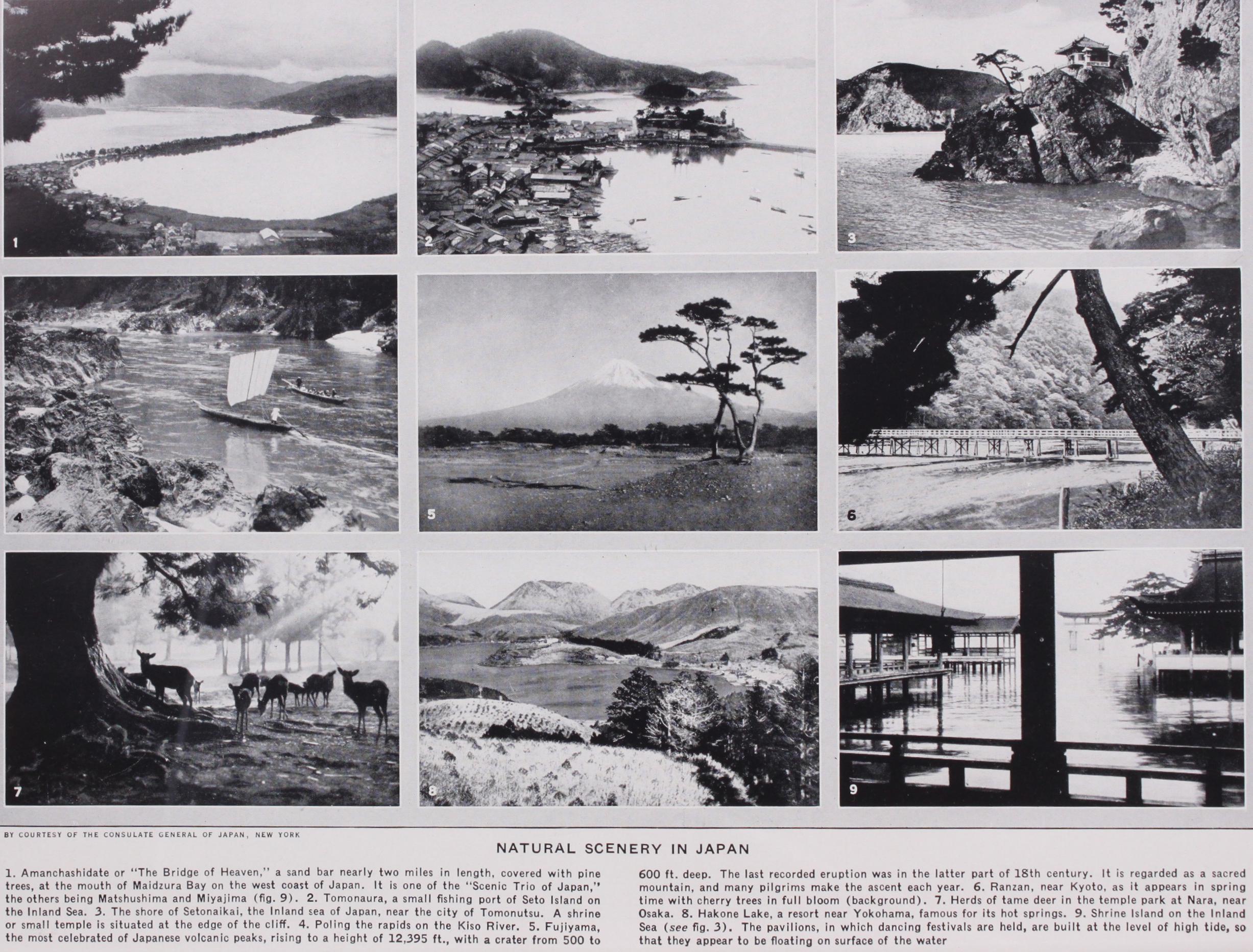
Foreign Commerce During the Meiji Era.—If Japan's in dustrial development in modern times has been remarkable, the same may be said even more emphatically about the development of her over-sea commerce. This was checked at first not only by the unpopularity attaching to all intercourse with outside nations, but also by embarrassments resulting from the difference between the silver price of gold in Japan and its silver price in Europe, the precious metals being connected in Japan by a ratio of i to 8, and in Europe by a ratio of i to 15. This latter fact was the cause of a sudden and violent appreciation of values; for the government, seeing the country threatened with loss of all its gold, tried to avert the catastrophe by altering and reducing the weights of the silver coins without altering their denominations, and a corresponding difference exhibited itself, as a matter of course, in the silver quotations of commodities. Another difficulty was the attitude of officialdom. During several centuries Japan's over-sea trade had been under the control of officialdom, to whose coffers it contributed a substantial revenue. But when the foreign exporter entered the field under the conditions created by the new system, he diverted to his own pocket the handsome profit previously accruing to the government ; and since the latter could not easily become reconciled to this loss of revenue, or wean itself from its traditional habit of interference in affairs of foreign commerce, and since the foreigner, on his side, not only desired secrecy in order to prevent competition, but was also tormented by inveterate suspicions of Oriental espionage, not a little friction occurred from time to time. Thus the scanty records of that early epoch suggest that trade was beset with great difficulties, and that the foreigner had to contend against most adverse circumstances, though in truth his gains amounted to 40 or 5o%.
Japan is not a country rich in natural resources or in mineral wealth, if coal and copper are excepted, and such articles as she manufactured in the days of her seclusion were not of a nature to command a market abroad. Her position, therefore, when she reentered the comity of nations, was not promising. She was dependent on foreign countries for practically all manufactured goods, such, for instance, as flour, sugar, leather, medicines, dyes, paints, hardware, drapery, machinery, etc.—and all she had to offer in exchange was some silk, tea, porcelain, curios, copper and marine products. The last found a ready market in China ; tea was equally successful in the United States, and a keen demand sprang up immediately in Europe for her raw silk, which happened to be available for export at a moment when the production of that article in France and Italy had been considerably curtailed by the appearance of disease in the European silkworm. These articles and copper were practically all the foreign merchant wanted to buy. But the statesmen in charge of Japan's destinies were farsighted and ambitious for the progress of their country, and, seeing the disadvantage under which Japanese merchants were labouring, they started manufacturing enterprises and com mercial undertakings under official management, handing them over to private enterprise when a satisfactory advance had been made. Progress was naturally slow at first, as may be seen from the fact that the export trade of the country, which amounted to only about 14 million pounds sterling in 187o had increased to little more than millions in 189o. There were two main reasons for this tardy advance. Several years necessarily elapsed before the nation's material condition began to respond perceptibly to the improvements effected by the Restoration government in mat ters of taxation, administration, and transport facilities. Financial burdens had been reduced and security of property and life ob tained; but railway building and road-making, harbour construc tion, the growth of posts, telegraphs, exchanges and banks, and the development of a mercantile marine did not begin to exercise a sensible influence on the nation's prosperity till about 1885. It was then that a period of steadily growing prosperity began, and it was then that private enterprise may be said to have started finally upon a career of independent activity. How enormous has been the progress made since then may be seen on reference to the values of the export trade in 1910 and 192o, which were respec tively 46 and 195 million pounds sterling. The articles Japan im ported in 1870,—flour, sugar, leather, dyes, paints, hardware, clothing, etc.—she now exports herself, and, whereas, 3o years ago she was a good customer for Lancashire cotton piece goods and the like, she now not only does not import them but is competing with them vigorously in the Chinese market and with Indian cotton goods in that of India. The same is true of many other com modities, and although her products may frequently be inferior to those of Europe or America, their greater cheapness appeals to customers to whom price is of more importance than quality. The phenomenal difference between the figures for 1910 and 192o is partly accounted for by the appreciation in values and by the fact that during the World War Japan was able, owing to the preoccu pation of the other nations more directly engaged in the conflict, to extend her markets enormously. But this advantage she has not been able to maintain in peace, and she herself has for some years past been suffering from severe commercial depression and from financial crisis, with the result that the value of her export trade in 1926 was only about 9 million pounds sterling higher than it was in 192o. Nevertheless an increase from 46 millions in 1910 to 205 millions in 1926 is remarkable. Pari passu with this increase in the export trade there has been a corresponding increase in the import, a fact which causes considerable anxiety in many quarters. But reference to official statistics will show that a very large proportion of these imports is represented by raw material, partly manufactured goods or machinery,—the last to be used itself for productive purposes. The following figures show the periods dur ing which either imports or exports have been in excess : 1868-82. Imports : material was being purchased for industrial development.
1883-95. Exports : home industries were developing, and silver had fallen in value.
1896-1913. Imports : this was a period of inflation and of national extravagance after the war with China.
1914-18. Exports : this was the period of the World War.
1919-27. Imports: the war markets had been lost ; the period was one of general commercial depression ; and the nation had suffered enormous losses owing to the earthquake of 1923.
It is estimated that the total excess of imports over exports for 6o years amounts to over 26t million pounds sterling. In connec tion with the phenomenal commercial and industrial progress of Japan the following comments, taken from a Report prepared at the British Embassy in Faye on economic conditions in Japan, are worthy of attention:— "By external circumstances and by the ambitious temperament uf her own people, Japan has been obliged to attempt to compress into a few decades an economic development which most other industrialized countries have spread over at least a century. This late and concentrated development has been of advantage to her in some respects, because she has been able to profit by knowledge gained by her rivals in long and often painful processes of trial and error. In other respects it has operated to her disadvantage, because there is certain necessary knowledge which can be acquired only by experience. The economic history of Japan in the past few years provides a striking illustration of this truth. Where the prime essentials are energy and technical knowledge she has made rapid progress, as is evident to anybody who compares the volume and range of her manufactures to-day and 20 years ago. But where advance depends not only upon the skill and knowledge of the leaders, but also on such imponderable elements as the com mercial and financial experience of the community as a whole, success has not been so uniform; and this is only too plainly apparent from the series of financial upheavals which have marked the period from 1920 to the present time." Japan's trade with the outer world was built up chiefly by the energy and enterprise of the foreign middleman. He acted the part of an almost ideal agent. As an exporter, his command of cheap capital, his experience, his knowledge of foreign markets, and his connections enabled him to secure sales such as must have been beyond reach of the Japanese working independently. More over, he paid to native consumers ready cash for their staples, taking upon his own shoulders all the risks of finding markets abroad. As an importer, he enjoyed, in centres of supply, credit which the Japanese lacked, and he offered to native consumers foreign produce brought to their doors with a minimum of re sponsibility on their part. Finally, whether as exporters or im porters, foreign middlemen always competed with each other so keenly that their Japanese clients obtained the best possible terms from them. It has, however, always been the aim of the Japanese to dispense with his help and to deal directly themselves with the foreign producer, and they have worked hard for the attainment of this object during many years. It must be admitted that a great measure of success has attended their efforts and that the middle man, so familiar a figure in the open ports in the early days of Japan's intercourse with foreign countries, is now slowly but surely disappearing.
Trade with Various Countries.
The following is a list of the countries most interested in trade with Japan, with the values in round numbers of her exports to and imports from them in 1926.
Kobe has now the first place in the matter of foreign trade; Osaka the second, and Yokohama the third.
The total tonnage of the steamships which entered the vari ous ports of Japan from abroad during 1926 was 49,186,029 tons, of which 31,873,523 tons represented Japanese shipping, 9,363,245 British and 3,960,342 American.
According to the "Financial and Economic Annual of Japan" the invisible trade of Japan for the years 1923-25 is estimated to be as follows National total amount of the National Debt of Japan in March 1927 was a little over 503 million pounds sterling, of which about 354 million pounds represented internal loans and 149 million external loans.
The Labour Movement.
The earliest labour organization in Japan is believed to have come into existence in 1890, when the printers formed an association called the Doshikwai (Community of Sentiment Society). This was followed in 1898 by a somewhat similar organization among railway employees. In each case the objects aimed at were the improvement of working conditions and wages and the securing of a greater measure of freedom. But both were small and of no importance, and it was not till the Yuaikwai (Labourers' Friendly Society) was formed in 1912 that the Labour movement can be said really to have started in Japan. Even the Yuaikwai was only a fore-runner of the real trade-union. Its membership, compared with the numerical strength of the class it was supposed to represent, was paltry,—not more than 50,000, and, although its President, Mr. Bunji Suzuki, was a genuine representative of Labour, capitalists also lent the society their support and patronage, hoping, apparently, that by adopting a conciliatory attitude they might succeed in guiding the move ment into moderate channels. The Yuaikwai had been in existence hardly two years when the World War broke out, and it was from this moment that Labour became truly articulate in Japan. As has been said elsewhere, the greater part of the rest of the world was, or eventually became, so preoccupied with the conflict that it had neither leisure nor means to attend to the ordinary affairs of commerce, with the result that an extraordinary demand was made on Japan,—more fortunately situated, by reason of her re moteness,—f or manufactured goods of all descriptions. This gave Labour an opportunity of which it was quick to avail itself. Higher wages were demanded, and if they were not granted a strike promptly followed. In the great majority of cases these strikes were successful; but as the price of commodities also rose out of proportion to the increase in wages, Labour was still dis contented. In 1918, just before the conclusion of the Armistice, there were serious rice riots in Tokyo, and similar disturbances with strikes took place in other parts of the country. It is true that they were stopped without difficulty because the Authorities were too strong; but they neyertheless gave a strong impetus to the Labour movement, and the Government, which had hitherto frowned on anything in the nature of serious organization on the part of Labour, decided that the moment had arrived when this attitude demanded some modification. Accordingly, while still refusing officially to recognize trade-unions, it began to wink at their existence, thinking possibly that open organization was better on the whole than an underground movement. A large increase in the number of labour associations at once took place. The capi talists on their side organized a society called the Roshi-Kyochii kwai (Society for the Harmonization of Labour and Capital) and withdrew their support from the Yuaikwai ; but the society was not a success because Labour viewed it with suspicion. In the meanwhile the Yuaikwai changed its name to Nihon-Rado SOdOmei (Japan Federation of Labour) and became a regular federation of trade and industrial unions with Mr. Bunji Suzuki as its President and a Board of Control under him to prevent his exercising the powers of a dictator. Its platform was much like that of a moderate labour organization in the West,—an eight-hour day, a six-day week and universal suffrage. Japan was at the moment preparing to select her delegates to the Inter national Labour Conference at Washington (1919) ; but the Gov ernment so manipulated matters that Labour had no voice in the choice of its own representative, an official nominee being sent instead. Loud protests followed; but they were of no avail. Similar methods were followed at the second, third, and fourth Conferences; but the attitude of Labour became at last so hostile and the protests so vociferous that the Authorities were forced to give way, and at the later Conferences real rep resentatives attended (Mr. Suzuki of the Japan Labour Federation or Mr. Narazaki of the Seamen's Union). It will thus be seen that the movement is growing steadily in strength, and, although Trades Unions are still not officially recognized by law, recogni tion cannot long be delayed. Attempts have also been made to form a regular party for parliamentary purposes; but owing to the continual dissension between the moderate and the extreme elements in the labour organizations, no success has yet attended them. In 1925 matters had, it is true, so far advanced that a meeting for the formal inauguration of a party actually took place in Tokyo. Delegates from the various labour and agricultural associations, for the tenant farmers and small holders are also now forming unions, were present ; but in the course of the pro ceedings the representatives of the Japan Labour Federation and of the other moderate and conservative elements seceded, and, although the extremists left behind proceeded to form a party of their own called the NOmin-ROdo-to (Farmer-Labour party) it was promptly suppressed the same evening by the Authorities on the ground that its programme contained items regarded as dangerous to the State. Labour is, however, now represented in the Diet, 8 "proletarians," representing various labour associations, having been successful in obtaining seats in the first Diet elected under the new Manhood Suffrage Law in 1928.
In 1926 the number of labour associations in Japan was 408 and their membership 260,348. The three bodies numerically strongest are the Naval Workers' Union (42,513), the Japan Sea men's Union (37,000), and the Japan Labour Federation (23,305). (The above information is drawn mainly from the Japan Year Book.) Labour Legislation.—Japan is now falling into line with other countries in labour legislation. A Factory Law was passed in 1911 and came into operation in 1916; but as a result of the First International Labour Conference held at Washington in 1919 it was revised in 1923 and, finally, after further amendment, put into force in 1926. Its principal features are as follows:— I. With certain exceptions it applies to all factories employing 10 or more operatives and to those engaged in industries which arc: regarded as dangerous or injurious to health.
2. While containing no restrictions as to the hours of work of adult male operatives, it fixes a maximum of 11 hours' work a day for boys under 16 or female operatives, and, in the latter case, further prescribes that a recess (varying from half an hour to an hour) must be allowed and that at least two days' holiday must be given to the operatives every month.
3. Boys under 16 and female operatives may not be employed on night-work (to P.M. to 5 A.m.).
4. Female operatives may not be employed 4 weeks before and 6 weeks after child-birth; but the latter period may be reduced to 4 at the request of the operative and with the consent of a doctor.
5. Operatives who fall ill or are injured while working are en titled to compensation in the shape of medical treatment and allowances for temporary disablement. In the latter case the amount is fixed at a minimum of 6o% of the operative's daily wages for a period of i8o days and not less than 4o% after that.
6. Should the accident or illness result in permanent disable ment the operative is entitled to a gratuity varying in amount from 18o to 54o times the rate of his (or her) daily wages.
7. Should an operative die as the result of an accident illness while working a compensation allowance of not less than 36o times the amount of his (or her) daily wages must be paid to the family or dependents of the deceased.
8. In addition an allowance must be paid for funeral expenses. This is fixed at a maximum of 20 times the operative's daily wages wifh a minimum of not less than 20 yen (about £2).
The Government has also established a Bureau of Social Affairs under the control of the Ministry of the Interior to deal with matters relating to labour and social undertakings, and in 1926 the Health Insurance Law was passed, the Law for the settling of Labour Disputes enforced, and Art. 17 of the Police Regulations for the maintenance of Public Safety and Order, which made the organization of strikes a penal offence, abolished. The Health Insurance Law prescribes for two forms of insurance,—compul sory, applicable to all workers to whom the Factory Law or the Mining Law are applicable and voluntary, applicable to work ers who at the request of employers and with the consent of the Authorities are allowed to benefit by the terms of the law. The insurers are the Government and the Labour Associations organ ized as juridical persons by the employers and workers concerned. The revenue for the administration of the law comes from State subsidies and premia, and in principle the latter are payable in equal shares by employers and employed. The number of persons insured in 1927 was about 2,927,00o, of whom some 27,00o were voluntary, and further it wasestimated that the total receipts from premia and subsidies during the year would amount to a little over 5 million pounds sterling, while the benefits pay able would be about 3 million.
Emperor and Princes.
At the head of the Japanese State stands the Emperor, who is called by his own subjects tenshi (son of heaven) or tenno (heavenly king). The emperor Hirohito is the 124th of his line, according to Japanese history, which reckons from 66o n.c., when Jimmu ascended the throne. But as written records do not carry us back farther than A.D, 712, the reigns and periods of the very early monarchs are more or less apocryphal. There are 3 families of princes of the blood, from any one of which a successor to the throne may be taken in default of a direct heir : Princes Fushimi, Kanin and Higashi Fushimi. These families are all direct descendants of emperors, and their heads have the title of shinnO (prince of the blood), whereas the other imperial princes, of whom there are ten, have only the second syllable of shinno (pronounced wo when sep arated from shin). Second and younger sons of a shinno are all and eldest sons lose the title shin and become w5 from the fifth generation. The Imperial prerogatives are specified in the Law of the constitution (2889). The Emperor's person is "sacred and inviolable," he combines "in himself the rights of sovereignty and exercises them according to the provisions of the Constitu tion," he "exercises the legislative power with the consent of the Diet," he "gives sanctions to laws and orders them to be promul gated and executed," he "has the supreme command of the Army and the Navy," he "declares war, makes peace and concludes treaties," he "convokes the Imperial Diet, opens, closes and prorogues it, and dissolves the House of Representatives" and his ministers are appointed by him and are individually responsible to him. In times of emergency the Emperor also issues Imperial ordinances in the place of law, but they must receive the approval of the Diet in the following session.
The Peerage.--In
former times there were no Japanese titles of nobility, as the term is understood in the Occident. Nobles they were, however, namely, kuge, or court nobles, descendants of younger sons of emperors, and dcsimye) (great name), some of whom could trace their lineage to former Emperors, but owed their exalted position as feudal chiefs to military prowess. The Meiji restoration of 1867 led to the abolition of the daimyd as feudal chiefs, and they, together with the kuge, were merged into one class called kwazoku (flower families), a term corre sponding to aristocracy, all inferior persons being heimin (ordinary folk). In 1884, however, the five Chinese titles of ki (prince), kei (marquis), haku (count), shi (viscount) and dan (baron) were introduced, and patents were not only granted to the ancient nobility but also conferred on men who had rendered conspicuous public service. The titles are all hereditary, but they descend to the firstborn only, younger children having no distinguishing ap pellation. The first list in 1884 showed 11 Princes, 24 Marquises, 76 Counts, 324 Viscounts and 74 Barons. After the war with China the total grew to 716, and the war with Russia (1904-5) increased the number to 912, namely, 15 Princes, 39 Marquises, ioo Counts, 376 Viscounts and 382 Barons. The num ber is now 953, 29 Princes, 39 Marquises, ios Counts, 381 Vis counts, and 409 Barons.
Household Department.—The Imperial household depart ment is completely differentiated from the administration of state affairs. It includes bureaux of treasury, forests, peerage, poetry, Imperial tombs, archives, Imperial mews, architecture and medi cal and culinary affairs, as well as boards of ceremonies and chamberlains, officials of the Empress's household and officials of the Crown Prince's household. The annual allowance made to the throne is £450,000, and the Imperial estate comprised in 1920 about 3,800,000 ac. of building land, forests and ordi nary land, with buildings, furniture, live stock and other effects, the whole valued at about 173,000,00o. Some of this has, however, since been disposed of. The Court in addition holds shares in various banks and industrial companies. Out of the income accru ing from these various sources the households of the Crown Prince and all the Imperial princes are supported ; allowances are granted at the time of conferring titles of nobility; a long list of charities receive liberal contributions, and considerable sums are paid to encourage art and education.
Departments of State.
There are 1 t departments of state presided over by ministers—Foreign Affairs, the Interior, Finance, War, Navy, Justice, Education, Agriculture and Forestry, Corn munications, Commerce and Industry and Railways. These min isters form the Cabinet, which is presided over by the minister president of state, so that its members number 12 in all. Min isters of state are appointed by the Emperor and are responsible to him alone. There stood until recently between the Cabinet and the Crown a small body of men, "elder statesmen" (genre)) who, though possessing no official status were by reason of their former distinguished services invariably consulted in a crisis and who had much to say in the making and unmaking of ministries. But of these men only one now survives. There is also a Privy Council, which consists of a variable number of distinguished men —in 1927 there were 24—whose duty it is to debate and advise upon all matters referred to them by the Emperor. There is no mention anywhere of•the "Cabinet" in the Law of the Constitution and although that body meets under the presidency of the Prime Minister to discuss and decide matters of state, its members have no joint responsibility.
The total number of civil officials in 1925 was 338,498. The annual salaries of the principal officials are as follows :—Prime Minister £1,200; Ministers of State 1800, Governor-General of Korea f800; Governor-General of Formosa £750; President of the Privy Council £750; Judges and Procurators £750 (mat.) ; Ambassadors £750 (with allowances varying from £2,600 to £4,500 yearly) ; Ministers Plenipotentiary £520 to £65o (with allow ances varying from L1,5oo to £2,200) ; Governors of Prefectures from £520 to £600 (with small allowances in certain cases). Pensions are small, ranging from -A- to 2 of the annual salary according to the period of service.
Legislature.
The first Japanese Diet was convoked the 29th of November, 189o. There are two chambers, a House of Peers (kizoku-in) and a House of Representatives (shugi-in). Each is invested with the same legislative power.
The upper chamber consists of four classes of members. They are, first, hereditary members, namely Princes of the Blood, Princes and Marquises, who are entitled to sit when they reach the age of 3o; secondly, Counts, Viscounts and Barons, elected— after they have attained their 3oth year—by their respective orders in the ratio of 18 Counts, 66 Viscounts and 66 Barons; thirdly, men of education or distinguished service who are nomi nated by the Emperor, and whose number must not exceed 125; fourthly, representatives of the taxpayers, elected, two for each prefecture, by their own class, and, fifthly, 4 members of the Imperial Academy elected by that body and nominated by the Emperor. The minimum age limit for non-titled members is 30. The House was composed in 1926 of 20 Princes of the Blood, 15 Princes, 31 Marquises, 18 Counts, 66 Viscounts, 65 Barons, 120 Imperial nominees and 66 representatives of the highest tax payers—that is to say, 405 altogether.
The Lower House consists of elected members only. Originally the property qualification was fixed at a minimum annual payment of 3os. in direct taxes (i.e., taxes imposed by the central govern ment), but this has been altered from time to time, and by the Manhood Suffrage Law of 1925 the property qualification for electors was abolished entirely. There is no property qualification for candidates; but they must deposit i20o in cash or public bonds as security. Members are of two kinds, namely, those re turned by incorporated cities and those returned by prefectures. In each case the ratio is one member for every 120,000 electors (3 to 5 for each electoral district) and the number of electoral districts is fixed at 122. Under the new law paid canvassers are not recognized; only election commissioners and election com mittees (not exceeding 5o persons) may take part in the election campaign. They however may receive payment for their services. The expenditure incurred by a candidate, which is now estimated at a maximum of L1,5oo, is in the charge of the election commis sioners, and if the maximum is exceeded the candidate's election, should he secure a seat, is void.
Voting is by secret ballot, one man one vote, and a general election must take place once in 4 years for the House of Repre sentatives, and once in 7 years for the House of Peers. The House of Representatives, however, is liable to be dissolved by order of the sovereign as a disciplinary measure, in which event a general election must be held within 3o days from the date of dissolution, whereas the House of Peers is not liable to any such treatment. Otherwise the two Houses enjoy equal rights and privileges, except that the budget must first be submitted to the representa tives. Each member receives a salary of £300, with travelling allowances; the president receives £750, and the vice-president £450. The presidents are nominated by the sovereign from three names submitted by each house, but the appointment of a vice president is within the independent right of each chamber. The lower house consists of 466 members, of whom 112 are returned by the urban population and 354 by the rural. Under the original property qualification the number of franchise-holders was only 453,474, or 11.5 to every 1,000 of the nation, but now that the Manhood Suffrage Law is in force the number must be a little over nine millions. By the constitution which created the Diet freedom of conscience, of speech and of public meeting, inviola bility of domicile and correspondence, security from arrest or punishment, except by due process of law, permanence of judicial appointments and all the other essential elements of civil liberty were granted. In the Diet full legislative authority is vested: without its consent no tax can be imposed, increased or remitted; nor can any public money be paid out except the salaries of officials, which the sovereign reserves the right to fix at will. The Diet must be convoked every year, and a session is supposed to last three months. The regular time of sitting is from the end of December to the end of March. While a session lasts members are, save in certain specified cases, free from arrest, and they are not responsible outside the Diet for opinions entered in it. It will thus be seen that the powers of the Diet are limited, for, while it has control over legislation and finance, it has none over the "Cabinet," the members of which are not responsible to it but to the Emperor. Moreover, by appealing to the Throne the Government is in a position to procure the prorogation or even the dissolution of the House of Representatives when relations become too strained, and this is a weapon which it has not failed to use. In the circum stances it could scarcely be expected that an assembly which had many grievances to ventilate, abuses to redress, and wrongs, real or fancied, to avenge should always behave with perfect decorum and never lose its temper. As a matter of fact the early history of the Diet is one of perpetual and noisy strife between an almost powerless House and an experienced, determined and strongly en trenched bureaucracy, in the course of which prorogations and dissolutions were of by no means infrequent occurrence. But gradually the various "Cabinets" found means, not always very reputable, of effecting understandings with the leaders or with individual members of the various political factions in the House, so that the position became a little less acute and intervals of comparative quiet intervened. Eventually that astute statesman, the late Prince Ito, who, as Prime Minister in three Cabinets had had ample experience of parliamentary opposition, decided to form a party of his own, mainly, it has been asserted, with the object of fighting the growing power of the militrrists. As a result the Seiyukwai (Friends of the Government) came into existence in 1900, and with its support he formed his fourth ministry. He did not remain in power for more than a few months ; but his successor, Prince Katsura, a soldier, followed the example he had set and organized another party, the DOshikwai, subsequently changed to Kenseikwai, and again recently to Min seitO (Democrats). From Prince Ito the succession to the lead ership of the Seiyukwai passed, through Prince Saionji, to the late Mr. Hara, and when the latter formed a Cabinet in 1918 it was generally considered that the era of party government had at last begun. But the original and the fundamental obstacle to party government in the full sense of the word still remains,— the Cabinet is not responsible to the Diet. For this reason and for others there is still an atmosphere of unreality and irre sponsibility about the proceedings in the Lower House, and noisy and violent scenes still disfigure its sittings.
Procedure of the Diet.—The official opening of the Diet takes place towards the end of December; but the Houses immediately go into recess for the New Year holidays, and the real business of the session does not commence till the latter part of January, when the Houses reassemble and the Prime Minister, the Min ister for Foreign Affairs, and the Minister for Finance, respec tively, address them in set speeches. The Budget, which by the Law of the Constitution must be laid before the Lower House first, is presented at the same time and referred at once to committee. This system of referring to committee applies to all measures of importance, and is a useful device because no debate can take place on a measure till the committee concerned has reported on it, and, as in the vast majority of cases the report in question determines the attitude of the House, much time, which would otherwise be spent in debate, is thus saved. In the Chambers themselves the seats of members are designated by num bers, and permission to speak is obtained not by catching the President's eye but by members calling out their numbers,—a method not always conducive to order. Speeches are made from a regular rostrum, and, while members rarely, if ever display self consciousness or awkwardness, eloquence is equally rare. Orators there have been, Mr. Yukio Ozaki and the late Mr. Saburo Shi mada, for example, but the structure. of the Japanese language is not conducive to clear and concise expression, and the great majority of the speeches made are verbose and confused. From the outset the proceedings of the Diet have been recorded ver batim, and Japan has thus, almost alone among the countries of the world, an exact record of all that has been said in the two Chambers from the day they first sat. The proceedings, both in committees and in the Chambers themselves, are printed and cir culated among the members ; but the general public is not allowed access to those relating to committees. The result is that garbled statements of what has happened at these meetings get into the press and are frequently telegraphed abroad. When committees are meeting the House does not sit.
Political Parties.—There is little to distinguish one party from another in Japan. It is true that during the last three or four years the Seiyilkwai, of which General Baron Tanaka is head, has been associated with a "forward" policy in China and the Minseito with one of laissez faire; but, speaking in general terms, there is practically no difference between the platforms of the various groups, big or small, in the Diet. In a word parties follow men rather than principles. Apart therefore from the strug gle for the establishment of real party government there i: little of real interest in their history; but it is generally agreed that they are very corrupt.
The distribution of the various parties and factions in the Lower House in the autumn of 1928 was as follows :— Divisions of the Empire.—The earliest traditional divisions of Japan into provinces was made by the emperor Seimu (131– 190), in whose time the sway of the throne did not extend farther north than a line curving from Sendai Bay, on the north-east coast of the main island, to the vicinity of Niigata on the north-west coast. The region northward of this line was then occupied by
barbarous tribes, of whom the Ainu (still to be found in Yezo) are probably the remaining descendants. The whole country was then divided into thirty-two provinces. In the 3rd century the empress Jingo, on her return from her victorious expedition against Korea, portioned out the empire into five home prov inces and seven circuits, in imitation of the Korean system. By the emperor Mommu (696-707) some of the provinces were sub divided so as to increase the whole number to sixty-six, and the boundaries then fixed by him were re-surveyed in the reign of the emperor ShOmu (723-756). The old division of Japan is as follows :— I. The Go-kinai or "five home provinces," i.e., those lying im mediately around Kyoto, the capital, viz. :—Yamashiro, Yamato, Kawachi, Idzumi and Settsu.
II. The seven circuits, as follow :— The Tdkaido, or "eastern-sea circuit," which comprised 15 provinces, viz. :—Iga, Ise, Shima, Owari, Mikawa, TOtOmi, Suruga, Idzu, Kai, Sagami, Musashi, -Awa, Kadzusa, ShimOsa and Hitachi.
2. The Tozand(5, or "eastern-mountain circuit," which com prised 8 provinces, viz. :—Omi, Mino, Hida, Shinano, Kodzuke, Shimotsuke, Mutsu and Dewa.
3. The Hokurikudo, or "northern-land circuit," which corn prised 7 provinces, viz. :—Wakasa, Echizen, Kaga, Noto, Echigo and Sado (island).
4. The Sanindo, or "mountain-back circuit," which com prised 8 provinces, viz. :—Tamba, Tango, Tajima, Inaba, Idzumo, Iwami and Oki (a group of islands).
5. The Sanyod5, or "mountain-front circuit," which com prised eight provinces, viz. :—Harima, Mimasaka, Bizen, Bitchil, Bingo, Aki, Suwo and Nagato.
6. The Nankgido, or "southern-sea circuit," which corn prised 6 provinces, viz. :—Kii, Awaji (island), Awa, Sanuki, Iyo and Tosa.
7. The Saikaido, or "western-sea circuit," which comprised 9 provinces, viz. :—Chikuzen, Chikugo, Buzen, Bungo, Hizen, Higo, Hyuga, Osumi and Satsuma.
III. The two islands, Tsushima and Iki.
In 1868, when the rebellious nobles of ()sill] and Dewa, in the Tozando, had submitted to the emperor, those two provinces were subdivided, Dewa into Uzen and Ugo, and Oshil into Iwaki, Iwashiro, Rikuzen, Rikuchil and Michinoku (usually called Mutsu). This increased the old number of provinces from sixty six to seventy-one. At the same time there was created a new circuit, called the Hokkaid5, or "northern-sea circuit," which com prised the eleven provinces into which the large island of Yezo was then divided (viz., Oshima, Shiribeshi, Ishikari, Teshibo, Kitami, Iburi, Hiaka, Tokachi, Kushiro and Nemuro) and the Kurile Islands (Chishima).
The term Kwanto (east of the barrier) is applied to the eight provinces of Musashi, Sagami, Kodzuke, Shimotsuke, Kazusa, Shimosa, Awa and Hitachi,—all lying immediately to the east of the old barrier of Hakone, in Sagami.
The following is a list of the prefectures with their respective areas :— Local Administrative Divisions.—For purposes of local administration Japan is divided into 3 urban prefectures (fu), 43 rural prefectures (ken), and 3 special dominions (cho), namely Formosa, Hokkaido and South Sakhalin. Korea, which was an nexed to Japan in 1910, is dealt with in a separate article (q.v.). Formosa, which is under a governor-general is divided into 5 prefectures; and the Hokkaido and Sakhalin are under civil gov ernors. The former, however, has its own assembly and is thus not unlike a prefectural government. The prefectures are divided again into 636 sub-prefectures (gun or kori); 'or towns (shi), 1,536 towns (cho) and 10,368 rural districts (son). The three urban prefectures are TOkyO, Osaka and KyOto. Each prefecture is named after its chief town, with the exception of Okinawa, which is the appellation of a group of islands called also Ryukyu (Luchu). The chief administrator of a prefecture, whether urban or rural, is called a chiji (prefect).
Local Administrative System.
In feudal times the domains of the Shogun were adMinistered by Governors (daikwan) and those of the various clans by the clan rulers themselves; but a general supervision of affairs on behalf of the Shogunate was exer cised by a class of officials called Metsuke. Although there was no such thing as popular representation an effective chain of re sponsibility was forged by dividing the people,—apart from the samurai,—into groups of five households or families,—each under the direction of a headman,—which were held jointly accountable for offences committed by any of their members. But after the Restoration, when the administrative system was remodelled on Western lines, steps were gradually taken in the direction of the introduction of the principle of representation in local adminis tration. Beginning with the establishment of prefectural assem blies in 1880, the principle was later extended to the lesser admin istrative units, so that eventually every prefecture, rural district or county, city, town or village had its own local assembly. Owing, however, to the imposition of substantial restrictions in the way of property qualifications both on the voters and on the candidates for election representation was very limited; but, gradually, as the country advanced these restrictions were modified, always in the direction of the extension of the franchise, until in 1926 prop erty qualifications were entirely abolished and every native-born Japanese of the age of 25 or over who had resided in any par ticular district for more than two years was accorded the right to vote or, if he chose, to stand for election to the prefectural, city, town, or village assembly of the locality in which he lived. The number of members of these various assemblies is fixed more or less in proportion to the population. In the case of a prefectural assembly there is no maximum limit; but the minimum is 3o; for a city the maximum is 6o and the minimum 3o, and for a village the minimum is 8. District assemblies no longer exist, the district system having been abolished in 1926 and its place taken by 25 branch prefectural offices. The duties of the head of the district or county were at the same time delegated either to the prefectural office itself or to the headmen of towns and villages. Members of assembly are not paid. For prefectural assemblies the term is four years ; for town and district assemblies, six years, with the provision that one-half of the members must be elected every third year. The prefectural assemblies hold one session of 3o days yearly; but those of towns and districts have no fixed session; they are summoned by the mayor or the head-man when their deliberations appear necessary, and they continue in session till their business is concluded.
The assemblies are mainly advisory and their chief function is to deal with all questions of local finance. They discuss and vote the yearly budgets; they pass the settled accounts; they fix the local taxes within a maximum limit which bears a certain ratio to the national taxes; they make representations to the Minister for the Interior ; they deal with the fixed property of the locality; they raise loans, and so on. It is necessary, however, that they should obtain the consent of the Minister for the In terior, and sometimes of the Minister of Finance also, before disturbing any objects of scientific, artistic or historical impor tance; before contracting loans; before imposing special taxes or passing the normal limits of taxation ; before enacting new local regulations or changing the old; before dealing with grants in aid made by the central treasury, etc. The governor of a prefecture, who is appointed by the central administration, is invested with considerable power. He oversees the carrying out of all works undertaken at the public expense; he causes bills to be drafted for discussion by an assembly; he is responsible for the adminis tration of the funds and property of the prefecture; he orders payments and receipts; he directs the machinery for collecting taxes and fees; he summons a prefectural assembly, opens it and closes it, and has competence to suspend its session should such a course seem necessary. The mayor of a city is nominated by the Minister for the Interior from three men chosen by the city assembly. Cities enjoy as greater measure of self-government than other local administrative bodies, for, in addition to being able to impose taxation, within certain limits they are empowered to own or control municipal undertakings,—such as water, gas, electric light and power, sewerage, sanitation, elementary educa tion, etc. Their activities, however, are subject to strict super vision by the prefectural or central Authorities. Over the gov ernors stands the Minister for the Interior, who discharges gen eral duties of superintendence and sanction, has competence to delete any item of a local budget, and may, with the emperor's consent, order the dissolution of a local assembly, provided that steps are taken to elect and convene another within three months. The first elections for prefectural assemblies after the franchise revision of 1926 took place, in the case of 39 prefectures, in the following year. The candidates for election exceeded 2,000, the number elected was 1,489 and the total votes cast were over 6 million. A significant feature of the introduction of universal suffrage is the great increase in the activities of labour bodies and farmers' associations. Under the old system the candidates in variably belonged to the comparatively well-to-do classes ; but in the elections of 1927 over zoo were members of labour organiza tions of some kind or other. Twenty-four of these candidates succeeded in obtaining seats. Political parties in the prefectural assemblies correspond with those in the Diet, the two most power ful in 1927 being the Seiyukai, with 716 seats, and the Minseito, with 577.
The Japanese—as distinguished from the aboriginal inhabitants of Japan—having fought their way into the country, are naturally described in their annals as a nation of soldiers. The sovereign is said to have been the commander-in-chief and his captains were known as o-omi and o-muraji, while the duty of serving in the ranks devolved on all subjects alike. This information is indeed de rived from tradition only, since the first written record goes back no further than 712.
Historical.
We are justified, however, in believing that at the close of the 7th century of the Christian era, when the empress Jito sat upon the throne, the social system of the Tang dynasty of China commended itself for adoption; the distinction of civil and military is said to have been then established for the first time, though it probably concerned officials only. Certain offi cers received definitely military commissions, and each important district throughout the empire had its military division (gundan). One-third—some say one-fourth—of the nation's able-bodied males constituted the army. Tactically there was a complete or ganization, from the squad of 5 men to the division of 600 horse and 400 foot. Service was for a defined period, during which taxes were remitted, so that military duties always found men ready to discharge them. Thus the hereditary soldier—afterwards known as the samurai or bushi—did not yet exist, nor was there any such thing as an exclusive right to carry arms. Weapons of war, the property of the state, were served out when required for fighting or for training purposes.
At the close of the 8th century stubborn insurrections on the part of the aborigines gave new importance to the soldier. The conscription list had to be greatly increased, and it came to be a recognized principle that every stalwart man should bear arms, every weakling become a bread-winner. Thus, for the first time, the distinction between "soldier" and "working man" received official recognition, and in consequence of the circumstances attending the distinction a measure of contempt attached to the latter. The next stage of development had its origin in the as sumption of high offices of state by great families, who appro priated as hereditary perquisites posts which should have remained in the gift of the sovereign. The Fujiwara clan, taking all the civil offices, resided in the capital, whereas the military posts fell to the lot of the Taira and the Minamoto, who, settling in the provinces and being thus required to guard and police the out lying districts, found it expedient to surround themselves with men who made soldiering a profession. These transmitted their functions to their sons, so that from the middle of the loth cen tury the terms samurai and bushi acquired a special significance, being applied to themselves and their hereditary followers by the local magnates, whose power tended more and more to eclipse even that of the throne. Finally, in the 12th century, when the Minamoto brought the whole country under the sway of military organization, the privilege of bearing arms was restricted to the samurai, who entered upon a period of administrative and social superiority which lasted, without serious interruption, until the middle of the 19th century. But it is to be observed that the dis tinction between soldier and civilian, samurai and commoner, was not of ancient existence, nor did it arise from any question of race or caste, victor or vanquished, as is often supposed and stated. It was an outcome wholly of ambitious usurpations, which, relying for success on force of arms, gave practical importance to the soldier, and invested his profession with factitious honour.
Weapons.
The bow was always the chief weapon of the fight ing-man in Japan. "War" and "bow-and-arrow" were synonymous terms. Tradition tells how Tametomo shot an arrow through the crest of his brother's helmet, in order to recall the youth's al legiance without injuring him; how Nasuno Michitaka discharged a shaft that severed of a fan swayed by the wind. Still better authenticated were the feats performed at the "thirty-three span halls" in Kyoto and Yedo, where the archer had to shoot an arrow through the whole length of a corridor 128 yards long and only I oft. high. Wada Daihachi, in the 17th century, succeeded in sending 8,133 arrows from end to end of the corridor in 24 con secutive hours, being an average of over 5 shafts per minute; and Masatoki, in 1852, made 5,383 successful shots in 20 hours, more than 4 a minute. The lengths of the bow and arrow were deter mined with reference to the capacity of the archer. In the case of the bow, the unit of measurement was the distance between the tips of the thumb and the little finger with the hand fully stretched. Fifteen of these units gave the length of the bow— the maximum being about 7f t. The unit for the arrow was from 12 to 15 hand-breadths, or from 3ft. to 3ift. Originally the bow was of unvarnished boxwood or zelkowa; but subsequently bamboo alone came to be employed. Binding with cord or rattan served to strengthen the bow, and for precision of flight the arrow had three feathers, an eagle's wing being most esteemed for that pur pose.
Next in importance to the bow came the sword, which is spoken of as the samurai's chief weapon, though often during long ages it ranked after the bow. It was a single-edged weapon remarkable for its three exactly similar curves—edge, face-line and back; its almost imperceptibly convexed blade; its admirable tempering; its cunning distribution of weight, giving a maximum efficiency of stroke. The loth century saw this weapon carried to perfection, and in every age numbers of men devoted their whole lives to ac quiring novel skill in swordsmanship. Many of them invented systems of their own, differing from one another in some subtle details unknown to any save the master himself and his favourite pupils. Not merely the method of handling the weapon had to be studied. Associated with sword-play was an art variously known as shinobi, yawara and jujutsu, names which imply the exertion of muscular force in such a manner as to produce a maximum of effect with a minimum of effort, by directing an adversary's strength so as to become auxiliary to one's own. It was an essen tial element of the expert's art not only that he should be com petent to defend himself with any object that happened to be within reach, but also that without an Orthodox weapon he should be capable of inflicting fatal or disabling injury on an assailant., Were he caught weaponless by a number of assailants, his art of yawara was supposed to supply him with expedients for emerging unscathed. Nothing counted save the issue. The methods of gain ing victory or the circumstances attending defeat were scarcely taken into consideration. Out of this perpetual effort to discover and perfect novel developments of swordsmanship, there grew a habit which held its vogue down to modern times, namely, that when a man had mastered one style of sword-play in the school of a teacher, he set himself to study all others, and for that pur pose undertook a tour throughout the provinces, challenging every expert, and, in the event of defeat, constituting himself the victor's pupil.
The sword exercised a very potent influence on the life of the Japanese nation. The distinction of wearing it, the rights that it conferred, the deeds wrought with it, the fame attaching to special skill in its use, the superstitions connected with it, the incredible value set upon a fine blade, the honours bestowed on an expert sword-smith, the profound study needed to be a competent judge of a sword's qualities—all these things conspired to give the katana an importance beyond the limits of ordinary comprehen sion. A samurai carried at least two swords, a long and a short. Their scabbards of lacquered wood were thrust into his girdle, not slung from it, being fastened in their place by cords of plaited silk. The short sword was not employed in the actual combat. Its use was to cut off an enemy's head after overthrowing him, and it also served a defeated soldier in his last resort—suicide. In gen eral the long sword did not measure more than 3ft., including the hilt; but some were 5ft. long, and some 7. Considering that the scabbard, being fastened to the girdle, had no play, the feat of drawing one of these very long swords demanded extraordinary aptitude.
Spear and glaive were also ancient Japanese weapons. The glaive (naginata, long sword) was a scimitar-like blade, some 3ft. in length, fixed on a slightly longer haft. Originally the warlike monks alone employed this weapon, but from the 12th century it found much favour among military men. Ultimately, however, its use may be said to have been limited to women and priests. The spear, however, formed a useful adjunct of the sword, for whereas the latter could not be used except by troops in very loose forma tion, the former served for close-order fighting.
Armour.
Japanese armour (gusoku) may be broadly de scribed as plate armour, but the essential difference between it and the European type was that, whereas the latter took its shape from the body, the former neither resembled nor was intended to resemble ordinary garments. Perhaps the easiest way of de scribing the difference is to say that whereas a European knight seemed to be clad in a suit of metal clothes, a Japanese samurai looked as if he wore protective curtains. The Japanese armour was, in fact, suspended from, rather than fitted to the person. Iron and leather were the chief materials, and as the laminae were strung together with a vast number of coloured cords—silk or leather—an appearance of considerable brilliancy was pro duced. Ornamentation did not stop there. Plating and inlaying with gold and silver, and finely wrought decoration were freely applied. On the whole, however, despite the highly artistic char acter of its ornamentation, the loose, pendulous nature of Japanese armour detracted greatly from its workmanlike aspect, especially when the horo was added—a curious appendage in the shape of a curtain of fine transparent silk, which was either stretched in front between the horns of the helmet and the tip of the bow, or worn on the shoulders and back, the purpose in either case being to turn the point of an arrow. A true samurai observed strict rules of etiquette with regard even to the garments worn under his armour, and it was part of his soldierly capacity to be able to bear the great weight of the whole without loss of activity, a feat impossible to any untrained man of modern days. Common soldiers were generally content with a comparatively light helmet and a corselet.
The Japanese never had a war-horse worthy to be so called. The misshapen ponies which carried them to battle showed qual ities of hardiness and endurance, but were so deficient in stature and massiveness that when mounted by a man in voluminous armour they looked painfully puny. Both stirrups and the wooden saddle-frame were often of beautiful workmanship, the former covered with rich gold lacquer, the latter inlaid with gold or silver. In the latter part of the military epoch chain-armour was adopted for the horse, and its head was protected by a monster faced mask of iron.
Early Strategy and Tactics.
Flags were used in battle as well as on ceremonial occasions. Some were monochrome, as the red and white flags of the Taira and the Minamoto clans in their celebrated struggle during the i 2th century ; and some were streamers emblazoned with figures of the sun, the moon, a dragon, a tiger and so forth, or with religious legends. Fans with iron ribs were carried by commanding officers, and signals to advance or retreat were given by beating drums and metal gongs and blow ing conches. During the military epoch a campaign was opened or a contest preluded by a human sacrifice to the god of war, the victim at this rite of blood (chi-matsuri) being generally a prisoner or a condemned criminal. Although ambuscades and surprises played a large part in all strategy, pitched battles were the gen eral rule, and it was essential that notice of an intention to at tack should be given by discharging a singing arrow. Thereafter the assaulting army, taking the word from its commander, raised a shout of "Ei ! Ei!" to which the other side replied, and the formalities having been thus satisfied, the fight commenced. In early mediaeval days tactics were of the crudest description. An army consisted of a congeries of little bands, each under the order of a chief who considered himself independent, and instead of sub ordinating his movements to a general plan, struck a blow wher ever he pleased. From time immemorial a romantic value has attached in Japan to the first of anything: the first snow of winter; the first water drawn from the well on New Year's Day ; the first blossom of the spring; the first note of the nightingale. So in war the first to ride up to the foe or the wielder of the first spear was held in high honour, and a samurai strove for that distinction as his principal duty. It necessarily resulted, too, not only from the nature of the weapons employed, but also from the immense labour devoted by the true samurai to perfecting himself in their use, that displays of individual prowess were deemed the chief object in a battle. Prior to the 15th and 16th centuries a battle resembled a gigantic fencing match. It was the samurai's habit to proclaim his name and titles in the presence of the enemy, some times adding from his own record or his father's any details that might tend to dispirit his hearers. Then some one advancing to cross weapons with him would perform the same ceremony of self-introduction, and if either found anything to upbraid in the other's antecedents or family history, he did not fail to make loud reference to it, such a device being counted efficacious as a means of disturbing an adversary's sang-froid, though the principle un derlying the mutual introduction was courtesy. The duellists could reckon on finishing their fight undisturbed, but the victor frequently had to endure the combined assault of a number of the comrades or retainers of the vanquished. When the fighting had ceased, each samurai proceeded to the tent of the commanding officer and submitted for inspection the heads of those whom he had killed. A tent was simply a space enclosed with strips of cloth or silk, on which was emblazoned the crest of the com mander. It had no covering.
Change of Tactics.
The disadvantage of such a mode of fighting was demonstrated for the first time when the Mongols invaded Japan in 1274. The invaders moved in phalanx, guarding themselves with pavises, and covering their advance with a host of archers shooting clouds of poisoned arrows. The Japanese never at any time of their history used poisoned arrows ; they despised them as depraved and inhuman weapons. When a Japanese samurai advanced singly and challenged one of the Mon gols to combat, they opened their ranks, enclosed the challenger and cut him to pieces. Many Japanese were thus slain, and it was not until they made a concerted movement of attack that they produced any effect upon the enemy. But although the advantage of massing strength seems to have been recognized, the Japanese themselves did not adopt the formation which the Mongols had shown to be so formidable. The great captains Takeda Shingen and Uyesugi Kenshin are supposed to have been Japan's pioneer tacticians. They certainly appreciated the value of a formation in which the action of the individual should be subordinated to the unity of the whole. But when it is remembered that firearms had already been in the hands of the Japanese for several years, and that they had means of acquainting themselves with the tac tics of Europe through their intercourse with the Dutch, it is re markable that the changes attributed to Takeda and Uyesugi were not more drastic. Speaking broadly, what they did was to organize a column with the musqueteers and archers in front ; the spearmen and swordsmen in the second line ; the cavalry in the third line; the commanding officer in the rear, and the drums and standards in the centre. In the days of Hideyoshi (1536-1598) combined flank and front attacks by bands of spearmen became a favourite device. But not until the close of the 17th century did the doctrine of strictly disciplined action obtain practical vogue. Yamaga Soko is said to have been the successful inculcator of this principle, and from his time the most approved tactical formation was known as the Yamagaryñ (Yamaga style), though it showed no other innovation than strict subordination of each unit to the general plan.
Military Principles.—Although, tactically speaking, the sa murai was everything and the system nothing before the second half of the I7th century, and although strategy was chiefly a mat ter of deception, surprises and ambushes, it must not be supposed that there were no classical principles. The student of European military history searches in vain for the rules and maxims of war so often invoked by glib critics, but the student of Japanese his tory is more successful. Here, as in virtually every field of things Japanese, retrospect discovers the ubiquitous Chinaman. The treatises of Sung and 'Ng (called in Japan Son and Go), Chinese generals of the third century after Christ, were the classics of Far-Eastern captains through all generations. (See The Book of War, tr. E. F. Calthrop, 1908.) These treatises came into the hands of the Japanese in the 8th century, when the celebrated Kibi no Mabi went to study civilization in China, just as his successors of the 19th century went to study a new civilization in Europe and America. Thenceforth Son and Go became household words among Japanese soldiers. Their volumes were to the sa murai what the Mahayana was to the Buddhist. They were be lieved to have collected whatever of good had preceded them, and to have forecast whatever of good the future might pro duce. The character of their strategic methods, somewhat anal ogous to those of i8th-century Europe, may be gathered from the following :—"An army undertaking an offensive campaign must be twice as numerous as the enemy. A force investing a fortress should be numerically ten times the garrison. When the adversary holds high ground, turn his flank; do not deliver a frontal attack. When he has a mountain or a river behind him, cut his lines of communication. If he deliberately assumes a posi tion from which victory is his only escape, hold him there, but do not molest him. If you can surround him, leave one route open for his escape, since desperate men fight fiercely. When you have to cross a river, put your advance-guard and your rear-guard at a distance from the banks. When the enemy has to cross a river, let him get well engaged in the operation before you strike at him. In a march, make celerity your first object. Pass no copse, enter no ravine, nor approach any thicket until your scouts have ex plored it fully." The basis of their tactics is The Book of Changes. This treats of the positive and the negative principles; the sympathetic and the antipathetic elements; cosmos growing out of chaos; chaos re-absorbing cosmos—on such conceptions they founded their tactical system. The result was a phalanx of complicated organi zation, difficult to manoeuvre and liable to be easily thrown into confusion. Yet when Yamaga in the 17th century interpreted these ancient Chinese treatises, he detected in them suggestions for a very shrewd use of the principle of echelon, and applied it to devise formations which combined much of the frontal expan sion of the line with the solidity of the column. More than that cannot be said for Japanese tactical genius. The samurai was the best fighting unit in the Orient—probably one of the best fighting units the world ever produced. It was perhaps because of that excellence that his captains remained indifferent tacticians.
Ethics of the Samurai.
In estimating the military capacity of the Japanese, it is essential to know something of the ethical code of the samurai, the bushido (way of the warrior) as it was called. A typical example of the rules of conduct prescribed by feudal chieftains is furnished in the code of Kato Kiyomasa, a celebrated general of the i6th century:— Regulations for Samurai of every Rank; the Highest and Lowest alike.
I. The routine of service must be strictly observed. From 6 a.m. military exercises shall be practised. Archery, gunnery and horse manship must not be neglected. If any man shows exceptional pro ficiency he shall receive extra pay.
2. Those that desire recreation may engage in hawking, deer hunting or wrestling.
3. With regard to dress, garments of cotton or pongee shall be worn. Any man incurring debts owing to extravagance of costume or living shall be considered a law-breaker. If, however, being zealous in the practice of military arts suitable to his rank, he desires to hire instructors, an allowance may be granted to him for that purpose.
4. The staple of diet shall be unhulled rice. At social entertain ments one guest for one host is the proper limit. Only when men are assembled for military exercises shall many dine together.
5. It is the duty of every samurai to make himself acquainted with the principles of his craft. Extravagant displays of adornment are forbidden in battle.
6. Dancing or organizing dances is unlawful ; it is likely to betray sword-carrying men into acts of violence. Whatever a man does should be done with his heart. Therefore for the soldier military amusements alone are suitable. The penalty for violating this pro vision is death by suicide.
7. Learning shall be encouraged. Military books must be read. The spirit of loyalty and filial piety must be educated before all things. Poem-composing pastimes are not to be engaged in by samurai. To be addicted to such amusements is to resemble a woman. A man born a samurai should live and die sword in hand. Unless he is thus trained in time of peace, he will be useless in the hour of stress. To be brave and warlike must be his invariable condition.
8. Whosoever finds these rules too severe shall be relieved from service. Should investigation show that any one is so unfo-tunate as to lack manly qualities, he shall be singled out and dismissed forthwith. The imperative character of these instructions must not be doubted.
Frugality, fealty and filial piety—these may be called the funda mental virtues of the samurai. Owing to the circumstances out of which his caste had grown, he regarded all bread-winning pursuits with contempt, and despised money. To be swayed in the smallest degree by mercenary motives was despicable in his eyes. Essen tially a stoic, he made self-control the ideal of his existence, and practised the courageous endurance of suffering so thoroughly that he could without hesitation inflict on his own body pain of the most horrible description. Nor can the courage of the samurai justly be ascribed to bluntness of moral sensibility resulting from semi-savage conditions of life. From the 8th century onwards the current of existence in Japan set with general steadiness in the direction of artistic refinement and voluptuous luxury, amidst which men could scarcely fail to acquire habits and tastes incon sistent with acts of high courage and great endurance. The samurai's mood was not a product of semi-barbarism, but rather a protest against emasculating civilization. He schooled himself to regard death by his own hand as a normal eventuality. The story of other nations shows epochs when death was welcomed as a relief and deliberately invited as a refuge from the mere weari ness of living.
Harakiri.—But wherever there has been liberty to choose, and leisure to employ, a painless mode of exit from the world, men have invariably selected it. The samurai, however, adopted in harakiri (disembowelment) a mode of suicide so painful and so shocking that to school the mind to regard it with indifference and perform it without flinching was a feat not easy to conceive. Assistance was often rendered by a friend who stood ready to decapitate the victim immediately after the stomach had been gashed; but there were innumerable examples of men who con summated the tragedy without aid, especially when the sacrifice of life was by way of protest against the excesses of a feudal chief or the crimes of a ruler, or when some motive for secrecy existed. It must be observed that the suicide of the samurai was never inspired by any doctrine like that of Hegesias. Death did not present itself to him as a legitimate means of escaping from the cares and disappointments of life. Self-destruction had only one consolatory aspect, that it was the soldier's privilege to expiate a crime with his own sword, not under the hand of the executioner. It rested with his feudal chief to determine his guilt, and his peremptory duty was never to question the justice of an order to commit suicide, but to obey without murmur or protest. For the rest, the general motives for suicide were to escape falling into the hands of a victorious enemy, to remonstrate against some official abuse which no ordinary complaint could reach, or, by means of a dying protest, to turn a liege lord from pursuing courses injurious to his reputation and his fortune. This last was the noblest and by no means the most infrequent reason for sui cide. Thus the samurai rose to a remarkable height of moral nobility. He had no assurance that his death might not be wholly fruitless, as indeed it often proved. If the sacrifice achieved its purpose, if it turned a liege lord from evil courses, the samurai could hope that his memory would be honoured. But if the lord resented such a violent and conspicuous mode of reproving his excesses, then the faithful vassal's retribution would be an exe crated memory and, perhaps, suffering for his family and rela tives. Yet the deed was performed again and again. It remains to be noted that the samurai entertained a high respect for the obligations of truth; "A bushi has no second word," was one of his favourite mottoes. However, a reservation is necessary here. The samurai's doctrine was not truth for truth's sake, but truth for the sake of the spirit of uncompromising manliness on which he based all his code of morality. A pledge or a promise must never be broken, but the duty of veracity did not override the interests or the welfare of others. Generosity to a defeated foe was also one of the tenets of the samurai's ethics.
Something more, however, than a profound conception of duty was needed to nerve the samurai for sacrifices such as he seems to have been always ready to make. It is true that Japanese par ents of the military class took pains to familiarize their children of both sexes from very tender years with the idea of self-destruc tion at any time. But superadded to the force of education and the incentive of tradition there was a transcendental influence. Buddhism supplied it. The tenets of that creed divided them selves, broadly speaking, into two doctrines, salvation by faith and salvation by works, and the chief exponent of the latter prin ciple is the sect which prescribes meditation as the vehicle of enlightenment. Whatever be the mental processes induced by this rite, those who have practised it insist that it leads finally to a state of absorption, in which the mind is flooded by an illu mination revealing the universe in a new aspect, absolutely free from all traces of passion, interest or affection, and showing, written across everything in flaming letters, the truth that for him who has found Buddha there is neither birth nor death, growth nor decay. Lifted high above his surroundings, he is prepared to meet every fate with indifference. The attainment of that state seems to have been a fact in the case both of the samurai of the military epoch and of the Japanese soldier to-day.
Abolition of the Samurai.
The policy of seclusion adopted by the Tokugawa administration after the Shimabara insurrec tion included an order that no samurai should acquire foreign learning. Nevertheless some knowledge could not fail to filter in through the Dutch factory at Deshima, and thus, a few years before the advent of the American ships, Takashima Shilhan, governor of Nagasaki, becoming persuaded of the fate his country must invite if she remained oblivious of the world's progress, obtained small arms and field-guns of modern type from Hol land, and, repairing to Yedo with a company of men trained ac cording to the new tactics, he offered an object lesson for the consideration of the conservative officials. They answered by throwing him into prison. But Egawa, one of his retainers, proved a still more zealous reformer, and his foresight being vindicated by the appearance of the American war-vessels in 1853, he won the government's confidence. At Egawa's instance rifles and cannon were imported largely from Europe, and their manufac ture was commenced in Japan. Finally, in 1862, the shOgun's government adopted the military system of the West, and organ ized three divisions of all arms, with a total strength of 13,600 officers and men. Disbanded at the fall of the shogunate in 1867, this force nevertheless served as a model for a similar organiza tion under the imperial government, and in the meanwhile the principal fiefs had not been idle, some—as Satsuma—adopting English tactics, others following France or Germany, and a few choosing Dutch. Then Omura Masujiro, a samurai of the Choshil clan attempted to substitute for the hereditary soldier conscripts taken from all classes of the people, but was assassinated. In 1870 Yamagata Aritomo (afterwards Field-Marshal Prince Yamagata) and Saigo Tsugumichi (afterwards Field-Marshal Marquis Saigo) returned from a tour of military inspection in Europe, and organized a corps of Imperial guards, taken from the three clans which had been conspicuous in the work of restoring the administrative power to the sovereign, namely, the clans of Satsuma, Choshu and Tosa. In 1873, an imperial decree sub stituted universal conscription for the system of hereditary militarism. Many persons viewed this experiment with deep mis giving, but it was dispelled a few years later. One of the serious difficulties encountered at the outset was that samurai conscripts were too proud to stand in the ranks with common rustics or artisans, and above all to obey the commands of plebeian officers.
But patriotism overcame this obstacle. To find competent officers was a problem, but the new military school turned out graduates at high pressure, and private soldiers who showed any special aptitude were rapidly promoted to positions of command. French military instructors were engaged. In 1877, this new army of conscripts had to endure a crucial test : it had to take the field against the Satsuma samurai, the very flower of their class, who in that year openly rebelled against the 'Faye. government. The campaign lasted eight months ; as the Imperial forces were re duced by casualties in the field and by disease, it became neces sary to have recourse to volunteers, but as these were for the most part samurai, the expectation was that their hereditary instinct of fighting would compensate for lack of training. That expecta tion was not fulfilled. Serving side by side in the field, the samurai volunteer and the heimin' regular were found to differ by precisely the degree of their respective training. The fact was thus finally established that the fighting qualities of the farmer and artisan reached as high a standard as those of the bushi.
Thenceforth the story of the Japanese army is one of steady progress and development.
In 1883, the total period of colour and reserve Service was ex tended to 12 years, and substitution was no longer allowed. In 1888 the seven divisions of the army first found themselves pre pared to take the field, and, in 1893, a revised system of mobiliza tion was sanctioned, to be put into operation the following year, for the Chino-Japanese War (q.v.). The infantry were armed with the Murata single-loader rifle, but the field artillery was inferior, and the only two divisions equipped with magazine rifles and smokeless powder never came into action. The experiences gained in this war bore large fruit. The total term of service was slightly increased; new divisions were added, bringing the whole number of divisions to 13 (including the guards) ; with the aid of a German military mission strenuous efforts were made to im prove the education of officers and men; and Japan became gradually independent of foreign aid so far as arms are con cerned. In 1900, she sent a force to North China to assist in the campaign for the relief of the foreign legations in Peking, and on that occasion her troops were able to observe at first hand the qualities and methods of European soldiers. In 19o4 took place the great war with Russia (see RUSSO-JAPANESE WAR). After the war important changes were made in the direction of augmenting and improving the armed forces. The number of divisions was increased to 19 (including the guards), of which one was for service in Korea and one for service in Manchuria. The term of service with the colours was shortened to 2 years for the infantry, 3 years remaining the rule for other arms, while the period of service with the reserves was extended to I4i years, which greatly augmented the potential war strength. (X.) 'The general term for commoners as distinguished from samurai.
All males between 17 and 4o are liable for military service, though normally those conscripted are not called up till the age of 20. About 600,000 attain military age each year. After under going a medical examination they are divided into five main categories according to their degree of physical fitness. As the annual colour quota is only about i oo,000, those in the highest category are generally more than sufficient for the active army and selection is therefore made by ballot. The remainder, other than those who are definitely rejected as physically unfit, or whose service has been postponed for family, educational, or other such reasons, are similarly divided by ballot among the con script reserve and 2nd levy of the national army.
Formerly those selected for the active army served three years with the colours, 44 years with the ist reserve ( Yobi), and ten years with the 2nd reserve (Kobi), but, since 19o5, successive changes have brought it down to months with the colours, 51 years with the ist reserve, and io years with the 2nd reserve, after which they are drafted into the 1st levy of the national army and do no more training. Those in the 1st reserve serve to fill up gaps in the active army on mobilisation, while the 2nd reserve is used to form reserve units on the outbreak of war.
In point of fact, most infantrymen have, since 1927, had their colour service reduced to 18 months as a result of a scheme inaugurated two years previously. Under this system (Seinen Kunren) a man who, prior to conscription, passes a satisfactory course of military instruction, either at school or in a Young Men's Training Centre, is entitled to this reduction in service, provided he is selected for the infantry. In the schools and col leges, this preliminary training is supervised by regular officers on the active list, about 1,200 having been specially appointed for this purpose.
Conscript Reserve.
Men allotted to the conscript reserve (Hoju, equivalent to Ersatz) nominally undergo 15o days' train ing during their service in it, but in practice only a few thousand of the yearly contingent receive any training. They may, how ever, be drawn upon to replace casualties in the active army contingent in peace time, and in time of war they are called up to form depot units, which supply drafts to replace casualties in the field armies. At the end of 12i- years they are drafted to the ist levy of the national army, where they merge with those who have passed through the active army. The 2nd levy of the national army absorbs considerably more than half of those passed medically fit, and entails no training, though its members are liable to be called up for service in wartime as a last resort. Though the ordinary conscript may rise to the rank of "superior soldier" (equivalent to Lance-Corporal) during his service with the colours, all other N.C.Os. and W.Os. in the active army are recruited from conscripts who extend their service voluntarily. The commissioned ranks are recruited from men who, taking up the army as a profession, have passed through the officers' school (see section, "Education"). Men with certain educational qual ifications are permitted to serve with the colours as volunteer cadets (Kainbu Kohosei), formerly known as "one year volun teers" (Iclunen Shiganhei). Those from universities and other educational establishments of high standing serve only ten months, others for one year. At the end of that period (during which they receive special training), they undergo an examination. If successful, they are appointed to the ist reserve as 2nd lieutenants. If they fail, they receive the rank of corporal or sergeant in the same reserve. Graduates of normal schools, in which teachers for Government schools are trained, receive only five months' training with the colours and then pass direct to the National Army. There are, in addition, certain men of inferior physique who are sent to commissariat units for two months' training in the care of horses under military discipline. In wartime these men would be called up to assist the fully-trained men of the commissariat.
Peace and War Strength.—On completion of demobilisation after her war with Russia, Japan was left with a peace-time army of 17 infantry divisions, two cavalry brigades and two artillery brigades, together with the independent garrisons of Formosa, North China, and of various fortresses, as well as certain guards in Korea. The total personnel numbered about 210,000. As a result of subsequent additions, the strength was gradually in creased to 21 divisions, four cavalry brigades, three field artillery brigades and two heavy artillery brigades, together with a number of smaller independent units, the total personnel amounting to 272,00o according to a statement made by the War Minister in the 1919-1920 session of the Diet.
The formation of another four divisions was contemplated, but the plans never materialised. Instead, in accordance with public wishes, steps were taken soon after to reduce the size of the army. By means of a re-organisation scheme drawn up in 1922, a number of smaller units were disbanded and other econ omies in man-power effected. A second and more drastic cut took place in 1925, when four whole divisions were disbanded, though this loss was partly offset by the decision to create a tank unit and an anti-aircraft regiment, and to carry out various improve ments in the matter of arms and military equipment generally. At the same time, the Army Air Force, which had been made an independent arm in April 1923 (up to which time it had been merely a branch of the engineers), was expanded from six bat talions (daitai) to eight regiments (rentai).
As a result of the reorganization and reduction', the peace strength, according to figures supplied by the Japanese War De partment, in May 1928 stood at 220,000, the main units of the Japanese Army being as follows,—17 divisions, four cavalry bri gades, four heavy field artillery brigades, three regiments and eight battalions of heavy artillery, eight air regiments and one anti-aircraft regiment. There are also certain smaller independent units.
Approximate Statistics.—Full details of both peace and war strength and organisation are kept strictly secret. The figures given below, therefore, can only be taken as approximate. Speaking generally, however, a division is normally composed of two infantry brigades (each of two regiments, each of three battalions), one regiment of cavalry (two squadrons), one regi ment of field artillery (three battalions, each of two 4-gun bat teries), one battalion of engineers (three companies) and one battalion of commissariat (two companies). Two of the exist ing 17 divisions (9th and nth) have each a mountain artillery regiment instead of field artillery, and the two divisions in Korea (19th and loth) are without commissariat units. In peace-time an infantry battalion is about 600 strong, a cavalry regiment about 300-400, an artillery regiment 500, an engineer battalion about 450 and a commissariat battalion about 30o men. An infantry battalion on peace footing has only three companies, but a fourth is added on mobilisation. An extra battery is likewise added to each artillery battalion. As each infantry company has six light machine-guns, it follows that a battalion at peace strength has 18 light machine-guns and at war strength 24. In addition, each infantry battalion and each cavalry regiment on mobilisation has four heavy machine-guns on pack transport, and a 37 mm. infantry gun and a mortar are added to each infantry regiment. A peace-time division may therefore be said to be from 5,000 5,500 strong with 24 field guns and 216 light machine-guns. On mobilisation it is expanded to about 20,000 with 36 field guns, 288 light machine-guns, 52 heavy machine-guns, four infantry (37 mm.) guns and four mortars.
Of units other than those included in the divisional organisa tion, the four heavy field artillery brigades each consist of two regiments, armed with both guns and howitzers. Each of the four cavalry brigades has two regiments, each of four ordinary and one machine-gun squadrons, the peace strength of a brigade being about 1,200. Mountain artillery regiments, the horse artil lery battalion and the heavy artillery units, have the same organ isation as field artillery. The anti-aircraft regiment, which is still in process of organisation, will probably be on a similar basis. The tank unit is understood to be the nucleus of a bat 'According to semi-official announcements made at the time the two cuts took place, the first involved a reduction of about 56,000 and the second effected a further net cut of about 27,00o. These figures, how ever, are not compatible with the present total strength of 2 20,000, as now given out by the War Department, and with the 272,00o quoted by the War Minister in Two.
talion with 25 tanks and may later be expanded still further. The strength of the air regiments is as uncertain as the organisation. At present there appear to be from 1--3 companies each of from 8-12 machines, the number varying according to type, per regi ment, or 18 companies in all, while another eight are in process of formation. By 1931 there should be a total of 26 companies with from 2-4 companies per regiment.
The present peace strength of the Japanese Army may there fore be classified as follows—infantry 7o regiments and four battalions; cavalry 25 regiments; field artillery 15 regiments; mountain artillery four regiments and one battalion ; horse artil lery one battalion; heavy field artillery eight regiments; heavy artillery three regiments and eight battalions; engineers 17 bat talions; railway corps two regiments; telegraph corps two regi ments; air corps eight regiments; balloon corps two companies; commissariat 15 battalions; motor transport one battalion; anti aircraft one regiment ; tank corps one battalion.
War Strength.—Japan's war strength is kept even more jeal ously guarded than her peace strength. In her war with Russia Japan sprang a surprise upon her opponents by putting a kobi (2nd Reserve) brigade in the field simultaneously with each infantry division. There are reasons to believe that, in the event of another first-class war, Japan is capable of placing one, and later on possibly a second, reserve division in the field for every division of her peace-time standing army, thus giving a total of 34 or, if trebled, 51 divisions as her war-time strength. The large proportion of officers and W.Os. on her peace establishment, and her large reserves of man-power, appear to make this quite feasible, even without drawing upon the "indispensables" re quired for work in munition factories and other necessary in dustries.
The exact number of reserves available is unknown, but rough estimates indicate that she has well over a million and a half trained reserves, more than half a million partially trained, and seven or eight million untrained men fit for service. Under the newly instituted system of preliminary training for youths (see section below, "Education"), the number of part-trained re serves will be greatly increased. Fully trained reserves will like wise increase to some extent as a result of the recent reduction in colour service for infantry.
Command and Distribution.—According to the Japanese Constitution, the Emperor is in supreme command of both army and navy. As advisory bodies on naval and military affairs he has the Board of Marshals (Gensuifu) and the Military Council (Gunji Sangiin). The former is composed solely of marshals and fleet admirals. The latter includes all the members of the former, together with the Ministers of War and Marine, the Chiefs of the General and Naval Staffs (all these being ex-officio members) and certain high officers specially nominated by the Emperor. The Military Council can initiate and decide on policies to be adopted. The Board of Marshals cannot initiate policies, but can give final decisions, subject to the Emperor's consent, to policies submitted to them for approval. The Army is controlled by the War Minister, Chief of General Staff, and Inspector-General of Military Edu cation ("I.G.M.E."). Each is co-equal with the others and is re sponsible to the Emperor alone. The War Minister, though he is a member of the Cabinet, has direct access to the Throne like the other two and is therefore virtually independent of the Pre mier so far as purely military administrative matters are con cerned. Although the question of making civilians eligible for the post of War Minister has frequently been mooted in recent years, the present regulations lay down that the appointment must be held by a general officer on the active list. He is re sponsible for administration and execution of policy, and pre sides over the War Office. Under him are a Vice-Minister (also a general officer) and the directors of 7 main bureaux.
The Chief of the General Staff ("C.G.S.") initiates plans, etc., and has a Vice-Chief and 6 bureaux directors immediately under him. The Commandant of the Staff College is likewise under his direct control. Like the C.G.S., the I.G.M.E. is also inde pendent of the War Minister. A Vice-Inspector-General and In spectors-General of the various arms are his immediate sub ordinates. Next in importance to the C.G.S., War Minister, and I.G.M.E. are the commanders of the Korean, Formosan (includ ing Pescadores), and South Manchurian garrisons, the Com mander of the Tokyo Garrison (all Generals or Lt. generals) and the 17 divisional commanders (Lt. generals). All these officers are appointed by, and are responsible to the Emperor, though they are under the orders of the War Minister for administration, C.G.S. for operations and I.G.M.E. for training. Other important posts are those of Chief of Military Police and Commander of North China garrison (directly under the War Minister), com mandants of the various military schools (under I.G.M.E.), and commanders of fortresses and of independent brigades and other independent units generally (responsible to the commanders of the divisions in whose areas they are located). Brigades are commanded by major-generals, regiments by colonels and bat talions by majors.
The main force of the Japanese Army, as is only natural, is concentrated in the four main islands of Japan. Of the 17 infan try divisions, 2 are stationed permanently in Korea and normally 14 are kept in Japan-2 in Kyushu, i in Shikoku, i in Hokkaido and io (including the Guards) in the main island of Honshu. Actually there are II divisional districts in Honshu, but i divi sion is always absent in S. Manchuria, this division being relieved every 2 years by a fresh one from the Homeland. In the over sea garrisons the distribution is as under—Korea 2 divisions, air regiment, I heavy artillery battalion. S. Manchuria r divi sion, 4 independent infantry battalions for guarding the railway, I heavy artillery battalion. N. China (Peking and Tientsin) 2 battalions (supplied from Home units) Formosa and Pescadores 2 independent infantry regiments, 2 heavy artillery battalions, mountain artillery battalion and i air regiment. Tsushima heavy artillery battalion. The 4 cavalry brigades, the 4 artillery brigades, and all other units not specifically mentioned above are kept permanently in Japan in peace-time.
Education.
Education in Japan is compulsory up to the age of 13. After this, those who desire to become army officers either enter a middle school for 4 years or else, after a year at a middle or higher primary school, pass into the military preparatory school (Yonen Gakko). They then enter the Officers' School (Shikwan Gakko), the number of vacancies for such applicants being fixed each year. There are also a few allotted (a) to con scripts between the ages of 17 and 21 who, after service with the colours, elect to try for commissions, and (b) to selected N.C.Os. of under 26, who have been recommended by their commanding officers. Formerly, successful candidates from the military pre paratory and middle schools did 6 months and 12 months regi mental training respectively in the ranks before entering the Officers' School, where they remained i years and then became probationary officers for 6 months.
Under the new system, however, all candidates for commis sioned rank carry out a 2-year preparatory course at the Officers' School and each one is then attached to a military unit for 6 months. The branch of the service to which a cadet is sent de pends partly on individual choice and partly on the arm for which this preliminary course has shown him to be best fitted. On com pletion of his regimental attachment, the cadet returns to the school for a further course of a year and i o months, during which he specialises in the particular arm to which he has been allotted. Then follows two months as a probationary officer in the unit to which he was formerly attached, after which he is gazetted 2nd lieutenant, provided the C.O. and other officers signify their approval.
For those who have obtained commissions, a large number of military educational establishments are available for specialising or increasing their knowledge generally. Of these the most im portant is the Staff College, aspirants for which must be under the rank of captain at the time of entry. A 3-years' course, both practical and theoretical, is provided. Successful graduates gen erally receive accelerated promotion, though no extra pay accrues to staff appointments. Other existing educational establishments for officers are the infantry school and schools of cavalry, heavy artillery, field artillery, artillery and engineering, military en gineering, aviation (3), physical training, mechanical transport, signalling and communications, and gendarmerie. Some of these schools include courses for N.C.Os, and there are, in addition, 3 N C.O's Schools. There are also schools of instruction for the medical and veterinary services and for intendance and bands men. Apart from those who pass through the Staff College, rise in commissioned rank in the earlier stages takes place automati cally without recourse to promotion examinations, though an officer who has shown himself inefficient may be passed over.
Morale and Tactics.
Taken generally, the outstanding points in Japanese military education are the immense importance at tached to training in morale (Seishin Kyaiku) and in tactics. The former includes instruction in the "seven duties of the soldier"— loyalty, valour, patriotism, obedience, humility, morality and honour—and insistence on frugality, simplicity and Spartan ex istence generally. Tactics, both practical and theoretical, are given far more attention than any other subject in most of the military schools and in barracks too. The encouragement of for eign language study is another noteworthy feature. Military his tory, on the other hand, finds little space as a separate subject in the curriculum of an officer's training, though examples are fre quently quoted in tactical instruction.
Fortifications.
Rather than spend large sums on powerful fortresses, Japan prefers to maintain a number of fortified zones which permit of manoeuvre and mobility, and co-operation with naval units. Being an island country with no land frontiers, other than the mountainous northern border line of Korea, such perma nent fortifications as exist within these zones are coastal. Just how much these zones are fortified is unknown, as extreme secrecy is observed and every precaution taken to prevent unauthorised persons obtaining any clue. The probability is that permanent fortifications are few in number and that very little in the way of fixed defence works exist, though it is safe to assume that all necessary steps have been taken in regard to the siting and con struction of gun emplacements and field works for use in time of war. All that is known for certain is that the localities marked off as fortified areas are centred round strategic points, such as the entrances to the Inland Sea, the Sea of Japan and Tokyo Bay, and the districts adjacent to naval bases. Formerly such forts as existed were manned by fortress artillery units, whose strength and organisation differed according to local requirements. Fixed fortifications and fixed armaments were the rule. Little or nothing in the way of mobile armaments existed. As a result of lessons learned in and since the Russo-Japanese War, however, the whole system has been altered. The organisation has been unified, lighter guns have been added, and the heavy artillery (which has now replaced the old-style fortress artillery) has been given a mobility which permits far greater freedom of action, both for offence and defence, than ever it had before.
Forts and fortified areas appear to be divided into three kinds in peace-time, according to their degree of importance. The 3 most important—Yokosuka, Miyama (eastern entrance of Inland Sea), and Shimonoseki—each have a regiment of heavy artillery stationed nearby. To each of the next 8, in order of importance, a battalion of heavy artillery is allotted. These are Hakodate, Maizuru, Sasebo, Keichi (island of Tsushima), Masan (southern Korea), Port Arthur, Keelung (northern Formosa), and Maho (Pescadores). After these come Nagasaki, Hoyo (the strait be tween Kyushu and Shikoku), the coastline facing Hakodate, Eiko (eastern Korea), and the Bonin islands, which, in peace time, have nothing but small maintenance parties for their up keep.
In so far as the Korean frontier is concerned, nothing in the way of strong permanent fortifications exist, so far as is known. as the natural features of the local terrain help to provide all the protection needed throughout the greater part of the border line. There are believed, however, to be a number of light defence works at certain points. (M. D. K.) The air services in Japan are definite branches of the army and navy, though co-ordination is effected by two service councils, the board of Marshals and the Supreme Military Council. In estimat ing the present position of aviation in Japan it must be remem bered that during the World War other nations were compelled by military necessity to develop their air arms with great rapidity. At the conclusion of peace Japan found herself, one of the great powers, considerably inferior to her allies in both branches of aviation. With characteristic energy she proceeded to build up the nucleus of powerful and efficient air services which, had not the disastrous earthquake of 1923 intervened, would by now be even stronger than they are.
The Military Air Service.—The Japanese military air service is part of the army and has been since 1925 a separate arm equal in status to the infantry, cavalry and artillery. The air service is controlled by a military aviation directorate which is divided into four departments (a) General Affairs. (b) Research and Investi gation. (c) Aircraft Inspection. (d) Supply.
The air service largely based on the French model consists of 8 wings, 3 schools and 1 balloon company. A wing somewhat similar to a French air regiment is made up of two or more squadrons, an operational and training section, an equipment sec tion, an intendance section and a medical section. It is considered that elasticity and easy expansion can be attained by this organi zation. Pilots are appointed from both commissioned and non commissioned ranks, the proportion being roughly officer and N.C.O. pilots. The Military Air Service having modelled itself on its French counterpart and having been trained largely by French personnel has naturally turned to France for its equipment, and has bough( machines and engines in that country or alterna tively their manufacturing rights. The following are approximate strengths: officers (including some 30o pilots) 700, other ranks (including some 15o pilots) 4,000, aircraft, 200.
Naval Air Service.—The naval air service is an integral part of the navy and is concentrated at the five stations and in the three aircraft carriers. After the World War the services of a British air mission were employed to lay the foundations of an efficient naval air arm and as a result a considerable a.aount of British material was bought. Aircraft are now being efficiently manufactured in Japan for the naval air service and generally speaking it is the policy to purchase manufacturing rights and to build up an efficient national industry. There are believed to be four operational stations and one training station, but the organi zation of each station is not definitely known. There are three air craft carriers in commission, or about to be commissioned, capable of carrying approximately 'co aircraft, namely, "Hosho" (9,500 tons displacement), "Akagi" 30,00o tons displacement, "Kaga" 27,00o tons displacement. The semi-rigid type of airship is favoured, but one which was recently purchased from Italy was destroyed in 1927. Pilots are appointed from both commissioned and non-commissioned ranks and are stated to be most efficient and energetic. The following are approximate strengths: officers (including some 15o pilots) 300; other ranks (including some 90 pilots) 3,000; aircraft 200; airships, 1 small in commission, under construction. (A. R. B.) Japan's geographical position, analogous as it is to Great Britian as an island outpost of a great continent, inevitably caused her to evolve into a sea power of very considerable importance; but, unlike Britain, the people of Japan were slow to appreciate the importance, in fact the vital necessity, for a fleet. In conse quence, she suffered severely at the hands of a more enterprising neighbour when, in the 13th century, a Mongol fleet came fo Kifishia and found her with no warcraft capable of opposing the invaders. Again, at the close of the 16th century, military opera tions in Korea were brought to an untimely end through the defeat of Japan's weak forces afloat by Korean war-junks. It was not as if, at this time, the Japanese were without models for sizeable ships, for the waters of the Far East, in the second half of the 16th century, were visited by the great galleons of Spain, Portugal, Holland and England.
In the early part of the 17th century, however, Japan first called in foreign aid to assist her in shipbuilding in the shape of a castaway English pilot, one Will Adams, under whose super vision two ships were built to the order of Iyeyasu; but a severe check to her maritime ambitions was received when, in 1636, an edict was issued vetoing the construction of seagoing vessels as part of the Tokugawa policy of isolation.
Modern Beginnings.—It was not until over 200 years later that a naval policy was initiated, and it was to the Dutch that Japan then went for assistance. In 1855 a seaman's training station was opened at Nagasaki with Dutch instructors. At the same place a building slip was constructed and an iron factory established. A naval school was organised at Tsukiji in Yedo, and the Dutch presented a small warship, the "Kwanko Maru," for training cadets. Two other vessels were purchased from the Dutch in 1857 and 1858, and these, with a third given by Queen Victoria, formed the nucleus of Japan's Navy.
The dockyard at Yokosuka was planned and its construction supervised by Monsieur Bertin, a Frenchman, but it was not long before the shoguns (government) sought British naval assistance, and Captain Tracey R.N., with a small mission of naval officers, was engaged to run the school at Tsukiji. Unfortunately they arrived just as the Tokugawa shogunate fell and the new admin istration did not desire their services. Eventually, however, such fleet as Japan possessed was taken over by the Imperial govern ment and in 1873 the British government, by request, sent out a second and much larger naval mission under Commander (after wards Admiral Sir) Archibald Douglas. The Japanese navy in embryo had already had some experience when in 1868 a naval force was sent to Yezo to attack a revolutionary squadron. In 1874 a fleet of transports was convoyed to Formosa and in the navy took part in crushing a serious rebellion at Satsuma. With the aid of Commander Douglas and his assistants the Jap anese navy steadily improved and increased.
The first steam warship constructed in Japan was a gunboat of 388 tons, launched in 1866 from a building yard at Ishikawa jima on the island at the mouth of the Sumida river on which Tokyo stands. Two larger vessels of 897 tons and 1,45o tons respectively followed in 1875 and 1876. Japan acquired her first ironclad from England in 1878. This was the "Fuso," a ship of 3,717 tons. Then came the "Kongo" and "Hiei," steel-framed cruisers of 2,248 tons. In 1878 the Japanese flag was seen for the first time in European waters, when the cruiser "Seiki" (1,897 tons), built in Japan and navigated solely by Japanese, appeared there. In 1882 a programme of construction of 3o cruisers and 12 torpedo boats was approved, and in 1886 this was extended, funds being obtained by issuing naval loan bonds. It was not until 1892, however, that political opposition was overcome and money was voted for the construction of two battleships. These latter, however, were not available at the outbreak of war with China in 1894. On paper Japan's naval position gave cause for considerable anxiety. She could only muster 28 fighting craft with an aggregate of 57,800 tons and 24 torpedo boats, the most powerful of the former being a belted cruiser of 4,300 tons, whereas China had two ironclads of nearly 8,000 tons each. Nevertheless the superior training and leader ship of the Japanese navy stood them in good stead and the Chinese were severely defeated off the Yalu and at Wei Hai Wei (see CHINO-JAPANESE WAR).
Superiority in Orient Attained.—From now onwards the fleet was rapidly augmented with battleships and cruisers, mostly built in England, so that when the Russo-Japanese War (q.v.) came, Japan was able to assert her sea superiority in no unmis takable fashion. The Japanese fleet and army together made Port Arthur practically untenable as a Russian naval base and corn bined to bring about its downfall, while the war at sea ended in the crushing defeat of the Russian naval forces at Tsushima. As the outcome of this war the Japanese naval authorities set out to acquire a fleet consisting of eight battleships, eight battle-cruisers and the necessary complement of auxiliary vessels, but the World War intervened before this standard was reached.
Meanwhile naval conditions in the Pacific had undergone con siderable change. Great Britain had withdrawn practically the whole of her battleships from eastern waters, and an Anglo Japanese alliance had been formed and was relied on to preserve the status quo in that ocean. The United States on the other hand had gradually attained a more prominent position in the Far East. In her desire to preserve the balance of power, it was rather to her trans-Pacific neighbour than to her ally on the opposite side of the world that Japan turned a critical eye in reviewing the naval position. In 1917 the Imperial Diet formally approved, in principle, the "eight eight" policy in capital ships.
The World War and After.
Japan entered the World War in August 1914, when the strength of her fleet was as follows:— The Japanese fleet co-operated with the Allied naval forces in the considerable combined operations against Tsingtau, which surrendered on Nov. 7, 1914. Japanese ships throughout the war also assisted the Allies in escort work in the Pacific and Mediter ranean. Her losses consisted of one battleship, the "Kawachi" and one battle-cruiser, the "Tsukuba," both destroyed by internal explosion; two light cruisers and one destroyer wrecked; one old coast defence ship torpedoed, and one torpedo boat mined.
After the war, Japan, in company with other of the great Pow ers, found herself faced with the expense of considerable naval construction if she was to hold her own in the arena of naval affairs, whilst financial stringency made itself more and more felt. Relief came in the shape of the Washington Treaty (q.v.). As the result of this Japan accepted a ratio of three as against five for Great Britain and the United States in capital ship tonnage, with the result that four old battleships, two old battle-cruisers and four capital ships building were broken up. Two more battleships were sunk, one converted to a target ship and two others to aircraft carriers. The Japanese fleet of 1928 consisted of :-6 Battleships, 4 Battle-cruisers, 35 Cruisers, plus 6 building, 3 Cruiser minelayers, 4 Aircraft carriers, plus one building, 114 Destroyers, plus 12 building, 65 submarines, plus 12 building, 5 Gunboats and despatch vessels, 8 River gunboats, 4 Mine-sweepers, plus 2 building.
Adtninistration.
The Japanese Navy is administered by a Minister, who is an Admiral, and one parliamentary and one permanent Vice-Minister (a Vice-Admiral). The bureaux of the Japanese Admiralty are divided into personnel, supplies, con struction, education, engineering, medical, finance, law, technical board, and geographical. There is an Admiral's council consisting of five members. The naval staff board consists of two Admirals.
Naval Commands.—The coast of Japan is divided into three naval districts, each having its naval port, i.e., Yokosuka, Sasebo and Kure. At each of these ports there is an arsenal, marine corps and the general equipment of a naval base. There are the "stra tegic ports" Maizuru, Ominato and Chinhai (Korea). There are also private shipyards approved for naval use. These latter in clude the Mitsubishi shipyard at Nagasaki, Kawasaki shipyard at Kobe and six others. The first two are capable of building the largest type of warships.
Personnel.—The executive officers, engineers and paymasters are trained respectively at a naval academy, engineering academy and paymasters' school. Other non-combatant officers, such as surgeons, pharmacists, hydrographers and construction officers are appointed from candidates who would otherwise be gradu ates of universities or other schools of similar standing. Warrant officers promoted from the lower deck are eligible for commissions and may rise to the rank of lieutenant commander or even higher. The ships' companies are composed of volunteers supplemented by conscription, in the proportion of approximately half and half.
Naval Air Service.—The navy has its own air service with shore bases at Yokosuka, Kosumigaura and Sasebo, to which is to be added one at Omura. When the approved programme is com pleted the navy will have seventeen fleets (flights) with 136 aero planes. A small semi-rigid airship is being built to replace the "N3" which was lost in a gale in 1927. (E. A.) There is no room to doubt that the literature and learning of China and Korea were transported to Japan in very ancient times, but tradition is the sole authority for current statements that in the 3rd century a Korean immigrant was appointed historiog rapher to the Imperial court of Japan and another learned man from the same country introduced the Japanese to the treasures of Chinese literature. About the end of the 6th century the Japanese court began to send civilians and religionists direct to China, there to study Confucianism and Buddhism, and among these travellers there were some who passed as much as 25 or 30 years beyond the sea. The knowledge acquired by these students was crystallized into a body of laws and ordinances based on the administrative and legal systems of the Sui dynasty in China, and in the middle of the 7th century the first Japanese school seems to have been established by the emperor Tenchi, followed some 5o years later by the first university. Nara was the site of the latter, and the subjects of study were ethics, law, history and mathematics.
Not until 794, the date of the transfer of the capital to KyOto, however, is there any evidence of educational organization on a considerable scale. A university was then opened in the capital, with affiliated colleges; and local schools were built and endowed by noble families, to whose scions admittance was restricted ; but for general education one institution only appears to have been provided. In this KyOto university the curriculum included the Chinese classics, calligraphy, history, law, etiquette, arith metic and composition; while in the affiliated colleges special sub jects were taught, as medicine, herbalism, acupuncture, sham. pooing, divination, the almanac and languages. Admission was limited to youths of high social grade; the students aggregated some 400, from 13 to 16 years of age; the faculty included pro fessors and teachers, who were known by the same titles (hakase and shi) as those applied to their successors to-day; and the gov ernment supplied food and clothing as well as books. The family schools numbered five, and their patrons were the Wage, the Fujiwara, the Tachibana (one school each) and the Minamoto (two). At the one institution—opened in 828—where youths in general might receive instruction, the course embraced only callig raphy and the precepts of Buddhism and Confucianism. Great academic importance attached to proficiency in literary composi tion, which demanded close study of the ideographic script, end lessly perplexing in form and infinitely delicate in sense. To be able to compose and indite graceful couplets constituted a passport to high office as well as to the favour of great ladies, for women vied with men in this accomplishment. But it is to be observed that all this refinement was limited virtually to the noble families residing in Kyoto, and that the first object of education in that era was to fit men for office and for society.
Education in the Middle
Ages.—Meanwhile, beyond the precincts of the capital there were fast growing to maturity nu merous powerful military magnates who despised every form of learning that did not contribute to martial excellence. An illite rate era ensued which reached its climax with the establishment of feudalism at the close of the t2th century. It is recorded that, about that time, only one man out of a force of five thousand could decipher an Imperial mandate addressed to them. Kama kura, then the seat of feudal government, was at first distin guished for absence of all intellectual training; but subsequently the course of political events brought thither from KyOto a num ber of court nobles whose erudition and refinement acted as a potent leaven. Buddhism, too, had been from the outset a strong educating influence. Under its auspices the first great public li brary was established (12 70) at the temple Shomyo-ji in Kana zawa. It is said to have contained practically all the Chinese and Japanese books then existing, and they were open for perusal by every class of reader. To Buddhist priests, also, Japan owed dur ing many years all the machinery she possessed for popular edu cation. They organized schools at the temples scattered about in almost every part of the empire, and at these tera-koya, as they were called, lessons in ethics, calligraphy, reading and etiquette were given to the sons of samurai and even to youths of the mer cantile and manufacturing classes.
Education in the Pre-Meiji Era.
When, at the beginning of the i7th century, administrative supremacy fell into the hands of the Tokugawa, the illustrious founder of that dynasty of shoguns, Iyeyasu, showed himself an earnest promoter of erudi tion. He employed a number of priests tc make copies of Chi nese and Japanese books; he patronized men of learning and he endowed schools. It does not appear to have occurred to him, however, that the spread of knowledge was hampered by a re striction which, emanating originally from the imperial court in Kyoto, forbade any one outside the ranks of the Buddhist priest hood to become a public teacher. To his fifth successor Tsunayoshi (168o-17o9) was reserved the honour of abolishing this veto. Tsunayoshi, whatever his faults, was profoundly attached to literature. By his command a pocket edition of the Chinese classics was prepared, and the example he himself set in reading and expounding rare books to audiences of feudatories and their vassals produced something like a mania for erudition, so that feudal chiefs competed in engaging teachers and founding schools, The eighth shOgun, Yoshimune was an even more enlightened ruler. He caused a geography to be compiled and an astronomical observatory to be constructed; he revoked the veto on the study of foreign books; he conceived and carried out the idea of imparting moral education through the medium of calligraphy by preparing ethical primers whose precepts were em bodied in the head-lines of copy-books, and he encouraged private schools. Iyenari (1787-1838), the eleventh shogun, and his im mediate successor, Iyeyoshi (1838-1853), patronized learning no less ardently, and it was under the auspices of the latter that Japan acquired her five classics, the primers of True Words, of Great Learning, of Lesser Learning, of Female Ethics and of Women's Filial Piety.
Thus it may be said that the system of education progressed steadily throughout the Tokugawa era. From the days of Tsunay oshi the number of fief schools steadily increased, and as students were admitted free of all charges, a duty of grateful fealty as well as the impulse of interfief competition drew thither the sons of all samurai. Ultimately the number of such schools rose to over 24o, and being supported entirely at the expense of the feudal chiefs, they did no little honour to the spirit of the era. From 7 to 15 years of age lads attended as day scholars, being thereafter admitted as boarders, and twice a year examinations were held in the presence of high officials of the fief. There were also several private schools where the curriculum consisted chiefly of moral philosophy, and there were many temple schools, where ethics, calligraphy, arithmetic, etiquette and, sometimes, commercial mat ters were taught. A prominent feature of the system was the bond of reverential affection uniting teacher and student. Before entering school a boy was conducted by his father or elder brother to the home of his future teacher, and there the visitors, kneeling before the teacher, pledged themselves to obey him in all things and to submit unquestioningly to any discipline he might impose. Thus the teacher came to be regarded as a parent, and the veneration paid to him was embodied in a precept: "Let not the pupil tread within three feet of his teacher's shadow." It may be remarked here that this wholesome spirit of respect can hardly be said to exist to-day.
Unfortunately, however, the policy of national seclusion pre vented for a long time all access to the stores of European knowl edge. Not until the beginning of the 18th century did any author ized account of the great world of the West pass into the hands of the people. A celebrated scholar (Arai Hakuseki) then com piled two works—Saiyo kibun (Record of Occidental Hearsay), and Sairan igen (Renderings of Foreign Languages)—which em bodied much information, obtained from Dutch sources, about Europe, its conditions and its customs. But of course the light thus furnished had very restricted influence. It was not extin guished, however. Thenceforth men's interest centred more and more on the astronomical, geographical and medical sciences of the West, though such subjects were not included in academical studies until the renewal of foreign intercourse in modern times. Then (1857), almost immediately, the nation turned to Western learning, as it had turned to Chinese thirteen centuries earlier. The Tokugawa government established in Yedo an institution called Bansho-shirabe-dokoro (place for studying foreign books), where Occidental languages were learned and Occidental works translated. Simultaneously a school for acquiring foreign medical art (Seiyo igaku-sho) was opened, and, a little later (1862), the Kaisei-jo (place of liberal culture), a college for studying Euro pean sciences, was added to the list of new institutions. Thus the eve of the Restoration saw the Japanese people already ap preciative of the stores of learning rendered accessible to them by contact with the Occident. Commercial education was compara tively neglected in the schools. Sons of merchants occasionally attended the tera-koya, but the instruction they received there had seldom any bearing upon the conduct of trade, and mercantile knowledge had to be acquired by a system of apprenticeship.
Education in Modern Japan.
Shortly after the government of the Restoration came into power, the Emperor solemnly an nounced that "henceforward education shall be so diffused that there may not be a village with an ignorant family nor a family with an ignorant member." But so long as the feudal system sur vived, even in part, no general scheme of education could be thor oughly enforced, and thus it was not until the conversion of the fiefs into prefectures in 1871 that the government saw itself in a position to take drastic steps. A commission of investigation was sent to Europe and America, and on its return a very elaborate and extensive plan was drawn up in accordance with French models, which the commissioners had found conspicuously com plete and symmetrical. This plan subsequently underwent great modifications. It will be sufficient to say that in consideration of the free education hitherto provided by the feudatories in their various fiefs, the government of the restoration resolved not only that the state should henceforth shoulder the main part of this burden, but also that the benefits of the system should be extended equally to all classes of the population, and that the attendance at primary schools should be compulsory. At the outset the sum to be paid by the treasury was fixed at 2,000,000 yen, that having been approximately the expenditure incurred by the feudatories. But the financial arrangements suffered many changes from time to time, and finally, in 1877, the cost of maintaining the schools became a charge on the local taxes, the central treasury granting only sums in aid. These grants now amount to four million pounds sterling annually; but the sums spent on account of education by the various provincial and communal treasuries in 1923 were close to thirty-five millions.
Every child, on attaining the age of six, must attend a common elementary school, where, during a six years' course, instruction is given in morals, reading, arithmetic, the rudiments of technical work, gymnastics and poetry. Year by year the attendance at these schools has increased. Thus, whereas in the year 1900, only 81.67% of the school-age children of both sexes received the pre scribed elementary instruction, the figure in 1905 was 94.93%. Now there is practically no illiteracy. The desire for instruction used to be keener among boys than among girls, as was natural in view of the difference of inducement; but ultimately this discrep ancy disappeared almost completely. Thus, whereas the per centage of girls attending school was 75.90 in 190o, it rose to 91.46 in 1905, and the corresponding figures for boys were 90.55 and 97.10 respectively. In 1924 the number of boys attending ele mentary schools was a little over 4,800,00o and of girls 4.300,000; so that now the proportion is almost the same in both sexes. The tuition fee paid at a common elementary school in the rural dis tricts must not exceed 5s. yearly, and in the urban districts, los.; but in practice it is much smaller, for these elementary schools form part of the communal system, and such portion of their ex penses as is not covered by tuition fees, income from school prop erty and miscellaneous sources, must be defrayed out of the pro ceeds of local taxation. Including public and private institutions there were in 1924 altogether 8,708 ordinary elementary schools with 183 higher elementary schools, and 16,571 combined ordinary and higher, that is to say schools classed as elementary hut having sections where, subsequently to the completion of the regular curriculum, a special supplementary course of study might be pursued in agriculture, commerce or industry (needle-work in the case of girls). The time devoted to these special courses is two or three years, according to the degree of proficiency contemplated, and the maximum fees are 15d. per month in urban districts and one-half of that amount in rural districts.
There were also in 1924 8o1 kindergartens, with an attendance of 66,687 infants of ages varying from 3 to 7. In general the kindergartens are connected with elementary schools or with normal schools.
If a child, after graduation at a common elementary school, desires to extend its education, it passes into a common middle school, where training is given for practical pursuits or for ad mission to higher educational institutions. The ordinary curricu lum at a common middle school includes moral philosophy, Eng lish language, history, geography, mathematics, natural history, natural philosophy, chemistry, drawing and the Japanese language. Five years are required to graduate, and from the fourth, year the student may take up a special technical course as well as the main course; or, in accordance with local requirements, technical subjects may be taught conjointly with the regular curriculum throughout the whole time. The law provides that there must be at least one common middle school in each prefecture. The actual number in 1924 was 491.
Great inducements attract attendance at a common middle school. Not only does the graduation certificate carry considerable weight as a general qualification, but it also entitles a young man to volunteer for one year's service with the colours, thus escaping one of the two years he would have to serve as an ordinary con script. Demand is, however, far short of supply, and so great is the number of applicants for admission that candidates are obliged to undergo a competitive examination for entry. It is said that only about o% of the qualified applicants succeed in getting in. The maximum number of boys in a middle school is at present Boo; but this is to be increased to 1,200.
The graduate of a common middle school can claim admittance, without examination, to a high school, where he spends three years preparing to pass to a university, or four years studying a special subject, as law, engineering or medicine. By following the course in a high school, a youth obtains exemption from conscription until the age of 28, when one year as a volunteer will free him from all service with the colours. A high-school certificate of graduation entitles its holder to enter a university without examination, and qualifies him for all public posts; 28 of these schools were in existence in 1924 with an attendance of 15,343 pupils. The com plete course covers seven years—four for the ordinary course and three for the higher.
For girls also high schools are provided, the object being to give a general education of higher standard. Candidates for admission must be over years of age, and must have completed the second year course of a higher elementary school. The regular course of study requires four years, and supplementary courses as well as special art courses may be taken. There were 746 of these schools (including private) in 1924, with 271,375 pupils.
In addition to the schools already enumerated, which may be said to constitute the machinery of general education, there are special schools, generally private, and a considerable number of commercial and technical schools (including a few private), where instruction is given in medicine and surgery, agriculture, com merce, mechanics, applied chemistry, navigation, electrical engi neering, art (pictorial and applied), veterinary science, sericulture and various other branches of industry. There are also appren tices' schools, classed under the heading of elementary, where a course of not less than six months, and not more than four years, may be taken in dyeing and weaving, embroidery, the making of artificial flowers, tobacco manufacture, sericulture, reeling silk, pottery, lacquer, woodwork, metal-work or brewing. There are also schools—nearly all supported by private enterprise—for the blind and the dumb.
Normal and higher normal schools are maintained for the pur pose of training teachers, a class of persons not plentiful in Japan, doubtless because of an exceptionally low scale of emoluments. The number of these institutions in 1924 was 98.
There are six Imperial Universities,—in Tokyo, KyOto, Sendai, Fukuoka, Sappiro, and Seoul (Korea). The most important is that in Tokyo, with a faculty of 598 professors and lecturers and with over 7,00o students. Its colleges number seven : law, medicine, engineering, literature, science, agriculture and economics. It has a university hall where post-graduate courses are studied, and it publishes a quarterly journal giving accounts of scientific re searches, which indicate not only large erudition, but also original talent. The University of KyOto is a comparatively new institution. It has the same number of colleges as the TOkyo University ; but its teaching staff numbers only 374 and the students number only a little over 4,000. The remaining Imperial Universities are much smaller. There are in addition four government and four pre fectural universities at which medical degrees only are given; there is a University of Commerce in Tokyo ; and there are 16 private universities which enjoy the same status as similar government institutions. Of these the most famous are the Keio University, founded by the late W. Fukugawa, and the Waseda University, the patron of which was Marquis Okuma.
By a reform effected in 1916 public and private schools are given practically the same status ; but notwithstanding this the latter are still in a somewhat disadvantageous position because unless a private school brings its curriculum into exact accord with that prescribed for public institutions of corresponding grade, its students are denied the valuable privilege of partial exemption from conscription, as well as other advantages attaching to state recognition.
Public education in Japan is strictly secular : no religious teach ing of any kind is permitted in the schools. The total number of libraries publicly or privately owned in 1926 was 3.904. Of these the most important is that of the Imperial University of TokyO. This was unfortunately totally destroyed in the earthquake of 1923, but is now in course of rapid restoration.
Owing to the disproportion between the number of persons anxious to enter educational institutions and the accommodation which those institutions are at present able to provide, entrance into practically all public schools or colleges, from the secondary schools upwards, is now a matter of competitive examination, in which the candidates are greatly in excess of the vacancies. The large majority of competitors therefore cannot possibly hope to be successful, although theoretically the certificates they may possess entitle them to admission into the school or college in question without examination. They are in consequence obliged to shift for themselves as best they can. For instance, the pro portion of successful candidates in 1926 for admission into the Technical and Mining schools was 46%, into the Agricultural, Forestry and Sericultural schools 37%, and into the Higher Commercial schools 48%. In the case of the High schools, out of 25,012 candidates in 1925 only 2,538 were successful in obtaining admission.
ShintO.
The primitive religion of Japan is known by the name of Shinto, which signifies "the way of the Gods," but this term is of comparatively modern application. The term ShintO being obviously of Chinese origin and acquaintance with the Chinese language in Japan having preceded the arrival of Buddhism by only a century, it is reasonable to conclude that the primitive religion of Japan had no name, and that it did not begin to be called ShintO until Buddhism had entered the field. Shinto was ultimately practically absorbed into Buddhism, a fate which would probably have been inevitable in any circumstances, for a reli gion without a theory as to a future state and without any code of moral duties could scarcely hope to survive contact with a faith so well equipped as Buddhism in these respects. But though absorbed it was not obliterated. Its beliefs survived ; its shrines survived ; its festivals survived, and something of its rites sur vived also.
Shinto, indeed, may be said to be entwined about the roots of Japan's national existence. Its scripttre—as the Kojiki must be considered—resembles the Bible in that both begin with the cos mogony. But it represents the gods as peopling the newly created earth with their own offspring instead of with human beings expressly made for the purpose. The actual work of creation was done by a male deity, Izanagi, and a female deity, Izanami. From the right eye of the former was born Amaterasu, who became goddess of the sun ; from his left eye, the god of the moon ; and from his nose, a species of Lucifer. The grandson of the sun goddess was the first sovereign of Japan, and his descendants have ruled the land in unbroken succession ever since, the 123rd ascending the throne in 1928. Thus it is to Amaterasu (the heaven-illuminating goddess) that the Japanese pay reverence above all other deities, and it is to her shrine at Ise that pilgrims chiefly flock.
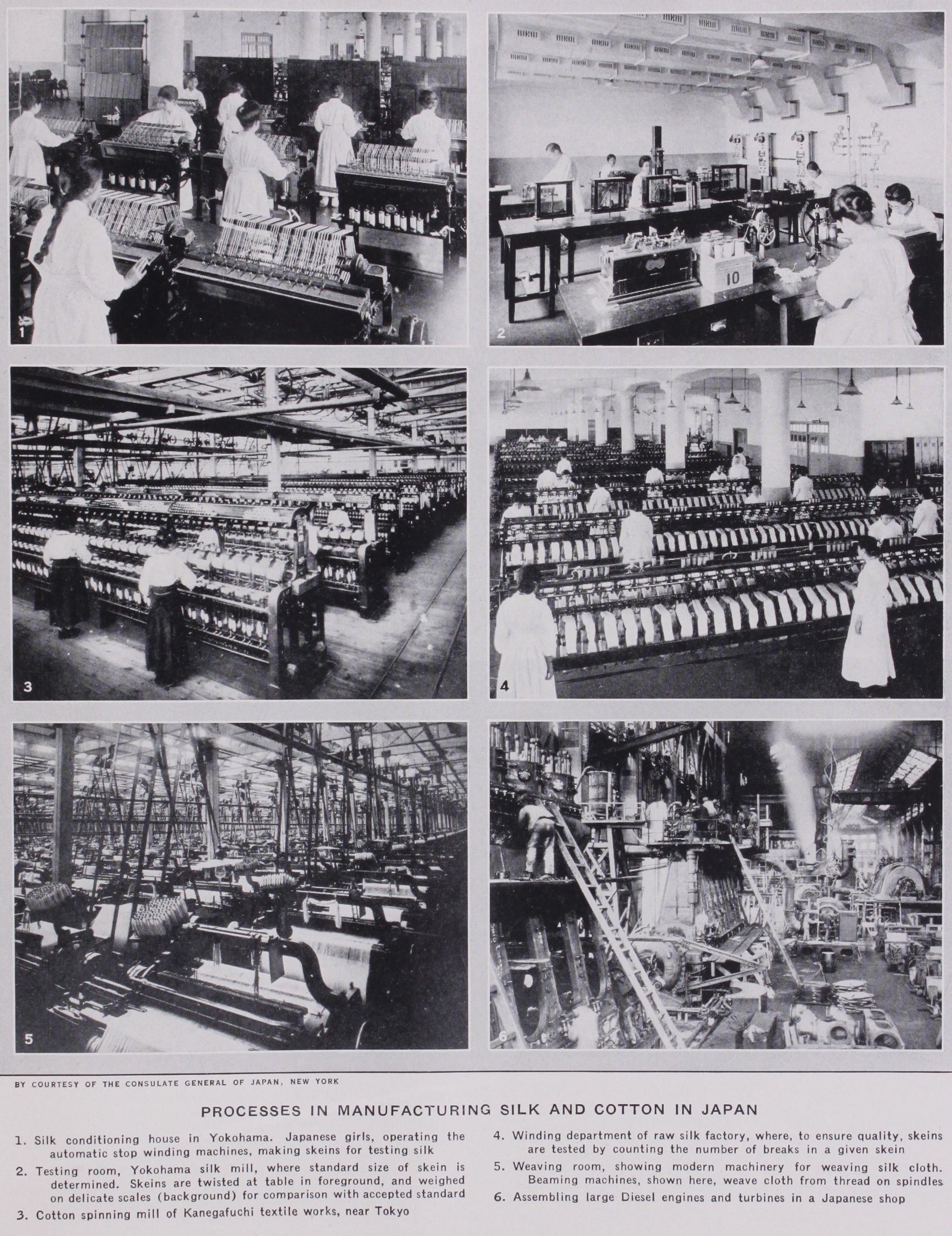
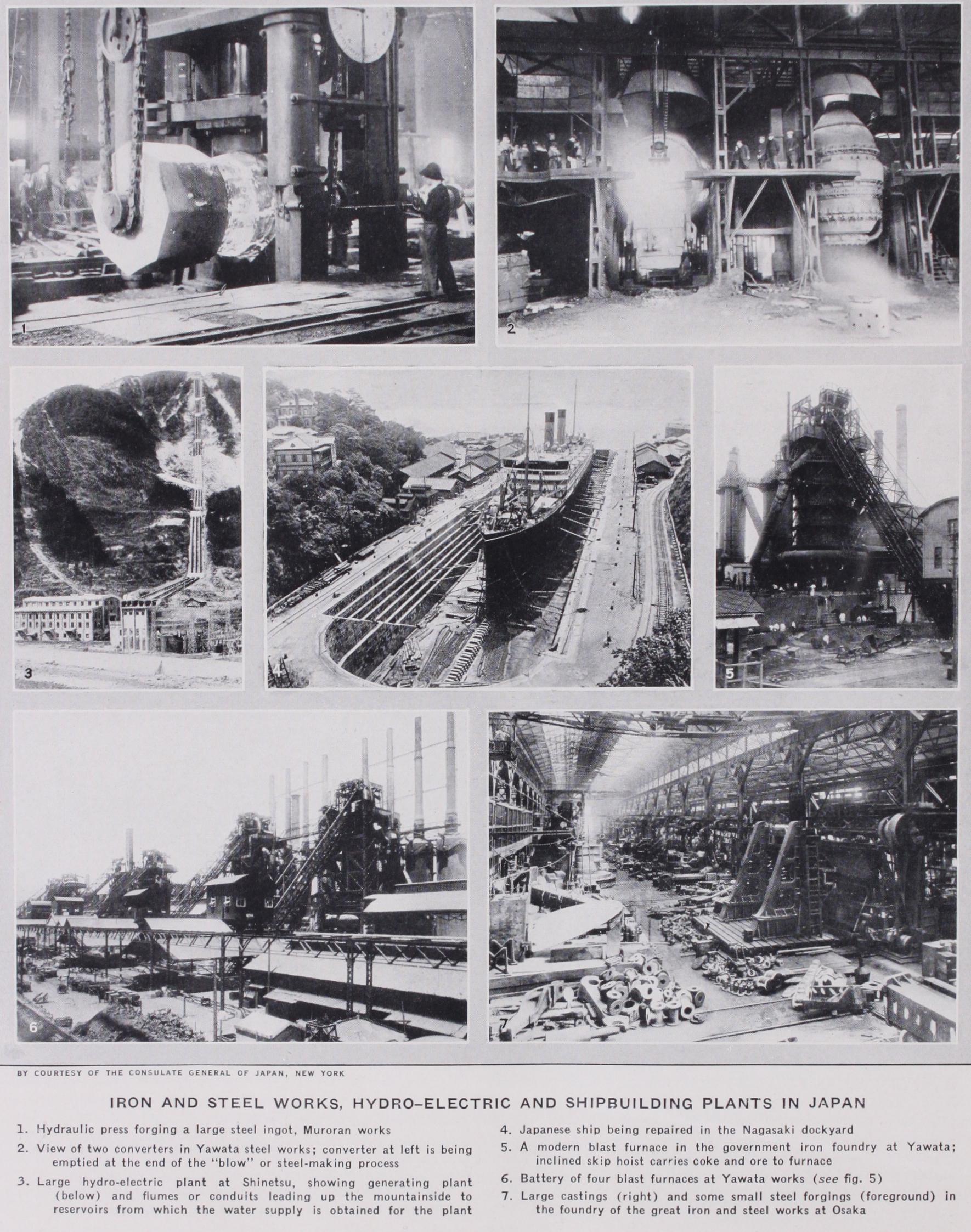
"Shinto," to quote Sir Charles Eliot, "makes no appeal to reason or emotion . . . it has no moral code ; its prayers and sacrifices aim at obtaining temporal prosperity and indicate no desire for moral or spiritual blessings. Yet these strange lacunae are some how filled by its intensely patriotic spirit. For it Japan is the land of the Gods; the greater preside over the Empire, the lesser over towns and hamlets; the noble or humble dead have their due place in the cult of the state, city, or family." It re gards human nature as naturally virtuous, and while believing in an existence after death, holds no theory as to its pleasures or pains. The dead become disembodied spirits and possess power to bring sorrow or joy into the lives of their survivors, which is why they were first worshipped or propitiated. Purity and sim plicity being essential characteristics of the cult, its shrines are built of white wood, entirely without ornament and fashioned on the model of the dwellings of the first Japanese settlers. There are no images—a fact attributed by some critics to ignorance of the glyptic art on the part of the original worshippers—but there is an emblem of the deity, which generally takes the form of a sword, a mirror, or a so-called jewel (magatama), these being the insignia handed by the sun-goddess to her grandson, the first ruler of Japan. The emblem is not exposed to public view. The mirror sometimes seen in temples is a Buddhist innovation and has nothing to do with the true emblem of the creed. Worship takes the form of offerings and the recital of rituals (ncrito). Twenty-seven of the latter were reduced to writing and embodied many centuries ago in the Engishiki. Couched in antique language, these liturgies are designed for the dedication of shrines, the avert ing of evil, for entreating blessings on the harvest, for purifica tion, for obtaining household security, for bespeaking protection on a journey, and so forth. But they contain no reference to a future state of reward or punishment or to assistance in the path of virtue. One ceremonial only is designed to avert the conse quences of sin or crime ; this is the rite of purification, which, by washing with water and by the sacrifice of valuables, removes the pollution resulting from wrong-doing. Originally performed on behalf of individuals, this Obarai (great driving away) ulti mately came to be a semi-annual ceremony for sweeping away the sins of all the people. The adherents of Shinto numbered in 1927.
Buddhism.—Buddhism reached Japan from China by way of Korea in A.D. 552, when the King of Pakche sent the Emperor of Japan an image of the Buddha with several sutras and a letter in which he extolled Buddhism as the most excellent of doctrines. Hostility to the new creed was manifested by some of the Shinto court officials, and its arrival was unluckily followed by an out break of pestilence, the result being that the reception accorded to it at first was not encouraging. Nevertheless after some vicissi tudes it succeeded in obtaining a foothold of a kind; but it was not till the Prince-Regent ShOtoku Taishi (572-621) appeared upon the scene that its position became really se cure. This brilliant statesman, warrior and scholar was through out his life its ardent supporter, and laboured to such effect on its behalf that when he died it was mote than strong enough to stand alone. The struggle between it and Shinto per sisted for a number of years, but was ultimately composed towards the end of the century by means of a compromise by which the ShintO deities were recognized as Bodhisattvas and their shrines handed over to the custody of the Buddhist priesthood. In this manner Buddhism became practically the es tablished church of the land. Thenceforward its history was one of steadily growing influence and power. There can be no doubt that in the earlier stages of its history in Japan it exercised a powerful civilizing influence over a nation then admittedly in a state of barbarism. Much of the best in the literature and art of the Nara and later periods is due to the inspiration of Buddhism or was the work of Buddhist priests themselves, and even in the darkest days of the Ashikaga regency art and literature still found a home within the monastery walls. But as the influence and the power of the Buddhist church increased its aims became more and more temporal. It began to interfere in political affairs; its abbots built in and around the capital or in the provinces great monasteries such as Hieizan, Koyasan, Miidera and others and filled them with armed monks; its prelates were involved in intrigues about the throne (it is possible that the removal of the capital from Nara to Kyoto may have been due to imperial fear of priestly statecraft) ; it even made attempts to establish direct ecclesiastical control over the state. The various sects too began to quarrel among themselves and were as ready to appeal to the arbitrament of arms as the warring factions outside. It was at this stage of Japanese history that the sovereign began to lose his hold of the reins of state and to become the shadowy figure he was fated to remain till the Restoration of 1868. As a result the control of affairs passed into the hands of a succession of powerful families of regents or of soldiers of fortune, and, save for a brief interval of peace in the Ashikaga regency, the country was for nearly two hundred years in a state of continual civil war. Rival houses strove for the reins of government in the capital; in the provinces the territorial nobility were a law to themselves; the common people suffered untold miseries. Into this welter of strife the Buddhist priesthood plunged readily. Monastery fought monastery ; sect fought sect ; while the monks of Hieizan and other priestly strongholds trooped down so often in their thousands to overawe the capital that the Emperor Shirakawa once exclaimed : "Three things there are which I can not control,—the river Kamo in flood, the fall of the dice, and the monks of Hieizan." On the other hand it was in this black period that the Jodo and other reforming sects made their ap pearance. Buddhism reached the zenith of its power and influence in the years following the Mongol invasions (1275 and 1281), in the defeat of which the prayers of its priesthood were believed to have been mainly instrumental ; its political eclipse dates from the rise to power of Nobunaga and Hideyoshi, which synchronized with the introduction of Christianity by the Portuguese mission aries. Nobunaga hated and feared the Buddhist church, and was resolved to humble it. For this reason and because he hoped to use Christianity as a counterpoise, he encouraged the new religion ; simultaneously he had recourse to arms to enforce his will. In the prolonged struggle which ensued he was ultimately successful. Hieizan and its three thousand monasteries were utterly destroyed, the greater part of the inmates massacred, and the rest driven into exile. A similar fate befell other priestly strongholds. From these blows the monasteries never recovered, while the church itself never regained its political influence. But for the folly of the missionaries themselves in indulging in political intrigue and for the intemperance of their attacks on the adherents of the native religion it is possible that Buddhism might have been completely annihilated ; their actions however drew on them the suspicions of the regents, and eventually the missionaries themselves were banished or put to death and the Christian faith proscribed under the severest penalties. The political power of Buddhism being effectively destroyed, the next line of regents, the Tokugawa, could afford to regard it with friendly eyes. Iyeyasu, the first of his line, was a member of the Fido sect, Iyemitsu, the second regent, was a staunch supporter of Buddhism, and Tsunayoshi, the fifth, was almost a fanatic. Its position too was assured by a decree in 1614 which obliged everyone to become a parishioner of the temple of the district in which he lived, to be entered on its registers, and to be buried according to its rites. It could reckon also on the solid and generous piety of the merchant and farming classes, a constant mainstay through all vicissitudes. Therefore although the church was shorn of political power the outlook. was by no means hopeless. But from the i 7th century onwards it had new foes to meet,—the hostile influences of Con fucianism and of the Shinto revival, the one pseudo-religious, the other political; and in the long struggle which ensued Shintoism ultimately triumphed. In 1868, when the Restoration took place, the Buddhist church was disestablished and partly disendowed and Shinto declared the state religion. Buddhist emblems were removed from the RyObu-Shinto temples and from the palace, the temples themselves were handed over to Shinto priests, and Bud dhist monks were forbidden to beg for alms. Thenceforward till 1875 the Government was openly hostile to Buddhism. Never theless it still remained a living force. But from 1875 onwards this hostility gradually relaxed, and, finally, in 1884, when freedom of religious belief was granted to all, the restrictions placed upon it were entirely removed. Since then popular interest in Bud dhism has revived, and at the present moment its temples and shrines number over 71,000, its priesthood about 54,000, and its adherents nearly 46 millions.
Japanese Buddhism is sometimes defined as a form of Maha yana; but this definition is, in the opinion of Sir Charles Eliot, inadequate. "Whatever its pedigree may be," he says, "whatever the doctrines it accepts in theory, its various phases, not only to-day but in some thousand odd years of history, smack of the soil." "Its most salient feature," he adds, "is its intimate con nection in all periods with the general condition of the nation, both political and social." Buddhist Sects.—There are at present 12 recognized Bud dhist sects in Japan,—the Hosso, Kegon, Tendai, Shingon, Yuzu Nembutsu, Jodo, Rinzai, Sodo, Obaku, Shin, Nichiren, and the ji. The first eight are old and imported from China; the last four came into existence at the end of the 12th century and were all remodelled, if not actually created, in Japan. The Tendai, which was introduced by Dengyo-Daishi, and the Shingon, which was introduced by that most celebrated of Japanese saints and hero of countless legends, Kabo-Daishi, are closely connected and came to Japan almost simultaneously. They had their centres in the two great monasteries of Hieizan and Koyasan, which have already been referred to above. Their theology is somewhat abstruse. The former preaches that all known forms of Buddhism are phases of true doctrine but that the Lotus SUtra is its crown and quintessence; the latter is the Mantrayana, a late form of Indian Buddhism which was carried to China, Japan and Thibet. But their rich mythology appeals to the popular taste. Their com bined priesthoods number at present about ten thousand and their adherents five million. Of the last four sects mentioned above the oldest is the Jodo; but this was overshadowed by the later Jado Shinshii, or Shin, which claims to present the Jodo teaching in a simpler form. The main doctrine of both is that by faith in Amida (Amitabha) the believer, when he dies, enters the Para dise of the West, or as it is known in the Far East, Jodo (the pure land). It is in fact the doctrine of faith not works. The founder of the Jodo sect was Genku (Honen-Shonin) and of the Jodo ShinshU his disciple, Shinran ShOnin. This sect is marked by a distinctly popular and progressive spirit and by the fact that its priests are allowed to marry, a privilege which in the middle ages resulted in its hierarchy becoming hereditary and practically feudal barons. The Nichiren sect was founded in the 13th century by the priest of that name. There are two salient features in the doctrines preached by Nichiren. The first is his identification of religion with the national life, the second is his protest against the worship of Amitabha. Nichiren divided the history of Buddhism into three millenniums, the last of which he called MappO (the period of the destruction of the law), a dark age full of trouble in both the political and the religious world. Salvation from this was to be found in the teaching of the Lotus sutra, concentrated in the invocation "Nammyo-ho renge kyo" (Reverence to the sutra of the Lotus of the Good Law), and the essence of the teaching itself is that Sakyamuni, not as the man but as the eternal omnipresent Buddha mind, is one with all reason and all nature. It is therefore not Amitabha but Sakya muni whom men should worship. The sect, like its founder, has always been noted for its aggressiveness and intolerance. The Rinzai, Soci, and Obaku sects are subdivisions of the Zen sect.
which was introduced into Japan in the twelfth century. The Zen rejects scripture as a medium for communicating truth and pre scribes meditation as a substitute for revelation. It met with little success when first introduced into Japan, but ultimately became the creed of the military caste, probably because of its insistence on simplicity of life, discipline of mind and body, and concentration of thought. It is still very influential, and its influence on art has been deep and enduring. (The above section is based on information contained in a manuscript lent by Sir Charles Eliot.) Christianity in Modern Japan.—The story of the first Christian missionaries to Japan is told elsewhere. Their work suffered an interruption for more than 200 years until, in 1858, almost simultaneously with the conclusion of the treaties, a small band of Catholic fathers entered Japan from the Luchu islands, where they had carried on their ministrations since 1846. They found that, in the neighbourhood of Nagasaki, there were some small communities where Christian worship was still carried on. It would seem that these communities had not been subjected to any severe official scrutiny. But the arrival of the fathers revived the old question, and the native Christians, or such of them as refused to apostatize, were removed from their homes and sent into banishment. This was the last example of religious intoler ance in Japan. At the instance of the foreign representatives in Tokyo the exiles were set at liberty in 1873, and from that time complete freedom of conscience existed in fact, though it was not declared by law until the promulgation of the constitution in 1889. The following figures taken from the Resume Statistique de l'Empire du Japon, show the numbers of the clergy, teachers, con gregations, and adherents of the various Christian denominations in Japan :— The total number of converts of all denominations is about 2 20, 000. The Roman Catholic Church, which is presided over by an archbishop with five bishops, of whom one is Japanese. resumed its labours in Japan in 5859. In addition to its regular mission aries it is assisted by about a thousand male and female workers belonging to various orders. There are, further, seven male and female orders engaged in charitable and educational work, three entirely Japanese sisterhoods, two leper hospitals, a number of dis pensaries, day nurseries, orphanages, schools for children of both sexes, and a university. An Apostolic Delegate is now stationed in TOkyO. The Greek Church is served entirely by Japanese clergy. Its fine cathedral, once a famous landmark in TOkyO, was destroyed in the earthquake of 1923. The Episcopal Church was established in 1859 by two American clergymen in Nagasaki and now, in conjunction with the Episcopal Churches of the United States and Canada, it has missions collectively designed as the Nihon Seikokwai. All the more important Protestant denomi nations maintain schools, seminaries, and hospitals, and the Con gregationalists, Methodists, and Episcopalians have in addition educational establishments which are practically universities,— as, for instance, the DOshisha, the Aoyama Gakuin, and St. Paul's University at Ikebukuro near TokyO. The work carried on by the Salvation Army is much the same in form in Japan as in England, —shelters, rescue homes, social settlements, slum posts, etc. In addition it publishes a fortnightly paper,—the Toki no Koe (War Cry). Other religious associations engaged in Christian propa ganda work are the Society of Friends, the American and London Religious Tract Societies, the Young Men's Christian Association, the Young Women's Christian Association, the Japan Women's Christian Temperance Union, etc. The translation of the Old Testament into Japanese was completed in 1879, that of the New Testament in 1876. Japanese Christians concern themselves little with the subtleties of dogma which divide European Christianity, and for this reason there is practically no sectarian strife. Their tendency is to consider only the practical aspects of the faith as a moral and ethical guide, and to adapt the creed to their own re quirements. This genius for adaptation has been from the earliest times a marked national characteristic and is not confined to religion only. There is, however, a strong movement among the Protestant bodies in the direction of home-rule in matters of finance and general administration, and it is believed to have been accelerated by the recent anti-Japanese immigration legislation in the United States. Outwardly Christianity makes little pro gress in Japan ; but its doctrines have undoubtedly secured a deep hold on the modern culture of the country. For the Anthropology of Japan see ASIA, Anthropology and Ethnology (North and East Asia). (X.) The early history of Japan is indistinguishable from mythology and consists of legends collected in the two chronicles called Kojiki and Nihongi or Nihonshoki. Both were composed in the 8th century: the first ends about zoo, but the second closes with the year A.D. 697, and the latter portion of it is more or less historical, though the chronology is not trustworthy. The legends contained in these works are so nebulous and disconnected that they can not be summarized in a coherent narrative but they tell how the land and people of Japan were produced by the Gods among whom the Sun goddess Amaterasu and her brother Susanoo play - prin cipal part. It is noticeable that in the earliest stories there are two centres. Susanoo descends to Silla in Korea and sails thence to Izumo in Japan where his posterity rule, but the child sent by the Sun goddess to rule Japan descends, after negotiations with the rulers of Izumo, to the province of Hyfiga in Kyushu. This confirms the theory, which is probable for other reasons, that the Japanese are a mixed race. The oldest known stratum of popula tion is represented by the Ainus, whose bones are said to show some of the characteristics found in European prehistoric skele tons. There is no record, even legendary, of their arrival in Japan, but the evidence of place names shows that they once occupied the entire country, including Kyushu. They were gradually driven to the north by invaders who came partly from Korea, and per haps ultimately from Central Asia, and partly from the south. Recent discussions tend to emphasize the importance of a Malay Polynesian element in the Japanese language and customs and the legend also dwells on the activity of the descendants of the Sun goddess who reigned in Kyushu rather than on the doings of the rulers of Izumo.
According to the chronicles the first human sovereign of Japan was Jimmu Tenna who, starting from Kyushu, proceeded to con quer the east. He halted on the northern shores of the Inland sea and then, after much fighting, established his rule in the pro vince of Yamato, which now becomes the centre of Japan. It is doubtless true that at some period before the Christian era there was a movement of population from the west to Yamato, but the details seem entirely legendary. Jimmu was not really the ancient name of the leader (Kami Yamato Ihare-biko) but a posthumous title invented by scholars in the 8th century, and the date of his accession, February II, 66o B.C., is a similar invention. But in 1889 the leaders of Japan wished the nation to believe in the continuity of Japanese history and the antiquity of the imperial lineage, and with this object promulgated the new constitution on the supposed date of Jimmu's accession and made it a public holiday. In the same spirit they erected in 1890 a mausoleum on the plains of Yamato near a tumulus where he is said to have been buried. The chronicles give the names of Jimmu's successors, hut ascribe to them impossibly long reigns, and there also appears to be an error in chronology by which the dates are 120 years too remote. Al.. though the record is mainly genealogical it contains points of in terest : (I) Women hold an important position and are the hero ines of many tales. (2) Irrigation works are mentioned and the Emperor Suinin is said to have constructed more than Soo ponds and channels. (3) The imperial harem was large. Thus the Nihongi tells us that the Emperor Keiko gave "fiefs of provinces and dis tricts" to 77 of his children and each child proceeded to his own province. In this way, no doubt, arose the territorial nobility which plays such a conspicuous part in subsequent history. (4) In an edict ascribed to 81 B.C. ships are stated to be of cardinal importance, because of the difficulty of land transport, and every province is ordered to build them. (5) About the time of our era the practice of burying men alive with princes was discontinued and clay figures were substituted. (6) Several expeditions against savages, that is, probably, Ainus, are mentioned, the principal be ing ascribed to Yamato-takeru, son of the Emperor Keiko and first of the picturesque young heroes of Japan. He subdued first the land of Kumaso in Kyushu (so called from the Kuma and So, two tribes which inhabited it) and then successfully attacked the north and east, penetrating as far as Shimosa and Shinano. But he fell ill and died at the age of 3o on "the moor of Nobo," regretting in his last words that he could not report his victories to the emperor. "Alone I lay me down on the waste moor with none to say a word to me. But why should I regret the loss of this body? My only grief is that I cannot meet thee." His son or de scendant, Chuai, became emperor and sent another expedition against the Kumaso, but it was not victorious.
Invasion of Korea.
We now come to an important legend, the conquest of Korea by the Empress Jingo, for which the tradi tional date is A.D. 200. Apparently it did not belong to the Yamato cycle, for the Kojiki transfers the scene abruptly to Kyushu. The Nihongi makes a more coherent though still very strange story by telling how the court removed to Kyushu and how the empress, after invading Korea, regained possession of Yamato which had revolted during her absence. But it is fairly clear that there were two cycles of legends, one having Kyushu the other Yamato as its centre. After this period Yamato definitely becomes the seat of the emperor and of government. The Empress Jingo appears to have been a real person, for the Chinese annals, though they do not mention her name, say that Japan was ruled by a woman at this period. The Nihongi recounts how she invaded Silla, how the neighbouring kings of Koryo (or Koguryo) and Pakche spontaneously tendered submission, and how during many years tributary missions were sent at intervals to Japan and occa sionally punitive expeditions despatched to Korea. Whether at this period the Japanese subdued any considerable part of Korea may be doubted, but the Korean annals mention many incursions of Japanese pirates and also the exchange of missions. There must have been considerable intercourse, both peaceful and hostile, be tween the two countries. In A.D. 284 the Emperor Ojin summoned from Pakche a learned man called Wang-in, who became tutor of the heir apparent and the ancestor of "the chiefs of writing." Ojin was succeeded by Nintoku who is one of the romantic figures in Japanese history. The throne remained vacant for three years because he wished his brother to occupy it. The latter refused and at last solved the question by committing suicide. Nintoku made Naniwa, the modern Osaka, his capital. A celebrated story relates how he ascended a tower and looking over his country observed that no smoke was rising from the houses. Inferring that his people were poor and had no rice to cook, he abolished forced labour for three years. His palace fell into disrepair, but "the people had plenty, the praise of his virtues filled the land and the smoke of cooking was also thick." The Nihongi states that in this reign an official named "Kino Tsuno was the first to distinguish the boundaries of provinces and districts and to commit to writing in detail the products of the soil in each locality." We also hear that it became the custom to store ice in ice-houses for use during the summer.
Beginning of History.
The first date given by the Nihongi which is confirmed by external evidence is equivalent to A.D. 461 and the reign of the Emperor Richu, which is reckoned as begin ning in A.D. 400, is generally considered to mark the commence ment of the historical period. The appearances of deities become less frequent, but the chronology is still confused, but, as few important events are recorded, this defect is not of much moment. The Government is represented as a monarchy inherent in one family of divine descent but with somewhat irregular succession and subject to frequent usurpation. The emperors are generally represented as beneficent and beloved of their subjects, with two exceptions Yuriaku (456-471) and Buretsu (498-506) who are described as monsters of cruelty and injustice. The nobles are called Omi and Muraji, the former apparently claiming divine, that is remote imperial lineage, and the latter content with a merely human pedigree and probably descended from the old nobles of Kyushu and Izumo. At the beginning of each reign a great Omi and a great Muraji were appointed who seem to have corresponded to a chancellor and a commander-in-chief. Be sides these there were personages, Kuni-no-Miyakko or chiefs of provinces, who were heads of clans owning the territory in which they resided. There were also numerous corporations called Be, such as the Bes of the mountain warders, seamen and carpenters. It is not clear how these corporations fitted into the clan system, but they included many immigrants from Korea. The most im portant feature of the period from A.D. 400-550 is the growth of relations with this country. The chronicles contain many admis sions that the Japanese learned from it various arts of life and, on the other hand, if the language used about conquest and tribute is unduly patriotic, it is clear that they had some sort of special sphere in the peninsula. Between the two little kingdoms of Silla (or Shiragi) on the coast facing Japan and Pakche (Kudara) to the west, lay a territory called Imna or Mimana, to the west of the modern Fusan. Here the Japanese had a settlement and we hear from time to time of a Japanese garrison and Japanese governors or perhaps residents, for a king of Imna is also mentioned. The relations of Imna and Pakche were generally friendly but the rulers of Silla were from the Japanese point of view unsatisfactory and insubordinate. With the aid of the northern kingdom of Koryo they invaded Pakche and in 562 they "destroyed the Miyake of Imna." Introduction of Buddhism.—But meanwhile an event of the utmost importance occurred. A mission from the king of Pakche asking for armed assistance recommended Buddhism to the at tention of the emperor of Japan as the religion of the civilized world, and presented an image of the Buddha and sacred books. This incident is justly selected by historians as marking the intro duction of Buddhism and Chinese civilization, for the Japanese Government were confronted with the immediate problem of what to do with the presents, but naturally the ground had been pre pared by immigration and intercourse. In 54o we read that the men of Ts'in (China) and Han, etc., were "assembled and en rolled in the registers of population": that the men of Ts'in alone numbered 7,053 houses and that one of them was made director of the Treasury. The emperor and his court were probably not wholly ignorant of Buddhism, and Soga, perhaps the greatest per sonage in the aristocracy, is represented as asking whether Japan was to be alone among the nations in not worshipping the Buddha. Other councillors objected, but at last it was agreed that the Soga family should worship the image as an experiment. A pestilence which broke out at this time was regarded as a sign of the anger of the native gods and Buddhism was forbidden but, as the pesti lence then grew worse, this was with equally good reason inter preted as the anger of the Buddha. As a compromise Buddhism was tolerated as the family cult of the Sogas, but since that family was very much to the fore and rising in importance it became the established church in a few decades. On the death of the Emperor Yomei there was a dispute as to the succession which led to war between the Sogas and their rivals, the Mononobe, opponents of Buddhism who championed the institutions of old Japan. The Sogas were completely victorious and after further dynastic troubles in which the Emperor Sujun was assassinated Soga no Numako's niece, known as the Empress Suiko (593-628), was summoned to the throne in her own right, although there was no lack of male heirs. At the same time Shatoku Taishi, a son of the Emperor YOrnei who had f ought with Soga against the Mononobe, was declared heir apparent and though he did not live to reign him self became one of the best known figures in all Japanese history. He was also called Umayado, or Prince Stable-door, because he was born unexpectedly while his mother was inspecting the im perial stables. He was entrusted with the government from 593 to 621 and when he died, says the Nihongi, the old wept as if they had lost a child, the young as if they had lost a parent. His name is associated with the establishment of Buddhism in Japan and he built the temple of HOryiiji which still exists. He was a lover of art and the greatest scholar of his time, the author of commen taries on several Buddhist scriptures and of a history of his coun try. But more than this; he seems to have introduced good ad ministration and humane customs into a land which sadly needed them. The Nihongi, speaking of the year 562, observes "at this time between father and child, husband and wife, there was no mutual commiseration." ShOtoku Taishi "prepared for the first time laws." They consist of 17 clauses which are moral maxims rather than legal enactments and are inspired by Confucianism, though Buddhism is held up for admiration as the universal reli gion. The power of the throne is emphasized, the duties of minis ters defined, the provincial authorities are forbidden to levy exac tions and forced labour is to be required only at seasonable times. Japan had now official relations with China as well as Korea. In 607 an envoy was sent to the Emperor Yang-Ti of the Sui dynasty and next year a return mission arrived. The two potentates were not quite agreed as to their respective rank, for while the Chinese despatch began "The Emperor greets the sovereign of Wa" (the old name of Japan), the reply said "the emperor of the east re spectfully greets the emperor of the west." But there was no doubt that Japan wished to learn from China all that was useful.
The Sogas.—Shotoku Taishi, as practical ruler of Japan, had maintained good relations with the great Soga family, but after his death their power and arrogance became excessive and pro voked the suspicion that they intended to usurp the throne. The story of their downfall is one of the best known episodes in early Japanese history. They had placed on the throne the Empress Kogyoku, widow of the Emperor Jomei, but Soga no Iruka gov erned the country and kept almost imperial state. There was at that time a certain young man called Kamatari, who afterwards received the name of Fujiwara and became the founder of that illustrious house. He belonged to the family of Nakatomi, heredi Lary guardians of the great Shinto shrines and rivals of the Soga. "He was indignant with Soga no Iruka," says the Nihongi, "for breaking down the order of prince and vassal, senior and junior and for cherishing veiled designs on the State." He was offered the post of head of the Shinto religion but refused it and, keeping away from court, entered into a conspiracy with the empress's brother, Prince Karu, and also secured the friendship and assist ance of Prince Naka, her son, by his politeness in a game of foot ball. As Soga was always guarded when out of doors it was de cided to kill him at court in the presence of the empress. When the critical moment arrived the swordsmen appointed to strike the blow were afraid and Prince Naka himself cut Soga down. He fell at the feet of the empress, who was greatly shocked, but Naka said to her—"He wished to destroy utterly the Heavenly House and subvert the Solar Dignity. Is he to take the place of the Heavenly House?" This ended the pre-eminence of the Soga fam ily. The empress thought it prudent to abdicate. Naka was con tent to be prince imperial and Karu succeeded her in 645 under the name of Kotoku.
The Reforms of Taikwa.—He decided that the beginning of his reign should be known as Taikwa, great civilization or de velopment, and the changes he introduced are spoken of as the Reforms of Taikwa. This is the first instance of the use of a nengd or year name, which became the regular method for fixing dates in Japan. Instead of using an era which covers many centuries, a special name is given to a few years. In quite modern times this period coincides with an emperor's reign; thus 1904 was the 37th year of Meiji and 1927 the second year of Showa. But formerly any remarkable event was considered a sufficient reason for a new nengo. In later Japanese history events are commonly referred to in terms of nengii, as for instance the Wars of Onin the Code of Kemmu (1334-6), where Onin and Kemmu are names not of people or places but of periods. From Taikwa down to the present Showa there have been 247 nengo. Kotoku was not a per sonality like ShOtoku Taishi, but he was assisted by Kamatari, who proved one of the ablest statesmen that Japan has produced. Under his guidance the Government was reorganized and Chinese institutions were adopted on a scale which can only be paralleled by the deliberate imitation of European methods under the Em peror Meiji. The Nihongi says that "he honoured the religion of Buddha and despised the way of the Gods," that is, Shintoism or the ancient worship of Japan. The development of Japanese reli gion does not come within the province of this article, but it may be mentioned that though there was naturally a struggle between the imported faith and old institutions, the contest was compara tively gentle and had little of the violence which attended the Ref ormation in Europe. It is only occasionally and mostly quite late in history that we hear of troubles arising between the two creeds. At the time of which we are treating the triumphal progress of Buddhism was remarkable; we hear continually how images were cast and temples built in a magnificent style unknown to Shinto, which favoured simplicity ; how teachers and priests arrived from Korea and China ; how Japanese eagerly received ordination as monks and nuns and how an important precedent was set by a prince who retired to a monastery to avoid political complications. But all this did not mean merely an influx of foreign piety or superstition. KOtoku and his advisers saw that the existing sys tem of government and society was radically wrong and set themselves to reform it, taking China as their model. The central power was weak and had no machinery by which it could exert its authority far from the capital; the great mass of the people were ignorant peasants, victims of the tyranny of numerous local mag nates, who were not appointed by the crown but owed their posi tion either to birth or, very often, to their unscrupulous use of their opportunities. The system of forced labour was abused; the administration of justice and the collection of taxes were both purely local and corrupt ; the families of serfs were distributed as their masters chose and provincial chiefs appropriated both lands belonging to private persons and the estates of the crown. To remedy such abuses the regulations of Taikwa appointed three great officials styled ministers of the left, right and interior; pro vincial governors were ordered to prepare registers showing the number of free men and serfs and the area of cultivated land in their jurisdiction. It was further ordained that the common people should have equal share in the advantages of irrigation : that the acceptance of bribes should be punished : that a box for receiving petitions should be placed in the imperial court and a bell be hung for the use of those who had complaints to make : that the absorp tion of land into great estates should cease : that officials should receive by way of emolument "sustenance fiefs," that is to say, the taxes of a certain number of homesteads : that in cities and town ships (defined as 5o houses) aldermen should be appointed for "the superintendence of the population and the examination of criminal matters": that officials should have as assistants "men of solid capacity, skilled in writing and arithmetic." Also the whole soil of the empire was supposed to be surrendered to the central Government and was theoretically at least distributed among peasants in equal holdings of a few acres, subject to a six-yearly redistribution. The old taxes and forced labour were abolished and a system of commuted taxes instituted. Many matters of detail which cannot be here enumerated, are dealt with at length. For instance, the practice of constructing enormous tombs di verted labour from more profitable work. It was now enacted that the tomb of a prince must not require the labour of more than 1,000 men for a week, and that the grave of an ordinary official must be completed by 5o men in one day. In 649 the emperor ordered the establishment of eight departments of State, though perhaps this central organization was not really completed until somewhat later. Of these eight ministries which were modelled on the six boards of the Tang dynasty, four were concerned with the court, but their province included questions which we should now call education and public worship. The other four were the Home Office (Minbusho), the War Office (Hyobusho), the Treas ury (Okurasho) and the Ministry of Justice. The intention of KOtoku's reforms was evidently to arrest feudalism, but in this they were not successful, though they did much for the improve ment and civilization of his country. In China there were few great families and public opinion found selection by merit and even by public examinations natural. But the subsequent history of Japan shows that the tendency to consider office and influence as hereditary was not easily eradicated.
On the death of the Emperor KOtoku, Prince Naka, though recognized as the heir apparent, again stood aside and allowed his mother to have a second reign under the style of Saimei. It was not till her decease in 661 that he at last came to the throne as Tenchi. At this period an important change occurred in Korea : with the assistance of the Chinese, Silla conquered the other States of the peninsula. The Japanese sent a force to help their old ally Pakche but it was annihilated by the Chinese fleet in 663, and until the time of Hideyoshi at the end of the 16th century Japan had to keep her hands off Korea. But after the fall of Pakche and Ko guryu large numbers of Koreans emigrated to Japan and were hospitably received by Tenchi. He was an able and enlightened monarch but on his premature death in 671 the country was thrown into confusion by civil war between his son Ohotomo, who had been set aside, and his younger brother who had been named prince imperial. The latter won and ruled till 686 as the Emperor Temmu. The Kojiki and Nihongi which were compiled by his orders, though not completed until after his death, give a long and sometimes imaginative account of the struggle.
When he died there was again a difficulty about the succession : his son Ohotsu was put to death and his widow came to the throne as the Empress Jito. She abdicated in 697 and for the first time in Japanese history a minor was made emperor, a practice which afterwards became very frequent. He was known as the Emperor Mommu and was both grandson and nephew of the late empress. Coming to the throne when only fourteen he died at the age of twenty and was succeeded by his own mother the Empress Gemmei. In 697 the Nihongi comes to an end, but the chronicles of old Japan are continued in the Shokunihongi, Nihon-Koki and other official histories. The Civil Code of Taiho also throws much light on the condition of Japan at this period. It is the oldest extant body of Japanese law, but what has come down to us is not the original text which was published in the year of 702 but the edition of 833, in which a commentary is incorporated.
Up to this time there had never been a fixed metropolis. The court had moved about from one town to another in the five home provinces (Gokinai), the provinces of Yamato, Yamashiro, Settsu, Kawachi and Izumi) or to Otsu on Lake Biwa, the capital being always changed on the death of the sovereign and often at other times. This habit had many inconveniences and caused great hardship to the labouring classes who were called upon to construct new palaces at frequent intervals. So in 710, in the reign of the Empress Gemmei, Nara was selected as a fixed capital and with brief intervals continued to be the imperial residence for three-quarters of a century. Except for a campaign in the north conducted by a Fujiwara general against the Ainu, the Naran period was eminently peaceful and marks an epoch in the history of art, literature and religion. The city was laid out on the plan of the Chinese capital and was visited by learned men and artists not only from China and Korea but from India, Cambodia and Cen tral Asia. Many Japanese also went to China to study. It was the fashion to imitate everything Chinese, in art and letters, in cos tume and amusements; but in many religious carvings and orna ments, Indian influence is also apparent. But though this culti vated society had not much originality, it was not wanting in force and power of expression, for the Naran sculpture is remarkable for its vigour and beauty. It was at this time that the first antho logy of poems (the Manyoshil) was compiled and the poets Hito maru and Akahito wrote. Nara was pre-eminently a Buddhist centre. There were seven monasteries in or near the city and, as ecclesiastical property paid no taxes, it tended to increase, for the peasants were quite ready to surrender their land to the church and then hold it as tenants in return for a rent smaller than the imposts levied by the Government. At this period the private own ership of land began to be recognized, for it was found that the uncertain tenure and frequent redistributions prescribed by the regulations of Taikwa deterred improvements. In 708 copper was discovered and a mint established, but its operations were seriously impeded because so much of the new metal was required for the casting of bells and images. The greatest of these was the Daibutsu in the Todai-ji of Nara, a gigantic image weighing more than 550 tons. It was dedicated in 749 by the Emperor Shomu who ap peared before it with all his Court and declared himself the servant of the Three Treasures—the Buddha, the Law and the Church. In fervour of devotion he may rank with the Indian emperor Asoka, and like him he constructed hospitals and almshouses, roads and bridges. In all these enterprises, whether appertaining to religion or public works, he was assisted by the eminent Korean priest, GyOgi Bosatsu, who was made head of the hierarchy. Shomu took the tonsure and abdicated in favour of his daughter 'Caen, who was also a zealous Buddhist and followed her father's example by becoming a nun in 752, a young prince succeeding her as the Emperor Junnin. But she continued to control the more important affairs of the empire and there was thus a dual monarchy consist ing of a retired and a reigning sovereign, a position which often reappears in Japanese history.
The emperor's chief adviser was Emi no Oshikatsu, of the Fuji wara family, which was growing powerful, and the empress was under the influence of a handsome and ambitious monk called DOkyo. Oshikatsu attempted to make away with him, but the empress took vigorous action in her favorite's defence and civil war broke out. Oshikatsu had many enemies on account of his sudden rise to eminence at court and was overpowered and executed. The empress then banished the young emperor to the island of Awaji where he was strangled and, emerging from her retirement, again ascended the throne in 756, changing her name to ShOtoku. DOkyo became chancellor and practically ruler of the empire, but his ambition knew no bounds and he spread a report that the God of War wished him to be made emperor. Even his devoted mistress raised objection to this and insisted that the oracle must be consulted officially. When this was done, his enemies arranged that the divine reply should be a decided nega tive. Dokyo, however, did not fall at once and even had time to take personal vengeance on his opponents. But, when the empress died in 769, he was banished. Nothing remarkable happened for the moment, but it is significant that no empress was allowed to reign again until 1630. An elderly prince came to the throne and ruled for twelve years as Konin TennO, under the guidance of Fujiwara Momokawa and was then succeeded by a really able emperor, Kwammu (782-805).