Iovilae or
IOVILAE or JovILAE, a latinized form of iiivilas, the name given by the Oscan-speaking Campanians in the 5th, 4th and 3rd centuries B.C. to an interesting class of monuments, not yet fully understood. They all bear crests or heraldic emblems proper to some family or group of families, and inscriptions directing the annual performance of certain ceremonies on fixed days. While some of them are dedicated to Jupiter (in a special capacity, which our present knowledge of Oscan is insufficient to determine), others were certainly found attached to graves.
See the articles OscA LINGUA, CAPUA, CUMAE and MESSAPII. The text of all those yet discovered (at Capua and Cumae), with particulars of similar usages elsewhere in Italy and other historical and archaeo logical detail, is given by R. S. Conway in The Italic Dialects (Cam bridge, 1897, pp. 101 ff.). (R. S. Co.) IOWA (I'o-wa), known as the "Hawkeye State," is a north central State of the United States of America, situated between 36' and 30' N. and 89° 5' and 96° 31' W. It is bounded north by Minnesota, east by the Mississippi river, which separates it from Wisconsin and Illinois, south by Missouri, and west by the Missouri and Big Sioux rivers, which separate it from Nebraska and South Dakota. The State's total area is 56,147 sq.m., of which 561 sq.m. are water surface.
Physical Features.
Topographically, Iowa lies wholly in the prairie plains region, part of it having been overrun by the great ice sheet of the glacial epoch. For the most part the surface is that of a prairie tableland, moderately rolling, and with a gen eral but scarcely perceptible slope, which in the eastern two-thirds is from north-west to south-east, and in the western third from north-east to south-west. Elevations above the sea range from between 1,200 to 1,600ft. in the north-west to 5ooft. and less in the south-east, the highest point being in Osceola county, the lowest at Keokuk. In the southern half of the State the height of the crests of the divides is very uniform. The northern half, because of glaciation, is more broken and irregular. Elevations, usually rounded, mingle with depressions, some of which are occupied by small shallow lakes or ponds. But the most marked departures from the prairie surface are in the north-east and south-west. In the north-east the whole of Allamakee and parts of Winneshiek, Fayette, Clayton, Delaware, Dubuque and Jackson counties form the only driftless area of the State. In that region cliffs frequently rise almost vertically from the banks of a river to a height of from 30o to 400ft. ; and from the summit of the cliff to the crest of the divide, a few miles distant, there is another ascent of 3ooft. or more, terminating occasionally in knob-topped hills crowned with small cedar. Moreover, the largest streams have numerous tribu taries flowing circuitously between steep if not vertical cliffs or in deep craggy ravines overlooked by distant hills. In the west, southward from the mouth of the Big Sioux river, extends a line of moundlike bluffs, usually free from rocks, rising abruptly from the flood plain of the Missouri to a height varying from 1 oo to 300 feet. A broad water-parting extending from Spirit lake, on the northern border, nearly south to within 6om. of the southern bor der, and thence south-east to Wayne county in the south central part of Iowa, divides the State into two drainage systems. That to the east, comprising about two-thirds of the whole area, is drained by tributaries of the Mississippi, of which the Des Moines, the Skunk, the Iowa with its tributary the Cedar, and the Wapsi pinicon are the largest. These streams of long courses and easy fall are frequently pebbly in the north, but muddy in the south. Their valleys are broad at their sources, well drained, and gently sloping in the middle of their courses, but becoming narrower and deeper towards their mouths. The region to the west of the divide is drained by tributaries of the Missouri, mostly short streams taking their rise from numerous rivulets, flowing quite rapidly over muddy beds through much of their courses, and in the bluff belt along the Missouri having steep but grassy banks 2ooft. in height or more.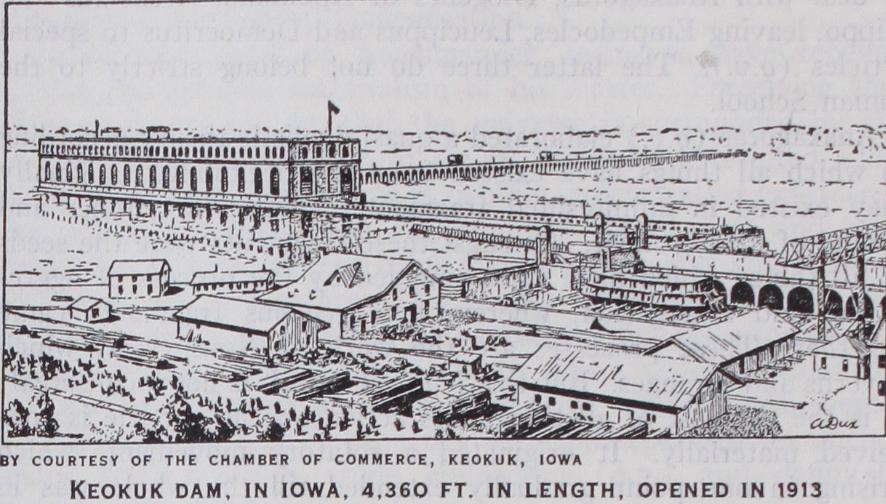
Climate.
The climate is one of great extremes of heat and cold, with a dry winter and a usually wet summer, the prevailing wind of winter being north-west, while in summer it not infre quently blows from the south-west. Both the midwinter isotherm of Montreal and the midsummer one of Washington, D.C., pass through the State. The mean annual temperature is 48° F; the average range of extremes per year is about 136° F; while the greatest extremes recorded are from —47° F in 1912 to 113° 1901, a difference of 16o degrees. The average mean annual tem perature at Cresco in Howard county, near the north-east corner of the State was while at Keokuk in the south-east corner it was 52.2 degrees. As the isotherms cross the State, especially in the north, their tendency is to move south-west. The rainfall is also very unequal in distribution throughout the year, as between the same periods of different years, and as between the different parts of the State. While the mean annual precipitation is 31.97in., about 71% of this falls during the six months from April I to Oct. 1, or io% in winter, 23% in autumn, 28% in spring and 39% in sum mer. May, June and July are the three wettest months. At the same time extremes during the four most critical crop months, from May I to Sept. 1, have ranged from 6.75in. to 27.8 inches. Within any one year the precipitation is in general usually less in the western part of the State than in the eastern ; the western part also is marked by having a still greater percentage of its rain in spring and summer than has the eastern. The unequal distribution throughout the State is in large measure caused by local showers. Though the average frost-free growing season is from May 31 until Oct. I, killing frosts may occur later or earlier. Injury to crops from drought and hot winds has occurred about two or three times in a decade, but liability to injury of the crops from ex cessive rainfall and hailstorms is greater than that from a defi ciency of moisture.
Soil.
Its depth, together with its porous nature, makes the fer tile soil of Iowa capable of withstanding the extremes of wetness and dryness remarkably well, and it is perhaps true that, taken as a whole, no other State in the Union has a superior soil for agri culture. Certainly no other has so many acres of improved land, or so large a proportion—from 85% to 90%—of its land subject to cultivation. The soil is of four kinds : till or drift, alluvial, loess or bluff, and geest. The dark drift, composed chiefly of clay, sand, gravel, boulders and lime, is both the soil and subsoil of the greater part (about 66%) of the State, being especially predominant in the north and north-west. The alluvial soil, composed of what has been washed from other soils, together with decayed vegetable matter, covers about 6% of the surface of the State, and is found in the river bottoms, particularly in the Missouri ; it varies much in fertility. The loess soil, chiefly a mixture of porous clay and carbonate of lime, forms the bluffs bordering the bottom lands of the Missouri and is common in the north-east. Its fertility is not inferior to that of the better drift. Geest is found particularly in the north-eastern part of the State ; it covers less than 1% of the area of the State.
Constitution.
There is comparatively little in the political institutions of Iowa dissimilar to those of other States of the Union; they show in recent years a tendency towards greater cen tralization—in boards, however, rather than in individual officers. The Constitution now in force was adopted in 1857, the Consti tution of 1846 having been superseded chiefly on account of its prohibition of banking corporations. The present one admits of amendment by a vote of a majority of the members of both houses of the legislature, followed by a majority vote of the electors in the State voting on the amendment ; and by this proc ess it was amended in 1868, 188o, 1884, 1904, 1908, 1916 and 1926. The present Constitution also provides that the question, "Shall there be a convention to revise the Constitution and amend the same?" shall be submitted to the people once every ten years (be ginning with 1870) ; but the vote taken in accordance with this pro vision was never in the affirmative until 1920, when it was—yes : 279,652; no : 221,763. The 39th general assembly, however, failed to provide for a Constitutional convention. The suffrage .low belongs to all citizens of the United States at least 21 years of age who shall have resided in the State for six months, and in some one county 6o days preceding an election, except idiots and per sons insane or convicted of some infamous crime. The franchise was conferred on negroes by an amendment adopted in 1868, and on women by the Federal amendment adopted in 1920. Prior to 1904 elections were annual, but by an amendment of that year they became biennial.
The central executive and administrative authority is vested in a governor, a lieutenant governor, an executive council, several boards and a few other officers. The governor and the lieutenant governor, who are elected for a term of two years, shall be at least 3o years of age and shall have been for two years immediately before their election residents of the State. Under the territorial Government when first organized the governor was given an ex tensive appointing power, as well as the right of an absolute veto on all legislation. This resulted in such friction between him and the legislature that Congress was petitioned for his removal, with the outcome that the office has since been much restricted in its appointing power, and the veto has been subjected to the ordi nary United States limit ; i.e., it may be overridden by a two-thirds vote of both houses of the legislature. The superintendent of pub lic instruction and the three railroad commissioners are elected for terms of four years; the attorney general for a term of two years. Most of the heads of the numerous boards and commissions are appointed by the governor with the approval of the executive council or the senate. The governor, however, is himself a member of the executive council as well as of some important boards or commissions, and it is in this capacity that he often has the great est opportunity to exert power and influence. His salary is $7,500 per annum.
The executive council, composed of the governor, secretary of State, auditor of State, treasurer of State and secretary of agri culture all elected by the people for a term of t wo years, has exten sive powers. It supervises and audits the accounts of State depart ments, directs the taking of the census, transfers cities from one class to another in accordance with census returns, constitutes the board for canvassing election returns, classifies railways, assesses railway and other companies, constitutes the State board of equalization for adjusting property valuations between the several counties for taxing purposes, supervises the incorporation of build ing and loan associations, appoints the board of examiners of mine inspectors, and has many other powers.
In 1911 the office of commerce counsel was created, the incum bent to be appointed by the board of railway commissioners and to serve as expert counsel for thatboard. In 1913 the department of insurance was created, and in 1917 a State banking department and the office of superintendent of banking. The road adminis tration was reorganized in 1913 when the general assembly es tablished a highway commission consisting of the dean of engi neering of the State college of agriculture and mechanical arts, and two appointed members. The highway commission was again altered in 1927 by increasing the number of its members to five and by giving it complete control over the primary road system. Highway legislation in 1919 di vided the highways into primary and secondary systems, and ar ranged for the distribution of Federal and State aid funds for the hard surfacing of primary roads. The State board of audit, which had been established in 1915, was abolished in 1933, its duties of control of State ex penditures being taken over by a controller.
The State legislature, or general assembly, composed of a senate and a house of representatives, meets in regular session the second Monday in January in odd numbered years at Des Moines. Senators are elected for a term of four years, one from each of 5o senatorial districts, the term of one-half expiring every two years. Representatives are elected for a term of two years, one from each of the 99 counties, with an additional one from each of the counties (not exceeding nine) having the largest popula tion; the ratio of representation and the apportionment of the additional representatives from the larger counties are fixed by the general assembly.
Judiciary.
The judiciary consists of a supreme court of nine judges, and a district court of 7o judges, from one to five in each of 21 districts. The supreme court has three sessions a year, and each district court judge is directed to hold at least one session a year in each county of his district. No two district court judges may sit together on the same case. The supreme court has orig inal jurisdiction in certiorari and mandamus cases, and appellate jurisdiction in cases sent up from the lower courts. It also has the power to pass on the constitutionality of State laws. The dis trict court has general, original and exclusive jurisdiction in all matters civil, criminal and probate not expressly conferred on an inferior court, and may hear appeals from inferior courts, boards or officers.
For purposes of administration and local government the State is divided into 99 counties, each of which is itself divided into townships that are usually 6m. square. The township may be di vided into school districts and highway districts, but in these mat ters option has resulted in irregularity. Each county has its own administrative boards and officers. The board of supervisors, con sisting of not more than seven members, elected for a term of three years, has the care of county property and the management of county business, including highways and bridges ; it fixes the rate of county taxes within prescribed limits and levies the taxes for State and county purposes. Other officers of the county are : auditor, treasurer, clerk, recorder, sheriff, attorney, engineer, cor oner and superintendent of schools. All are elected for a term of two years, except the engineer and superintendent of schools, who are appointed. The officers of the township are three trustees, a clerk, an assessor, two justices of the peace and two constables. The trustees are elected for a term of three years, the other offi cials for two years. All taxable property of the State, that of cor porations for the most part excepted, is assessed by the township assessor.
The municipal corporations are civil divisions quite independent of the county and township system. They are divided into cities of the first class, cities of the second class and towns, besides a few cities with special charters. Cities of the first class are those having a population of 15,000 or more; cities of the second class, a population of at least 2,000 but less than 15,000; all other municipal corporations, except cities with special charters, are known as incorporated towns. The commission plan of govern ment, authorized in 1907 for cities of 25,00o or more inhabitants, was extended to cities of 2,00o or more inhabitants. According to the Iowa Official Register 1935-36, eight cities had organized under the commission plan : Burlington, Cedar Rapids, Des Moines, Fort Dodge, Keokuk, Mason City, Ottumwa and Sioux City. Commissioners are elected on a non-partisan ticket for a term of two years. In 1915 the general assembly passed acts allowing cities not exceeding 25,000 inhabitants to organize their municipal government under the commission-manager plan, the city manager being appointed by the commissioners. The f our cities, Camanche, Davenport, Muscatine, and Wapello are gov erned under special charter, granted before the adoption of the present constitution which forbids such acts of incorporation. All other municipalities are governed under the mayor-city council plan.
Under the laws of Iowa a wife enjoys property rights equal to those of her husband. The expenses of the family, including the education of the children, are chargeable alike upon the property of either or both. Otherwise, the wife may control her property as if single, and neither is liable for what are clearly the debts of the other. In case of the death of either, one-third of the prop erty of the deceased becomes that of the survivor. A homestead cannot be conveyed or encumbered without the consent of both husband and wife, if held by a married man; and a homestead, to the value of $500, is exempt from liability for debts post-dating the purchase, unless for improvements on the property.
Population.
The population of Iowa in 1930 was The native whites of native parentage, in 1930, numbered 1,697, 538; those of foreign or mixed parentage, 585,109; and the foreign-born whites, 165,735. The larger foreign groups in the order of their numerical strength were: Germans, Scandinavians, and Dutch. The negro population was 17,380. There were in 1930 44.5 inhabitants per square mile as against 43.2 in 1920. In 1930 there was only one city with , over 100,00o population, Des Moines, the capital, with 142, 559; the second, Sioux City, had 79,183; 19 cities exceeded io,000. Finances.—The taxing sys tem of Iowa includes a general property tax, an inheritance tax, a tax on insurance companies, a cigarette sales tax, a gasolene tax of two cents per gallon and other taxes for special purposes. The auditor's report for the fiscal year from July 1, 1933, to June 30, 1934, showed balances of $2,728,978 in the general fund.
The disbursements from the trust and general funds, for the fiscal year, were $29,138,604. The balances in both funds on June 3o, 1934, were $1,403,023. The chief expenditures from the general fund were for educational and charitable institutions. By far the greater part of the trust fund was expended on the primary road system. In 1g35 there were outstanding primary road bonds valued at $87,092,000. To the primary road fund there was credited in 1935 $15,218,000, representing motor vehicle fuel taxes and motor vehicle licence fees. The assessment of property for 1935 showed real estate having an adjusted actual value of $2,438,438,304; personal property, valued at $182,423,501 and public utilities at $277.471577. On June 30, the floating debt of the State and its subdivisions was $227,271,221 and the bonded debt $11,324,637, incurred to pay a bonus to World War veterans.
Education.
The first step toward establishing a system of public schools dates from the first session of the territorial legis lature in 1838, but the system was not established until after 1850.
At the head of the whole system is the State superintendent of public instruction, assisted by a board of educational examiners. The county administration is in the hands of a board of educa tion and a superintendent. The county superintendent is elected for a term of three years by a convention of presidents of each school township, consolidated independent and city independent school districts. The county board of education consists of six members elected for a term of six years and the county super intendent. Each school district has its separate board of educa tion or trustees. The school revenue is derived from the State's permanent school fund, which grew out of land granted to the State by the Federal Government and from local or district taxa tion. School attendance was first made compulsory by legislative action in 1902. Subsequent acts have extended the period of school attendance to 24 consecutive weeks every year for children between the ages of seven and sixteen. State aid became an impor tant factor in the development of public schools in the period fol lowing 1910. Legislation granted such aid to large centrally lo cated, consolidated schools, which replaced small scattered ones. At the close of 1920 there were 43o consolidated districts, includ ing about 25% of the area of the State and taking care of approxi mately 50,000 pupils. In 1911 State aid was granted by law to high schools organizing normal training of rural teachers. In 1917
a State board for vocational education was established to take advantage of the provisions of the Smith-Hughes law offering Fed eral aid for vocational education. A law, enacted in 1919, pro vided for part-time schools for the benefit of children between the ages of 14 and 16 working on employment certificates. The estab lishment of these schools was required where there were 15 eligi ble pupils in the district, and attendance became compulsory.
The total population between five and seventeen years of age, inclusive, in 1932, was 616,80o, of whom were enrolled in public and 47,064 were in private and .parochial schools. In the public schools 430,352 were enrolled in the kindergarten and elementary schools ; and 124,989 in secondary schools. The total number of teachers employed was 24,803. The average number of days attended per pupil enrolled had increased from 121.4 in 1910 to 151.8 in 1932. The total expenditure for public school education for the year ending June 3o, 1935 was $37,524,273.
For advanced education Iowa has 27 universities and colleges. The State-supported institutions of higher education are the State university of Iowa at Iowa City (1847), the Iowa State college of agriculture and mechanic arts at Ames (opened in 1869) and the Iowa State teachers' college at Cedar Falls (1876). The State also maintains a school for the deaf at Council Bluffs, and a school for the blind at Vinton. The enrolment for the academic year (nine months) was as follows :—State university, 7,556, Iowa State college, 4,196. All of the State-supported educa tional institutions are under the management of a single board of control known as the State board of education. The members of the board, nine in number, are appointed by the governor for six year terms, subject to approval by the senate. The board chooses from outside its own members a finance committee of three mem bers. The committee selects its chairman and secretary.
Educational institutions not supported by the State include: Iowa Wesleyan college (Methodist, 1842) at Mount Pleasant ; Grinnell college (opened in 1846 as Iowa college, Congregational) at Grinnell; Coe college (1880) at Cedar Rapids; Drake uni versity (1881) at Des Moines; Cornell college (Methodist, 1853) at Mount Vernon; Upper Iowa university (Methodist, 1857) at Fayette; Luther college (Norwegian Evangelical Lutheran, 1860 at Decorah; Penn college (Friends, established 1873) at Oska loosa ; Parsons college (Presbyterian, established 1875) at Fair field. Des Moines university, a Baptist institution, established as Des Moines college in 1865, was closed by the trustees in 1929 after dismissal of the president and 4o faculty members for modernist theological beliefs.
Charities and Corrections.
The charitable, penal and re formatory institutions of the State are all under a board of con trol of State institutions, composed of three members appointed by the governor and approved by two-thirds of the senators, care ful provision being made also to prevent the board from becoming subject to either political party.
The institutions under its charge include a Soldiers' home at Marshalltown ; an institution for feeble-minded children at Glen wood ; an industrial school for boys at Eldora ; an industrial school for girls at Mitchellville; a State sanatorium for the treat ment of tuberculosis at Oakdale; Mount Pleasant State hospital at Mount Pleasant; Independence State hospital at Independence; Clarinda State hospital at Clarinda ; Cherokee State hospital at Cherokee ; hospital for female inebriates at Mount Pleasant ; hos pital for male inebriates at Independence ; State penitentiary at Fort Madison; men's reformatory at Anamosa; women's re formatory at Rockwell City; hospital for epileptics and school for feeble-minded at Woodward; and a juvenile home at Toledo. The board of control of State institutions has supervisory and inquisitorial powers over all county and private institutions in the State in which the insane are kept, and over homes for friendless children maintained by societies or institutions. In the year 1907 the general assembly passed a law under which the indeterminate sentence was established in the State, and the governor appoints a board of parole of three members, of whom one must be an at torney, and not more than two are to belong to the same political party. In connection with the passage in 1929 of a bill for the sterilization of mental defectives there was created a State board of eugenics.
Industry, Trade and Transportation.
The superior qualities of the soil, together with the usually warm and moist months of spring and summer, make Iowa one of the foremost States in the Union in agriculture and stock raising, especially in the production of Indian corn, oats, hay and eggs, and in the raising of hogs, horses, dairy cows and poultry. Of the State's 912,835 persons engaged in profit-earning occupations in 1930, 330,881 were engaged in agriculture, 173,149 in the manufactur ing and mechanical industries and 77,015 in trade and transporta tion. Of the total farm acreage of in 1933, 22,238,505 were under actual cultivation. The average size of Iowa farms was 158.3 acres in 1930. The tenure distribution for the State's 221,986 farms on January 1, 1935 was as follows : full owners, 86, part owners, 23,305; mana gers, 1,583; tenants, 110,151.
According to estimates the total value of farm products in the year 1934 was $355,400,000, the distribution being $42,500, 000 for crops of all kinds, an,c1 $312,800,000 for live stock and products.
Indian corn is the chief crop, more than half of the cultivated area being devoted to its culture. In the 5,981,258 acres planted in Indian corn had an average yield of 29 bushels per acre, the total yield being 168,405,545 bushels valued at The grain second in importance was oats, which, from 4,434,753 acres, and an average yield of 13 bushels per acre, pro duced 58,126,863 bushels valued at $26,157,088. Both winter and spring wheat are raised, but wheat is a minor crop, its total value in 1934 being about $3,140,436. As a producer of cultivated hay, Iowa ranks among the leading States. The yield from acres of all varieties of cultivated hay was 3,408,887 short tons valued at $52,818,578. Other crops that had a value in excess of $1,000,000 in 1934 were: barley, $3,355,426; and Irish potatoes, $4,712,199. Iowa is not only a great feeding State for live stock shipped into the State, but ranks high as a breeding State. In the year 1934, Iowa led the other States in the total number of swine and horses raised. There were reported that year (1934) swine valued at $42,372,660; 4,569,590 cattle valued at sheep valued at $8,468,804; 902,552 horses valued at $75,469,227.
Iowa's first settlement was a mining camp, but this event proved to be no index to her future importance as a mineral pro ducing State. The early worked lead and zinc mines about Dubuque are little worked at present, and these products are of small significance in comparison with the State's total mineral output.
The value of all products, in 1933, was $15,155,000. Coal mined in twenty counties extending from the south-east along the Des Moines river and three counties in the south-west, was the chief mineral product. The total production for the State in was 3,366,992 short tons, valued at $7,862,000. The product second in importance was cement, 4,092,144 barrels being pro duced in 1936. In 13,340,049 barrels of cement valued at $5,094,922, were shipped in the State. Clay products were manu factured to the value of $33,547 in 1935. The production of gypsum in 1933 was 172,555 short tons. The producing area is confined to about 5o square miles in the vicinity of Fort Dodge in Webster county. Other products of commercial value were sand and gravel and building stone. The total value of all mineral products produced in Iowa in 1933 was $15,154,652.
The manufactures of Iowa deal chiefly with the products of the farm. Meat packing is the most important, the product of this industry amounting in 1933 to $119,585,000. Next in importance is the manufacture of dairy products, the value of which in 1933 was $48,885,000. The manufacture of cereal preparations was the industry third in importance, its value in 1933 having been $20, 369,000. The State's great railway systems gave rise to the in dustry next in importance—the construction and repair done in steam railway shops. In 1933 the work done in 43 railway shops was valued at $9,852,000.
Other industries which had a product in excess of $10,000,000 in 1935, in the order of their importance, were:—corn syrup, oil, starch, $17,397,000; printing and publishing $16,321,000; bakery products, $14,435,000; washing machines, clothes wringers, etc., $12,462,000; foundry and machine-shops, $8,831,000; flour and grain-mills, $7,037,000; canned and preserved fruits and veg etables, $5,107,000; planing mills, $4,662,000. Manufacture of lumber, once the chief industry of Clinton and other cities along the Mississippi, dropped to minor importance when log rafts ceased to be floated down from Wisconsin and Minnesota.
The State ranked first in the product of pearl buttons, with Muscatine the centre of the industry. The chief shell supply came from the Mississippi and tributary Iowa rivers. In 1933 the industry gave employment to 2,334 persons working at 26 plants, and had a value of $4,247,000. The 1929 census of manufactures identified 89 separate industrial groups within the State. In 1933 the 2,217 establishments engaged 52,137 wage-earners and had a product value of $381,668,000.
Transportation is afforded chiefly by steam railways, of which the State had 9,517 in 1934. Scarcely a farm is more than 6 or 8 miles from a railway station ; and only three other States have a greater mileage—Texas, Illinois and Pennsylvania. The great period of railway building in Iowa came during the 25 years im mediately following the close of the Civil War, the railway mile age being only 655 in 186o. The several roads are under the management of twenty-two companies, but the chief systems are the Chicago, Burlington and Quincy Railroad; the Chicago and Northwestern Railroad; the Chicago, Milwaukee and St. Paul Railroad ; the Chicago, Rock Island and Pacific Railroad ; the Atchison, Topeka and Santa Fe Railroad, the Great Northern Railroad, the Illinois Central, the Union Pacific and the Wabash.
Electric inter-urban railways are of importance for freight and passenger i service. In 1908 about 225 miles of such railways were in operation; and in 1932 the mileage was 891, a slight decrease from the years immediately previous. Transportation facilities by water are afforded by the Mississippi river. With the canal constructed by the U. S. Government between Keokuk and Montrose and the channel improvements at Clinton, there has been a revival of river traffic. Iowa has long had a State highway system, but it was not until 1919 that the highways were classified as primary and secondary. At the end of 1934 the highway corn mission controlled 7,834 miles of road, of which 7,424 miles were surfaced. The Lincoln highway traverses the State, passing from Clinton in the east to Council Bluffs in the west, where it passes into Nebraska.
Iowa, as a part of the Mississippi valley, was taken into the formal possession of France in the year 1682 ; in 1762 as a part of the western half of that valley it was ceded to Spain ; in 1800 it was retroceded to France; in 1803 it was ceded to the United States. From 5804-05, as a part of the District of Louisiana, it was under the government of Indiana Territory; from 18o5 to 1812 it was a part of Louisiana Territory; from 1812-21 it was a part of Missouri Territory; from 1821-34 a part of the unor ganized territory of the U.S.; from 1834-36 a part of Michigan Territory; from 1836-38 a part of Wisconsin Territory. In 1838 Wisconsin Territory was divided, the western portion being named Iowa, and out of this the State with its present bounds was carved in 1846.
The name Iowa was taken from a tribe of Siouan Indians (probably of Winnebago stock) which had dwelt in that part of the country for some time and were still there when the first white men came—the Frenchmen, Marquette and Father Joliet, in 1673, and Father Hennepin in 1680. Father Hennepin left an account of his early travels in Iowa and its neighbouring districts entitled Description de la Louisianne. In the century following, the terri tory of Iowa was left to its Indian inhabitants by the explorers and missionaries. The tribe of Iowa was forced to the westward and largely supplanted by the tribes of Sacs and Foxes who had in turn been driven from Michigan by the French.
Not until after 1785 did the next white man, Julien Dubuque, cross to the Iowa side of the Mississippi River. He was a French Canadian who came to trade and made friends with the Fox In dians. Discovering the valuable lead mines of the district, he negotiated for their sole ownership with Kettle Chief and his people. In 1788 he obtained an Indian grant of about 21 sq.m.
and established a settlement of mines. He received a verifica tion of his grant from the later Governor, Carondolet, and con tinued his mining operations, to gether with a trade in furs, until his death in 181o. Dubuque's story is the rare one of a white man who was respected by the Indians with whom he lived and his Indian friends gave him the honours of a chief at his burial, which took place in the city which bore his name and which was the outgrowth of his first dis covery of the lead mines in Iowa. The Indians would not allow any outsiders to work the mines and were upheld in this by the United States troops, especially from 183o to 1832. But the war which Black Hawk instigated ended in 1832 with a cession to the United States of nearly 9,00o sq.m., embracing much of this region.
In spite of the act of Congress of 1807 prohibiting such settle ments, the frontiers-men rushed in to mine and to farm, and established a government through voluntary associations. Pro ceedings of these associations which related to claims to land were later recognized by the United States authorities; those relating to the establishment of schools were tolerated for a time by the State government. Iowa separated from Wiscensin in 1838 on account of lack of courts for judicial relief, and the question of applying for admission into the Union as a State was voted on as early as 1840, the Territory in that year having a population of 43,112. The measure was defeated then, as it was again in 1842, by those who most wished to avoid an increase of taxes. In 1844, however, a convention was called, a Constitution framed and application for admission made. The question of boundaries, raised by the question of slavery, then caused delay, but the ter ritory became a State in 1846.
The Whigs had steadily opposed applying for admission, but the Democrats carried it through, and remained in power until Since 1857 the State has been preponderantly Republican in all national campaigns except in when a split in the party gave the electoral vote to Woodrow Wilson, the Democratic candidate, and in 1932 and 1936 when Franklin D. Roosevelt caused a com plete reversal of the Republican tradition. With four exceptions in 1889 and 1891, when liquor and railroad legislation were the leading issues, and in the Democratic landslides of 1932 and 1936, Iowa has elected a Republican State Administration. Within the dominant party, however, there has been a tendency towards the formation of two opposing elements, the more radical seeking the promotion of the "Iowa Idea," which in substance was to further the expansion of the trade of the United States with the rest of the world through the more extended application of tariff reci procity, and at the same time to revise the tariff so as to prevent it from "affording a shelter to monopoly." In 1882 an amendment to the Constitution was passed pro hibiting the manufacture and sale of intoxicating liquors within the State. The supreme court, in April 1883, pronounced this amendment invalid on the ground of irregularity in recording it, whereupon the legislature provided for a like prohibition in an ordinary statute. Attempts to execute this were, however, so un successful that it was succeeded by a law imposing the "mulct tax," which required the payment of $600 in quarterly instal ments for a licence to sell liquors, and placed a lien for the whole amount on the real property in use for the business. The vital portions of the "mulct tax" law were repealed by the general assembly in 1915, thus restoring statutory prohibition in Iowa, but a prohibitory amendment to the State Constitution was voted down by the election in Oct. 1917. The 18th (Prohibition) Fed eral amendment was, however, ratified by Iowa Jan. 15, 1919. After repeal of this Amendment in 1933 measures were passed to legalize the sale of beer with 3.2% of alcoholic content and to establish a State monopoly in liquor traffic. In 1916 a constitu tional amendment extending suffrage to women was submitted to the electors, but was defeated. The Federal suffrage amend ment was adopted by the legislature in 192o, and in 1926 a constitutional amendment allowed women to be elected to the general assembly.
The general assembly in 1913 passed an employers' liability and workmen's compensation act, and a mothers' pension act, provid ing for the granting to widowed and indigent mothers of sums not to exceed $2 per week for each child under 14. In 1915 the Per kins law was passed, providing free treatment for crippled chil dren of poor parents. In 1917 an appropriation was made by the general assembly for the erection and equipment of a hospital at Iowa City for such children. In 1917 the general assembly es tablished at Iowa City a child-welfare station. The cost of an old-age pension system, created in 1935, whereby persons 65 years of age, if without support, were to receive $25 a month, was to be met by a tax of $2 each year on every person of voting age. The general assembly also passed in 1935 a law enacting a tax on individual net incomes at graduated rates and a 2% tax on corporation incomes.
The farm bureau movement in Iowa was an important develop ment. By 1917 organizations among farmers were numerous, and in that year the general assembly passed an act providing that where a farm-improvement association in any county had among its members 2oo farmers or farm owners and had raised $50o in annual subscriptions, the county board of supervisors could con tribute $2,500 for the employment of a county agent. A law in 1919 modified the amount and terms of payment by the county, and made the contribution mandatory. The movement gained rapid headway, county associations being established for the bet terment of both social and economic conditions and the improve ment of agricultural methods.
BIBuoGRAPHy.—Bibliographies relating to Iowa are Dan Elbert Clark, One Hundred Topics in Iowa History (published by the Iowa State Historical Society in 1914) ; Alice Maple, Iowa Authors and their Works (1914) ; and more recent lists issued by the Iowa State Histori cal Society. For history see Johnson Brigham, Iowa: Its History and Its Foremost Citizens (1918) ; Cyrenus Cole, History of the People of Iowa (1921) ; B. F. Shambaugh, Iowa Applied History Series (3 vols.) ; Charles R. Tuttle, An Illustrated History of the State of Iowa (1876) ; Benjamin F. Gue, History of Iowa from the Earliest Times (4 vols., 1903) ; Iowa Historical Record (Iowa City, 1885-1902) ; Iowa Journal of History and Politics (Iowa City, 1903, seq.) ; and G. T. Flom, Chap ters on Scandinavian Immigration to Iowa (1907). (W. A. J.)