Iquique
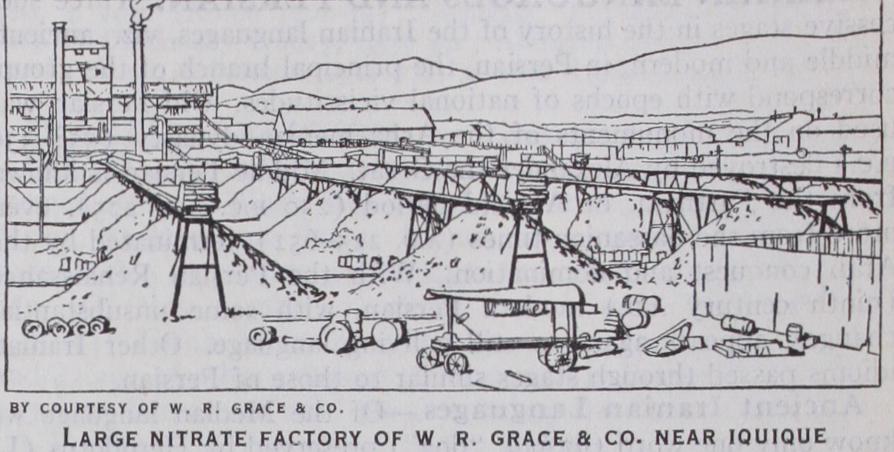
IQUIQUE, a city and port of Chile, capital of the province of Tarapaca, 820m. N. of Valparaiso, in 20° 12' 15" S., I 5" W. Population (1930) 46,458. The coast here runs due north and south and the city is built on a narrow level plain between the sea and bluffs, the latter rising steeply 2,000ft. to the level of the great desert plain of Tarapaci, celebrated for its rich deposits of nitrate of soda. Facing the city is the low barren island of Ser rano, or Iquique, which is connected with the mainland by a stone causeway i,sooft. long, and shelters the anchorage from southerly storms. A mole extending from the north-eastern end of the island affords further protection. The city is laid out on the rectangular plan, with broad streets and large squares. Water is brought by pipes from Pica, so miles distant. Iquique is a city of much commercial importance and is provided with banks, sub stantial business houses, newspapers, clubs, schools, railways, tramways, electric lights, telephone lines, and steamship and cable communication with the outside world. It exports iodine and
immense quantities of nitrate of soda obtained from the desert region of the province. A large number of vessels are engaged in the nitrate trade, and Iquique ranks as one of the two leading ports of Chile in the aggregate value of its foreign commerce. It is connected by rail with the inland town of Tarapaca and various mining centres, and through them with the ports of Pisagua on the north, and Patillos on the south. Iquique was an insignificant Peruvian fishing settlement until 1830 when the export of nitrate began. In 1868, the town was nearly destroyed by an earthquake, in 1875 by fire, and again, in 1877, by earth quakes, a fire and a tidal wave. It was occupied by the Chileans in 1879 in the war between Chile and Peru, and was ceded to Chile by the treaty of Oct. 20, 1883.