Virginia
population, house, assembly, election and white
The altitude of the mountainous ridges to the west of the Great valley varies from 1,50o to above 4,00o feet. Some of the valleys and slopes are of sandstone, some of slates and shales, some of limestone, so that they present a great variety of surface.
The rainfall is everywhere sufficient for farming. Snowfall is confined almost entirely to the three winter months and in the Piedmont and Tidewater region snow is infrequent and of short duration. In the mountains it often becomes very deep.
Flora.—The Coastal plain is covered with pine forests, which merge westward with the hard woods of the Piedmond section, where oaks formerly prevailed, but where a second growth of pine now constitutes part of the forest. The Blue Ridge and Allegheny regions are covered with pine, hemlock, white oak, cherry and yellow poplar ; while toward the south-west corner of the State there are still groves of walnut and hickory. The cypress grows in the Dismal swamp, the river birch along the streams of the coastal plain, and sweet gum and black gum where the ground is swampy. Characteristic plants of the coastal region are the cranberry, wild rice, wild yam, wax myrtle, wistaria, trumpet flower, passion flower, holly and white alder. Many of these continue into the Piedmont section. Rhododendron, moun tain laurel and azaleas are common in the mountains.
Population.
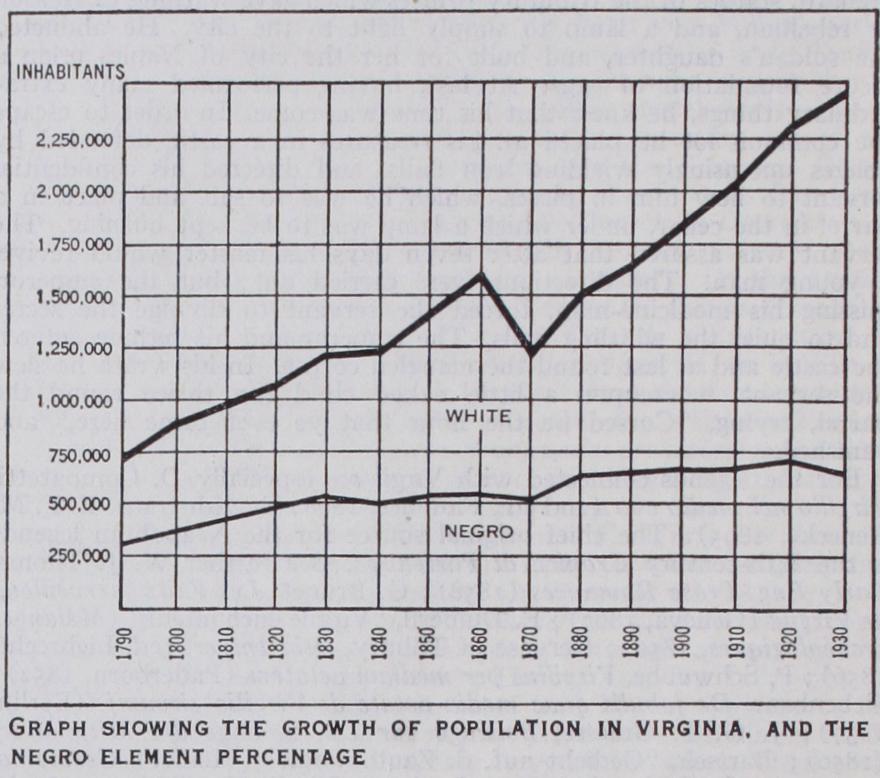
In 179o, the year of the first Federal Census, Virginia ranked first among the States in population, with 747,610 inhabitants. By 186o, just before the Civil War, population had about doubled. The separation of West Virginia during the Civil War lowered the total to 1,255,163 in 187o, but in 190o it was 1,893,81o, in 191o, 2,061,612 and in 192o, 2,309.187. The popu lation April I, 193o was given by the Federal Census at 2,421,851.
The density increased from 46.1 per sq.m. in 1900 to 57.4 per sq.m. in 192o, and to 60.2 in 193o.
Of the total in 1930 1,770,405 were of the white race, 650,165 were negroes, 779 Indians and 502 of other races. The percentage of negroes had decreased from 35.6 in 190o to 32.6 in 1910 and 26.8 in 193o. They were most numerous in the Tidewater region and in the south-eastern counties of the Piedmont district.
Of the white population 1,692,703 or 95.6%, were natives— born of native parentage. Those born of foreign or mixed parent age numbered 53,882 and those who were born in foreign lands numbered 23,82o. The percentage of illiteracy among the popu
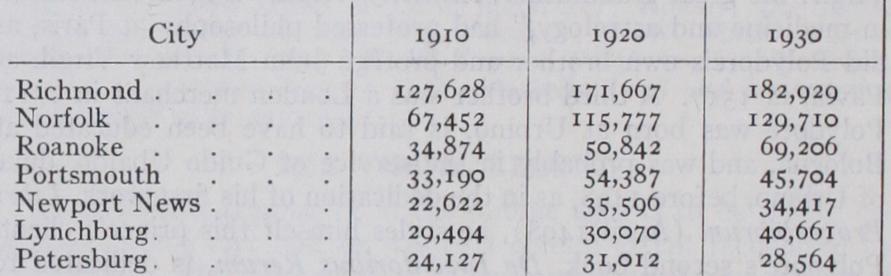
lation over 10 years of age amounted for the State as a whole to 8.7; among the native whites it was 4-8%; among the negroes 23.5%. The proportion of the population living in cities of more than 2,500 inhabitants increased from 18.3 in 190o to 23.1 in 1910 and 32.4% in 1930. The chief cities with their population according to the 191o, 192o and 193o censuses, are given in the following table : Government—Virginia has had six State Constitutions : the first was adopted in 1776, the second in 183o, the third in 1851, the fourth in 1864, the fifth in 1869 and the sixth, the present, in 1902. Amendments to the present Constitution may be proposed in either house of the general assembly, and if they pass both houses of that and the succeeding general assembly by a majority of the members elected to each house and are subsequently ap proved by a majority of the votes polled at the next general election they become a part of the Constitution. A majority of the members in each house of the general assembly may at any time propose a convention to revise the Constitution and, if at the next succeeding election a majority of the voters approve, the general assembly must provide for the election of delegates. To be entitled to vote one must be a citizen of the United States and 21 years of age; have been a resident of the State for one year, of the county, city or town for six months, and of the election precinct for 3o days next preceding the election.
The general assembly consists of a senate and a house of dele gates. Senators and delegates are elected by single districts (into which the State is supposed to be apportioned once every ten years according to population), the senators for a term of four years, the delegates for a term of two years. The member ship of both the senate and the house was in 1937 at the maximum allowed by the State Constitution, 4o senators and ioo delegates. The general assembly meets regularly at Richmond on the second Wednesday in January of each even-numbered year. The length of a regular session is limited to 6o days unless three-fifths of the members of each house concur in extending it.