Virginia
college, crops, value, coloured and school
There were 16,411 school teachers in the public school system in 1934. Their total salary was $13,228,000, or $779 each. Total expenditures for the public schools in 1933-34 amounted to $20, 362,000 as compared to $22,318,000 in 1932. This amounted to $7.83 per capita of population, or $32.72 for current expenses and $1.87 for outlay for each pupil. In comparison with other States Virginia stood 4oth, 41st, and 17th for each of these expenditures respectively. The amount spent on the coloured schools is much lower than the amount spent on the white schools.
Institutions for higher learning receiving State support are the University of Virginia at Charlottesville, the College of Wil liam and Mary at Williamsburg, the Virginia Polytechnic insti tute at Blacksburg, the Medical college of Virginia at Richmond, the Virginia Military institute at Lexington, four State teacher's colleges for women, located at Farmville, Fredericksburg, Har risonburg and Radford. These are for whites. The State supports one normal school for coloured teachers at Petersburg, and in addition there is the Hampton Normal and Industrial institute at Hampton, supported by endowment. Special schools are the Virginia School for the Deaf and Blind at Staunton, and the Virginia School for the Coloured Deaf and Blind at Newport News. Important private institutions of higher learning are : for men, Washington and Lee university at Lexington, Roanoke col lege at Salem. University of Richmond, which includes West hampton college (for women), Emory and Henry college at Emory, Hampden-Sidney college at Hampden-Sidney, Bridge water college at Bridgewater, Randolph-Macon college at Ash land and Lynchburg college ; for women, Hollins college at Hol lins, Randolph-Macon Woman's college at Lynchburg, and Sweet Briar college at Sweet Briar. Virginia Union university at Rich mond is for coloured students. For theological education there are the Theological seminary at Alexandria (Episcopal) and the Union Theological seminary at Richmond (Presbyterian).
Charities and Corrections.
The department of public wel fare has for its duties the inspection of all State, county, muni cipal and private institutions of a charitable or correctional nature, or those which have to do with the care or training of defective, dependent, neglected or criminal classes. It also enforces the juvenile and probations laws, inspects maternity hospitals, child placing agencies, children's nurseries' and orphan homes and ad ministers mother's aid to widows with children under 16 years of age. The State penitentiary is located at Richmond, and there is a State penitentiary farm at Lassiter. There is a State home and industrial school for white girls at Bon Air and for coloured girls at Peaks Turnout, a State industrial school for white boys at Beaumont and for coloured boys at Hanover.
Agriculture and Live Stock.
Agriculture is an important industry of Virginia. Its fluctuating fortunes are revealed by the following figures. Value of land and buildings amounted in the year 1920 to $1,024,435,000, in 1930 to $855,850,000 and in to $593,855,000. The amount of land in farms fell from 19,908,000 ac. in 1900 to 18,561,000 ac. in 1920 and 17,645,000 ac. in 1935 or from slightly more than three-fourths the area of the State in 1900 to approximately two-thirds the area in 1935. De spite this loss in acreage the number of farms increased from 170,610 in 1930 to 197,632 in 1935, their average size decreasing from 98.iac. in 1930 to 89.3ac. in 1935. The average value per acre of farm land decreased between 192o and 1930 from $40.75 to $30.24. Farm population was 950,757 (39.3% of the total) in 1930 and (39.9% of the total) in 1935. Of the 197,632 farms in 1935, 138,139 were operated by their owners, 58,386 by tenants and 1,107 by managers. White farmers numbered 154,421 and coloured farmers 43,211.
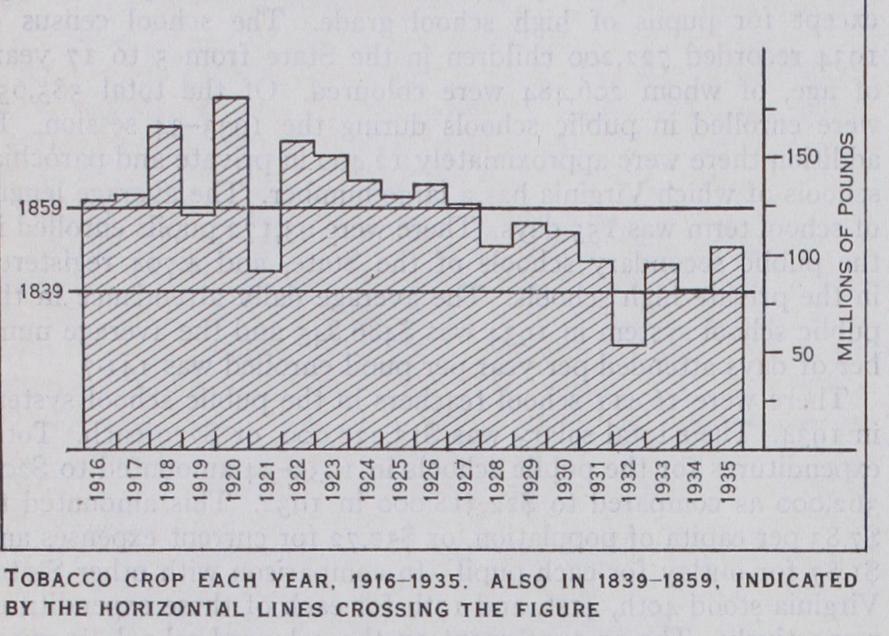
The yield of all crops was approximately average in 1935, the production of major crops, with the exception of cotton, oats and potatoes, was greater than in 1934. The total value of all crops in 1935 was estimated to be $74,459,000 ($61,500,000 in money crops sold direct, $12,959,000 in crops fed to live stock), com pared with $76,680,000 in 1934. Virginia in 1934 ranked third among the States in the value of the tobacco crop ; fourth in acreage and production of tobacco, production of apples and pea nuts harvested for sale ; fifth in the value of farm garden vegetables ; and sixth in production of snap beans and strawberries. The 1935 acreage of leading crops was as follows : corn, 1,5oi,000; tame hay, 976,000; wheat, 629,000; peanuts, 142,640 (in ; tobacco, 119,900; Irish potatoes, 9o,000; oats, 82,00o ; rye, 54,000; cotton, 52,00o. The leading crops in order of value were as follows: corn, $27,213,000; tobacco, $18,765,000; tame hay, $12,911,000; apples, $10,017,000; wheat, $7,278,000; Irish potatoes, ; pea nuts, $5,068,000 (in 1934) sweet potatoes, $2,466,000; cotton, $2,107,000; peaches, $928,88o; oats, $787,000 ; strawberries, 000 (in 1934). Of minor value were barley, soybeans, rye, pears, cowpeas, grapes, buckwheat and sorghums. The great acreage of tobacco, potatoes and truck crops gives Virginia a high rank in the average value per acre of all crops. Tobacco is the most important strictly money crop. With few exceptions its cultiva tion is confined to the section east of the Blue Ridge and west of the fall-line, and, excepting portions of a half-dozen counties, south of the James river. The Great valley and the Alleghany valleys are unsurpassed hay regions. Clover, timothy, herdsgrass or redtop, and alfalfa grow anywhere in the State. Long seasons and abundant rainfall give several cuttings. Wheat is the prin cipal money crop in the Shenandoah and Rappahannock river valleys. Cotton and peanuts are grown almost entirely in the south-eastern counties, where they constitute a large share of the farm income. During 1934, 97,542ac. were devoted to truck crops compared to 75,2o5ac. in 1929, the chief items, besides potatoes, being strawberries ($774,000), spinach, cabbage, beans, tomatoes and cucumbers.