BRANCHIOPODA, one of the sub-classes of the Crustacea (q.v.), comprising some of the most primitive existing forms of the class, distinguished by the flattened, leaf-like form of the limbs. Although, like most Crustacea, they cannot be said to have any popular English names, various members of the group have been distinguished by writers on natural history as Fairy shrimps, Tad pole shrimps, Clam shrimps and Water fleas. Nearly all of them are inhabitants of fresh water, and they are remarkable for the prevalence of parthenogenesis (reproduction by unfertilized eggs) and for the fact that the eggs resist desiccation and can survive for long periods in the dry state. Owing to this they often make their appearance in numbers in rain-pools, even in dry countries where for long periods no aquatic life is possible.
The members of the five orders named below differ much in structure. Those of the first four orders are characterized by the large number of somites, the general uniformity of the trunk limbs, and, in the living species, by the tubular form of the heart and the "ladder-like" arrangement of the central nervous system. These characters are very primitive, but on the other hand the palpless mandibles and the reduced maxillulae and maxillae are more specialized than those of some other Crustacea.

The Anostraca have no carapace and the fully segmented body is almost worm-like. The males are distinguished by the modi fication of the antennae into large and complicated claspers which are used for holding the females. The eyes are set on movable stalks. Most Anostraca inhabit rain-pools and other temporary accumulations of fresh water, but the "Brine-shrimp" (Artemia) is found in the brine of salt-pans in which sea-water is exposed to evaporation by the heat of the sun for the manufacture of salt., and in salt lakes in which the brine is so concentrated that few other animals can live in it. Brine shrimps are found all over the world wherever conditions are suitable. Specimens from differ ent localities differ considerably, but it has been shown that many of their variations are directly correlated with the degree of salinity of the water and probably many of the forms described are variants of a single cosmopolitan species. The brine shrimps are the only Anostraca known to be parthenogenetic, some colonies consisting entirely of females.
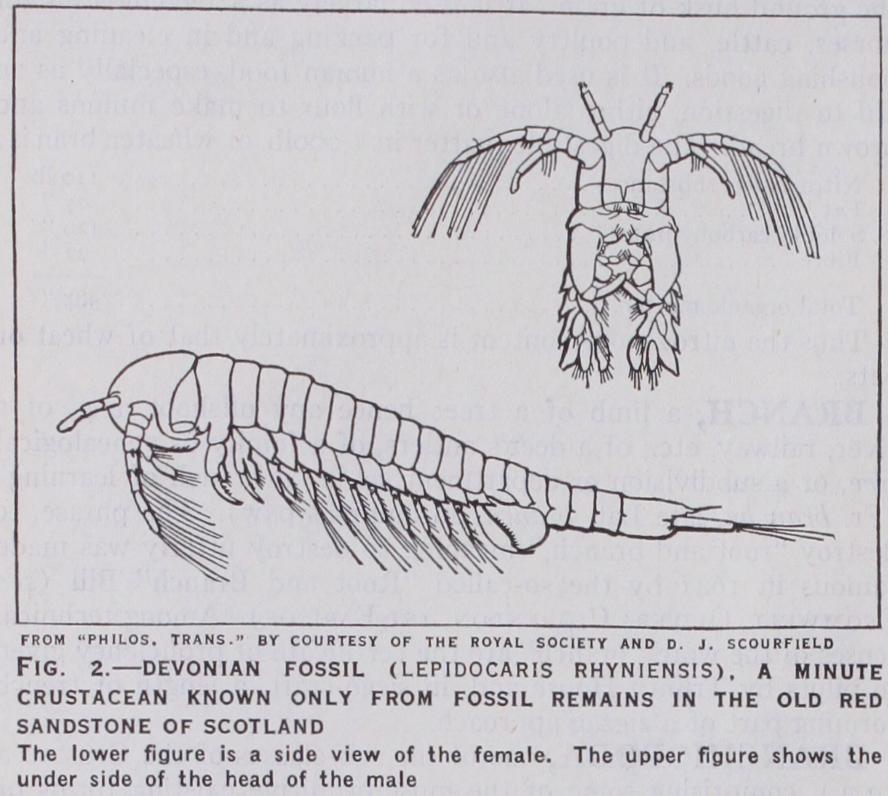
Related to the Anostraca is the order Lipostraca established for the remarkable fossil Lepidocaris discovered in the old red sand stone of Scotland. The remains of this minute Crustacean al though fragmentary are so per fectly preserved that its structure is known in greater detail than that of any other fossil Crus tacean. Resembling the Anos traca in general form, it differs from them in the structure of the limbs, of which the posterior pairs are simply biramous ; in the absence of paired eyes ; and, most remarkably, in the claspers of the male which are formed, not by the antennae but by the maxillulae.
The Notostraca have a broad, shield-shaped carapace covering the fore part of the body and giving the animals, at first sight, some resemblance to the Arach nidan King Crabs, with which, however, they have no near re lationship. The somites and ap pendages are more numerous than in any other living Crus tacea. The eyes are sessile on the upper surface of the head, and the antennules and antennae are much reduced, their place as "feelers" being perhaps taken by - - the filamentous terminal processes of the first pair of feet. The principal genus is Apus (Triops), the species of which may be two or even three inches long. Reproduction is largely partheno genetic and males are rare.
The Conchostraca have the carapace in the form of a bivalve shell enclosing the body and limbs and marked with concentric "lines of growth," so that it resembles very closely the shell of a lamellibranch mollusc. The large two-branched antennae are used in swimming. The paired eyes are sessile and are more or less completely coalesced into one.
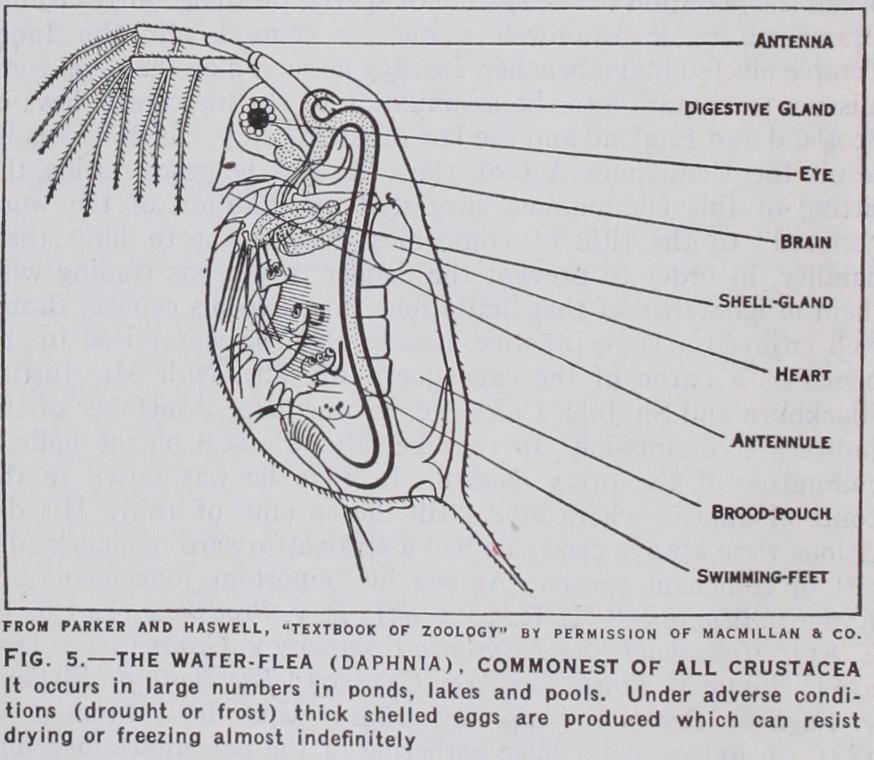
The Cladocera are closely related to the Conchostraca, from which they should not, perhaps, be separated as a distinct order, and from which they differ chiefly in the great reduction in the number of body-somites and of limbs. They are the "water fleas" which are abundant everywhere in ponds and lakes. All are of small size and some species which do not exceed one hundredth of an inch in length are among the smallest of living Crustacea. Their transparency, which allows the internal structure to be studied in the living animal, makes them interesting objects for microscopic examination. The Cladocera reproduce largely by parthenogenesis. The developing eggs are carried within the shell of the female. In addition to the parthenogenetic eggs, which hatch while still within the brood chamber, the Cladocera produce, at certain seasons, another kind of eggs which require to be fertilized. These eggs have a thick shell and do not hatch at once but are cast off when the shell of the female is moulted and often a specially thickened part of the shell forms an addi tional protection. These "resting eggs" can survive drying or freezing without injury. They are often produced in autumn and do not hatch until the following spring; in species that live in small pools, they may be produced in spring to ensure against the drying up of the habitat in summer.