
BRANDY, an alcoholic potable spirit distilled from fer mented grape juice. The term is often regarded as having the same application as the German "Branntwein" or the French "brandevin." This is not correct, as in France and Germany the respective titles are applied to any spirit obtained by distillation, the significance of the word being in the first syllable "brand" meaning burnt or burning. In France, also, brandy is known as Eau de Vie, a title which is applied equally and with legal author ity to spirit distilled from wine, cider, perry, cherries, plums and "mare." It is evident also that at one time the term "brandy" or "brandy wine" had a similarly wide significance in England. Thus the preamble to an act passed in 1690 in the reign of William and Mary runs, "Whereas good and wholesome brandies, aqua vitae, and spirits may be drawn and made from malted corn, etc.," and as late as 186o the Spirits act of that year prescribed that "all spirits which shall have had any flavour communicated thereto and all liquors whatsoever which shall be mixed or mingled with any such spirits shall be deemed a British compound called `British brandy'." This section was repealed in 188o and during the past half century the accepted sense of the term has been re stricted to spirits obtained by distillation from fermented grape juice.
The definitions in the pharmacopoeia are of interest. Thus that of the United States for 1926 describes "Spiritus Vini Vitis" as "an alcoholic liquid obtained by the distillation of the fermented juice of sound, ripe grapes and containing not less than 54% by volume of at 15.56°C. It must have been stored in wood containers for a period of not less than four years." It is "a pale amber colored liquid, having a characteristic odour and taste and an acid reaction. Specific gravity from 0.933 to 0.941 at The British Pharmaceutical Codex (1923) under the title "Spiri tus Vini Gallici" states that "brandy is obtained by distillation from the wine of grapes, and matured by age. It occurs as a pale amber coloured liquid, having a characteristic odour and taste and, as a rule, a slightly acid reaction. Specific gravity about 0.957. It contains about 4o% by volume of ethyl hydroxide. It contains minute quantities of volatile acid, aldehydes, furfural, esters and higher alcohols, to which impurities or secondary products the characteristic flavour and odour are due." Commercial brandy, however, does not correspond exactly with these definitions. As distilled it is a colourless liquid, but storage in casks, necessary to allow the spirit to mature, results in the extrac tion of certain materials from the wood imparting a pale brown colour to the liquid. This colouration varies with each cask and, for purposes of commercial standardization, a varying amount of caramel is added to bring the colour up to a uniform tint.
The brandies which enjoy the greatest popular favour are those from the Cognac district and the extension of the name to include the word Cognac, e.g., "Eau de Vie de Cognac," under the French law can be applied only to spirits so derived. Brandy is manufac tured in other districts of France such as Armagnac, Marmande, Nantes and Anjou, the spirit of poorest quality being known as Trois-Six de Montpellier.
It is of interest that, according to Beckmann, brandy is said to have been introduced into France from Italy in 1533 on the occa sion of the marriage of Henry II., then Duke of Orleans, to Cath erine de Medici. At the present time production in Italy is com paratively negligible. In other wine producing countries such as Spain and Algiers brandy is manufactured, the Spanish product being of high quality and resembling the French. In Australia and South Africa production is steadily increasing, although very little brandy is exported.
Another spirit for which the title Brandy is claimed is that obtained from the marc—the grape skins and other residue of the wine press. Although possessing characteristics of its own, Marc or "Dop" brandy, as it is called in South Africa, is generally accepted and is often of good quality.
During the period when the manufacture and sale of alcoholic liquors for beverage purposes were prohibited in the United States, there was a marked decrease in the quantity of brandy imported into this country, the figures, for example, in 1924 and 1925 being respectively 4,125 and 4,236 gallons, as compared with 510,725 in 1914.
In Great Britain and Northern Ireland also there was consider able decrease in the demand, the number of proof gallons retained for consumption from 1922 to 1927 being as follows: These figures can be compared with those for the years 1913-14 and 1921-22 both of which, however, included the whole of Ireland. Although doubtless this decrease was due partly to alteration in the popular taste, it may also be ascribed in some measure to the increase in duty, which in 1914 was 15s. id. per proof gallon in cask and in 1928 £3. 15s. 4d. full duty and £3. 12s. on spirit imported from British Dominions.

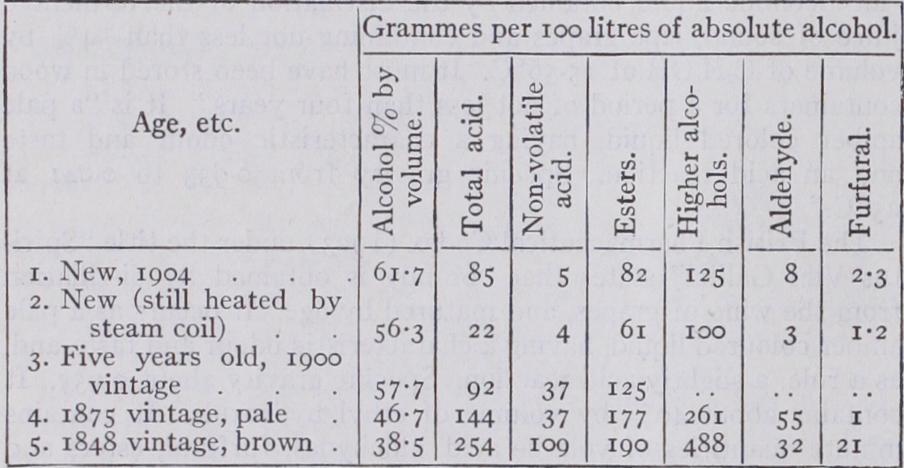
Normal propyl alcohol 40.0 Normal butyl alcohol 218.6 Amyl alcohol 83.8 Heyl alcohol . . . . . . . . o•6 Heptyl alcohol 1.5 Acetic ester . . . . . . . . . 35 •0 Propionic, butyric and caproic esters . 3•o Oenanthic ester (about) 4.0 Acetal and amines . . . . . . traces It is to one of the esters—oenanthic ester or ethyl pelargonate that the characteristic flavour of brandy is supposed more partic ularly to be due. Ordonneau attributes the peculiar fragrant odour to a small quantity of a terpene which in old brandy becomes oxi dized. The nature and proportion of the secondary ingredients vary, however, depending primarily upon the character of the wine employed, which in its turn is liable to many varying influ ences. The type of fruit and the composition of the soil are of first consideration. In the Cognac district, where the soil is mainly calcareous, the fruit is a small white grape with very acid juice, yielding a wine of inferior quality for drinking purposes. The wine produced in the Midi is also unsuitable for drinking and is dis tilled. This district was one of those ravaged by the Phylloxera, a disease which devastated the French vine-growing areas in the years 1875-78. Vineyards which had suffered were replanted with vines which were not appropriate to the soil, the resultant wine being of poor quality. In wines of this character, especially if they have been allowed to become sour, the proportion of acids, esters and other substances which are likely to be distilled with the alcohol and water is high. The method of distillation also has a marked effect upon the ultimate product. In the Cognac district a small "pot" still is generally used, and this, from its construc tion, ensures the retention in the distillate of the larger bulk of the volatile ingredients of the wine, to which the well known bouquet of Cognac brandy is due. Care is taken to carry out the distillation very slowly over a wood fire, a quantity of about 200 gallons of wine being operated upon in ten hours.
The spirit obtained from wine of inferior quality and that dis tilled from the mare contains a high proportion of secondary products. Occasionally this is used for blending with "clean" spirit obtained from grain, beet, etc., the consequent dilution of the secondary products yielding a so-called brandy, the analytical values of which correspond very closely with those of a good brandy. The stills used are of a much more complicated pattern, varying in type from the small pot still with a rectifying head to the elaborate distilling column from which fractions of higher or lower strength can be drawn as desired. A high degree of rectifi cation is possible in apparatus of this character, which is often used for the production of strong spirit for industrial purposes or for the preparation of liqueurs.