
BREADFRUIT. This important staple food of the tropical islands in the Pacific ocean is the fruit of Artocarpus incisa (family Moraceae). The tree attains a moderate height, has large, acutely lobed, glossy leaves, the male flowers in spikes, and the female flowers in a dense head, which by consolidation of the fleshy carpels and receptacles form the fruit. This is globular, about the size of a melon, with a tuberculated or nearly smooth surface. Many varieties are cultivated; in the best kinds the seeds are aborted. The tree is a native of Polynesia and Malaysia, where its fruit occupies the position held by cereals in temperate latitudes. Distinct varieties ripen at different periods, affording a nearly constant supply; it is gathered just before it ripens, when it is gorged with starchy matter. It may be prepared in a variety of ways, the common practice in the South Sea Islands being to bake it entire in hot embers and scoop out the interior, which should have a soft smooth consistence, fibrous only towards the heart, with a taste comparable to that of boiled potatoes and sweet milk. Of this fruit A. R. Wallace (Malay Archipelago) says : "With meat and gravy it is a vegetable superior to anything I know either in temperate or tropical countries. With sugar, milk, butter, or treacle it is a delicious pudding, having a very slight and delicate but characteristic flavour, which, like that of good bread and potatoes, one never gets tired of." A common method of preserving the fruit consists in cutting it into thin slices, which are dried in the sun. From such slices a flour is prepared which is used for puddings, bread, and biscuits, or the slices are baked and eaten without grinding. The tree also yields cloth from the fibrous inner bark; the wood is used for canoes and furniture; and a glue and caulking material are obtained from the viscid milky juice which exudes from incisions in the stem.
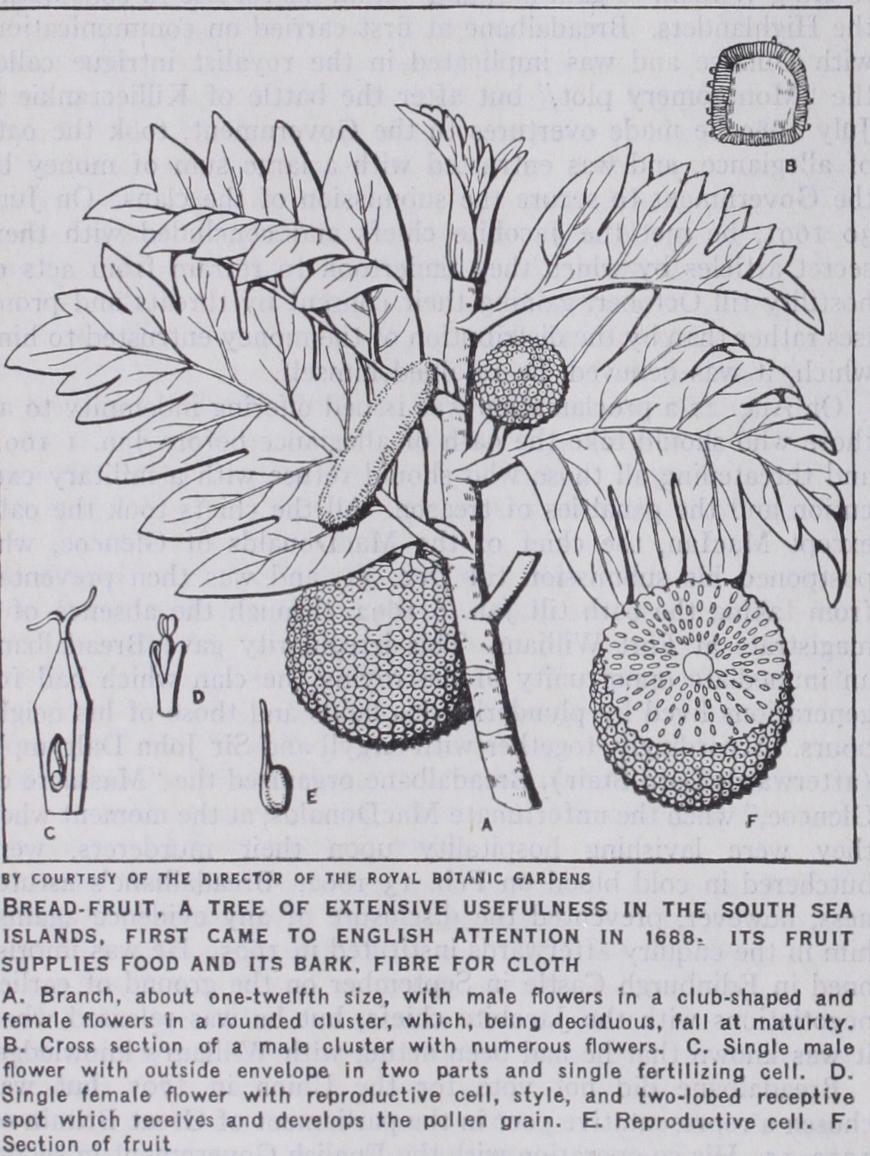
The bread-fruit is found throughout the tropical regions of both hemispheres, and its introduction into the West Indies is connected with the famous mutiny of the "Bounty." A similar but inferior fruit is produced by an allied species, the jack, A. integrifolia, growing in India, Ceylon and the Eastern Archipelago. The large fruit is 12—I 8in. long by 6-8in. in diameter, and is much eaten by the natives in India. This tree is valuable on account of its timber, which has a grain similar to mahogany.