
BREVIARY, the book which contains the daily service for the canonical hours in the Roman Catholic Church (Lat. breviar ium, abridgment, epitome). It includes psalms, lessons, antiphons, etc., for every day in the year; but excludes the Eucharistic of fice (contained in the Missal) and the rites of baptism, marriage, ordination, etc. (which are found in the Ritual or the Pontifical). In the early days of Christian worship the Bible furnished all that was required, containing as it did the books from which the lessons were read and the psalms recited. The first step in the evolution of the Breviary was probably the separation of the Psalter into a choir-book. The monastic practice of daily recit ing the 150 psalms took so much time that the monks began to spread it over a week, dividing each day into hours, with its allotted psalms for each hour. St. Benedict in the 6th century drew up such an arrangement, and the Roman division, which remained practically unchanged until 1912, is perhaps even older. To the Psalter were added, in course of time, other service-books, containing prayers, antiphons, etc. Jean Beleth, a 12th-century liturgical author, gives a long list of books needful, besides the Psalter and Old and New Testaments, for right conduct of the canonical office :—Antiphonary, Passionary, Collectar, etc. The inconvenience of using such a library naturally led to the substi tution of one compendious volume. Attempts in this direction were made as early as the 8th century by Alcuin, and a little later by Prudentius, bishop of Troyes; Gregory VII. (pope 1073-85) simplified the liturgy used at the Roman court, and gave his abridgment the name of Breviary. But the earliest extant ms. containing the whole canonical office is of the year 1o99 (from Monte Cassino, now in the Mazarin library). A few 12th century Breviaries are extant, all Benedictine; but under Innocent III. (pope 1198-1216) their use began to be more general. The Breviary of the Roman court was adopted (with some modifica tions, e.g., the substitution of the "Gallican" for the "Roman" version of the psalms) by the newly founded order of Franciscan friars, with the authorization of Gregory IX. (1227-41); and through their wide-ranging activity it became known all over Europe, and supplanted the older partial books. Nicholas III. (1277-80 introduced the Franciscan Breviary for the Roman churches, and thus made its position secure. It did not, however, supersede the various local diocesan Breviaries until 1568, when Pius V. issued it in a revised form, and made it obligatory in every diocese where the local use could not show at least 200 years of existence ; and since then it has gradually become uni versal except in the Benedictine, Dominican and some other re ligious orders, in the diocese of Milan (where the Ambrosian use persists), and in the cathedrals of Toledo and Salamanca (where the Mozarabic use, once universal throughout Spain, is still fol lowed). Of the many revisions of the Roman Breviary the most remarkable is that by Cardinal Francis Quinones , which, undertaken by order of Clement VII., passed through many edi tions before its suppression in 1568, and was largely used by the compilers of the English Prayer Book of 1549. The Pian Breviary was altered by Clement VIII. in 1602 (through Baronius and Bel larmine), especially as concerns the rubrics; and by Urban VIII. , a purist who unfortunately tampered with the text of the hymns, injuring both their literary charm and their historic worth.
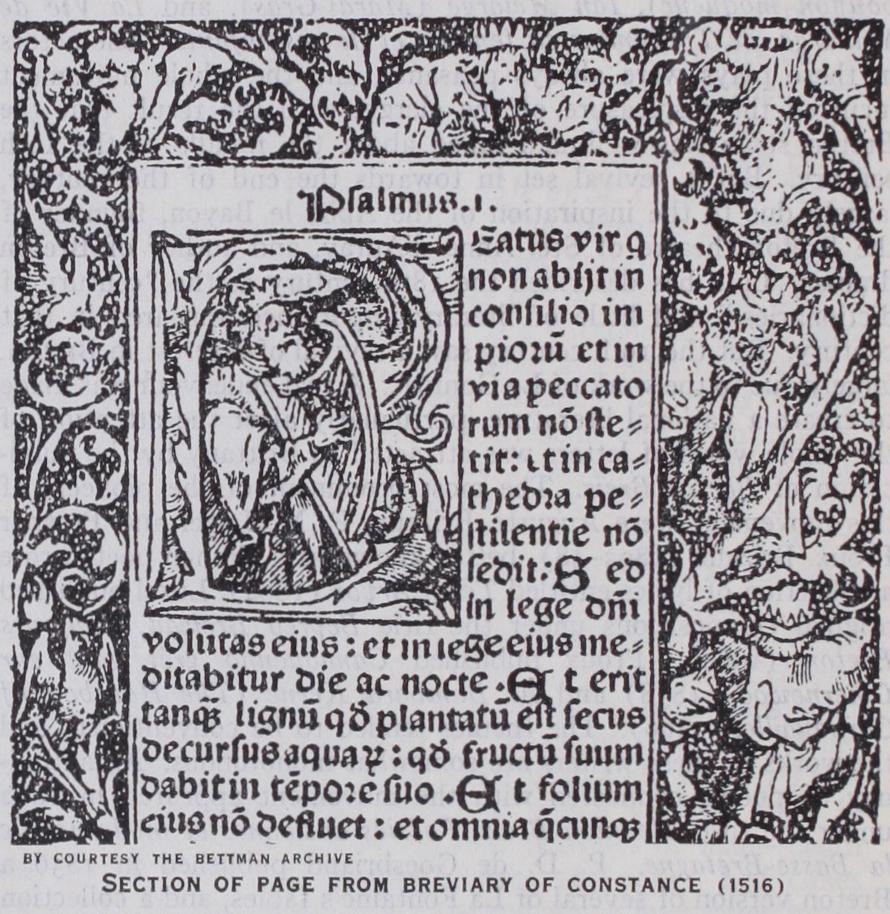
In the 17th and 18th centuries a movement of revision, largely under Gallican and Jansenist influences, but also in the interests of sound critical scholarship, took place in France, and succeeded in modifying about half the Breviaries of that country. These re formed French Breviaries—e.g. the Paris Breviary of 1680 by Archbishop Francois de Harlay (1625-95) and that of 1736 by Archbishop Charles Gaspard Guillaume de Vintimille —show a deep knowledge of Holy Scripture, and much careful adaptation of different texts; but during the pontificate of Pius IX. a strong Ultramontane movement arose against them. This was inaugurated by Montalembert, but its literary advocates were chiefly Dom Gueranger, a learned Benedictine monk, abbot of Solesmes, and Louis Veuillot (1813-83) of the Univers; and it succeeded in suppressing them everywhere, the last diocese to surrender being Orleans in 1875. The Jansenist and Gallican in fluence was also strongly felt in Italy and in Germany, where Breviaries based on the French models were published at Cologne, Munster, Mainz and other towns. Meanwhile, under the direction of Benedict XIV. (pope 1740-58), a special congregation col lected many materials for an official revision, but nothing was published. In 1902, under Leo XIII., a commission under the presidency of Monsignor Louis Duchesne was appointed to con sider the Breviary, the Missal, the Pontifical and the Ritual. The findings of this commission have not been published ; but Pius X., by the Apostolical Constitution "Divino Afflatu" (Nov. 1, 1911), ordained (as from Jan. 1, 1913) the use of a newly arranged Psalter, as well as the observance of certain new regula tions in the manner and order of reciting the office—the main object of the changes being to restore the weekly recitation of the entire Psalter.
The beauty and value of many of the Latin Breviaries were brought to the notice of English churchmen by one of the num bers of the Oxford Tracts for the Times, since which time they have been much more studied, both for their own sake and for the light they throw upon the English Prayer Book.
From a bibliographical point of view some of the early printed Breviaries are among the rarest of literary curiosities. Being merely local, the copies were not spread far, and were soon worn out by daily use. Doubtless many editions have perished without leaving a trace of their existence, while others are known by unique copies. In Scotland the only one which has survived the convulsions of the i6th century is that of Aberdeen, a Scottish form of the Sarum Office, revised by William Elphinstone (bishop 1483-1514), and printed at Edinburgh in 1509-10 (the Sarum Rite was much favoured in Scotland as a kind of protest against the jurisdiction claimed by the church of York). Four copies have been preserved, and it was reprinted in 1854 for the Bannatyne Club. It is particularly valuable for the notices of early Scottish history embedded in the lives of the national saints. Though en joined by royal mandate in 1501 for general use within the realm of Scotland, it was probably never widely adopted. The new Scottish Proprium sanctioned for the Roman Catholic province of St. Andrews in 1903 contains many of the old Aberdeen collects and antiphons.
The Sarum Breviary itself, originally compiled by St. Osmund (bishop of Salisbury 1078-99) was very widely used. Many edi tions were printed in the 15th and i6th centuries. Other English uses are those of York (observed in the northern province) and Hereford.
I. Psalter.—The psalms arranged in sections, with prayers, hymns, antiphons, etc., for the several hours throughout the week. In the new Breviary the psalms are arranged so that the whole psalter may be recited each week, and (by dividing some of the longer psalms) that the portion allotted to each day's office may be of approximately the same length (e.g., the quota for Matins is nine psalms of 15 verses each). Psalms cxlviii.–cl. are always used at Lauds, and give that office its name. The text of the psalms is that commonly known as the Gallican, i.e. St. Jerome's second revision of the Old Latin version. This was adopted at Rome in the 13th century (having long been accepted elsewhere) instead of his first revision, the so-called Roman version, which is still used in St. Peter's.
2. Proprium de Tempore.—The lessons, little chapters, and special antiphons, etc., for every Sunday and week-day throughout the ecclesiastical season.
3. Proprium Sanctorum.—The like for saints' days and other festivals determined by the day of the month. The lessons con sist largely of summaries of the saints' lives, and this part of the Breviary, though revised from time to time, is often criticized adversely as containing historical inaccuracies. As about 90% of the days in the year have, during the course of centuries, been allotted to some saint or other, it is easy to see how this section of the Breviary has encroached upon the Proprium de Tempore. This has long been one of the chief problems involved in a re vision of the Breviary; it is dealt with to some extent in the re formed Psalter of Pius X.
4. Commune Sanctorum.—Offices for feasts of various groups or classes of saints (apostles, evangelists, martyrs, etc.), for the dedication of a church, and for feasts of the Blessed Virgin Mary. These offices are of very ancient date.
5. Extra Services.—These include the Little Office of the Blessed Virgin Mary, the Office of the Dead and offices peculiar to each diocese.
It has already been indicated, by reference to Matins, Lauds, etc., that not only each day, but each part of the day, has its own office, the day being divided into liturgical "hours." A de tailed account of these will be found in the article HOURS, CANON ICAL. Each of the hours of the office is composed of the same elements, viz. psalms (including canticles), antiphons, respon sories, hymns, lessons, little chapters, versicles and collects.
The psalms have already been dealt with.
The Psalter of the Breviary also includes seven Old Testament canticles for use of Lauds, viz. the Song of the Three Children (Dan. iii. 57-88, on Sunday), Song of Isaiah (Is. xii., Monday), Song of Hezekiah (Is. xxxviii. 10-2o, Tuesday), Song of Hannah (I Sam. ii. I–IO, Wednesday), Song of Moses (Exod. xv. 1-19, Thursday), Song of Habakkuk (Hab. iii., Friday), Song of Moses (Dent. xxxii. 1-43, Saturday), and three from St. Luke, viz. the Benedictus (i. 68-79) at Lauds, Magnificat (i. 46-55) at Ves pers, and Nunc Dimittis (ii. 29-32) at Compline.
The antiphons are short liturgical forms, of biblical or patristic origin, used before and after a psalm. The term originally sig nified a chant by alternate choirs, but has quite lost this meaning in the Breviary.
The responsories and versicles are similar in form to the anti phons, and are used with them before and after psalms, also after the lessons and little chapters, and sometimes after prayers.
The hymns are short poems going back in part to Prudentius and Ambrose. Together they make a fine collection, despite Urban VIII.'s misguided attempts to improve them.
The lessons are drawn from the Bible, the Acts of the Saints, and patristic homilies. In the lessons, as in the psalms, the order for special days breaks in upon the normal order of ferial offices and dislocates the scheme for consecutive reading. The lessons are read at Matins (which on Sundays and feast-days is sub divided into three nocturns).
The little chapters are very short lessons read at the other "hours." The collects come towards the close of the office and are short prayers summing up the supplications of the congregation. They are largely drawn from the Gelasian and other Sacramentaries.
Every clerk in orders and every member of a religious order must publicly join in or privately read aloud (i.e., using the lips as well as the eyes) the whole of the Breviary services allotted for each day. Laymen do not use the Breviary to any great extent.
The Roman Breviary has been translated into English (by the marquess of Bute in 1879: new ed. with a trans. of the Martyro logy, 1908), French and German. The English version is note worthy for its inclusion of the skilful renderings of the ancient hymns by J. H. Newman, J. M. Neale and others.
Cabrol, Introduction aux etudes liturgiques; Probst, Kirchenlex., ii., s.v. "Brevier" ; Baumer, Geschichte des Breviers (Freiburg, 1895) ; P. Batiffol, L'Histoire du breviaire romain (3rd ed., Paris, 1911 ; Eng. tr.) ; Baudot, Le Breviarre romain (19o7) . A com plete bibliography is appended to the article by F. Cabrol in the Catholic Encyclopaedia, vol. ii. (1908) . For the reforms introduced by Pius X. see Cath. Enc., vol. xvi. (1914) , pp. 13-14; E. Burton and E. Myers, The New Psalter and its use (1912) ; E. J. Quigley, The Divine Office: a study of the Roman Breviary (1920).