
BRISBANE, the capital city of Queensland, Australia, situ ated (27° 28' S., 153° 2' E.) near the south-eastern corner of the state on the Brisbane River about 14m. from its mouth in Moreton Bay. The city lies astride the river, which here winds through gently hilly country ; the low-lying river flats have been visited by disastrous floods. Inland the roomy basins and valleys of the Brisbane and Logan give access to the uplands of the Darling Downs and of northern New South Wales.
Northwards lowlands, interrupted by hill-ranges (Glasshouse Mountains), lead towards the central coastal basins. The cli mate is subtropical: mean ann. temps. about F (absol. extremes: 1o9°-36° F) with about 2,64o hours sunshine; ay. ann. rainfall 45 in. (variation 88 in.-24 in.), falling chiefly in Dec. March. Spells of excessive heat are very rare, but the heat for two or three months in summer is moist and oppressive. Brisbane began (1824) as a penal settlement, and was named after the Governor, Sir T. M. Brisbane. Its civil status was established in 1842, and, after a period of difficulties, it became (1859) the official capital of the newly-created colony of Queensland. The present metropolitan area (Greater Brisbane) covers some io sq.m. (including South Brisbane), and has a population of about 299,782 (1933) or about 31% of the total population of Queens land (birth-rate about 23 : deaths about io per i,000). Like the other Australian capitals, Brisbane is spacious, solidly built and well laid-out. There are also ample and beautiful recreation grounds, parks and public gardens. The city is served with elec tricity, has an abundant water supply and good sanitation. The river is crossed by bridges and services of ferry-boats. The centre of a rich agricultural, pastoral and mining area, stretching back to the Darling Downs and the western plains beyond, Brisbane has attracted to itself considerable trade and manufacturing industry. There were (1925) some 677 factories in all, employing 23,000 hands, and having a total output valued at nearly £17,225,000, (gross). The industries are connected mainly with the production of foodstuffs and clothing, but include also engineering, saw milling, tanning and motor-building. Coal is conveyed down stream from Ipswich. Railways radiate inland in various direc tions, and link the Darling Downs (Warwick, Toowoomba, etc.) to the capital, while the Charleville line, in particular, opens up the heart of pastoral Southern Queensland. Northwards the coastal line links the "sugar" ports and southwards main-line connection exists with Sydney (via Warwick), while a new (4' 82" standard gauge) through-link is being constructed by the coastal route (South Brisbane–Kyogle). A dredged channel in the lower Brisbane river (400 ft. wide, 26-24 ft. deep low water with 7 ft.
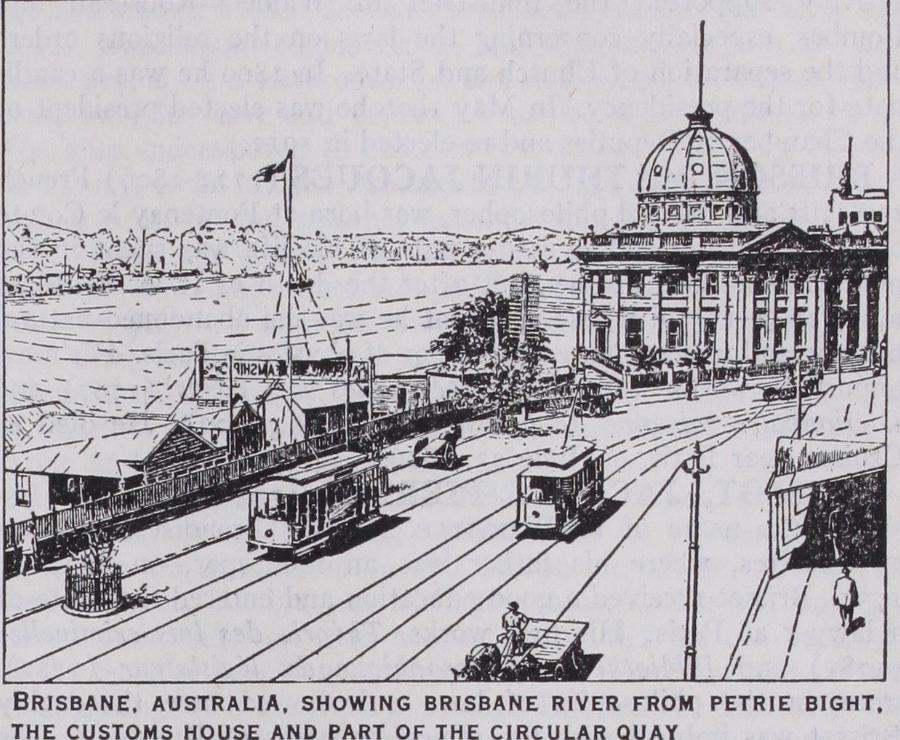
[max.] tidal rise) gives access to Brisbane from the sea. There are over 14,000 f t. of wharfage with depths alongside of 23-30 ft.; a proposed basin at Hamilton (about 4m. downstream) will provide a further 18,000 ft.; there is also a dry dock, and three patent slip ways. In 1925-26 over 3,000,00o tons of shipping used the port, including ships of the regular ocean lines. The total trade is valued at about /29,500,000, of which f 18,000,000 repre sents exports (wool, meat, and other cattle products, sugar, dairy products, and maize, wool representing more than half of the total value). In spite of the extended nature of the coast and the relatively uncentralized nature of economic development in Queensland, Brisbane is by far the largest and most rapidly growing port.