
BRISTOL, parliamentary and county borough, city and sea port of England, in Gloucestershire and Somersetshire, but also a separate county in itself with its own assizes, lying on both sides of the river Avon at the confluence of the rivers Avon and Frome, 118m. W. of London by rail. Population (1920 376,975 (census of 396,918. The Avon here forms the boundary between Gloucestershire and Somersetshire. Although entering the Bristol Channel only eight m. below the city, it is confined between considerable hills, with a narrow valley-floor on which the nucleus of the city rests. Between Bristol and the Channel the valley becomes a gorge, crossed by the famous Clifton Sus pension bridge. Above Bristol the hills again close in at Keyn sham, so that the city lies in a basin-like hollow some four m. in diameter, and extends up the heights to the north. The G.W.R., striking into the Avon valley near Bath, serves Bristol from Lon don, connects it with South Wales by the Severn tunnel, and with the southern and south-west counties of England. The G.W.R. ex press trains to London, however, are run on the line via Badmin ton. Local lines of this company encircle the city on the north and south, serving the outports of Avonmouth and Portishead on the Bristol Channel. A trunk line of the L.M.S.R. connects Bris tol with the north by way of Gloucester, Worcester, Birmingham and Derby. The central station, Temple Meads, is used by the G.W.R., and by the L.M.S. and L.N.E. Joint Railways.
Early History.—Bristol (Brigstow, Bristou, Bristole) is one of the best examples of a town that has owed its greatness entirely to trade. It was the western limit of the Saxon inva sion of Britain, and about the year moo a Saxon settlement began to grow up at the junction of the rivers Frome and Avon. Bristol owed much to Danish rule, and during the reign of Canute, when the wool trade with Ireland began, it became the market for English slaves. In Domesday it was already a royal borough, with a mint. One-third of the gold was paid to Geoffrey de Coutances, bishop of Exeter, who threw up the earthworks of the castle. Earl Robert of Gloucester still further strengthened the castle, probably with masonry, and involved Bristol in the rebel lion against Stephen. A charter of 1172 granted the city of Dublin to the men of Bristol as a colony with the same liberties As their own town.
As a result probably of the close connection between Bristol and Ireland the growth of the wool trade was maintained. About this time Bristol began to export wool to the Baltic, and had de veloped a wine trade with the south of France, while soap making and tanning were flourishing industries. Bristol was still organized manorially rather than municipally.
At some date after this a commune was established in Bristol on the French model, Robert FitzNichol, the first mayor of Bristol, taking the oath in 1200. The mayor was chosen by the merchants of Bristol who were members of the merchant gild.
In the reign of John, Bristol began the struggle to absorb the neighbouring manor of Bedminster, the eastern half of which was held by the Templars by gift of Earl Robert of Gloucester, while the western half, known as Redcliffe, had been sold to Robert FitzHardinge. The Templars acquiesced, but the wealthy owners of Redcliffe resisted for nearly zoo years. In 1247 a new course was cut for the river Frome, vastly improving the harbour, and a stone bridge was built over the Avon, bringing Temple and Redcliffe into closer touch with the city. About this time Bristol seems to have become practically independent of the king. The exclusiveness of the merchant gild led to the insurrection of 1312. During the reign of Edward III., cloth manufacture devel oped in Bristol. Thomas Blanket set up looms in 1337, employing many foreign workmen, and in 1353 Bristol was made one of the staple towns.
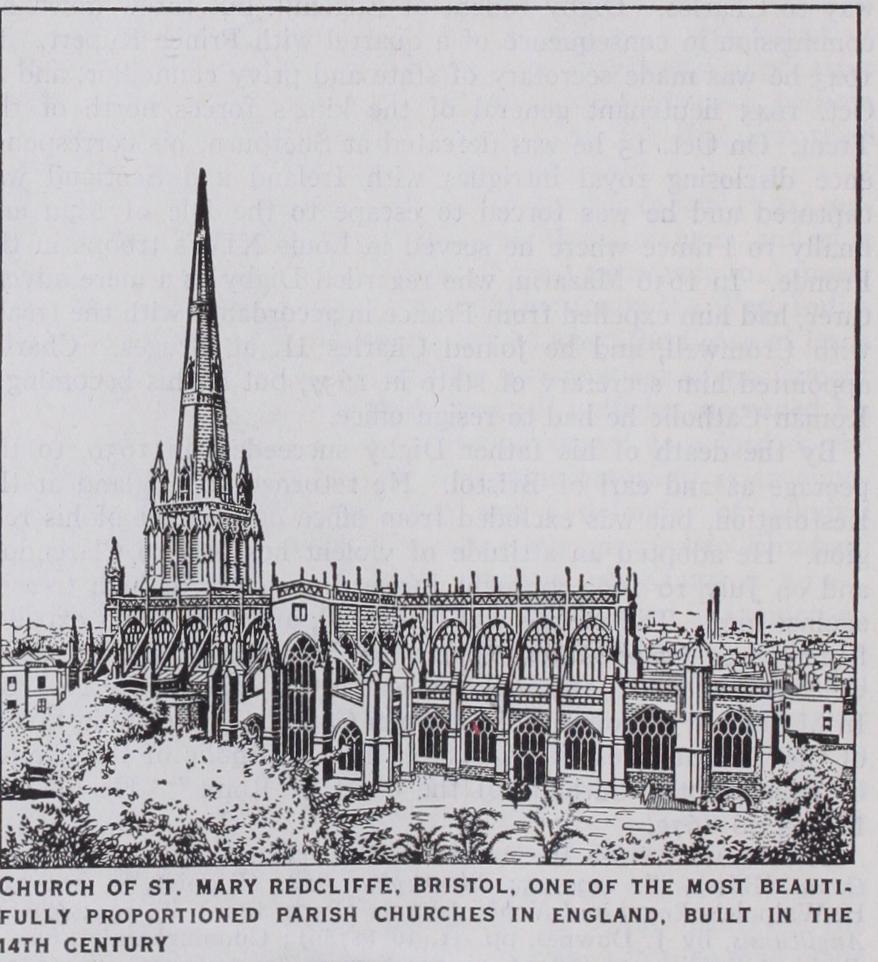
The charter of 1373 extended the boundaries of the town to include Redcliffe (thus settling the long-standing dispute) and the waters of the Avon and Severn up t'o the Steep and Flat Holmes, and made Bristol a county in itself, independent of the county courts. It was the first city outside of London to receive this honour. This charter (confirmed in 1377 and 1488) was followed by the era of William Canyng, of the foundation of the Society of Merchant Venturers, and of the voyages of John and Sebastian Cabot. William Canyng was five times mayor and twice represented Bristol in parliament he carried on a huge cloth trade with the Baltic and rebuilt St. Mary Redcliffe.
In the 16th century Bristol traded with Spain, the Canaries and the Spanish colonies in America, shared in the attempt to colonize Newfoundland, and began the trade in African slaves which flour ished during the 17th century. A formal charter of incorporation was granted in 1664. In the 18th century the cloth trade declined owing to the competition of Ireland and to general migration of manufactures to the northern coalfields, but prosperity was main tained by the introduction of manufactures of iron, brass, tin and copper, and by the flourishing West Indian trade, sugar being taken in exchange for African slaves.
The hot wells became fashionable in the reign of Anne (who granted a charter in 171o), and a little later Bristol was the centre of the Methodist revival of Whitfield and Wesley. The city was small, densely populated and dirty, with dark, narrow streets, and the mob gained notoriety for violence in the riots of 1708, 1767 and 1831. At the beginning of the 19th century prosperity was diminishing, comparatively if not actually, owing to (1) the rise of Liverpool, which had more natural facilities as a port than Bristol, (2) the abolition of the slave trade, which ruined the West Indian sugar trade, and (3) the extortionate rates levied by the Bristol Dock Company, incorporated in 1803. The decline was checked by the efforts of the Bristol chamber of commerce (founded in 1823) and by the Municipal Reform Act of The new corporation bought the docks in 1848 and reduced the fees.
University College (1876) forms the nucleus of the University of Bristol (chartered 1909). The new buildings, designed by Sir George Oatley, and opened by King George in 1925, were the gift of Sir George Wills and Mr. H. H. Wills, as a memorial to their father, the first Chancellor of the university. The Grammar School (1532), opposite the main university buildings, was en larged in 1914. Clifton College, a modern public school, was founded in 1862. There is a technical college of the Company of Merchant Venturers (1885), where the University Faculty of Engineering is housed. The medical charities of Bristol are con siderable in number and of various origins.
Of the open spaces in and near Bristol the most extensive are those bordering the river in the neighbourhood of the gorge, Durdham and Clifton Downs, on the Gloucestershire side (see CLIFTON) . Others are Victoria Park, south of the river ; Eastville Park by the Frome, on the northeast of the city; St. Andrew's Park to the north ; and Brandon Hill, west of the cathedral, an abrupt eminence commanding a fine view over the city, and crowned with a modern tower commemorating the "fourth cente nary of the discovery of America by John Cabot, and sons, Lewis, Sebastian and Sanctus." But, like other places with a long history, Bristol is faced with the problem of slums. It was stated in 1927 that at least 25,000 people were compelled to live, within the boundaries of the city, in houses which were unfit for occupation.
Portishead dock, on the Somerset shore, has an area of i4ac. The Port of Bristol, through Avonmouth and Portishead docks, has proved a most convenient centre for the distribution of petroleum and its products, received in bulk from large ocean tank-steamers. Avonmouth and Bristol are connected by the new "low-level road" which necessitated extensive blasting in the Avon Gorge. The port has a large trade with America, the West Indies and elsewhere, the principal imports being grain, sugar, tobacco, metals, petroleum, fruit, oils, ore, timber, hides, cattle and general merchandise ; while the exports include machinery, chemicals, hardware, manufactured oils, cotton goods, tin and salt. The Elder-Dempster, Dominion and other large steamship companies trade at the port.
The principal industries are ship-building, chocolate factories, sugar refineries, tobacco mills, glass works, potteries, soaperies, shoe factories, leather works and tanneries, chemical works, saw mills, breweries, iron works, machine works, stained-paper works, anchors, chain cables and sailcloth. A coal-field extending 16m. south-east to Radstock avails much for Bristol manufactures.
The parliamentary borough is divided into five divisions, each returning one member. The government of the city is in the hands of a lord mayor, 2 2 aldermen and 66 councillors. Area See W. Hunt, Bristol, in "Historic Towns" series (1887 and 18A5) ; J. Latimer, Annals of Bristol; The Little Red Book of Bristol (5900) ; Victoria County History, Gloucester; D. Harvey, Bristol—an historical and topographical account of the city; The Official Guide to the City of Bristol (1927), and W. Dodgson Bowman, Bristol (1927).