
BRITISH EMPIRE, the name given to the whole aggregate of territory, the inhabitants of which, under various forms of government, are linked together by a common ultimate allegiance to the British Crown as their titular sovereign.
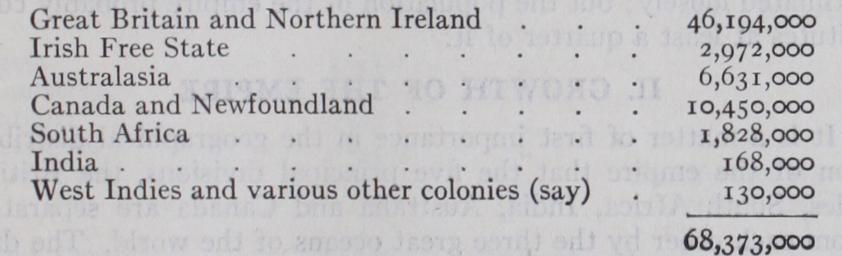
The land surface of the earth is estimated to extend over about 52,500,000 square miles. Of this area the British empire occupies nearly one-quarter, or about 12,000,000 square miles. By far the greater portion lies within the temperate zones, and is suitable for white settlement. The notable exceptions are the southern half of India and Burma; East, West and Central Africa; the West Indian colonies; the northern portion of Australia; New Guinea, British Borneo and that portion of North America which extends into Arctic regions. The area of the territory of the empire is divided almost equally between the southern and the northern hemispheres, the great divisions of Australasia and South Africa covering between them in the southern hemisphere 5,308,506 sq.m., while Great Britain and Ireland, Canada and India, in cluding the native States, cover between them in the northern hemisphere square miles. The alternation of the seasons is thus complete, one half of the empire enjoying summer, while one-half is in winter. The division of territory between the eastern and western hemispheres is less equal, Canada occupy ing alone in the western hemisphere while Austral asia, South Africa, India and Great Britain and Ireland occupy in the eastern hemisphere 6,925, 975 square miles. As a matter of fact, however, the eastern portions of Australasia border so nearly upon the western hem isphere that the distribution of day and night throughout the empire is, like the alterna tions of the seasons, almost com plete, one-half enjoying daylight, while the other half is in dark ness. These alternations of time and of seasons, combined with the variety of soils and climates, are calculated to have an in creasingly important effect upon the material and industrial, as well as upon the social and political developments of the empire. According to the latest census reports and estimates available in the total population of the empire is over 475,004,458. Its white population, which includes some French, Dutch and Spanish peoples, but is mainly of Anglo-Saxon race, numbers over 66, 000,000. It is distributed roughly as follows:- The native population of the empire includes types of the prin cipal black, yellow and brown races, classing with these the high type races of the East, which may almost be called white. The native population of India, mainly high type, brown, was returned at the census of 1931 as 352,669,664. The population of India is divided into 128 groups on the basis of language. These may, how ever, for the sake of convenience, be collected into the following principal groups :- (A) Malayo-Polynesian.
(B) Indo-Chinese.
i. Mon-Khmer.
ii. Tibeto-Burman.
iii. Siamese-Chinese.
(C) Dravido-Munia.
i. (Kolarian).
ii. Dravidian.
(D) Indo-European. Indo-Aryan sub-family.
(E) Semitic.
(F) Hamitic.
(G) Unclassed, e.g., Gypsy.
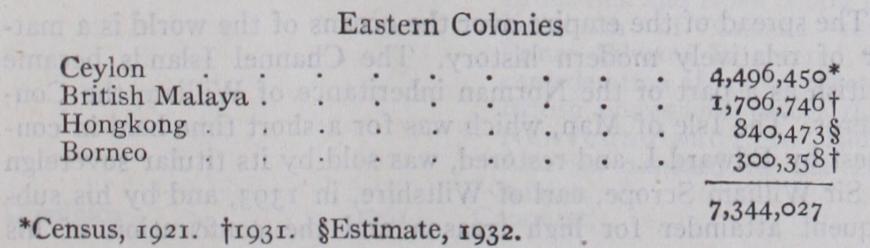
The native population of Ceylon is mainly high type brown (about 3,000,00o Sinhalese and over i,000,000 Tamils). In British Malaya and Borneo the natives are Malay, but Chinese immigrants have settled there in almost equal numbers. The population of Hongkong is virtually Chinese, the inhabitants of_other races only numbering about West Indies The West Indies, including the continental colonies of British Guiana and Honduras, and 17 islands or groups of islands, have a total coloured population of about 2,300,000. The colonies of this group which have the largest coloured populations are :- black, some brown and yellow . 900,000 Trinidad and Tobago---black and brown . . 380,000 British Guiana—black and brown . . . . 304,000 'Estimate 1925.
The populations of the West Indies are very various, being made up largely of the descendants of imported African negro slaves.
In Jamaica these contribute four-fifths of the population. There are also in the islands a considerable number of imported East Indian coolies and some Chinese. The aboriginal races include American Indians of the mainland and Caribs. With these there has been intermixture of Spanish and Portuguese blood, and many mixed types have appeared. The total European population of this group of colonies amounts to upwards of 90,00o, to which 23,000 on account of Bermuda may be added.
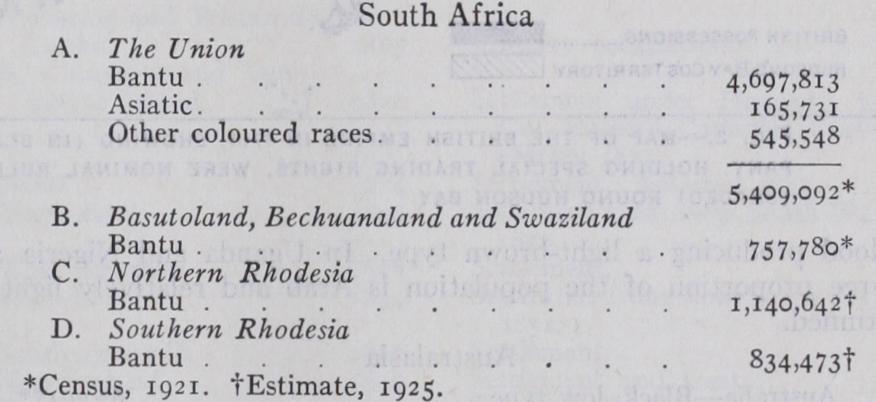
The aboriginal races of South Africa were the Bushmen and Hottentots. Both these races are rapidly diminishing in numbers; the Bushmen are nearly extinct ; and though the Hottentot strain is preserved in the half-castes or "coloured people," the pure stock is also dying out. Besides these primitive races there are the dark skinned negroids of Bantu stock, commonly known in their tribal groups as Kaffirs, Zulu, Bechuana and Damara, which are again subdivided into many lesser groups. There are also in the Union, Malays, Indians and others, who during the last 200 years have been introduced from Java, Ceylon, Madagascar, Mozambique and British India, originally .as slaves and in the 19th century as inden tured labourers, when they were used mainly for the sugar plan tations of Natal.
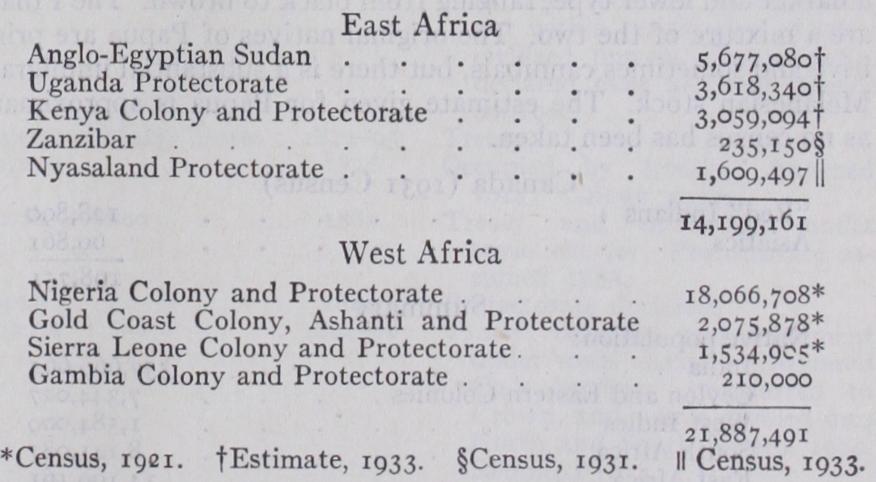
From east to west across Africa the aboriginal nations are most ly of the black negroid type. The tendency of some of the lower types has been to drift towards the west coast, where they still practise cannibalistic and fetish rites. On the east coast are found much higher types approaching to the Christian races of Abyssinia, and from east to west there has been a wide admixture of Arab blood producing a light-brown type. In Uganda and Nigeria a large proportion of the population is Arab and relatively light skinned.
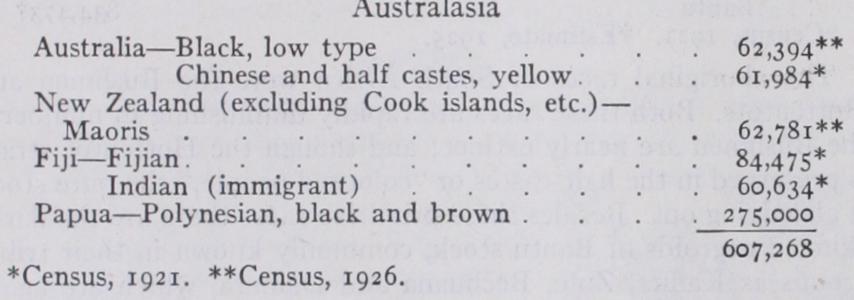
The aboriginal tribes of Australia are of a primitive pre-Dravid ian black race. The natives of the islands east of Fiji are Malayo Polynesians, tall, handsome and light-brown in colour. Their highest and lightest type is represented by the Maoris of New Zealand. In the islands west of Fiji the natives are Melanesians, a darker and lower type, ranging from black to brown. The Fijians are a mixture of the two. The original natives of Papua are prim itive and sometimes cannibals, but there is a substantial immigrant Melanesian stock. The estimate given for Papua is approximate, as no census has been taken.
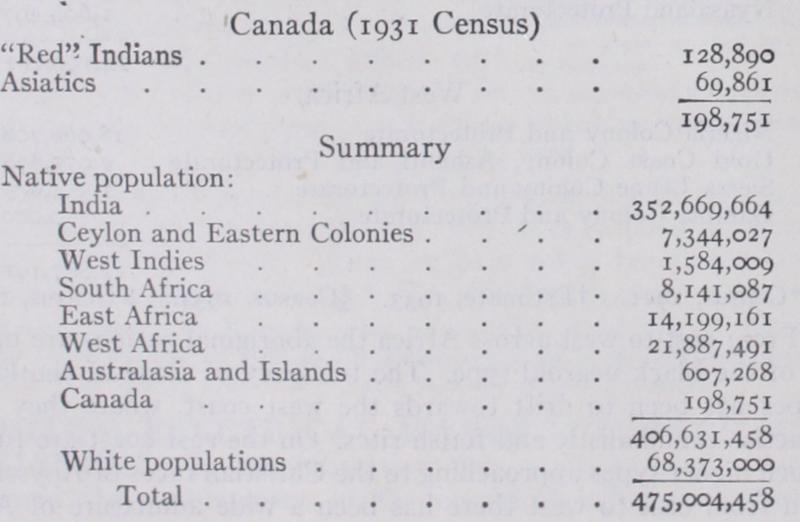
This is without taking into account the population of the lesser Crown colonies or allowing for the increase likely to be shown by later censuses. The population of the earth as a whole can only be estimated loosely; but the population of the empire probably con stitutes at least a quarter of it.
It is a matter of first importance in the geographical distribu tion of the empire that the five principal divisions, the British Isles, South Africa, India, Australia and Canada are separated from each other by the three great oceans of the world. The dis tance, as usually calculated in nautical miles, from England to the Cape of Good Hope is 5,84om. ; from the Cape of Good Hope to Bombay is 4,610m.; from Bombay to Melbourne is 5,630m.; from Melbourne to Auckland is i,83om.; from Auckland to Vancouver is 6,21 om. ; from Halifax to Liverpool is 2,744 miles. From a British port direct to Bombay by way of the Mediterra nean it is 6,272m.; from a British port by the same route to Syd ney 11,548 miles. These great distances have necessitated the ac quisition of intermediate ports suitable for coaling stations on the trade routes, and have determined the position of many of the lesser Crown colonies which are held simply for military and com mercial purposes. Such are the Bermudas, Gibraltar, Malta, Aden, Ceylon, the Straits Settlements, Labuan, Hongkong, which com plete the chain of connection on the eastern route and such on other routes are the lesser West African stations, Ascension, St. Helena, the Mauritius and Seychelles, the Falklands, Tristan da Cunha and the groups of the western Pacific. Other annexations of the British empire have been rocky islets of the northern Pacific required for the purpose of telegraph stations in connection with an all-British cable.
The spread of the empire over the oceans of the world is a mat ter of relatively modern history. The Channel Islan Is became British as a part of the Norman inheritance of William. the Con queror. The Isle of Man, which was for a short time held in con quest by Edward I. and restored, was sold by its titular sovereign to Sir William Scrope, earl of Wiltshire, in 1393, and by his sub sequent attainder for high treason and the confiscation of his estates, became a fief of the English Crown. It was granted by Henry IV. in 1406 to Sir John Stanley, K.C., ancestor of the earls of Derby, by whom it was held till i 736, when it passed to James Murray, 2nd duke of Atholl, as heir-general of the loth earl. It was inherited by his daughter Charlotte, wife of the 3rd duke of Atholl, who sold it to the Crown for L70,000 and an annuity of £2,000. With these exceptions and the nominal possession taken of Newfoundland by Sir Humphrey Gilbert in 1583, all the terri torial acquisitions of the empire have been made since 1600.
The following is a list of the British colonies and dependencies (other than those belonging to the Indian empire) together with a summary statement of the date and method of their acquisition. Arranged in chronological order they give some idea of the rate of growth of the empire. The dates are not, however, in all cases those in which British sovereignty was established. They indicate in some instances only the first definite step, such as the building of a fort, the opening of a trading station, or other act, which led later to the incorporation in the empire of the country indicated. In the case of Australian States or Canadian provinces originally part of other States or provinces the date is that, approximately, of the first settlement of British in the district named; e.g., there were British colonists in Saskatchewan long before it was consti tuted a province in 1905. Save where otherwise stated, British authority has been continuous from the first date mentioned in the table. Reference should be made to the articles on the various colonies.
In the Pacific are also Bird Island, Bramble Cay, Cato Island, Cook Islands, Danger Islands, Ducie Island, Dudosa, Howland Is land, Jarvis Island, Kermadec Islands, Macquarie Island, Manihiki Islands, Nassau Island, Palmerston Island, Palmyra Island, Phoe nix group, Purdy group, Raine Island, Rakaanga Island, Rotumah Island, Surprise Island, Washington or New York Island, Willis group and Wreck reef.
In the Indian ocean there are, besides the colonies already men tioned, Rodriguez, the Chagos Islands, St. Brandon Islands, Ami rante Islands, Aldabra, Kuria Muria Islands, Maldive Islands and some other small groups.
The Indian section of the empire was acquired during the 17th 19th centuries under a royal charter granted to the East India Company by Queen Elizabeth in 1600. It was transferred to the Imperial Government in 1858, and Queen Victoria was proclaimed empress under the Royal Titles Act in 1877. The following list gives the dates and method of acquisition of the centres of the main divisions of the Indian empire. They have, in most instances, grown by general process of extension to their present dimensions.
The above territories constitute British India. The rest of the sub-continent is made up of so-called native States, numbering over 500, of greatly varying sizes situated in various parts of India, and containing in all a population of nearly 72,000,000. These States are governed by their own princes or chiefs, the more important of whom are autonomous in their domestic affairs, but, under trea ties, they all owe allegiance to the King-Emperor and their ex ternal relations are under the control of the governor-general in council. Nepal stands alone as a wholly independent kingdom— a status confirmed by the treaty of 1923 ; but, since the war of 1814-15, it has maintained close and friendly relations with the British Government and a British envoy resides according to treaty at the capital. Between the north-west frontier of British India and that of Afghanistan there are districts known as the North-West Frontier Agencies and Tribal Areas, over which the Government of India exercises surveillance but interferes as little as possible with the rule of the tribal chiefs.
This vast congeries of communities, widely varying in character and absorbed within the empire by varying methods, is governed, under the supreme headship of the British Crown, in several differ ent forms. These forms of government are the outcome of a pro cess of development which is continually at work and has not yet reached its final stages.
The empire may be divided into the following political classes : (1) The United Kingdom of Great Britain and Ireland, con sisting of England, Wales, Scotland and Northern Ireland. It pos sesses full sovereignty, external and internal, but is limited in action as regards the dominions by certain recognized conventions. Northern Ireland has a parliament and a Government responsible to it for local matters. The Channel Islands and the Isle of Man, are in an anomalous position inasmuch as they have independent legislatures and semi-independent executives, subject to the su premacy of the British parliament.
(2) The self-governing dominions, possessing membership in the League of Nations and therefore a quasi-international status, and, though de iure still subject to }he supremacy of the British parliament, possessing de facto the same independent status as Great Britain with which they are equal members of the Imperial Conference. These are Canada, Australia, New Zealand, South Africa and the Irish Free State.
(3) A self-governing dominion with membership of the Impe rial Conference, but without membership in the League of Nations: Newfoundland.
(4) Two self-governing colonies, with a wide but not unrestrict ed autonomy, and not entitled to representation at the Imperial Conference : Malta and Southern Rhodesia.
(5) Crown colonies, or colonies not possessing responsible Gov ernment, that is, colonies in which the executive Government is controlled by the British Government through the secretary of state for the colonies. The legislatures in these cases may be en tirely independent of the executive, as in Bahamas, Bermuda and Barbados, with their nominee upper houses and their elective as semblies, but normally are, either in case of emergency as in Cey lon or regularly, subject to control either because there is an official majority or because the governor alone constitutes the legislature. To the Australian Commonwealth are attached, as dependencies administered on Crown colony lines, Papua and Norfolk Island; to New Zealand, the Cook Islands and the Ross dependency.
(6) Protectorates administered on colonial lines. These differ from colonies mainly in that they are not annexed to the British Crown, and their inhabitants are not British subjects. The protec torate status in such cases normally preludes annexation when ad ministration has become more developed; it usually rests on prom ises of protection granted to more or less uncivilized tribes and the Administration often makes wide use of the agency of chiefs in government, especially in Nigeria and Uganda.
(7) Protected States, retaining distinct personality. Some of them, as Sarawak, possess internal autonomy, while in the case of others, like Zanzibar, the administration is carried on in effect by British officers.
(8) India, including British India and the Indian States. The former is administered under the governor-general, and his execu tive council, appointed by the Crown; the latter possess various degrees of internal autonomy. India as a whole possesses mem bership in the League of Nations and representation at the Impe rial Conference. (See INDIA.) The Mandated Territories, held under mandate by Great Brit ain, Australia, New Zealand and South Africa though under British administration, are not parts of the British empire and will be considered separately below.
These classes fall into four main groups: (A) the self-governing communities (Nos. I, 2, and 3 above, comprising the United King dom of Great Britain and Northern Ireland, and the dominions) ; (B) Malta and Southern Rhodesia (No. 4) ; (C) India; (D) the non-self-governing communities (Nos. s, 6, and 7). The term "British Commonwealth of Nations," often used since the World War as an alternative to "British Empire" and first officially so used in the Irish Treaty of 1921 (see below), implies self-govern ment and is a more suitable description of Group A, and, with reservations, of Groups B and C, than of group D.