
BROCADE.) The type of fabrics generally described as "cotton brocades." as produced by modern powerlooms (of which a typical model is illustrated in fig. 1), are embellished with Jacquard figuring developed by causing either warp, weft, or both series of threads to "float," or lie more or less freely, in the figure portions of the design, usually on a neutral ground texture of the plain calico or "tabby" weave, or other suitable weave structure, in order to de velop are effect in contrast with that of the figuring.
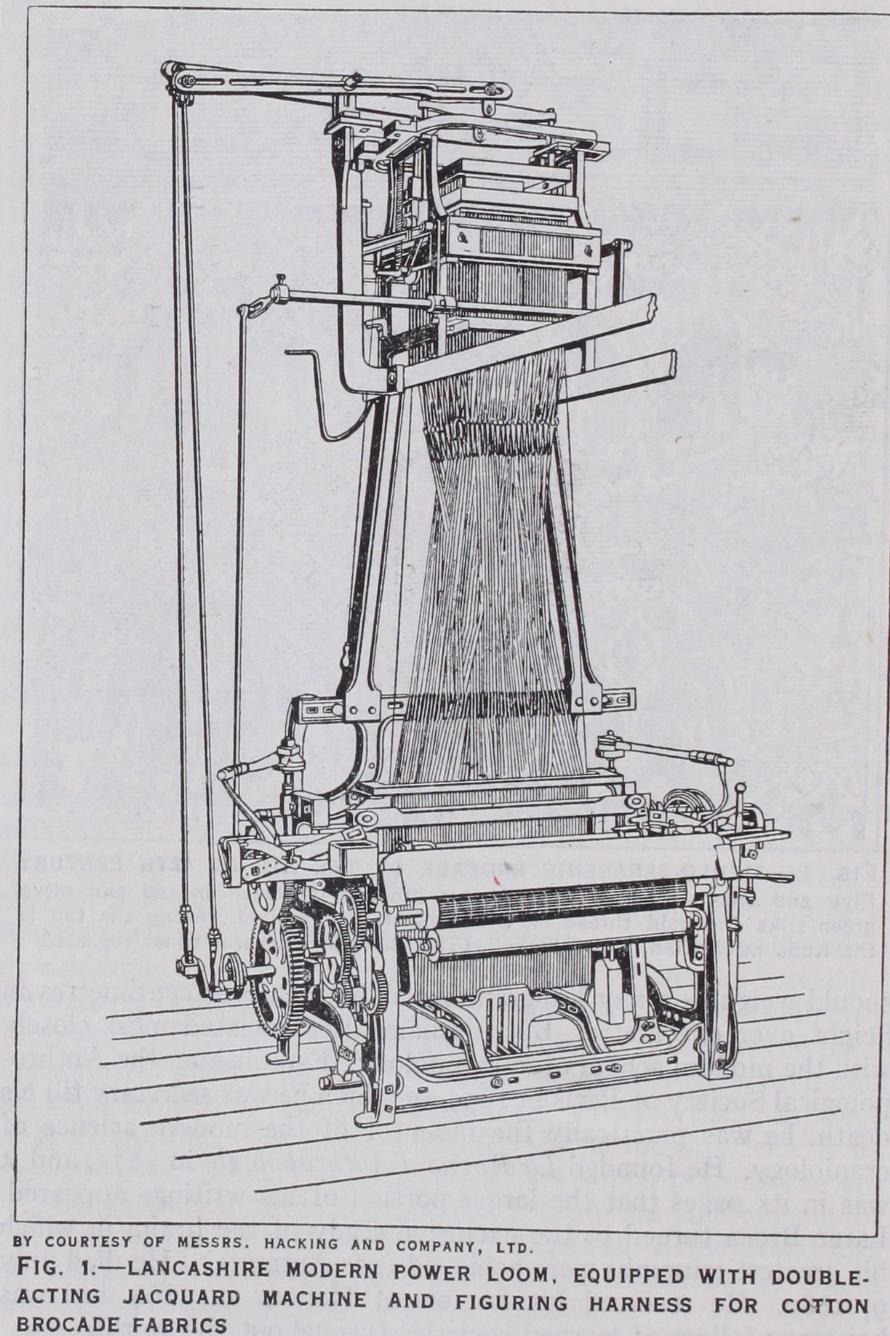
Cotton brocades constitute one of the largest classes of woven fabrics that are employed for an infinite variety of domestic purposes, as, for example, bed counterpanes, hangings, curtains, table covers, and similar household articles ; whilst those of lighter texture are used as ladies' and children's dress fabrics.
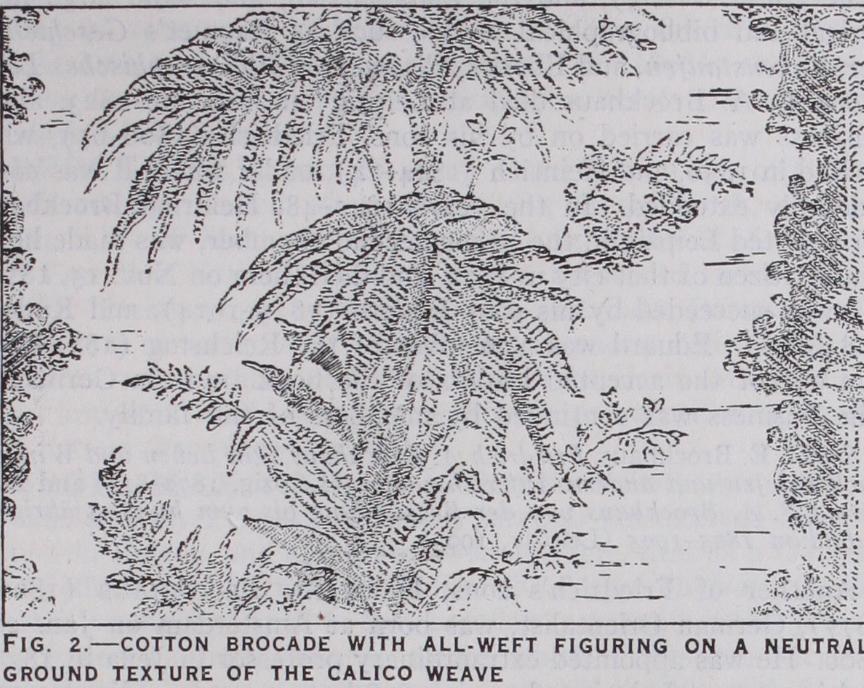
Cotton brocade fabrics may be broadly classified under the following chief modifications, viz.: 1. With all-weft figuring on a neutral ground texture of the calico weave, as in the example illustrated in fig. 2.
2. With all-warp figuring on a neutral ground texture.
3. With all-weft figuring on an all-warp ground texture, as in the example illustrated in fig. 3.
4. With all-warp figuring on an all-weft ground texture.
5. With warp and weft figuring on a neutral ground texture.
6. With warp and weft figuring on a diapered ground texture, as in the example illustrated in fig. 4.
Reversible Fabrics.—In addi tion to these chief modifications, the brocade principle of weaving permits of endless combinations of the above-named variations. It will be apparent, therefore, that brocade textures ate virtually reversible in respect of the general design, but not in respect of colour where warp and weft threads are of different colour.
Brocade fabrics are made either one-sided or reversible, accord ing to the particular purpose for which they are intended. If they are not reversible they are usu ally produced with warp and weft of widely different counts and quality, and also with a greater number of threads per inch in one direction than in the other. For the purpose of hangings and cur tains in which both sides of the fabric are exposed to view, the disparity in the counts, quality, and the relative amount of warp and weft, may be less pronounced than for dress materials and furnishing fabrics, of which one side only will be exposed to view, when in use.
See H. Nisbet, Grammar of Textile Design (5927). (H. N.)