
BRUSSELS, the capital of the kingdom of Belgium (Fr. Bruxelles, Flem. Brussel) and of the province of Brabant, in a central position about Tom. from the North sea at Ostend. It oc cupies the valley of the Senne, a small tributary of the Schelde, and the surrounding hills on the east, south-east and west. The earliest inhabited site in the area is thought to have been what is now the eastern suburb of Anderlecht, a favourable natural clear ing in the primitive forest. Foundations of an important Roman villa and Frankish cemeteries have been discovered; and the col umns of the villa seem to have been utilized in constructing the crypt of the old church, St. Guidon, at Anderlecht. The Gallo Roman population, dispersed by the Franks, sought refuge in the islands among the vast marshes of the Senne, and the Franks themselves later followed them. Brussels, Bruocsella, Broekzele, "the village of the marsh," thus took its origin. In the 6th-7th centuries the evangelization of the region began, and Saint Gery founded an oratory in the main island, thenceforth known as "Ile Saint Gery." The name St. Gery occurs in the centre of the old town to-day, and reminds one of its early history.
At the fall of Charlemagne's empire, the small isles of the Senne were fortified and alongside the chapel a walled enclosure was built. In the loth century, after the Norman incursions, there came comparative security and prosperity. Commerce and industry developed side by side with the establishment of the merchant road linking Cologne, the Rhine metropolis, with the Flemish towns of Ghent and Bruges; and especially in those spots where it crossed north-flowing rivers, colonies of merchants and artisans grew up. The road crossed the Senne by Ile St. Gery and the adjacent islands and then climbed towards the Brabancon plateau on the right bank of the stream. Its course was marked by the old street called "Montagne de la Cour" now the Mont des Arts. The merchants of the new industrial town, free from the authority of an overlord, created a market, the origin of the grande place, and a house, the forerunner of the hotel de ville, where they met. While the commercial town flourished and gradually formed the nucleus of the "low town" which is still the business quarter of Brussels, Henry I., duke of Brabant and count of Louvain, built a residence and, about the year 1200, the abbey of Saint Jacques on the Caudenberg, on the eastern edge of the plateau bordering the Senne valley. This was the beginning of the ducal agglomera tion and of the "high town," still the aristocratic quarter with the king's palace.
In the first half of the 13th century new ramparts, including eight gates and 24 towers, were constructed to protect the indus trial city. In 1312, Duke John II. of Brabant granted the citizens their charter, distinguished from others as that of Cortenberg. This charter, with the Golden Bull of the emperor, Charles II. , was confirmed by the famous "Joyous Entry" of Duke Wenceslas into Louvain (1356). This established the early consti tution of the South Netherlands, which remained almost intact till the Brabant Revolution in the reign of Joseph II. The 13th century wall was soon outgrown, ar.d in 1357 Duke Wenceslas ordered a new wall to be built, enclosing a much greater area. The modern boulevards follow its course. ft included 74 towers and eight gates, and survived until 183o. In 1383 the dukes of Brabant transferred their capital from Louvain to Brussels, although resid ing for some time in their castle at Vilvorde, half-way between the two turbulent cities. Brussels is supposed to have then had 50,000 people, one-fifth the number of Ghent. In 1420 a further charter was granted recognizing the gilds of Brussels as the Nine Nations, a division still existing. The dukes of Brabant built a castle and place of residence on the Caudenberg, and this eventu ally became the famous palace of the Netherlands whence Charles V. abdicated in 1555. In 143o the duchy was merged in the pos sessions of the duke of Burgundy.
Seventeenth-century Brussels was described as "one of the finest, largest and best-situated cities of Europe." It suffered severely, however, from the bombardment of the French under Villeroi (1695). Sixteen churches and 4,000 houses were burnt down, and the historic buildings on the Grande Place were seriously injured, the houses of the Nine Nations on the eastern side being completely destroyed. In 1731 the famous palace of the Netherlands was practically destroyed by fire, some ruined arches and walls alone remaining.
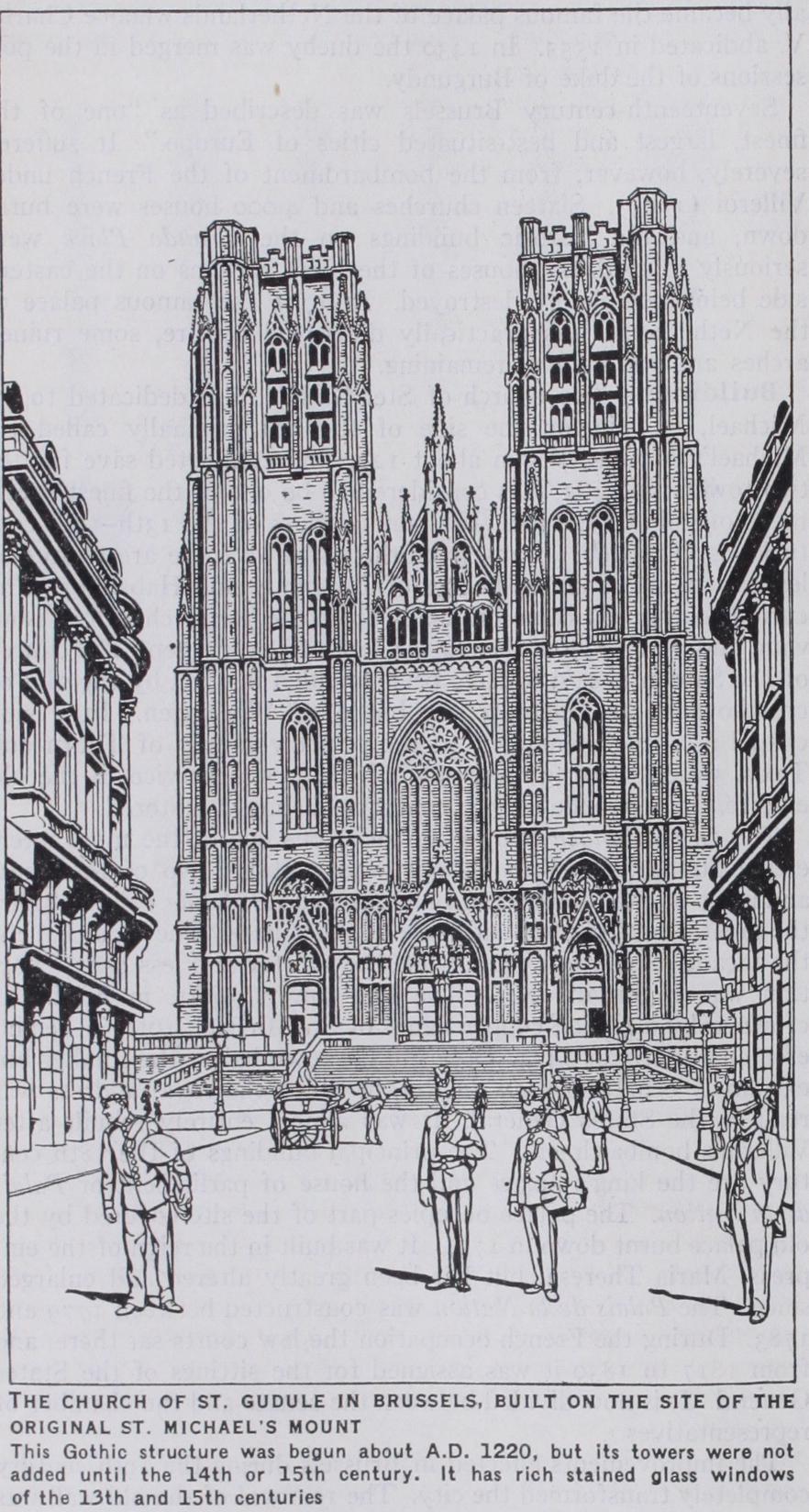
Buildings.—The church of Ste. Gudule, also dedicated to St. Michael, is built on the side of the hill originally called St. Michael's Mount. Begun about 1220 and completed save for the two towers, in 1273, it is considered to be one of the finest speci mens of pointed Gothic. The stained glass of the 13th–I5th cen turies is very rich. In many of the windows there are figures of leading members of the houses of Burgundy and Habsburg. The curious oak pulpit came originally from the Jesuit church at Lou vain, and is considered the masterpiece of Verbruggen. The church of the Sablon is said to have been founded in 1304 by the gild of crossbowmen to celebrate the battle of Woeringen. In a side chapel is a fine monument to the princely family of Thurn and Taxis, which had the monopoly of the postal service in the old empire. La Chapelle is 13th century, but much restored.
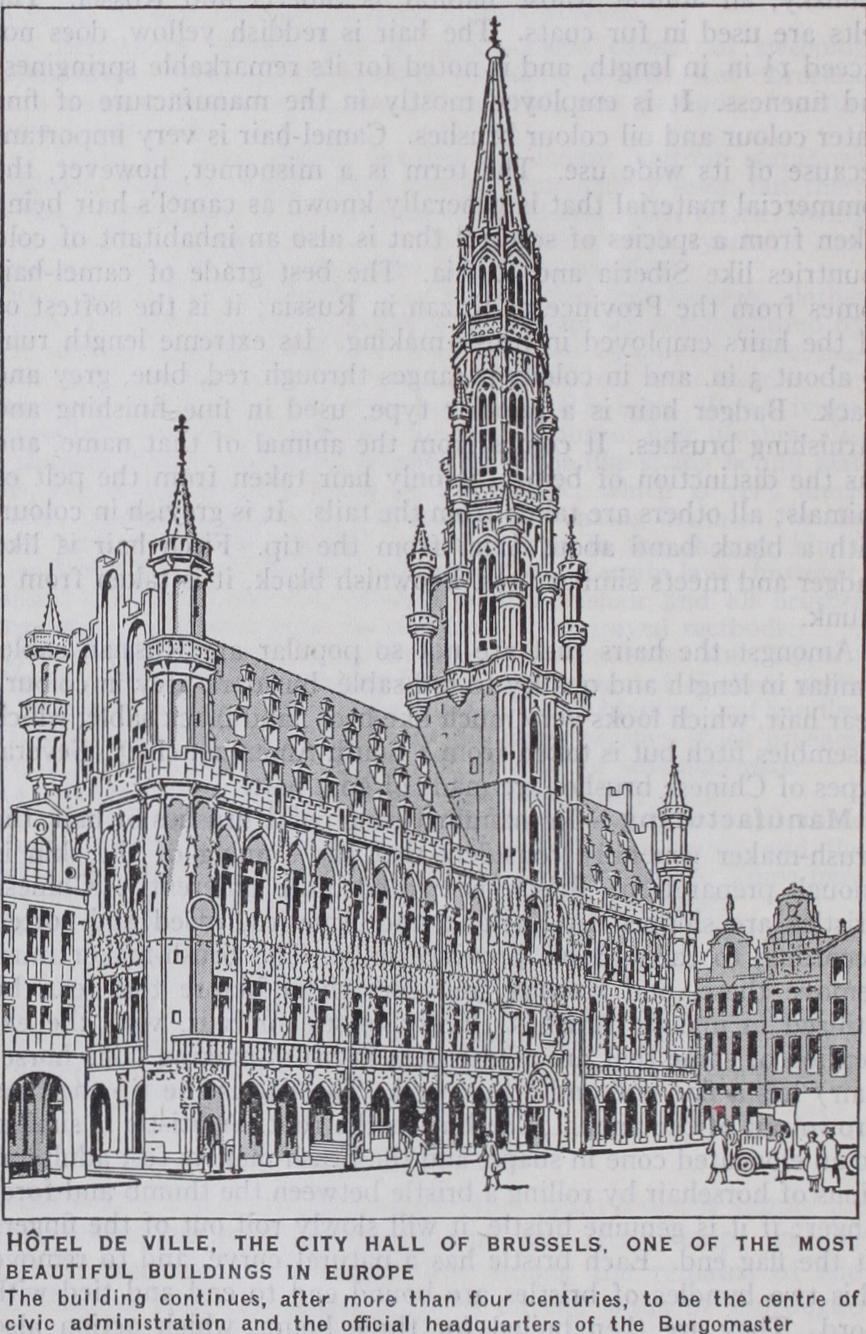
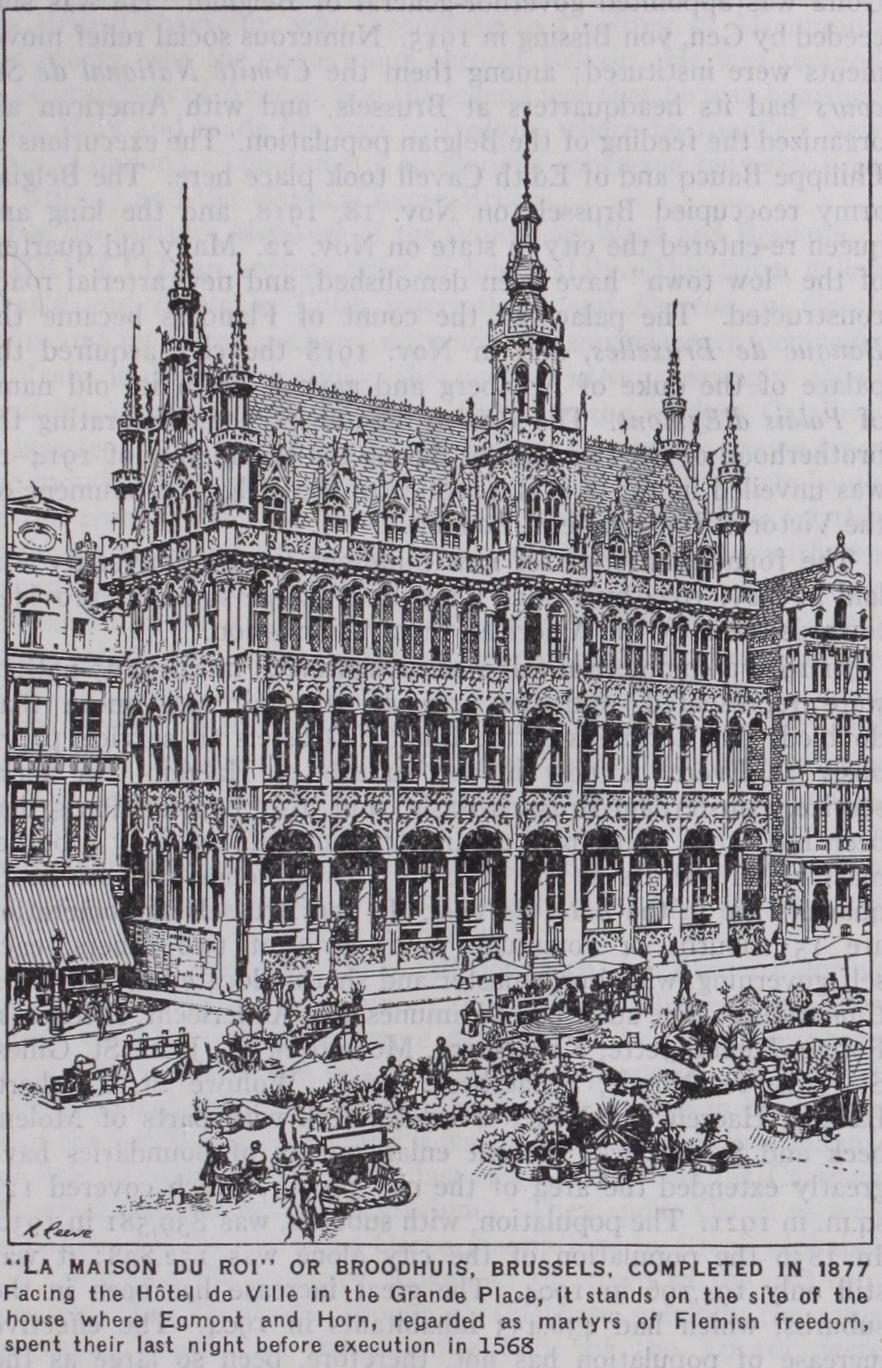
The Grande Place is by its associations one of the most inter esting public squares in Europe, and contains two of the finest and most ornate buildings in Belgium. The Hotel de Ville occupies the greater part of the south side of the square. The older half of the facade dates from 1410, while the shorter and less ornate por tion was begun in 1443. The fine tower, 36oft. in height, is crowned by a golden copper figure of St. Michael, 16f t. in height, erected as early as 1454. Opposite the town hall is the smaller but extremely ornate Maison du Roi, in which the royal address was read to the States General. It was almost entirely rebuilt after Villeroi's bombardment. The principal buildings of the 18th cen tury are the king's palace and the house of parliament or Palais de la Nation. The palace occupies part of the site covered by the old palace burnt down in 1731. It was built in the reign of the em press, Maria Theresa, but has been greatly altered and enlarged since. The Palais de la Nation was constructed between 1779 and 1783. During the French occupation the law courts sat there, and from 1817 to 183o it was assigned for the sittings of the States General. It is now divided between the senate and the chamber of representatives.
The improvements effected in Brussels during the 19th century completely transformed the city. The removal of the old wall was followed by the creation of the quartiers Leopold and Louise in the upper town. In the lower, the Senne was bricked in, and the fine boulevards du Nord, Anspach, Hainaut and Midi took the place of slums. The Bourse and the post office are two fine mod ern buildings in this quarter of the city. The Column of the Con gress (i.e., of the Belgian representatives who founded the kingdom of Belgium) surmounted by a statue of King Leopold I., was erected in 1859. The Palais de Justice was erected between 1866 and 1883, from the design of Poelaert, in the style of Karnak and Nineveh, but surmounted with a dome. (See ARCHITECTURE. ) It is conspicuously placed on the brow of the hill at the southern extremity of the rue de la Regence, which contains the new pic ture gallery with an excellent collection of pictures, the palace of the count of Flanders, and the garden of the Petit Sablon. Im mediately above this garden is the Palais d'Arenberg, one of the Renaissance hotels (showing Spanish influence), which was, in the 16th century, the residence of Count Egmont.
In the early years of the 2oth century new and spacious avenues were driven into the suburban woods, and below the Place Royale the old tortuous street called the "Montague de la Cour" gave place to a Mont des Arts. The ridge on the west and north-west of the Senne valley, from which Villeroi bombarded the city, is built over from south to north by the suburbs of Anderlecht, Molenbeek and Koekelberg, while Laeken with its royal château and park forms the northern part of the Brussels conglomeration. The communes of Laeken, Haeren and Neder Overheembeek, with parts of Molenbeek and Schaerbeek were incorporated in the city by a law of April 2, 1921, in order to facilitate the construction of the new outer port.
Although mainly a court city and a residential centre, Brussels has numerous industries among which the manufactures of lace, carpets, curtains and furniture stand out. It is also an educational centre: the university had 1,64o students in 1925-26, while the ecole militaire trains students for the professions as well as for the army. The period since 1910 has seen many transformations in Brussels. The German occupation of the capital extended from Aug. 1914 to Nov. 1918. Gen. Sixt von Armin's troops entered on Aug. 20, and on Sept. 2 F.M. von der Goltz was appointed governor-general of Belgium. He was suc ceeded by Gen. von Bissing in 1915. Numerous social relief move ments were instituted ; among them the Comite National de Se cows had its headquarters at Brussels, and with American aid organized the feeding of the Belgian population. The executions of Philippe Baucq and of Edith Cavell took place here. The Belgian army reoccupied Brussels on Nov. 18, 1918, and the king and queen re-entered the city in state on Nov. 22. Many old quarters of the "low town" have been demolished, and new arterial roads constructed. The palace of the count of Flanders became the Banque de Bruxelles, and in Nov. 1918 the city acquired the palace of the duke of Arenberg and gave it again its old name of Palais d'Egmont. The British monument commemorating the brotherhood of the two nations during the World War of 1914-18 was unveiled in 1923; it is a replica of the Belgian monument on the Victoria Embankment, London.
The foundation stone of new buildings for the university was laid in Nov. 1924 by Prince Leopold. A large sum was provided towards these by the American relief commission.
In 192o a commercial fair was inaugurated; in 1925, 27 nations were represented, and the area of the fair was more than doubled. The terminus of the London-Brussels air service, previ ously at Evere, is now in the suburb of Haeren. An aerial service, Amsterdam-Brussels-Basle, and also Brussels-Paris, has been instituted. The town administration is directed by a burgo master and sheriffs at the head of a town council, whose head quarters are in the hotel de ville. In the Brussels agglomeration are 15 suburbs or communes and parts of two others, each self-governing, with burgomaster and sheriffs located in a Maison Communale. The suburban communes are : Anderlecht, Etterbeek, Forest, Ixelles, Jette, Koekelberg, Molenbeek St. Jean, St. Gilles, St. Josse-ten-Noode, Schaerbeek, Uccle, Woluwe St. Lambert, Laeken, Haeren and Neder Overheembeek with parts of Molen beek and Schaerbeek. Recent enlargements of boundaries have greatly extended the area of the city proper, which covered 124 sq.m. in 1921. The population, with suburbs, was 839,581 in 193o. In 1856 the population of the city alone was 152,828: it was still only 194,196 in 1904. The great increase has been in the suburbs, which had 436,453 inhabitants in 1904. The effective increase of population has not, therefore, been so large as the figures for the administrative unit would imply.