
BUDAPEST, the capital and largest town of Hungary, is situated on both banks of the Danube and includes the former towns of Buda and 0-Buda on the right bank and Pest, together with Kobanya, on the left bank. The site of the town is one of extraordinary geographical energy. The Danube has few good crossing places on its north-south course over the Hungarian plain, and the frowning hills (7 7of t. ), over which straggle the old fortress and town of Buda, with their steep plunge beneath the sandy plain of Pest, are conveniently approached by an intermediate step in the river, the Margaret island. Around the hills curve easy valleys leading to the fertile plain of the Little Alf and the wooded downs of Transdanubia. Northward the Danube valley is a threshold to the mines and pastures of the highlands, while the local heights are rich in building stone, lime and mineral springs. Less constricted than Esztergom and more central than either Esztergom or Szekesf ehervar, the old capitals, the plain of Pest was a convenient rallying point for tribal con claves which were protected by the marshes and by Buda. In time Buda became the outer guard of Vienna, since it commanded the gate between the Bakony mountains and the Carpathian ranges, by which that city is approached from the east.
There is evidence of settlement on the right bank during pre Roman time. The Romans founded a colony, which they called Aquincum, A little north of the site of a previous settlement, and where 0-Buda now stands. This acted as an outpost of the empire until A.D. 376, when it fell before the assaults of the bar barians. History is silent about the centuries that elapsed before the Magyar invaders approached, but it is certain that when they arrived towards the close of the 9th century they found Slavonic settlements on the present sites of Buda and Pest. (Slay. Pestj =oven; cf. the Ger. term "Of en" for Buda.) In 1241 Pest was destroyed by Mongols, after whose departure Bela IV., king of Hungary, founded the modern Buda (1247), and repeopled Pest with colonists of German and other nationalities. From this time onward both towns made rapid progress in the development of their separate functions. In 1361 Buda was selected as the capital of Hungary and henceforth gathered to itself the administrative duties while Pest looked more and more towards commerce. But neither was allowed to advance undisturbed. For centuries the rock of Buda overlooked scenes of strife between West and East, yet despite the periods of hardship, the attraction of its key position brought many compensations. Crusaders from the West brought with them the glories and advantages of 14th century French civilization. French masons and Italian artists combined to produce in Buda a city fit to rival those of the West, while Flemish and Venetian merchants raised Pest to the rank of one of the leading commercial centres of Europe. Then, in 1526, Pest was captured and sacked by the Turks, and later (1541) Buda was occupied and until 1686 controlled by Turkish pashas. Their architectural and other treasures stolen or destroyed, both towns were, at the close of this occupation, little more than ruins. But geographical site and situation, combined with his torical tradition, were strong enough to overcome even this catastrophe. Stimulated by the patronage of Maria Theresa and Joseph II., revival was rapid, particularly in Pest, which in the 19th century completely outstripped Buda. In 1872 both towns were united into one municipality, Budapest, which became the political, commercial and intellectual centre of Hungary. The World War, followed by a brief period of Communist rule in 1918-19 and by Rumanian occupation and looting in 1919, brought its development to a standstill. The conclusion of peace caused an influx of thousands of refugees and unemployed officials from the lost Hungarian territories and resulted in much unemploy ment and a serious housing shortage. The milling industry, the greatest in Europe, upon which the city depended so heavily, was almost ruined by the high import duties upon grain entering Hungary and the difficulty of establishing relations with former customers. Further, since Budapest shared with Vienna the financial control of south-east Europe, the loss of this side of its commercial life brought ruin to many. The position began to improve after the financial reconstruction of 1924 and as a result of the action of the international committee of enquiry that met at Basle in Jan. 1925 to examine the financial position of the city in the interests of its bondholders.
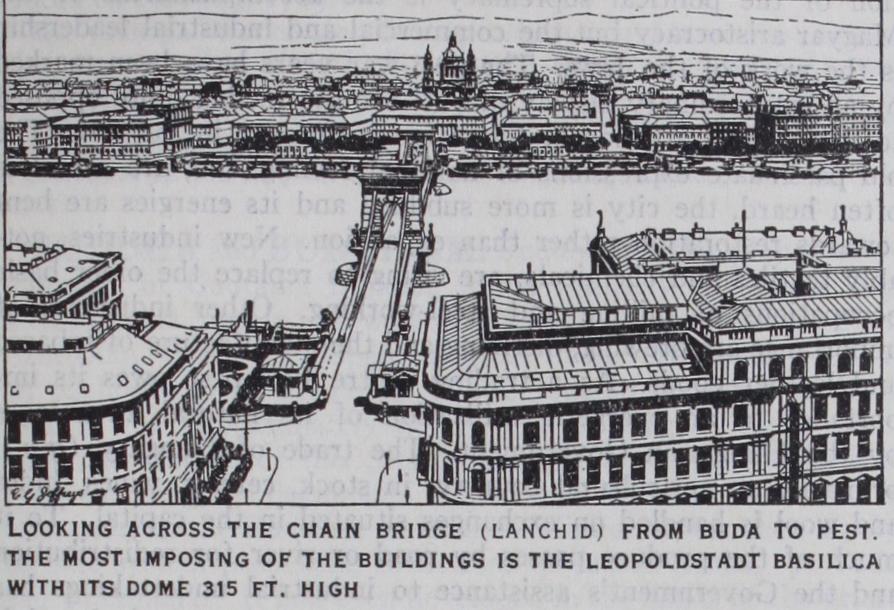
The modern town covers an area of about 8osq.m., on both sides of the river, which varies in width from 30o to 65o yards. The two banks are connected by six bridges, which include one of the largest suspension bridges in Europe. In almost direct continuation of one end of this bridge a tunnel 383yd. long pierces the hill on which the castle of Buda is built.
Buda, though of ancient origin, resembles Pest in its lack of buildings of historic and architectural interest. Both convey the impression of comparatively recent creation but the peace of Buda produces an appearance of old-world quietude that is a pleasing contrast to the bustle of its busy partner. Shabby, yellow-plastered houses, with here and there odd reminders of earlier glories in the shape of old arches and simple inscriptions commemorating the residence of by-gone notabilities, linger in the shadow of grandiose buildings in the ostentatious style that characterized the architecture of Budapest during the wave of construction that swept over it during the closing decade of last century. Reconstructions during the course of time to replace the ravages of war have failed to capture the spirit of con tinuity. Yet Buda has impressive buildings that are not without inspiration for its citizens. The plateau, which is approached by road, by terraced walks or by funicular railway, is crowned by the citadel and royal palace. Erected in 1748-71, it was partially destroyed by fire in 1849 but restored and enlarged in The palace now contains 86o rooms, many of them furnished and decorated with great magnificence. A short distance away rises the coronation church, begun by King Bela IV. in the 13th century in Romanesque style and completed in Gothic by King Matthias Corvinus in the 15th century. After a period of service as a mosque during the Turkish occupation it lost some of its importance but regained it following the coronation there of Francis Joseph, and it was thoroughly restored in 2873-96. Behind the church is a fine bronze equestrian statue of King Stephen the Saint, which, situated near the edge of the plateau, overlooks the Fisher bastion and ramparts that terrace the slope. In Buda, too, are situated some of the larger curative baths for which the city is famed ; these are at the base of the Blocksberg, where hot thermal springs (ii 5 °) gush from the limestone beds.
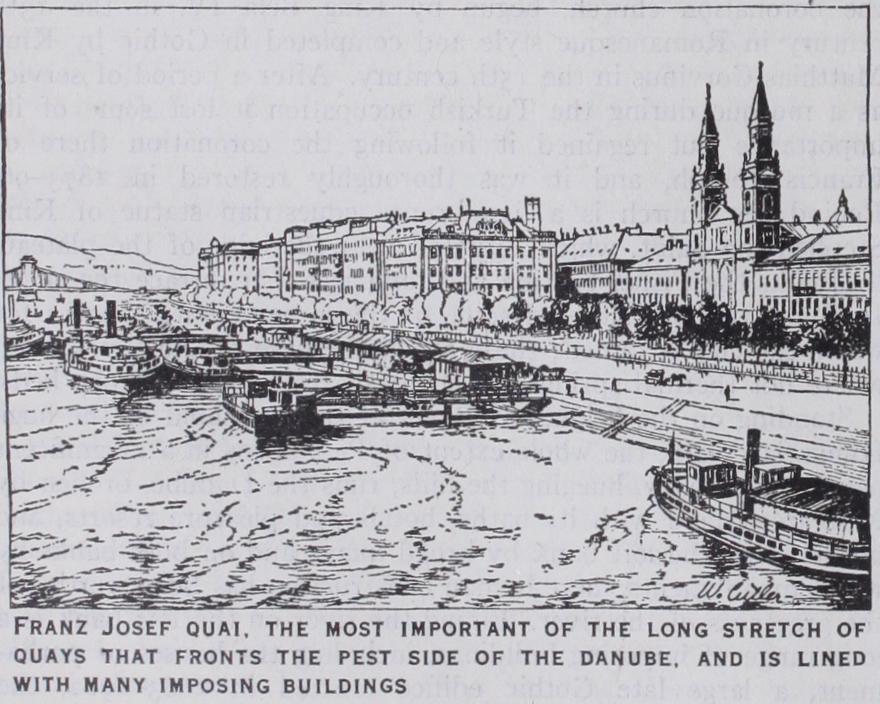
Standing on the heights of Buda, at the threshold of the huge Hungarian plain, the whole extent of Pest opens in a magnificent panorama. Below, hugging the hills, runs the Danube, broken by Margaret island with its baths, hotels and pleasure resorts, and bordered on the left bank by broad quays and on both banks by wide embankments; here human construction has been worthy of the greatness of the river. Lining the river on the left bank is a long range of imposing buildings, including the houses of parlia ment, a large late Gothic edifice erected in 1883-1902, the academy, in Renaissance style, the larger hotels and the Custom house. Beyond the left embankment, which stretches for a length of the old "inner town" of Pest is the nucleus of the city. Built on a slight elevation, sufficient in earlier times to give pro tection from flood, it is the shopping centre and is encircled by wide boulevards, the Belsokorut or inner circle, on the site of the old walls. From it streets radiate like the spokes of a wheel, while built around this inner town is the new Pest, a vast number of large dwelling-houses and public buildings intersected by two other semicircular girdles commencing and ending at the Danube, the Nagykorut or large circle and the Kiilsokorut or outer circle, beyond which lie the manufacturing districts. Narrow cobbled streets, broad acacia-bordered boulevards, wide squares, lined with substantial buildings and dotted with gardens and monu ments, all contribute to the grandeur of one of the most beautiful capitals of Europe.
Pest, too, has its fine buildings. Apart from those already men tioned the most striking in the town are the Basilica church, a Romanesque building with a dome 315f t. in height, the opera house, in the Italian Renaissance style, the redoute buildings, in mixed Moorish and Romanesque styles, the university and the palace of justice, all of these dating from the latter half of last century. Amongst the many other fine buildings may be men tioned the agricultural museum, the museum for fine arts and the national archives.
The finest thoroughfare in Budapest, the Andrassy avenue, runs in a straight line from the centre of the city to the city park, which is entered by way of the millenium monument, a semi circular pillar-colonnade, housing statues of the Hungarian kings and allegoric bronzes with, in the centre, a column, I I 7f t. high, surmounted by a statue of the archangel Gabriel. The city park (Varosliget), covers 240ac. and is the centre of a vast system of amusements. In close proximity to it lie several museums, the zoological gardens and other smaller parks.
In many other directions Budapest has endeavoured to escape from the overshadowing influence of Vienna and to act as the real centre of inspiration for its country. Part of the scheme in volved a strenuous effort to keep its students at home, and for this purpose numerous educational institutions of all types and grades were established. At the head is the Pqzmany university with a staff of 321 and some 6,000 students. After it ranks the technical high school with a staff of 120 and about 3,00o students. The city also possesses an adequate number of elementary and secondary schools with a great number of special and technical schools. Scientific and literary societies are headed by the Academy of Sciences, founded in 1825, the Kisfaludy society (1 836) and the Petofi society (1875) ; the last two aim at. the preservation of the Hungarian language and folklore. Other active associations of peculiar significance are the central statistical department, the communal bureau of statistics and the Hungarian sociographical institute. The natural love of music is furthered by the academy of music, of which Liszt was at one time director, and in addition the Government maintains schools of drama and painting.
The growth of Budapest and the development of its cultural aspects has been most rapid since the Ausgleich with Austria in 1867. Since then centralization has been the watchword of the awakened national consciousness of Hungary. To that ideal transport, manufacture, trade and intellectual opportunities have been subordinated. The capital has little competition to meet from regional centres within the country. In fact it has grown at their expense and its composite population has become nine tenths Magyar by absorption of non-Hungarian and by immigra tion from Hungarian regions. Thus, while in 188o the population was 355,682, of whom 56.7% were Magyars, 34.4% Germans and 6.1% Slovaks, the corresponding figures for 1930 were as follows: —1,006,184, 94.3%, 0.8%. The first step in the move ment to rival Vienna was made in 1848 when Budapest became the seat of the legislature, and the promotion of its interests has been an integral feature of the policy of government. Consolida tion of the political supremacy is the accomplishment of the Magyar aristocracy but the commercial and industrial leadership is the work of the Jews. The post-war years have been marked by an extraordinary display of anti-Semitic feeling quite opposed to the original attitude of toleration customary in the city. The old passionate expressions of national feeling, too, are now less often heard, the city is more subdued and its energies are bent towards restoration rather than expansion. New industries, not ably textiles and chemicals, are rising to replace the older basic occupations of milling and steel-working. Other industries of importance are brewing, distilling and the manufacture of tobacco and leather goods. As a trading centre Budapest owes its im portance to an energetic utilization of its natural advantages by the Hungarian Government. The trade of Hungary (q.v.), primarily an agricultural country, in stock, cereals, wines, hides and wool is handled on exchanges situated in the capital. To it much of the produce passes by road or river for redistribution and the Government's assistance to industrial undertakings has always been controlled by an effort to locate the principal activi ties in Budapest. A zone system of railway development focussing on the capital has fostered this concentration.
Figures given above supply some indication of the phenomenal growth of the city during the last half-century. Only Berlin has surpassed Budapest in this direction, and the rate of increase during the first 90 years of last century was nearly two-and-a-half times that of London. Budapest may, despite its large Jewish population, be said to express faithfully the spirit of Hungary. It has grown as a concrete expression of the national conscious ness under the inspiration of such notable reformers and patriots as Count Stephen Szechenyi and derived great benefits from the diverse elements in its population. For the moment, like Vienna but to a lesser degree, it suffers by its size in comparison with the reduced territory it serves. Strenuous efforts to overcome the resultant difficulties are being made, notably in the direction of attracting foreign visitors. Its virtues as a health resort and centre for tourists are increasingly advertised, and it will be well for the future of Budapest if such contacts can be made, for the city can fulfil an important function in European and world civilization. Given the correct outlook, the rock of Buda may yet recover its attraction for the South and East, but this time as a natural and convenient centre for peaceful commercial and cultural intercourse. (See HUNGARY. ) See also F. B. Smith, Budapest, the city of the Magyar (1903) ; R. Millet, Budapest et les Hongrois (1913). (W. S. L.)