BUENOS AIRES, the Province of Buenos Aires is one of the 14 States which together with io Territories (gobernaciones) and the Federal district form the nation Argentina. It is bounded north by the provinces of Cordoba, Santa Fe and Entre Rios, the last named separated by the river Parana; east by the La Plata estuary which separates it from the Republic of Uruguay, and by the Atlantic ocean; south by the Atlantic and the territory Rio Negro from which it is separated by the river of the same name; west by the territories of Rio Negro and La Pampa and the Pro vince of Cordoba. The province is situated between 33° 8' and 41° 4' S. lat. and 56° 36' and 63° long. W. from Greenwich. Its area is approximately 118,460 sq.m.
Although the province has a frontage of about i,000 m. on the La Plata and the Atlantic and nearly 310 m. bounded by the Parana in the north and the Rio Negro in the south, it has but few good natural ports, the best being Bahia Blanca, where the Argentine Government has constructed a naval port, and Ensenada de Barragan (La Plata), where extensive arti ficial basins have been constructed for the reception of ocean going steamers. San Nicolas and Zarate, on the Parana, have fairly good ports, while at Buenos Aires and Mar del Plata (a fashionable seaside resort) extensive artificial ports have been con structed. In its general aspect the province forms a part of the great treeless plain extending from the Atlantic and La Plata estu ary westward to the Andes. A fringe of small tangled wood covers the low river banks and delta region of the Parana between San Nicolas and Buenos Aires; thence southward to Bahia Blanca the seashore is low and sandy, with a zone of lagoons and partially submerged lands immediately behind. The south-eastern and cen tral parts of the province are low and marshy, with numerous lakes. Two ranges of low mountains extend partly across the southern part of the province—the first from Mar del Plata, on the coast, in a north-east direction, known at different-points as the Sierra del Volcan, de los Padres, Azul, Tandil and Olavarra. The second and shorter range starts near Bahia Blanca, has the same general direction as the above, and is known at different points as the Sierra Pillahuinco and Sierra de la Ventana (3,543 ft.). The country is well-watered with numerous lakes and small rivers, the largest river being the Rio Salado del Sud, which rises near the north-west boundary and flows entirely across the province in a south-easterly direction with a course of about 36o miles. The Rio Colorado crosses the extreme southern extension of the pro vince, a distance of about 8o m., but its mouth is obstructed, and its lower course is subject to occasional disastrous inundations.
The climate, healthful and mild, is generally temperate ; al though sudden changes are frequent. The rainfall is very irregular, varying from an annual precipitation of about 32 in. in the north to about 1 o in. in the extreme south.
The province is not only the largest but also the most populous, even excluding the Federal district, in the republic.
The official census of 1914 gave it a population of 2,066,165, of whom 703,931, or 31% were foreigners. The most numerous of the foreign element are Spanish, Italian and French, however, there are also Germans, English and other nationalities. An official estimate of Sept. 3o, 1926 gave it a population of 2,762,525, or a density of 9.1 persons per square kilometre. The principal cities with their estimated populations in 1926 were: Avellaneda (182, 000), an important industrial centre adjacent to the city of Buenos Aires; La Plata (162,00o), capital of the province and its chief overseas shipping point; Bahia Blanca (70,000), an important At lantic port; Lanus (38,00o) ; Mar del Plata (35,00o), a famous seaside resort ; and Chivilcoy, Mercedes, Lomas de Zamora, Junin and Pergamino, all having something over 30,00o inhabitants. San Nicolas, Azul, Quilmes, Tres Arroyos, Tondil, San Fernando, En senada, Dolores, Chacabuco, San Martin and Zarate have popu lations varying from 15,000 to 30,000.
Considerable legislative and administrative power is vested in the provincial Government. The executive is a governor, who, with a vice-governor, is elected by popular vote for four years. The legislature consists of a senate and a chamber of deputies. The judiciary comprises the supreme court, and courts of appeal in La Plata, and civil, commercial and criminal courts in La Plata, San Nicolas, Mercedes, Dolores, Bahia Blanca and Azul. The province is divided into 110 partidos, or districts, each with a justice of the peace and certain administrative officials.
Education.—According to the census of 1914, 30.8% of the population was illiterate : the percentage, however, is rapidly being lowered. In 1924 there were 2,401 schools in the province, at tended by 320,136 pupils. There were national secondary schools in all the principal cities and a national university at La Plata.
A mild climate, an abundant rainfall (except in the extreme south) and a humid soil have all contributed to endow the province with an abundant vegetation, not only in its rich, natural pastures, but also of cultivable plants suited to the temperate zone. Cattle-raising quite naturally be came the principal industry of this region soon after its settlement by the Spaniards, and sheep-raising on a profitable basis was de veloped about the middle of the 19th century. Toward the end of that century the export of wool, live stock and dressed meats reached enormous proportions. There is still a limited export of jerked beef (tasajo), but the chief exports are refrigerated meats and live stock, which go to the neighbouring South American re publics, Europe, South Africa and the United States. Much at tention has been given to the raising of horses, and, to a more limited extent, to mules and swine. There were in the province on June 1, 1925, according to a census of live stock of that date, 13,625,238 cattle, 12,488,936 sheep, 2,242,151 horses and 785,062 swine. Buenos Aires ranks first in the republic, alike for the num ber and the high quality of its live stock. Dairying has gained considerable prominence during recent years.
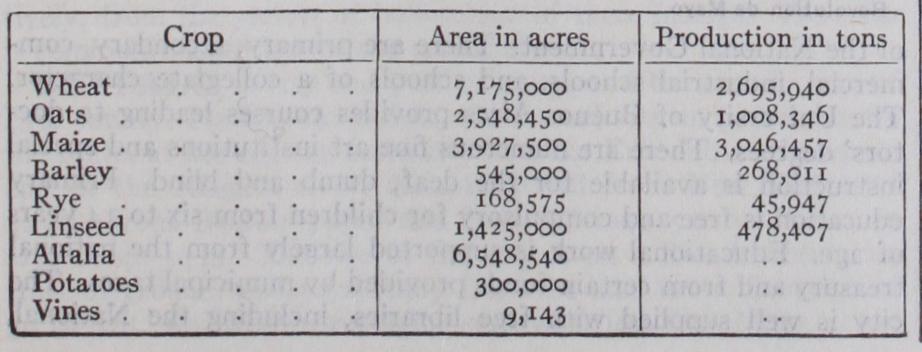
Little attention has been given to agriculture until the last quarter of the 19th century, but its subsequent development is tending more and more to displace the pastoral industry. Maize (Indian corn) and linseed are the chief crops of the north; in the centre and south-west wheat predominates; and in the south-east potatoes. Oats, barley, alfalfa, fruit and vegetables are less local ized. About 3o% of the area sown to cereals and linseed in the whole of the republic was in the Province of Buenos Aires. The land in actual cultivation increased from 3,400,000 ac. in 1895 to approximately 22,500,000 ac. in 1926. The areas and productions of the principal crops for the agricultural year 1925-26 are given in the table below :— Fruit-growing—peaches, grapes, pears, strawberries and figs— has made good progress, especially on the fertile delta of the Parana river.
Buenos Aires also ranks first as regards industrial and commercial development and means of transportation. Chief among the manufacturing establishments were meat refrigeration plants, flour-mills, creameries and cheese factories, breweries, distilleries, foundries, tanneries, boot and shoe factories and numerous industries with a smaller output. Meat re frigeration is by far the chief industry, representing in 1925 a capi tal investment of 231,202,296 pesos. In that year the refrigerating plants slaughtered 3,104,519 cattle, 4,174,438 sheep and 107,949 swine. The products of the factories with those of agriculture give rise to an extensive commerce, both domestic and foreign.
Because of the difficulties of navigating the Parana, the greater part of the trade of the northern and western provinces must pass through the ports of Buenos Aires and La Plata, at which an im mense volume of business is concentrated. All the great trunk railways of the republic pass through the province and converge at these ports, and from them a number of transatlantic steam ship lines carry away the products of its soil and factories. The province is also liberally supplied with branch railways, bringing the total mileage to approximately 8,300. Bahia Blanca, in the south, has become prominent in the export of wool and wheat. Highways and motor transportation are increasing rapidly.
The early history of the Province of Buenos Aires was a struggle for supremacy over the other provinces for a period of two generations. Its large extent of territory was secured through successive additions by conquest of adjoining Indian terri tories south and west, the last additions being as late as 1879. Buenos Aires became a province of the Confederation in 1820, and adopted a Constitution in 1854, which provides for its ad ministration by a governor and legislature of two chambers. An unsuccessful revolt in 188o against the national Government led to the federalization of the city of Buenos Aires (185.12 sq.km.), and the founding (1882) of La Plata as the provincial capital, the republic assuming the public indebtedness of the province at that time, as an indemnification. Liberal laws as regards immigration and foreign capital have caused the province to grow rapidly in both population and material wealth.
See The Times Book on Argentina (1927), published by the London Times; La Provincia de Buenos Aires (1926), official publication of the Direction General de Estadistica de la Provincia de Buenos Aires; and the Boletin Mensual issued by the above-named office.
