
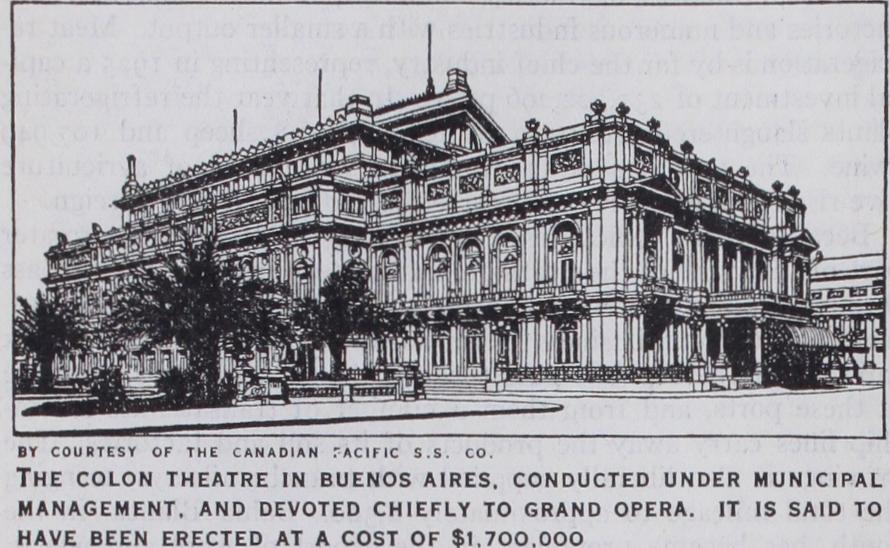
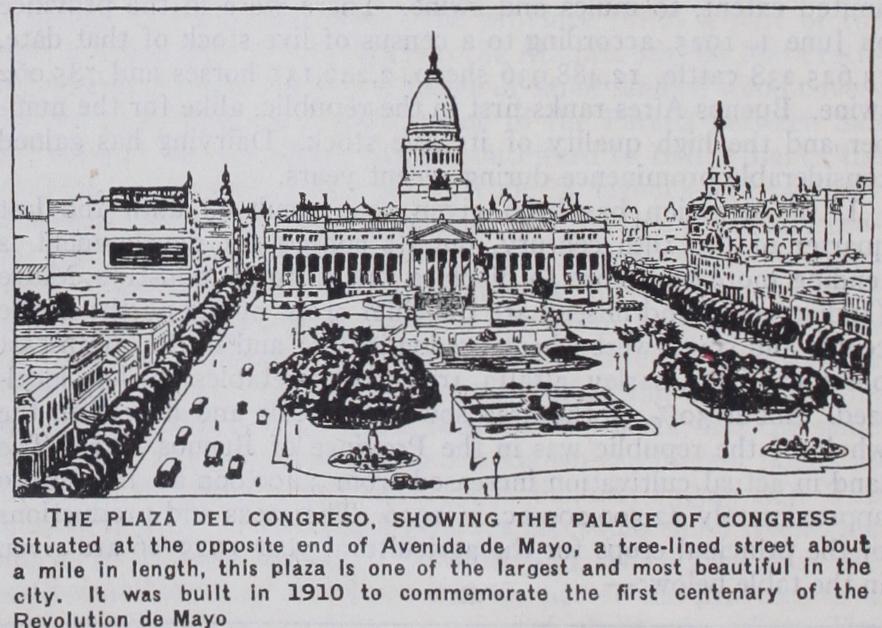
BUENOS AIRES, the capital, and chief port of the Repub lic of Argentina, is situated in a Federal district of 72 sq.m. which lies along the western shore of the Plata river estuary. The city is about 125m. from the Atlantic ocean in 36' 21" S. and 21' 33" W. It is only about 65ft. above sea-level. The population in 1934 was about 2,230,946. The city is laid out on the "checkerboard" plan with streets intersecting at right angles. Of the business streets Avenida de Mayo stands first; it is 12oft. wide, extending from Plaza Mayo to the Palacio del Congresso, for about a mile. Its striking features are the uniformity of height (generally six to eight stories) and fine architecture of the build ings. It has a double row of lights along the middle, and is lined with trees. The city's architecture, largely of the French Renais sance, has been promoted by the municipality's annual award of prizes for the most attractively designed business and residence building. The city has more than a hundred parks covering a total area of 3,00o acres. The largest is Parque 3 de Febrero, at the suburb of Palermo, one of the most popular resorts, reached by splendid boulevards. The principal square of the city is the Plaza de Mayo, on to which front the Government palace, the Banco de la Nacion and the historic cathedral in which repose the remains of the Argentine hero, Gen. San Martin. Other notable buildings are the Colon theatre, the Palace of Justice, the Capitol, the opera house, the Jockey club, etc.
Since 1921 annual building permits for the city have ranged from 13,500 to 27,36o; the value of these structures ranges from 115,4 2 2,000 to 226,149,000 pesos (peso equals about 42 cents of United States Currency). Among new structures are several gov ernment buildings, some of which are seven stories in height.
Extensive property areas have been appropriated for municipal improvements; land lying between Plaza San Martin and the water front was being prepared in 1928 for a public park, the estimated cost of which is given at 5,000,000 pesos. The city street railway system is excellent. Average daily passenger traffic amounts to more than I,' oo,000. The subway extending from the Plaza de Mayo to Plaza Once, for more than a mile is to be prolonged in order to relieve serious surface congestion. The growth of manufacturing industries in recent years is reflected by the fact that factories have increased to a total of more than I I ,000 and the capital invested in them has increased nearly S00%. Much of the manufacturing is done in the region of the Riachuelo river.
The seasons at Buenos Aires are the reverse of those prevailing in regions at about the same latitude north of the equator. June, July and August are the coldest months and embrace a large part of the periods of rains, although precipitation comes before and after these months, whose average temperature is 5o° F ; Septem ber, October, November average 6o° F; December, January, Feb ruary 72° F; March, April, May 62° F. The annual rainfall is 894mm.; days of the year are classed as 5o% cloudy; 115 are more than 5o% cloudy. A hundred miles out on the pampa there is much more sunshine than at Buenos Aires, a condition largely attributable to the expanse of river estuary in the region of the capital.
Buenos Aires, in addition to being a municipality, is also the capital of the republic, and as such has intimate connection with the Federal Government. Through the intendente matters pertain ing to the welfare of the municipality are presented to the Na tional Congress whenever necessary, and he, as the representative of the National Government, is empowered to present to the mu nicipality matters affecting it that have originated in Congress. Other manifestations of this dual character of the city are to be found in the police and fire departments, under the control of the Federal Government, which meets the expenses of these depart ments. Certain branches of the educational system, and also the sanitary regulations of the city, carried out by means of a na tional department of public service—the Asistencia Publica—are partly national in character.
Public sanitation is directed by two organizations, one national, the other municipal. The first body controls conditions that di rectly affect the country by virtue of the city's being the gateway to the republic. The second body has charge of municipal labora tories, conducts bacteriological examinations and disinfecting ac tivities, and controls the relief services that respond to emergen cies. The city's water supply and sewer system are departments of the National Government. Water is obtained from the Plata far enough up stream to avoid pollution, the supply being taken from wells bored beneath the surface of the river. At central stations this water is purified further by sedimentation and filtration. The sewerage system discharges into the Plata below the city, whence it is carried out to sea. Gravity not being sufficient, a series of pumps and relief sewers are in use.
Education.—The public school system is partly national and partly municipal, although the schools are under the supervision of the National Government. There are primary, secondary, com mercial, industrial schools, and schools of a collegiate character. The University of Buenos Aires provides courses leading to doc tors' degrees. There are numerous fine art institutions and special instruction is available for the deaf, dumb and blind. Primary education is free and compulsory for children from six to 14 years of age. Educational work is supported largely from the national treasury and from certain funds provided by municipal taxes. The city is well supplied with free libraries, including the National, Mitre, Municipal, Typographic Society's library, Popular, La Prensa library, National Library of Masters, Velez Sarsfield Public Library and others.
History.—In 1515 Juan de Solis sailed his vessels into the water known to-day as the Plata river, believing that he had found the route to the Indies. Solis and his party were the first Euro peans to reach this waterway, but the leader never lived to tell the story. On the north shore of the river he and most of his followers met their death in an encounter with the wild Charruas. Five years later another European ex pedition arrived, headed by a Portuguese, Ferdinand Magellan, in the service of the emperor, Charles V. Magellan followed the coast of the country and finally discovered a watercourse leading to the East. In 1527, Sebastian Cabot, the Venetian, who had re signed from the service of Eng land for that of Spain, was sent by Charles V. to determine the line of demarcation between the colonizing spheres of Spain and Portugal ; learning of inland re gions abounding in silver, he de cided to move up the river. In 1535 another expedition, com manded by Pedro de Mendoza, landed on the present site of Buenos Aires. This event marks the first serious attempt of Euro peans to establish themselves within the bounds of what is now Ar gentina. The native Indians proved hostile, after a time conditions became desperate, and Mendoza himself decided to return to Spain, but died on board ship before reaching there. Those he left behind, also discouraged, migrated farther up the Plata and the settlement started by Mendoza soon disappeared. In 158o Juan de Garay arrived with other adventurers and re-occupied the site that Men doza had abandoned. Garay called the place La Trinidad, and the actual landing site on the river's bank was christened Port Santa Maria de Buenos Aires. As time passed the settlement became known simply as Buenos Aires (Span. "good airs").
The settlement had grown to a village of several hundred peo ple by 1650. Most of the houses were constructed of stone and mud and had thatched roofs, although a few were roofed with tile. Dwellings were low, many not more than 1 aft. high. The plaza of Santo Domingo convent became a general trading mart. There seems to have been a census-taking in 1664, when the town had 2 families or a population of more than 1,000 people. Cattle were imported from the Old World, and from this early beginning was thus developed the great pastoral industry upon which largely rest Argentina's progress and wealth to-day. (W. A. R.)