Home >> Encyclopedia-britannica-volume-4-part-1-brain-casting >> Brookings to Buffer >> Buffalo

Buffalo

Loading


BUFFALO, a city and port of entry, and the county seat of Erie county, New York, U.S.A., the second city in population in the State, at the eastern extremity of Lake Erie and at the upper end of the Niagara river, distant by rail from New York city 423m., from Boston 499m. and from Chicago S4om. It has an area of 42 sq.m. The site of the city is on a broad, undulating tract of ground, rising gradually from the lake to an elevation of so to 8oft. its altitude averaging somewhat less than 600ft. above sea-level. The high land and temperate climate and the excellent drainage and water-supply make Buffalo one of the most health ful cities in the United States. As originally laid out by Joseph Ellicott, the plan of Buffalo resembled that of Washington. It has broad and spacious streets, most of which are lined by trees. The municipal park system consists of a chain of parks with a total area of 1,342ac., encircling the city and connected by boule vards and driveways. The largest is Delaware park, about 365ac., including a lake of 461ac., in the north part of the city; the west part of the park was enclosed in the grounds of the Pan-American Exposition of 1901.

Buildings and Monuments.—Buffalo is widely known for the beauty of its residential sections, the houses being for the most part detached, set well back from the street and surrounded by attractive lawns. The Federal building, county hall, city hall and State office building provide quarters for various branches of governmental work. The chamber of commerce is the centre of business activity. There are three State armouries. An audito rium and a music-hall are owned by the city. The Albright art gallery and the building of the Buffalo Historical Society, which houses a library and a museum, stand in Delaware park. The museum of the Buffalo Society of Natural Sciences is in Hum boldt park. A monument in memory of President McKinley dis tinguishes Niagara square, around which is the civic centre. A soldiers and sailors' monument, commemorating Civil War vet erans, is in Lafayette square; a statue "The Hiker" appropri ately recalls the Spanish War, and the figure of Commodore Oliver Hazard Perry at The Front preserves the memory of the com mander of the American squadron in the battle of Lake Erie on Sept. to, 1813. In Forest Lawn cemetery are the monuments to President Millard Fillmore and the famous Seneca chief Red Jacket (1751-1830), a friend of the whites, who was faithful when ap proached by Tecumseh and "the Prophet," and warned the Ameri cans of their danger. Churches include St. Joseph's (Roman Catholic) and St. Paul's (Protestant Episcopal) cathedrals, and Trinity (Protestant Episcopal), Westminster Presbyterian, Dela ware Avenue Baptist, Delaware Avenue Methodist, First Presby terian and others.
Education.

In addition to the usual high and grammar schools, the city supports a training school for teachers and a system of night schools, kindergartens and vocational schools, including a vocational high school. The State teachers' college at Buffalo, developed from a State normal school, has expanded on a new site with enlarged and appropriate buildings. The Univer sity of Buffalo (organized in 1846) comprises schools of medicine (1846), pharmacy (1886), law (1891), dentistry (1892) and arts and sciences (1913) . The university in 1909 under Chancellor Charles P. Norton acquired a new site of io6ac. in the northern part of the city, to which 442c. were added in 1919. In 192o an endowment fund of $5,177,000 was raised by popular subscrip tion, since increased by other gifts and bequests. Samuel P. Capen became chancellor in 1922. A unique gift by the will of the late Chancellor Norton provides for the conferring by the university annually of a civic medal to the citizen of Buffalo who is adjudged to have done the most distinguished service to the community and the world. The first medal was given in 1924 to Bishop Charles H. Brent, delegate of the United States to the international opium conference. Canisius college (Jesuit) was established in 1870 and chartered in 1883. In 1920 it raised by popular subscription an endowment fund-of $1,000,000 and with the erection of a new building began a notable expansion. D'You ville college for women (Roman Catholic) was opened in 1908. Other important schools are the Academy of the Sacred Heart, Buffalo seminary, Franklin school, Elmwood school, Holy Angels academy, St. Mary's seminary, St. Joseph's Collegiate Institute, Nardin academy, Mt. St. Joseph academy and Nichols school for boys. Important libraries are the Buffalo public (founded in 1837), the Grosvenor, a reference library founded in 1859, the Buffalo Historical Society library, which includes special collec tions, the law library (8th judicial district) and the Catholic Institute.

Buffalo

Public Institutions.

The new city hospital in Buffalo and the J. N. Adam Memorial hospital for tuberculous patients at Perrysburg (N.Y.), are maintained by the city. The Erie county home and infirmary occupies a farm site at Wende (N.Y.). The U.S. marine hospital is maintained by the Federal Government. Other important hospitals are the General, the Millard Fillmore, the hospital of the Sisters of Charity, the Children's, the Dea coness, the Columbus, the Lafayette, the Emergency, the Mercy, the Moses Taylor and the Providence Retreat. Among the chari table institutions are the Home for the Friendless, Buffalo and St. Vincent's orphan asylums, Children's Aid Society, Erie county lodging-house, Ingleside home for erring women and Le Couteulx St. Mary's deaf-mute institution. The Charity Organization Society was founded in 1877, the first of its kind in the United States, and has been the model followed in many other cities.

The first newspaper, the Gazette (a weekly), was established in 1811 and became the Commercial (a daily) in 1 83 5. The first daily was the Western Star (1834) which later became the Courier. There were in 1936 three English daily papers, the News, the Courier-Express and the Times.

Government and Population.

From 1916 to 1928 Buffalo had a commission form of government with legislative and execu tive powers united in five commissioners, chosen at non-partisan primaries and elections. A new charter went into effect on Jan. I, 1928, which restored government by mayor and council with some original features. Nominations, though under direct affili ated primaries, are by party tickets. The elective officers. are mayor, controller, president of the council, five councilmen at large and nine district councilmen. The mayor prepares the budget, and executive powers are strongly concentrated in his hands, with the council holding a check through the powers of taxation, appropriation and confirmation. The council sits as a unicameral body. The mayor, president of the council and coun cilmen at large may not be re-elected to succeed themselves after completing their four-year terms. The district councilmen, who are elected for two-year terms, may be re-elected once, but may not serve for more than four continuous years.

Buffalo's first census, taken in 1820, showed a population of about 2,000. A century of growth brought it in 1920 to 506,775, with a total of 602,847 in the metropolitan district (Buffalo and suburbs). The State enumeration of 1925 returned 538,016 and the Federal census figures of April r, 1930 were 573,076. The population includes numerous elements of German, Canadian, Polish, Irish and Italian birth or descent.

Commercial Importance.

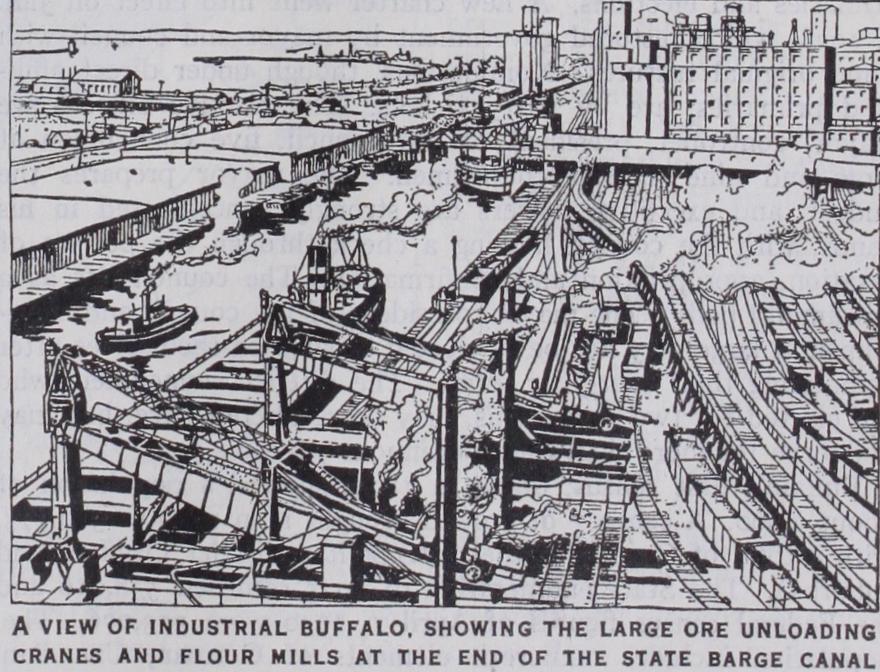
Situated almost equidistant from New York, Boston, Philadelphia, Baltimore and Chicago, at a natural junction point for lake and railroad transportation, Buf falo has become one of the leading commercial and industrial centres of the United States. Its annual record in tonnage handled usually ranks the city eighth or ninth among American ports. The outer harbour is protected by a breakwater 41m. long enclosing an area of about 68o acres. There are 37.4m. of water frontage, obtained in part by the development of the Buffalo river and canals. Municipal piers supplement private dockage. Grain ele vators have a capacity of almost 42,00o,000bu. and handle from 200,000,000 to 300,00o,000bu. a year. The New York State barge canal gives water transport to the seaboard for barges up to 2,00o tons capacity. Eleven main railway lines make the city an exceptional centre for land transportation. Electric power is obtained in great part from Niagara Falls. Natural gas, piped from Pennsylvania and western New York fields and supple mented by manufactured gas, is an important source of fuel sup ply. An abundant water-supply is pumped from Lake Erie and a filtration plant protects its purity. A municipal airport provides adequate landing facilities for air-borne mails and commerce. Flour and grain products, iron and steel, rubber, linseed-oil and meat products stand among the city's most important manufac tures. There is diversity in lesser lines of manufacture, of which some 6o% of the Federal census classification is represented.

History.

The first white men to visit the site of Buffalo were undoubtedly the adventurous French trappers and various Jesuit missionaries. On the east bank of the Niagara river at the mouth of Cayuga creek, La Salle in 1 679 built his ship the "Griffin," and at the mouth of the river built Ft. Conti, which, however, was burned in the same year. In 1687 Marquis Denonville built at the mouth of the river a fort which was named in his honour and was the predecessor of the fortifications on or near the same site later called Ft. Niagara. The neighbourhood was the scene of military operations up to the close of the Revolutionary War. As early as 1763 the present site of the city of Buffalo came to be known as the "Buffalo Creek region," either from the herds of buffalo or bison which, according to Indian tradition, had fre quented the salt licks in the neighbourhood, or more probably from an Indian chief. In 1784 Ezekiel Lane and Michael Mid daugh became the first permanent white residents. The land was a part of the original Phelps-Gorham purchase. In 1797 it came into the possession of the Holland Land Company, being part of the tract known as the Holland purchase.

Joseph Ellicott, the agent of the company, who has been called the "Father of Buffalo," laid out a town in 1803, calling it New Amsterdam, and by this name it was known on the company's books until about 181o. The name of Buffalo Creek, or Buffalo, however, proved more popular. The village became the county seat of Niagara county in 1808, and two years later the town of Buffalo was erected. Upon the outbreak of the second war with Great Britain Buffalo became headquarters for most of the mili tary operations on the Niagara frontier. Lieut. Jesse D. Elliott, U.S.N., established a navy yard on Scajaquada creek where sev eral vessels were built that figured in later naval operations. On Oct. 9, 1812, he led an expedition which captured two merchant vessels moored under the guns of Ft. Erie on the Canadian side. On Nov. 3o, 1812, Gen. Alexander Smyth made an unsuccessful attempt to cross the river and attack Ft. Erie. On July r 1, 1813, a British force crossed the river and a sharp skirmish occurred within the present limits of Buffalo. On Dec. 30-31, 1813, a force df British, Canadians and Indians under Gen. Sir Phineas Riall (1769-1851) burned the greater part of Buffalo and Black Rock, with little resistance from the defending troops. The de struction, in which most of the other villages along the frontier were included, was an act of retaliation for similar devastation done by American troops in Canada. Gen. Jacob Brown from headquarters in Buffalo directed the troops which crossed the river and received the surrender of Ft. Erie on July 3, 1814. The army thence marched down the river to the vicinity of Niagara Falls where the battles of Chippewa (July 5) and Lundy's Lane (July 25) were fought. The American troops retired to Ft. Erie. A strong attack by the British was repulsed on Aug. 15, a por tion of the fort being blown up. On Sept. 17 a sortie of the Americans against the British camp resulted in the abandonment of the siege for the time being. Another advance by the Ameri cans as far as Chippewa was turned back in October and on Nov. 5, 1814, Maj.-Gen. Izard abandoned Ft. Erie and withdrew across the river to Buffalo.

After the war Buffalo was rapidly rebuilt. It was incorporated as a village in 1816. With the westward movement of immigra tion its prosperity increased. The first steamboat on the Great Lakes, "Walk-in-the-Water," was built in Buffalo in 1818. It was named in honour of a famous Wyandot Indian chief. The completion of the Erie canal in 1825 greatly increased the im portance of the place. In 1832 Buffalo was incorporated as a city and Dr. Ebenezer Johnson was chosen as the first mayor. In that year and again in 1834 cholera epidemics caused considerable loss of life.

In the Civil War, Erie county, of which Buffalo is the chief city, furnished 15,249 men to the Federal army. Their casualties numbered 4,704. In 1882 Mayor Grover Cleveland of Buffalo was elected governor of the State of New York, and in 1884 was nominated and elected president of the United States. In 19o1 Buffalo citizens organized the Pan-American Exposition with the purpose of promoting trade between the United States and other countries in this hemis phere. While attending this expo sition, President William McKinley was assassinated by an an archist, who had come to Buffalo for the purpose (Sept. 6, 190 1) . Vice-President Theodore Roosevelt took the oath of office as president in Buffalo.

Buffalo furnished over io,000 volunteers and selected service men to the U.S. army in the World War. The greater number of these served in the 77th and 78th Divisions and had an active part in several battles. On Aug. 7, 1927, an international vehicular bridge was opened to Fort Erie as a memorial to a century of Canadian-United States peace. In July 1932, the city celebrated its centennial with an exposition. Recent construction includes a new city hall and a federal building. City life was severely dis rupted in July 1937 by a teamsters' strike.

BIBLIOGRAPHY.-O.

Turner, History of the Holland Land Purchase Bibliography.-O. Turner, History of the Holland Land Purchase (Buffalo, 185o) ; William Ketchum, History of Buffalo (Buffalo, 5864-65) ; Publications of the Buffalo Historical Society (1879 et seq.) ; H. P. Smith, History of Buffalo and Erie County (Syracuse, 1884) ; J. N. Larned, History of Buffalo (191I) ; Frank H. Severance, Peace Episodes on the Niagara (1915) and An Old Frontier of France (1917) ; Henry W. Hill, Municipality of Buffalo (1923) ; Louis L. Babcock, The War of 1812 on the Niagara Frontier (1927) ; M. M. Wilner, Niagara Frontier (Chicago, 1931) . (M. M. W.) .

city, erie, niagara, river and county