
ANCHOR.) Well-known types of cable-holders, like Napier'r and Fiarfield's, differ chiefly in mechanical details. The principle of each type is that there is a long vertical shaft connected at the bottom by worm gearing to the engine. On the forecastle, at the top of the shaft, is pivoted the cable-holder, which can either revolve freely, as when cable is running out, or be locked to the shaft for "heav ing in." In the latest types the locking arrangement is a "dead" lock, in an earlier one it was frictional. In the newer type too, a frictional band-brake is fitted to control the cable when it is running out. In the older type the friction plates acted as a brake. Cable-holders are not fitted with hand gear, nor can they be used for hauling in a hawser. The centre-line capstan can be either connected to the engine or worked by hand. For the latter, long bars are shipped into recesses in the capstan head at equal inter vals to enable it to be "manned." The bars are kept in place by a rope "swifter" passed round their extreme ends. To prevent the capstan taking charge when weighing, pawls and pawl stops are brought into use.
In the latest types of capstan the whelps (projections to grip a hawser) are portable and ship over the sprockets, i.e. the part of the capstan fitted with "stops" or "snugs" to take chain cable.
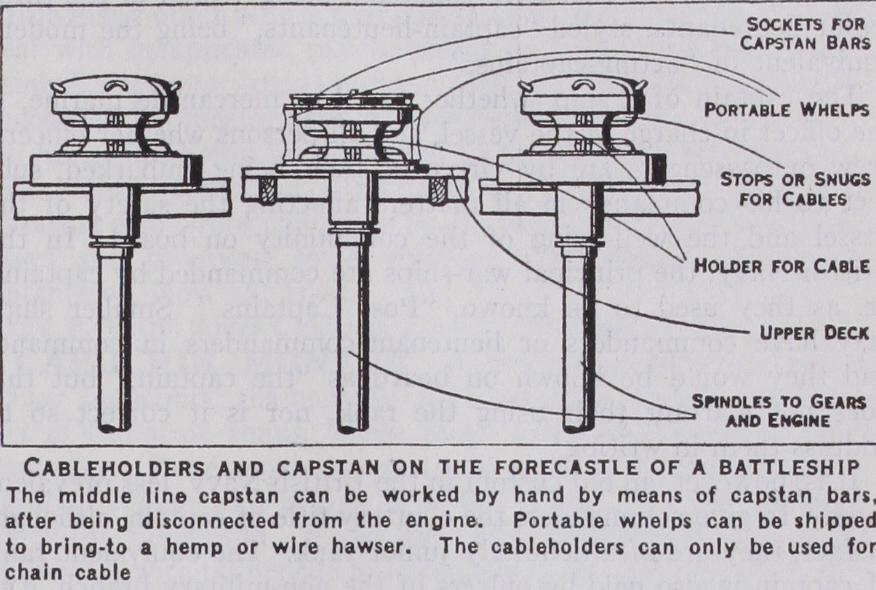
In older types, the capstan was only fitted for winding in hawsers and could only be used to work cables by employing a hook-rope or "messenger." Merchant ships are usually fitted with a windlass type of anchor gear having a horizontal axis. The two bower cables lead over the sprockets of a cable-holder at each end of the driving shaft ; outboard of these, at the extremities, are drums for bringing to hawsers. The cable-holders are frictionally connected to the driving shaft on much the same principle as the vertical type in warships.
The machinery for driving capstans and cable-holders on board ship may be steam or electric. Power-capstans on dock sides are generally electric or hydraulic. The derivation of the term "cap stan" is connected with the O.Fr. capestan or cabestan, from Lat. capistrum a halter, ca Pere to take hold of. (E. A.)