CACTUS. This word, applied by the ancient Greeks to some prickly plant, was adopted by Linnaeus as the name of a group of curious succulent or fleshy-stemmed plants, most of them prickly and leafless, some of which produce beautiful flowers, and are now popular in gardens. As applied by Linnaeus, the name Cactus is almost conterminous with what is now the family Cactaceae.
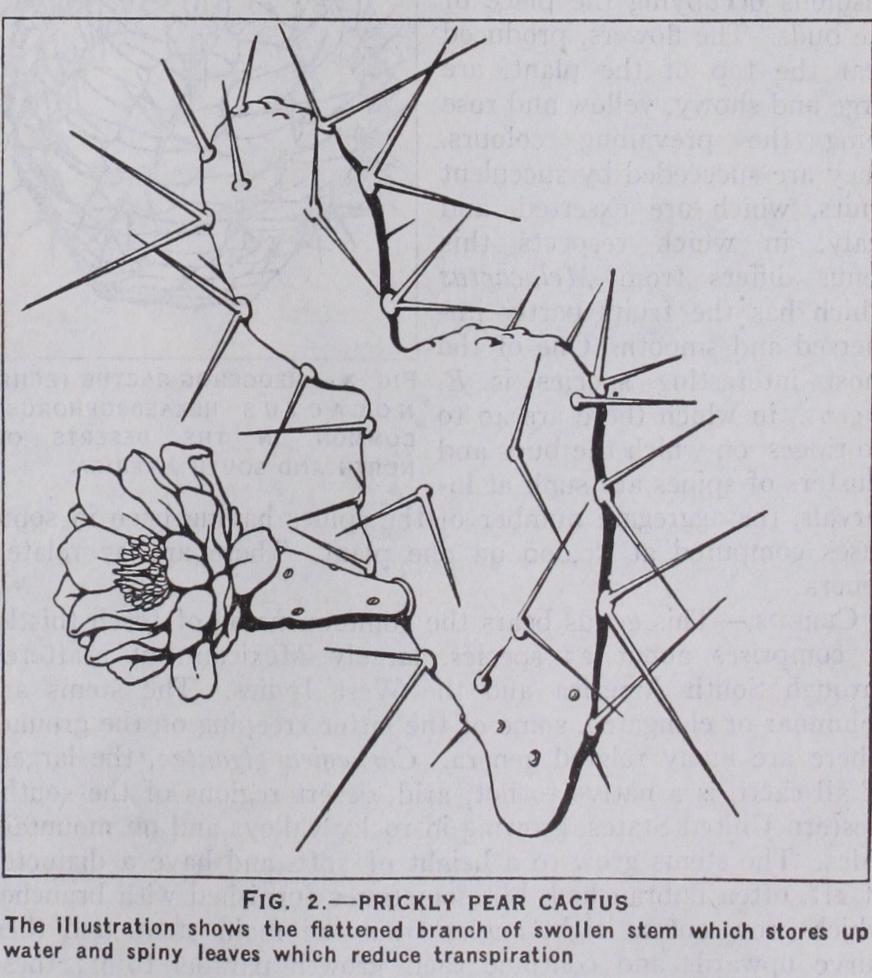
The Cacti may be described in general terms as plants having a woody axis, or skeleton, overlaid with thick masses of cellular tissue forming the fleshy stems. These are extremely various in character and form, being globose, cylindrical, columnar or flat tened into leafy expansions of thick joint-like divisions, the sur face being either ribbed like a melon, or developed into nipple-like protuberances, or variously angular, or smooth, but in the greater number of species furnished copiously with tufts of horny spines, some of which are exceedingly keen and powerful. These tufts show the position of buds, of which, however, comparatively few are developed. The leaves, if present, are generally much reduced. In Pereskia, however, the stems are less succulent, and the leaves, though fleshy, are developed in the usual form. The flowers are frequently large and showy, and are often attractive from their high colouring. In one group, represented by Cereus and related genera, they consist of a tube, elongated, on the outer surface of which, towards the base, are developed small and at first incon spicuous scales, which gradually increase in size upwards and at length become crowded, numerous and petaloid, forming a funnel shaped blossom, the beauty of which is much enhanced by the multitude of conspicuous stamens which with the pistil occupy the centre. In another group, represented by Opuntia, the flowers are rotate; i.e., the long tube is replaced by a very short one. At the base of the tube, in both groups, the ovary develops into a fleshy (often edible) fruit, that produced by the Opuntias being known as the prickly pear or Indian fig.
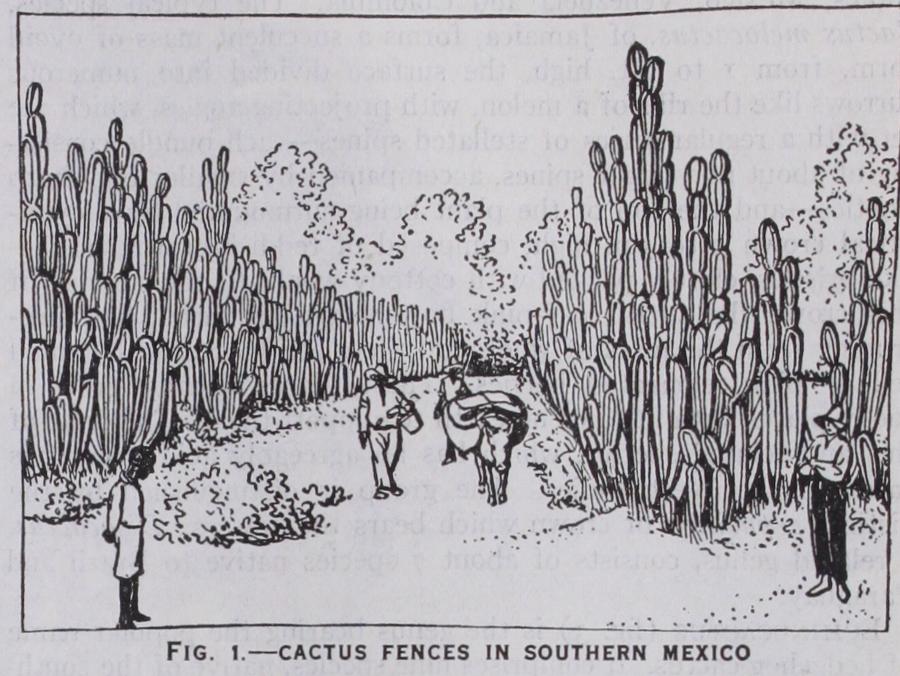
Genera with long-tubed flowers include Echinocactus, Echi nopsis, Cereus, Epiphyllum, Cephalocereus and many others, while those with short-tubed flowers are Rhipsalis, Opuntia, Pereskia and several of minor importance. Cactaceae belong to the New World; but some of the Opuntias have been long distributed on the shores of the Mediterranean and the volcanic soil of Italy and several species of Rhipsalis occur in tropical Asia and Africa. They mostly affect the hot, dry regions of tropical America, the aridity of which they are enabled to withstand in consequence of the thickness of their cuticle and the fewness and "sunk" condi tion of the stomata with which they are furnished. The thick fleshy stems and branches contain a store of water. The succulent fruits of some kinds are not only edible but agreeable, and in fevers are freely administered as a cooling drink. The Spanish Americans plant the Opuntias and others around their houses, where they serve as impenetrable fences.