
CALCUTTA, a city in British India and the capital of the province of Bengal. It is situated in 34' N. and 88° 24' E., on the left or east bank of the Hugli, about 8om. from the sea. It extends over an area of 32 sq.m. and contains a population of 1,260,709. Including Howrah on the other side of the river, which has been described as being as much a part of Cal cutta as Southwark is of London, Calcutta has a total population of 1,485,682 and claims to be the second city in the British empire. It was until 1912 the seat of the Government of India, which in that year was transferred to Delhi.
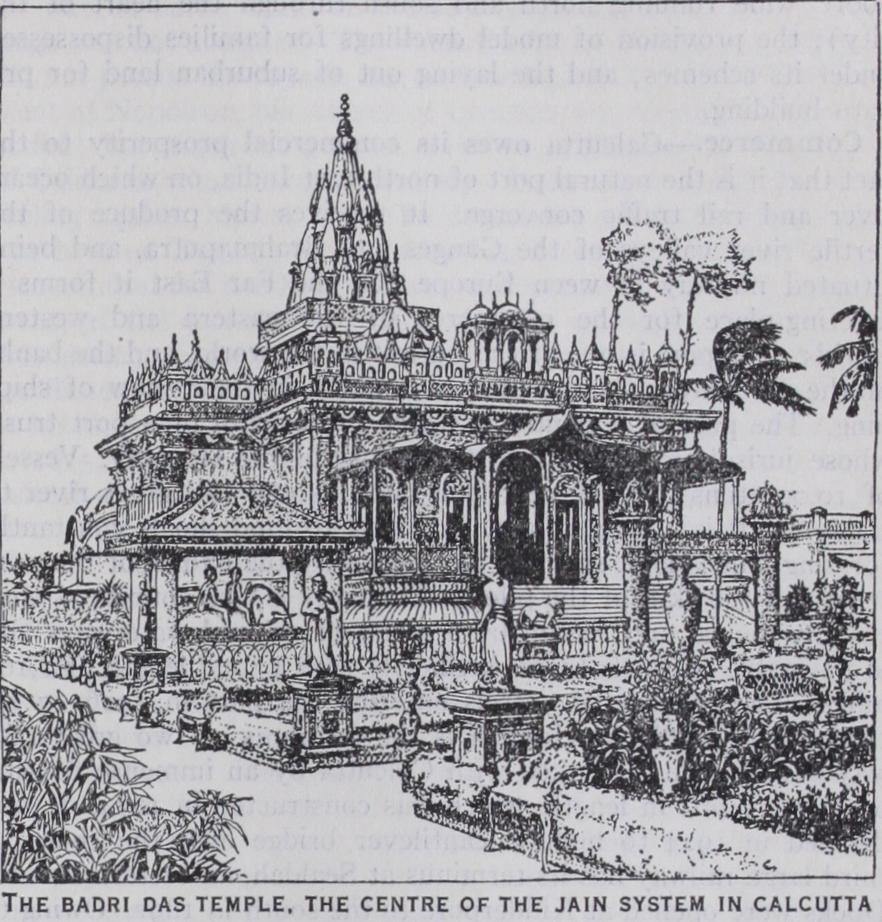
Buildings.—Though Calcutta has been called "the city of palaces," its modern public buildings cannot compare with those of Bombay. Its chief glory is the Maidan or park, 2 sq.m. in area, which is large enough to embrace the area of Ft. William and a racecourse. It is adorned by many statues and a pillar 165ft. high erected to the memory of Sir David Ochterlony, who brought the Nepalese War to a victorious conclusion. South-east of the Maidan stands the finest building in Calcutta, the Victoria Me morial, the conception of which was due to Lord Curzon; it was built on the site of the old gaol and opened in 1921. It is a domed marble building with a great centre dome, and contains pictures, documents, etc., illustrating Indian history. This great building dwarfs the cathedral, to the east of it, which has a spire 207ft. high. A war memorial to the lascars of Bengal and Assam has been erected near Prinsep's Ghat by the river bank. Gov ernment House, which is situated near the Maidan and Eden gardens, was the residence of the viceroy until 1912, since when it has been occupied by the governor of Bengal. It was built by Lord Wellesley in 1799, and is a fine pile situated in grounds cov ering six acres. The town hall has been used for some years for meetings of the Bengal legislature pending the construction of a separate council chamber. The High Court building in its vi cinity was designed on the model of the town hall at Ypres. Calcutta being a city of modern growth, there are few buildings of any considerable age. Lord Curzon restored, at his own cost, the monument which formerly commemorated the massacre of the Black Hole, and a tablet let into the wall of the general post office indicates the position of the Black Hole in the north-east bastion of Ft. William, now occupied by the roadway. Belvedere House, a country house of Warren Hastings and the official resi dence of the lieutenant-governor of Bengal from 1854 to 1921 is situated close to the zoological gardens in Alipore, the southern suburb of Calcutta. Here also are Hastings House, another resi dence of Warren Hastings, the Bengal Meteorological Observatory and cantonments. Facing the Maidan for a couple of miles is Chowringhee, once a row of palatial residences, but now given up almost entirely to hotels, clubs and shops. Several magnificent buildings have been erected in the commercial quarter, including the Royal Exchange. Some areas have been almost transformed by an improvement trust which since its creation in 1912 has carried out the clearing of insanitary areas; the widening and con struction of roads (the chief being the Central avenue, a fine road 1 oof t. wide running north and south through the heart of the city) ; the provision of model dwellings for families dispossessed under its schemes ; and the laying out of suburban land for pri vate building.
The university exercises control over the hundreds of secondary schools in Bengal by means of the matriculation examination, for which from 16,00o to 19,00o candidates present themselves an nually; it exercises control over the "affiliated" colleges by deter mining the curricula and examinations in the faculties of arts, laws, teaching (education), science, medicine and engineering; and it carries on since 1909 "post-graduate" teaching in arts and science and teaching in law in the university law college. A com prehensive survey of the university work was made by the Cal cutta university commission presided over by Dr. (now Sir) Michael Sadler in 1917-19. Since the report was issued an area with a radius of five miles in the Dacca district and the province of Burma have been removed from the educational jurisdiction of Calcutta and the universities of Dacca (q.v.) and Rangoon created in 1921. In 1928 the senate adopted a resolution approv ing reorganization on the lines of this report. There are a num ber of affiliated institutions, of which the chief is Presidency col lege, maintained by Government. The university has a number of endowed chairs and lectureships and a very large number of benefactions for scholarships and prizes.
Hardly more than one-third of its population were born in Cal cutta; men outnumber women by two to one, the bulk being below the age of forty. The explanation of these peculiarities is that the trade and manufactures of the city attract an enormous num ber of able-bodied men, mostly illiterate workers, from outside. The day population largely exceeds that which sleeps in the city; there are 300,00o season ticket holders to the railway termini. As in other towns in Bengal, Hindus predominate, outnumbering Mohammedans by 500,00o.
The history of Calcutta practically dates from Aug. 24, 169o, when it was founded by Job Charnock (q.v.) of the English East India Company. In 1S96 it had obtained a brief entry as a rent-paying village in the survey of Bengal executed by command of the Emperor Akbar. In 1686 the English merchants at Hugli retreated about 26m. down the river to Sutanati, a village now within the boundaries of Calcutta. They occupied Sutanati tem porarily in Dec. 1686, and permanently on Aug. 24, 169o. The new settlement soon extended itself along the river bank to the then village of Kalikata, and by degrees the cluster of neighbour ing hamlets grew into the present town. In 1696 the English built the original Fort William by permission of the nawab, and in 1698 they formally purchased the three villages of Sutanati, Kali kata and Govindpur from Prince Azim, son of the Emperor Aurangzeb.
The site thus chosen had an excellent anchorage and was de fended by the river from the Mahrattas, who harried the districts on the other side. The fort, subsequently rebuilt on the Vauban principle, combined with the natural position of Calcutta to ren der it one of the safest places for trade in India during the expir ing struggles of the Mogul empire. It grew up without any fixed plan and with little regard to the sanitary arrangements required for a town. Some parts of it lay below high-water mark on the Hugli, and its low level throughout rendered its drainage a most difficult problem.
The chief event in the history of Calcutta is the sack of the town, and the capture of Fort William in 1756, by Suraj-ud Dowlah, the nawab of Bengal. The majority of the English of ficials took ship and fled to the mouth of the Hugli river. The Europeans who remained were compelled, after a short resistance, to surrender. The prisoners, numbering 146 persons, were forced into the guard-room, a chamber measuring only 18f t. by 14f t. loin., with but two small windows, where they were left for the night. It was the 20th of June; the heat was intense; and next morning only 23 were taken out alive, among them Holwell, who left an account of the awful sufferings endured in the "Black Hole." The site of the Black Hole is now covered with a black marble slab, and the incident is commemorated by a monument erected by Lord Curzon in 1902. In Jan. 1757 the expedition despatched from Madras, under the command of Admiral Watson and Colonel Clive, regained possession of the city. The battle of Plassey was fought on June 23, 1757, exactly 12 months after the capture of Calcutta. Mir Jafar, the nominee of the English, was created nawab of Bengal, and by the treaty which raised him to this position he agreed to make restitution to the Calcutta merchants for their losses. By another clause in this treaty the Company was permitted to establish a mint, the visible sign in India of territorial sovereignty, and the first coin, still bearing the name of the Delhi emperor, was issued on August 19, Modern Calcutta dates from 1757. The old fort was abandoned, and its site devoted to the custom-house and other Government offices. A new fort, the present Fort William, was begun by Clive a short distance lower down the river. At this time also the maiddn, the park of Calcutta, was formed.
Up to 1707, when Calcutta was first declared a presidency, it had been dependent upon the older English settlement at Madras. From 1707 to 1773 the presidencies were maintained on a footing of equality; but in the latter year the act of parliament was passed, which provided that the presidency of Bengal should exer cise a control over the other possessions of the Company ; that the chief of that presidency should be styled governor general; and that a supreme court of judicature should be established at Calcutta. In the previous year, 1772, Warren Hastings had taken, under the immediate management of the Company's servants, the general administration of Bengal. The treasury was removed from Murshidabad to Calcutta which thus became the capital. In 1834 the governor general of Bengal was created governor gen eral of India. It was not until 1854 that a separate head was appointed for Bengal. In 1912 the 1905 partition of Bengal was reversed and Calcutta was no longer the capital of India, the seat of Government being transferred to Delhi (q.v.). Since 1920 the harbour has been greatly extended and in internal devel opment and foreign trade, Calcutta still leads the other large cities of Northern India. (See BENGAL.) See A. K. Ray, A Short History of Calcutta (Indian Census, 1901) ; C. R. Wilson, Early Annals of the English in Bengal (1895) ; and Old Fort William in Bengal (1906) ; S. S. O'Malley, History of Bengal, Bihar and Orissa under British Rule, Calcutta (1925).