
CALLICULA, a historic mountain of Campania, Italy, some 4m. N.E. of Teanum (mod. Teano) (q.v.). After the victory of Trasimenus (q.v.) and the Roman failure to block Hannibal's (q.v.) march into Picenum at the pass of Plestia, the Carthaginian army remained at rest in Picenum for some time, and then marched along the Adriatic coast into northern Apulia, encamping first near Luceria and then near Vibinum (Bovino). The dictator, Q. Fabius Maximus, encamped near Aecae (Troia), about 6 miles away from him, and when Hannibal offered battle, wisely refused it. Hanni bal, therefore, who had no supply or recruiting base, and was living from hand to mouth, crossed the Apennines for the third time in the same year (217) and marched into Campania plunder ing the territory of Beneventum and taking the town of Telesia on his way down the valley of the Calor (mod. Calore) and up that of the Volturnus (mod. Volturno). Leaving the latter valley near Allifae he entered Campania by the defile below the ridge of Callicula, to the north-east of the modern village of Pietravairano, and plundered the Falernian territory. Unable to bring Fabius to battle, he planned to return to Apulia with the booty he had collected by the way by which he had come, but found it blocked by Fabius. Hannibal, however, collected 2,000 of the strongest oxen among those he had captured, and after nightfall sent them off by a higher pass, crossing the ridge of Callicula in a westerly direction, with lighted torches tied to their horns, with a detach ment of light troops, who had orders to make as much noise as possible. The Roman force which held the defile was completely deceived, left its position to pursue them, while Hannibal with the main body marched through the defile unhindered back to the valley of the Volturnus, and sent a detachment of light troops which successfully disengaged the light troops and the oxen.
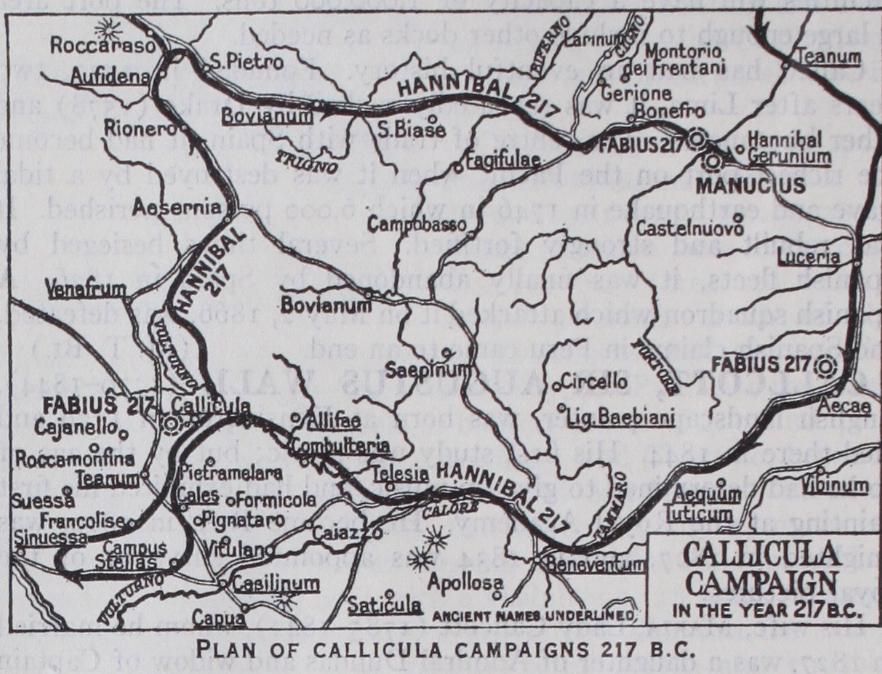
Hence he marched through Samnium and into the country of the Paeligni, as though he were moving towards Rome, making Fabius keep between him and the city ; and then he suddenly turned back and marched eastwards to Gerunium, Apulia, which is to be placed at Colle d'Armi, on the right bank of the Fortore some tom. E.N.E. of Luceria and the same E.S.E. of Larinum which he captured and used as a supply base, encamping outside the town and pillaging the countryside. The Romans eventually heard where he was, came up with him and established a camp on the left bank of the river, near Calene in the territory of Larinum. Both sides then advanced their camps closer to the river, so that each lay on a hill above it, but on opposite sides. Minucius, the master of the horse, who was in command in Fabius's absence, took advantage of the fact that the greater part of the Carthaginians were on a foraging expedition to attack their camp, and very nearly took it, so that Hannibal thought it more prudent to withdraw to his old camp near Gerunium itself, while Minucius occupied the abandoned camp on the right bank. Fabius now returned from Rome, and divided the army with him, each taking two legions; the camps were i 2m. apart and that of Fabius appears to have been on the left bank of the river. Be tween that of Minucius and that of Hannibal there was a hill and a deep ravine, in which the latter concealed 5,000 light troops and some cavalry; he then occupied the hill at dawn with a small force, and when Minucius attacked, as he expected, he sent con tinual reinforcements, and when the Romans were sufficiently en gaged, threw in his reserves from both wings and the rear. A catastrophe was only avoided by the intervention of Fabius with his two fresh legions, and the Carthaginians sounded the retreat, Hannibal declaring that he had beaten Minucius, but that Fabius had beaten him. He had, indeed, succeeded in living on the country, so that in the next summer he was able to win the victory of Cannae; and he had sufficient self-restraint and self-confidence to be ready to wait for a decisive battle until the circumstances were favourable to his tactics of surrounding the enemy.
See Kromayer, Antike Schlachtfelder, iii. i (Berlin, 1912) for a full description of these operations in which it is once more clear that Polybius' authority is to be preferred to that of Livy. (T. A.)