
CAMBODIA, a protectorate within French Indo-China. It is bounded north by Siam and Laos, east by Annam, south-east and south by Cochin-China, south-west by the Gulf of Siam, and west by Siam. Its area is 65,000 sq.m. ; its population (1926) 2,402,583, three-quarters Cambodian, the rest Chinese, Annamese, Chams, etc. Cambodia has more varied surface features than Cochin China. The Cardamone mountains in the west reach 4,900 ft., and their granite buttresses extend north-eastwards to the lakes, with forests on their steep sides, while the calcareous Elephant moun tains extend from them southwards to the Gulf of Siam. To the north the sandstone terraces of the Dangrek mountains fall abruptly to the Cambodian plain, the old Mekong (q.v.) delta. The Tonle-Sap depression is a striking feature with the smaller and the larger lake, remnants of an old sea-gulf. It is fed by several streams and links with the Mekong by a channel at Pnom-Penh, through which it receives Mekong flood waters. In June the waters of the Mekong rise to a height of 4o to 45 ft. and flow through the Bras du Lac towards the lake, which then covers an area of 77o sq.m. and, like the river, inundates the marshes, forests and culti vated lands on its borders. During the dry season the current re verses, the lake shrinks to an area of ioo sq.m., and its depth falls from 45-48 ft. to a maximum of 5 ft. Tonle-Sap probably repre sents the chief wealth of Cambodia. It supports a fishing popula tion of over 30,000 ; the fish, taken in large nets at the end of the inundation, are either dried or fermented for the production of nuoc-mam sauce. West of the large lake, around Battam Bang, is the largest Cambodian rice-area. The mountainous region east of the Mekong is traversed by affluents of the Mekong, the Se-khong and the Tonle-srepok, which unite to flow into the Mekong at Stungtreng. Small islands, with a fishing population, fringe the west coast.
Cambodian idiom is like some aboriginal dialects of south Indo China ; it is agglutinate and rich in vowel-sounds. The king's language and the royal writing, and also religious words are, how ever, apparently of Aryan origin and akin to Pali. Cambodian writing is syllabic and complicated.
Trade, largely in Chinese hands, is carried on chiefly through Saigon in Cochin-China, Kampot, the only port of Cambodia, being accessible solely to coasting vessels. Pnom-Penh (q.v.) communicates regularly by the steamers of the "Messageries Fluviales" by way of the Mekong with Saigon. About 90% of the exports are accounted for and are by river. In 1925 they included 26,470,039 kg. of fish and fish products, 3,029 kg. of silk, 5,566 tons of rice, 1,189 tons of cotton and 114,565 tons of paddy.
The French are developing a network of communications, and the production of cotton and silk, as well as the fisheries of the lakes.
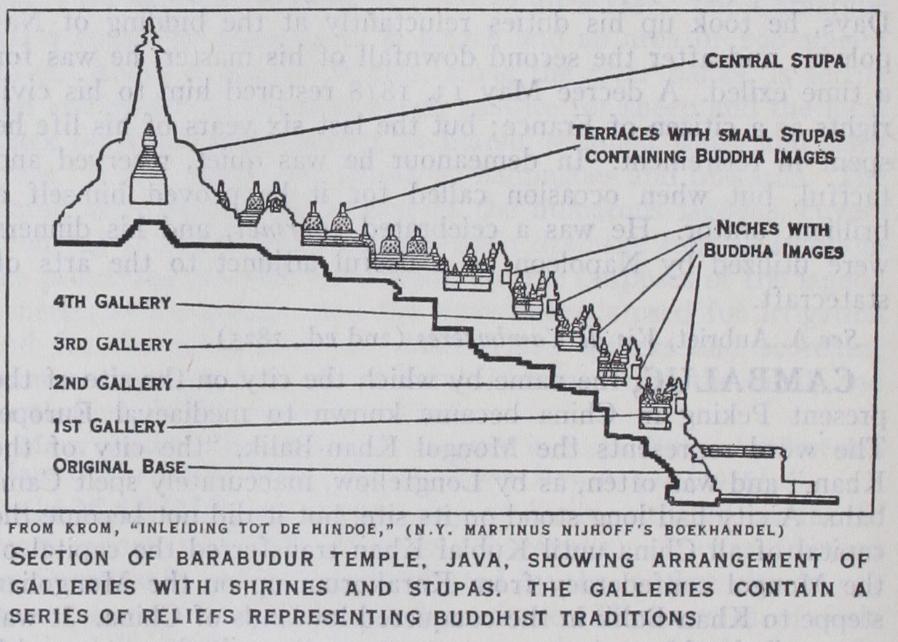
The chief sources of revenue are direct taxes, including poll-tax and taxes on the products of the soil, which amounted to 8,215, 575 piastres in piastres per head. (See INDOCHINA, The spread of Indian culture to this area, after the beginning of the Christian era, left no monuments of the first centuries, probably because at that time wood was the only building mate rial known, but from the sixth and seventh centuries onwards temples and stone and bronze images are found. In the older forms the direct influence of the Indian tradition is perceptible. The monuments are small with great sobriety of sculpture. In the more recent period the native elements of the district in question assert themselves and the ornamentation becomes richer and more elaborate. Vast elaborately constructed groups of temple build ings arose in Java in the second half of the first period, while in Cambodia they belong to the more recent period. Finally, due principally to political circumstances, a period of degeneration set in, in Cambodia after the 12th century, in Champa after the 11th and in Java after the 14th century.
In the valley of the Mekong, the district around the great lake and the adjoining hills, the name of the oldest established king dom, Fu-nan, gives place in the Chinese documents after the sixth century, to that of Chen-La, without evidence of the connection between the ancient kingdom and the two simultaneous Chen-La states, the northern and the southern. The art of the sixth to the eighth century may be termed primitive Khmer. In the course of the eighth century the northern Chen-La gained predominance, and from the ninth century union with the Khmers was an estab lished fact. In regard to art the first part of this century is a blank, followed by a transition period, named after the reigning prince Indravarman, which has certain common features with the primitive style, but is in gen eral nearly related to the classi cal Khmer art of the following centuries. Classical art flour ished from the loth to the 12th century, reaching its highest point in the temple of Angkor Vat. After this degeneration rapidly set in.
The Primitive Khmer Style. —This yields usually small, soli tary temples (prasat) rectangu lar or square constructed in brick. Horizontal lines predominate, the profiling is weak and the mouldings are furnished with niche-shaped antefixes, with hu man heads as ornamentation. The external roof, built in storeys, does not correspond to the vaultings of the interior, be cause this style of building arose through the adaptation in stone of a style already using lighter materials. Probably a survival of the pre-Khmer style is to be found in the miniature buildings carved in relief, forming the decoration of the frontages and the space above the entrance, in the latter case enclosed in a wide arch. The entrance itself, flanked by roue d pillars, is covered by a lintel, a favourite theme for which is a depressed arch, often set with medallions, the extremities springing from the open mouths of makaras (sea elephants).
In this primitive art two styles, a simpler and a more compli cated, are recognizable. The latter is richer and lighter in decora tion, the building is raised upon a considerable base, having pro jections on all four sides, one of which contains the entrance, the others bearing niches or blind doors. The roof, which is the first style, is constructed of many storeys, each of small height, is in the latter a few stories of great height, which lend to the whole a slender appearance. The first style has been regarded as being Hindu, and therefore in contrast to the later Khmer art.
The most important remains are those of Sambor Prei Kuk, to the east of the great lake, some forty buildings, divided into different groups of both types. The stone cell of Asram Maha Rosei on the lower Mekong represents the older type and the lofty temple of Bayang the later one. In the lake district the simple Trapan Kuk contrasts with Damrei Krap and the group of Pra Srei ; while on the upper Mekong at Han Cei both styles are found. At Boran is preserved the only complete example of a temple with two chambers. The sculpture of this period com bines severity of design with delicacy of modelling; of which the images of Phnom Da and the Harihara of Andet are striking examples.
The representation of buildings upon the facade has disappeared and given place to sculptured panels; mouldings and decoration have taken different forms, the technique is changed, the lintel has lost its architectural character and has become merely an ornament. In everything a tentative search for new forms is felt. The group of sacred buildings at Roluoh, south east of Angkor, consisting of the shrines of Prah Ko, Bakong and Lolei, is char acteristic of the Indravarman style. The first consists of two rows of three temples with a few outbuildings, contained within a double wall; Bakong is a tall pyramidal construction of six stories in stone, with two brick smaller temples on either side; Lolei is formed of four temples upon a vast terrace. With these, though of a somewhat later date, may be grouped Pre Rup, five temples raised upon a terrace, with twelve upon a lower level and a con glomeration of terraces, gateways and minor buildings; the (east ern) Mebon, also comprising five central temples, but with rather different surroundings; and Baksei Camkrong set alone upon a foundation raised in terraces. At Icvarapura, the present Bantay Srei, is a main temple between two others, in which the propor tions of the stone buildings are small. They are conspicuous for the delicacy of their execution. This temple is typical of the Indravarman style in a number of particulars, although it was only built in the i4th century in what was then a very archaic style, to replace a loth century sanctuary. The principal image is the representation of diva with Uma, almost naked, carved in bold lines, without ornamentation except for the head dress.
The oldest productions of the classical style are usually attrib uted to the ninth century (King Yagovarman, 889-91o). Certain characteristics are shared with the Indravarman style, which also produced groups of buildings with gateways and minor construc tions, divine figures, often heavenly nymphs in niches, forming the principal decoration of the panels on the facade. The entrance, between octagonal pillars, is covered by a lintel, ornamented by garlands extending from the centre-piece, this centre-piece being frequently formed by the head of a monster. The makaras are replaced by ragas (snakes) which coil around the pointed-arch above the lintel, and other projecting parts and rear their heads on both sides; also the profiling is more animated.
The principal buildings, now almost invariably of stone, are connected by a more or less consecutive system of galleries. Great projections on each side transform the square into a cruciform plan. The layers of the roof repeat this form, succeeding each other in such a way that the whole roof, beneath the great lotus flower by which it is crowned, acquires an elongated cone shape, giving it the appearance of a tower.
The centre of this classical art is the capital city of Angkor Thom, the building of which is supposed to have been begun at the end of the 9th century. At Banteai Chma, in the north west, are still older remains of an ancient stronghold of the gth cen tury, showing even then the typical construction of a classical sanctuary. The temples of which the centre one has a portico, are combined and surrounded by a square gallery with four gate ways ; in front more passages and galleries join on, connected by side galleries ; the whole, with other buildings at the side and back, is surrounded by another gallery, outside which again lie ponds and entrances with balustrades, the latter formed of huge snakes. The mountain of Kulen and perhaps Prah Khan, yield further examples of the older classical style ; in the latter group there are twelve minor temples, excluding the outbuildings.
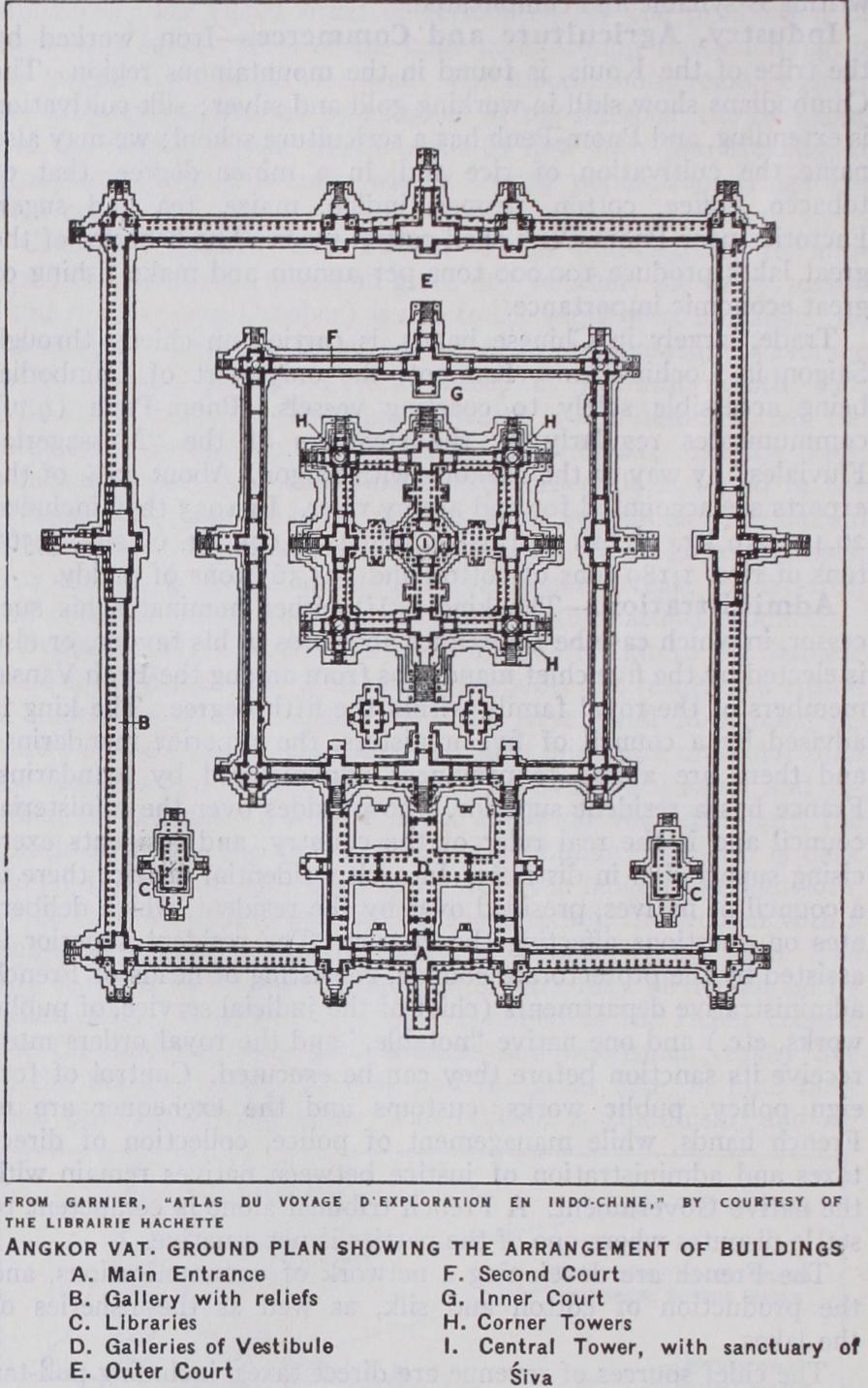
Angkor Thom itself, the ancient Yacodharapura, is a square, surrounded by wall and moat, each side of which is three kilo meters in extent. There are five gateways, from which roads with snake-balustrades lead to the centre of the city. In this centre stands the state temple Bayon. The chief building is surrounded by two galleries provided with portals and turrets and decorated with reliefs. These towers and the gates are cut in the form of four huge human faces, presumably representations of Siva. The cen tral tower, outside which a ring of small chapels are built, is provided with projections. In front there is a network of corri dors and side passages ; the inner chamber contained 8iva's Lingga, while in the chapels both Hindu and Buddhist sacred images are found. The latter, however, were probably introduced at a later date. North of Bayon lie the remains of the palace, in which the royal temple Phimeanakes still stands. Gallery and shrine here arise above three steep terraces. In front of the building runs a great terrace of honour ornamented with reliefs (elephants and others). All this is believed to belong to the most ancient plan of the city. Ta Prohm, to the east, dates from the same time, having a particularly intricate arrangement of projections against the inner gallery, large gateways and ponds. The neighbouring Banteai Kedei, attached to a great pond, while adhering to the leading principles, shows a very mixed ground plan.
The group of Koh Ker, the remains of a new capital city, in the classical style but much simpler in construction, belongs to the second quarter of the tenth century. In the capital itself, Baphuon dates from this period, and is reared up high upon the topmost of three steep terraces, each of which is surrounded by a gallery and reached by a triple balustraded way. Ta Keo, just outside the city, is of the nth th century, with five towers on a high terrace, four at the corners and one in the middle. These great institutions are mostly 8ivaitic; Buddhism is rather less conspicuous, although a great veneration for the Bodhisattva Lokesvara is apparent everywhere. The same reign (Suryavarman I. 1002-1050) saw Prah Vihear arise, on a high forepost of the Dangrek, a temple now ruinous with gallery porticos and a long approach with steps, portals and terraces. In Phnom Chiso(r) the same features can be recognized, the 200 sanctuaries of which are constructed of the old brick material.
The culmination of classical art is reached in Angkor Vat, the magnificent Sivaitic sanctuary raised by Suryavarman II. (I '12- 1152) to the south of the capital. The temple court, surrounded by a broad moat, contains two square cloisters rising one above the other and surrounding the central pile of four corner turrets and a central tower connected by galleries, with an elaborate approach. The celebrated reliefs in the first gallery represent scenes from the heroic epics, the contemporary royal court, priest hood and army.
Champa.—The history of Champa art, taken as a whole, shows a gradual process of degeneration, following the expulsion of the Chams from Annam, by the Annamites from Tonkin. The re moval of the capital to Chaban in the south about A.D. 1000, divides the older (primary) period from the more recent (sec ondary). When stone came into favour for temple buildings (kalan) and replaced the lighter material—in Champa they have always gone on building in brick—we find, beside the small tem ples of the delicate form of the primitive art, another kind of building of a much more massive and heavy construction, to which the name of cubic art has been given. In the loth century they fuse and form a hybrid style, though the pure primitive style still persists, and at the beginning of the secondary period, produces the so-called classical art, which follows the forms of the older style. In several buildings, an alteration in the form of the roofing leads to the pyramidal style, which survived to the 14th century. Classical art maintained itself up to the beginning of the I2th century. It then shows a rapid decline and after the fall of Chaban in 1471 is completely degenerate, although up to the 17th century it still produced buildings.
In sculpture, the oldest pieces are the best, some obviously dating from before the oldest monuments, e.g., those from Tra kieu. The primitive shrines are small square edifices, with a separate vestibule in front and projections for blind doors on the other sides. The plan of the temple building is repeated in the stories of the roof, which recede and leave space for small corner towers, the whole surmounted by an apex usually octagonal. The façades are decorated with slender pillars and floral or foliated scrolls. Divine nymphs, at the corners of the cornice with pro jecting motives at the foot of the buildings, form a typical char acteristic of Cham art. The cubic style is much more artificial and conventional; the layers of the roof recede less and the corner towers disappear. The pilasters are broad and heavy. Mi-Son, south of Tourane contains the remains of some sixty small temples, dedicated to Siva; which exemplify the whole develop ment of the Cham style from the 7th century onwards. In the sculpture of the divine figures, the gradual deterioration is perceptible. In Po Nagar near Nhatrang, beside the style of the first period, pyramidal forms are found; the primitive style marks the temples of Khuong My and Binh Lam. As specimens of cubic style, Po Dam and Hoa Lai and the group of Dong Duong, south of Mi-Son, are the most important.
The remains of the second period are necessarily in the south. In the classical style of the nth century, descended from the primitive way everything that demands special skill is eliminated; decorative sculpture is replaced by a repetition of mouldings and edgings, terra-cotta ornaments take the place of sculpture ; the roofs become higher and more clumsy, as at Binh Dinh, in the so-called Towers of Silver, Copper and Gold. The increase in number and the decrease in size of the stories of the roof which at the same time are less overlapping, lead to the pyramidal roof, running up in gentle curves, of Hung Thanh and Chanh Lo. An attempt to return to the old style at the end of the 11th century forms the derivative style, as at Chien Dang, Klaung Garai and Po Rome.
See A. Leclerc, Les codes cambodgiens (1898) ; E. Aymonier, Le Cambodge (19oo-o4) ; Russier, Histoire Sommaire du Rozaume de Cambodge (1916) ; De Beerski, Angkor (1923).