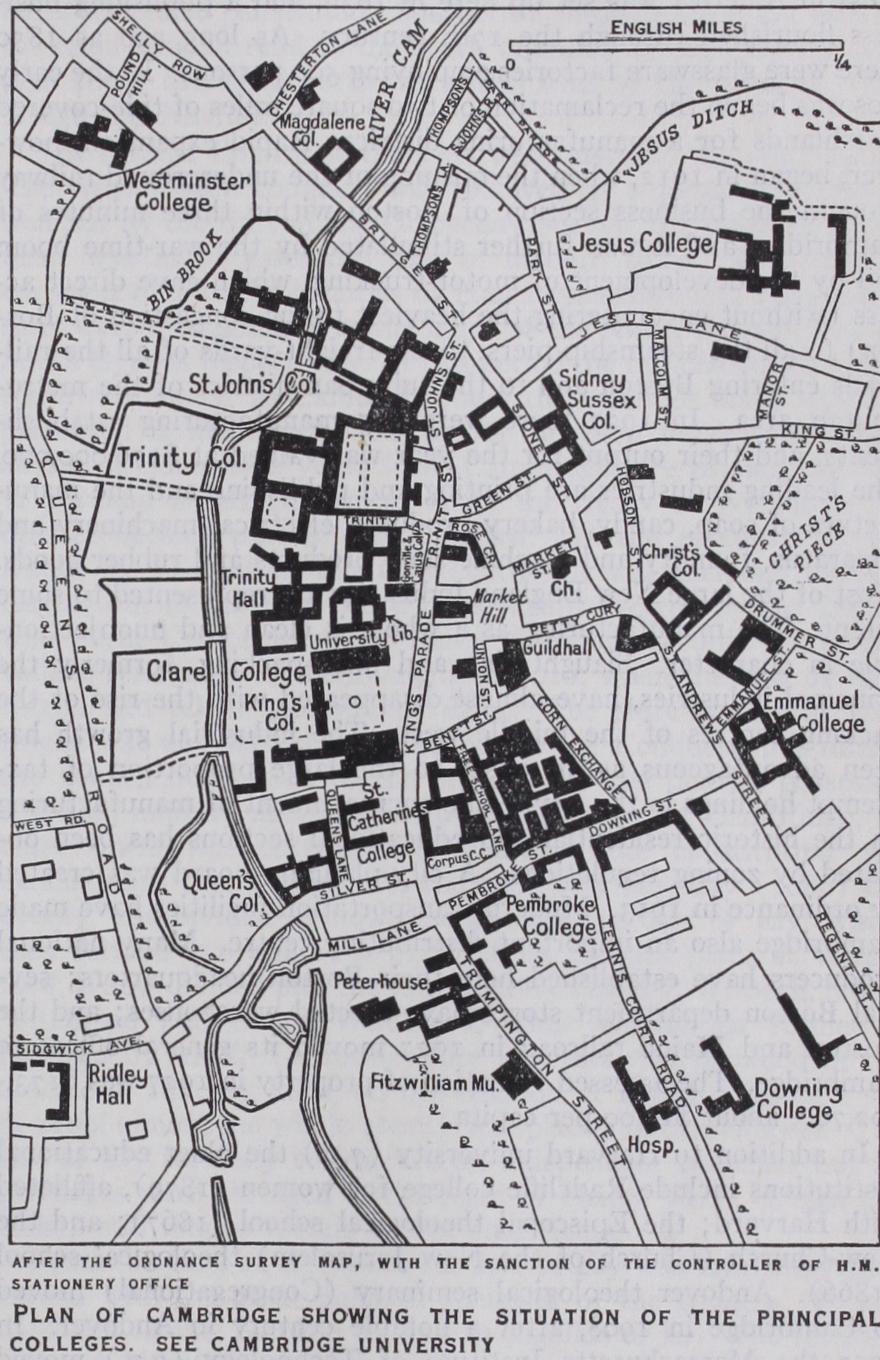
CAMBRIDGE, a municipal and parliamentary borough, the seat of a university, and the county town of Cambridgeshire, England, 56 m. N. by E. of London by the L.N.E.R. and served also by the L.M.S.R. Area 5,457 acres. Pop. (1931) 66,803. It lies at the southern border of the Fen country, at an elevation of only 3o to 50 ft. above sea-level. The greater part of the town is situated on the right bank of the Cam, a tributary of the Ouse, but suburbs extend across the river. To the south and west the slight hills bordering the fenland rise gently. The borough re turns one member to parliament.
Cambridge owed its growth to its command of a ford over the River Cam on a natural line of communication between the east and the midlands of England, flanked on the one hand by the deep forests which covered the uplands, on the other by the un reclaimed fens. The importance of this highway may be judged from the number of early earthworks, including Castle Hill at the north side of the present town. Roman remains discovered in the same locality give evidence of the existence of a small town or village at the junction of roads; the name of Camboritum is usually attached to it, but without certainty. The modern name of Cambridge has usually been derived from a corruption of the original name Grantebrycge or Grantabridge (Skeat) ; but it has been suggested that the name Cantebrig was very early given to that quarter of the town near the Cante brig. Cambridge castle was built in this quarter, close to the bridge, by the Conqueror, as a base of operations against Hereward the Wake and the in surgents of the fenland, and the name spread to the whole town, the similarity between the names Grantebrig and Cantebrig play ing some part in this extension (see A. Gray, The Dual Origin of the Town of Cambridge, p. 31). Granta is the earlier and still an alternative name of the river Cam, this more common form having been adopted in sympathy with the modern name of the town. Cambridge had a further importance from its position at the head of river navigation, and a charter of Henry I., in which the town is already referred to as a borough, grants it exclusive rights as a river-port, and regulates traffic and tolls. The wharves lay principally along that part of the river where are now the celebrated "backs" of some of the colleges. The great Stur bridge or Stourbridge fair at Barnwell, formerly one of the most important in England, is a further illustration of the ancient commercial importance of Cambridge; the oldest known charter concerning it dates from the opening of the 13th century, though its initiation may perhaps be placed a century before. From the 14th century onward materials were taken from the castle by the builders of colleges while the gatehouse, the last surviving por tion, was removed in 1842. See CAMBRIDGE UNIVERSITY below.