
CANBERRA, the national capital of the Commonwealth of Australia, was established as the seat of Government under powers conferred by s. 125 of the Commonwealth Constitution Act, which received the assent of Queen Victoria on July 9, 1900.
The provision for the establishment of a seat of Government was presented before the national conventions in various forms. The final convention, which agreed to a bill for submission to the people, sat in Melbourne from Jan. to March 1898. At a con ference of premiers held in Melbourne in Jan. 1899 it was agreed and subsequently incorporated in s. 125 of the Constitution Act, that "The seat of Government of the Commonwealth shall be determined by the parliament, and shall be within territory which shall have been granted to or acquired by the Commonwealth, and shall be vested in and belong to the Commonwealth, and shall be in the State of New South Wales, and be distant not less than miles from Sydney. Such territory shall contain an area of not less than 100 square miles, and such portion thereof as shall consist of Crown lands shall be granted to the Commonwealth without any payment therefor." Before the end of 1899 the Government of New South Wales appointed Alexander Oliver, president of the Land Appeal Court, a royal commissioner, to enquire into and report upon sites for the federal capital. Oliver submitted his report on Oct. 26, 19oo, and made Dalgety his first choice, and bracketed Canobolas (Orange) and Yass as his second choice. Not till Jan. 14, 1903, was any further definite step taken. On that date the Federal Government appointed a royal commission of four to inquire into and examine sites near Albury, Armidale, Bombala, Lake George, Orange (Bathurst and Lyndhurst) and Tumut, with in structions that consideration was to be given to the following: (I) Accessibility to the state capitals; (2) means of communica tion; (3) climate; (4) topography; (5) water supply; (6) drain age; (7) soil; (8) building materials; (9) fuel; (I o) general suitability; (I I) cost of resumption of site and area and Crown lands available ; (12) any other material matters.
On July 16, 1903, the commissioners presented their report and submitted an order of preference for certain sites under the various headings of their terms of reference but made no definite recommendation in favour of any particular site. In a supplemen tary report dated Aug. 4, 1903, the commission gave special consideration to the advantages and disadvantages of the site at Dalgety.
On Oct. 8, 1903, an exhaustive ballot was taken in the House of Representatives which resulted in Tumut receiving the selec tion. A bill was introduced into parliament naming Tumut as the site. This bill also contained the provision that the territory granted to or acquired by the Commonwealth within which the seat of Government shall be, shall contain an area of not less than 1,000 square miles. The Senate amended the bill by sub stituting Bombala for Tumut. The House of Representatives de clined to accept the Senate's amendment and the bill lapsed. What has been termed the "Battle of the Sites" proceeded. No agreement was reached until the Federal House of Representa tives, after an exhaustive ballot, decided on the Yass-Canberra site, which included proposed sites at Yass, Lake George and Canberra. The Senate agreed by a ballot to the site chosen by the House of Representatives.
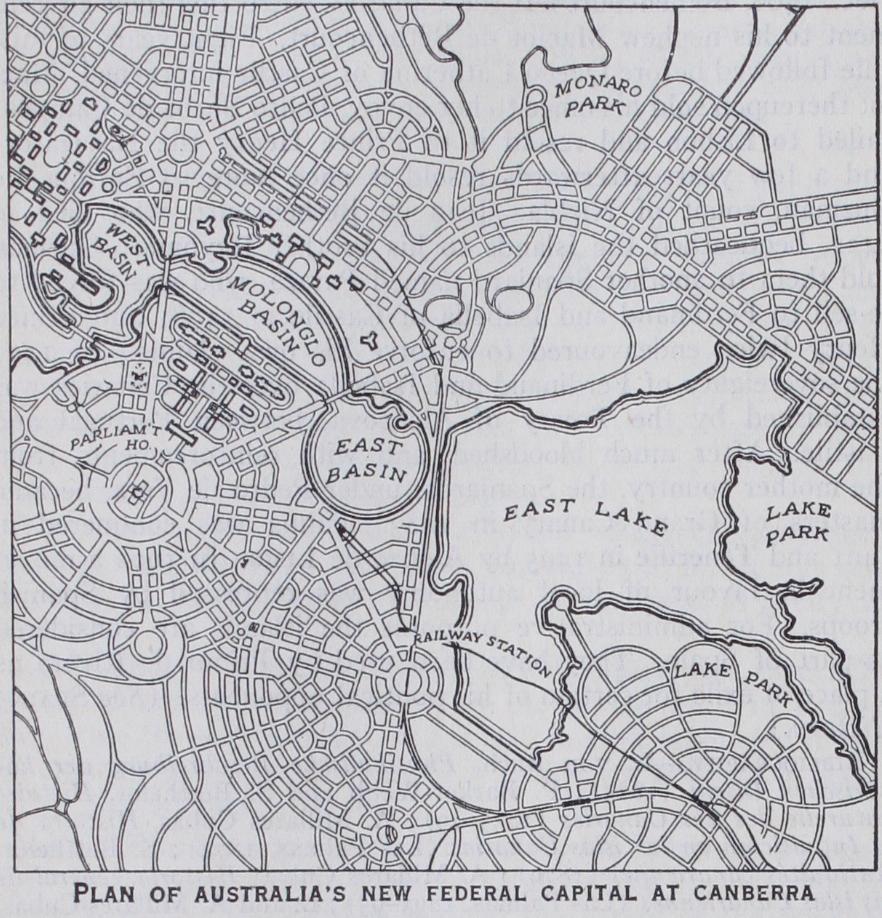
The Seat of Government Act was assented to on Dec. 14, 1908, and during the following year the actual site of Canberra—the future capital city—was determined. The Seat of Government Acceptance Act was proclaimed on Dec. 15, 1909 and on Jan. 20, 1910, the governor-general issued a proclamation which brought the Seat of Government Acceptance Act into force two days later. This proclamation vested the territory in the Commonwealth. A further act providing for the provisional government of the terri tory was assented to on Nov. 25, 1910. The State of New South Wales surrendered an area of approximately 9oosq.m., which embraces the uninhabited catchment area of the Cotter river and the valleys of the Molonglo and Queanbeyan rivers. Subsequently 212,000 acres were acquired from private owners at a cost of On April 3o, 1911, the Commonwealth Government, in a world wide competition, invited designs for the capital city, for prizes of £750 and £500. Of 126 designs submitted, the first prize was awarded to Walter Burley Griffin, of Chicago. A depart mental board was subsequently appointed to report. It did not recommend the adoption of any of the designs, but submitted a design of its own which embraced certain features of the sub mitted designs and certain modifications of those designs. In June 1913 a change of Government occurred and the new Govern ment rejected the departmental plan and adopted Griffin's plan with certain amendments. The foundation stones of a "commence ment column" were laid on March 12, 1913, on Camp hill by the governor-general (Lord Denman), the prime minister (Andrew Fisher), and the minister for home affairs (King O'Malley).
The outbreak of war delayed building operations. The prince of Wales, during his visit in 1920, laid the foundation stone of the Capitol. A dam has been constructed to hold up the waters of the Cotter river and its tributaries. This ensures a splendid supply of crystal-clear water, sufficient for a population of 70,00o persons. Good roads have been constructed within the Federal capital area, water mains, sewers, electric light and power works, and brickworks have been installed. The city avenues and parks have been well laid out with ornamental trees and attractive gardens.
The temporary Parliament House was completed in time for the opening by the duke of York on May 9, 1927, of the first Federal parliament to sit at Canberra. It is a handsome structure and is elaborately furnished and appointed. Two secretariats which will temporarily house the permanent staffs have also been completed. The prime minister, Mr. Bruce, turned the first sod for the permanent secretariat in Oct. 1927. Attractive dwelling houses have been erected in the suburbs of Red Hill, Blandfordia, Acton, North and South Ainslie, Eastlake, Westridge and Manuka. Several hotels, boarding houses and guest houses have been opened. Excellent school accommodation has been supplied. There are extensive and attractive banking and shopping centres at Civic Centre (Ainslie) and Eastlake.
By the Seat of Government (Administration) Act which was assented to in July 1924, and which came into operation on Jan. I, 1925, the administration of the territory was placed in the hands of a commission of three, of which Sir John Butters, K.B.E., is chairman. Of the three persons first appointed one shall be appointed for five years, one for four years, and the third for three years. Thereafter, each appointment shall be for a term not exceeding three years. The commission is subject to the control of the minister for home and territories. The commission, subject to the approval of the governor-general in council, may make by laws and ordinances for the good government of the territory. The commission controls the lands of the territory and has power to levy and collect rates upon land, has charge of domestic hous ing and of the developmental works and administration of the territory.
The first ordinance, passed in 1911, when the administration of the territory was under an administrator, subject to the control of the minister for works and railways, contained a provision pro hibiting the issue of licences for the sale within the territory of alcoholic liquors. That ordinance is still in force and will remain so until a plebescite is taken to determine the question. No date has yet been fixed, but the Government has expressed a view that the matter shall remain in abeyance until there is a "stable" population in the Federal capital. Up to the end of June 1928, the amount expended in the territory was £ 10,546,084. The pop ulation of the city proper in 1931 was 7,325; that of the whole federal capital territory, The city of Canberra is beautifully situated in an amphitheatre of wooded hills at an elevation of approximately 2,000f t. above sea level in 35° 15' S. latitude and 149° 15' E. longitude. It lies approximately 8om. from the coast, is distant by rail 2o4m. from Sydney, 429 from Melbourne, 912 from Adelaide, 929 from Brisbane and 2,600 from Perth. Ultimately it will be connected with the sea by a railway covering a distance of about 123m., terminating in Federal territory at Jervis bay. Meteorological information: Average ,annual rainfall 2 2.65in. ; mean summer temperature 67.5° ; mean winter temperature The name "Canberra" is of aboriginal origin. It is pronounced with the accent on the first syllable as if it were spelt "Cannbra."