
CANOE, a general term for a boat sharp at both ends, orig inally designed for propulsion by one or more paddles (not oars) held without a fixed fulcrum, the paddler facing the bow. As the historical native name for certain types of boat used by savages (Columbus found the word candoa in use in the West Indies; it has a curious resemblance to the French carrot, a boat) it is applied in such cases to boats which are open within from end to end, and the modern "Canadian canoe" preserves this sense. The name is used in some countries for craft differing from such boats by being covered in with a deck except for a "well" or cock pit where the paddler sits. Modern developments are the cruising canoe, combining the use of paddle and sails, and the racing canoe, equipped with sails only.
The primitive canoes were light frames of wood over which skins, as in the old British coracle (q.v.) or in the Eskimo canoe or "kayak" (q.v.), or the bark of trees, as in the North American Indians' birch-bark canoe, were tightly stretched. The modern canvas covered canoe, built on Indian lines, was a natural de velopment of this idea. Primitive peoples also used and still use the "dug-out," made from a tree hollowed by fire of ter the manner of Robinson Crusoe. Many of these are wonderfully carved and ornamented with inlay, and are of considerable size and carry ing capacity; one in the New York Natural History museum from Queen Charlotte's island is 63ft. long, 8ft. Sin. wide, and 5ft. deep, cut from a single log. "The "war canoe" of paddling races is its modern successor.
In the islands of the Pacific and elsewhere dug-out canoes are handled with great skill by the natives, who make long sea voyages in them, often stiffening them by attaching another hull (see PROA and CATAMARAN) ; in New Zealand the Maoris were formerly mas ters of the art of dug-out canoe construction, some of their ancient war canoes being of huge size. Along the coast of West Africa the fisher tribes still use large dug-out canoes for fishing at sea, re maining out of sight of land for days, and the return of the fish ing canoes each with its 'large square sail set on sprits and travelling at great speed is a picturesque sight still to be wit nessed all along the coast. In the earlier part of the 19th century, what was known as a "canoe" in England was the short covered in craft with a "well" for the paddler to sit in, which was popu larly used for short river prac tice; and this type still survives. But the sport of canoeing in any real sense dates from 1865, when John MacGregor (q.v.) designed the canoe "Rob Roy" for long journeys by water, using both double-bladed paddle and sails, yet light enough (about 701b.) to be carried over land. The general type of this canoe is built of oak with a cedar deck; the length is from 12f t. to 5ft., the beam from 26in. to 3oin., the depth io in. to 16 in. The paddle is 7f t. long and 6in. wide in the blade.
The canoeist sits low in the cockpit, and in paddling dips the blades first on one side and then the other.
The late W. Baden Powell and E. B. Tredwen, both members of the Royal Canoe Club, modified the "Rob Roy" and con structed paddlable sailing canoes, known as the "Nautilus" and "Pearl" respectively, by the introduction of a centre-board and yawl rig, and in 1886 Paul Butler of Lowell, Mass., added a slid ing outrigger seat allowing the canoeist to slide out to windward as shifting ballast. This type of canoe was universal in racing till, under the influence of the late Linton Hope's designs, the Royal Canoe Club developed the "B class" canoe which in Great Britain has entirely taken its place as a racing machine and is a wonderful sea boat withal. These vessels are 17ft. long, aft. 6in. in beam and 1 ft. in depth, decked, with the exception of the steering well, and are divided into three compartments by two watertight bulkheads. Out-board seats are barred. The rig is sloop with sliding gunter or Bermuda mainsail and roller foresail, the total sail area being 150 sq.f t. Speeds up to 1 om. per hr. have been attained by these canoes in the Royal Canoe Club's races.
In the paddling races of the Royal Canoe Club, both the open Canadian type of canoe is used with single-bladed paddles, and a partly decked, very long, light and shallow type for team racing, propelled by double-bladed paddles. In Canada team racing with single bladed paddles in "war canoes" is a popular amateur sport. The "Canadian," an all wood canoe, clinker or carvel built with mahogany, cedar or basswood planking always popu lar in Canada and the canvas covered canoe with cedar hull, chiefly of United States manufacture, both on the general lines of the Indian birch bark, are as common on American rivers as the punt is on the Thames and are similarly used.
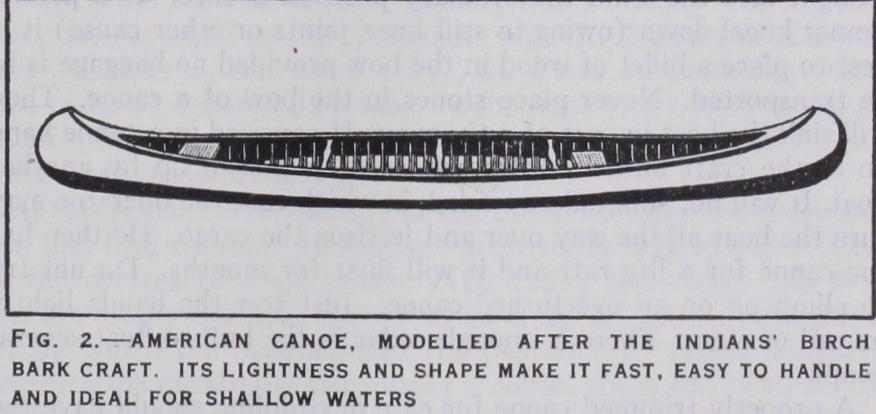
The United States.—The canoe in the United States is the direct descendant of the American Indian's birch-bark canoe and, being indigenous, it has a wider range of use than any other small water-craft. Although it is considered unsafe by persons unacquainted with its possibilities, its graceful appearance and the romance associated with it imparts a glamour even to the uninitiated. The white man found the Indian's birch bark a per fectly developed craft and promptly adopted it. The early explor ers, the frontiersmen, all used the canoe. They and the Indians are inseparably bound with the canoe in the mind of a boy, and the youthful longing thus created to own a canoe is often the first to be fulfilled. Three other factors have been influential in the increased popularity of the canoe: the vogue of outdoor sports; the almost national ability to swim, both greatly accelerated by the World War; and the use of larger canoes. The fatalities for which the canoe was formerly blamed have decreased, not due to better handling of the craft, but to the fact that an upset today means only a ducking, and to the use of the 17 f t. canoe which is much harder to capsize than the smaller models favoured in earlier years.
Canoes are still built in almost any size from io ft. up, but the usual size in the United States is 17 ft. long and 34 in. wide. Its depth ranges from I 2 to 14 in., the ends rising 4 to 6 in. higher. This size was gradually accepted as canoemen found few lengthy portages in their usual waters and discovered that it was still within the limits that one man could conveniently handle.
In Canada, where long carries militate against the weight of the larger canoe, the general size is 16 ft. by 3o in. beam. The all wooden canoe is the favourite in Canada, while the canvas-cov ered craft is the more commonly used in the United States. The all wood is faster, the canvas-covered is more buoyant. The orig inal birch-bark canoe, while almost impossible to obtain now, is slower than either of the other two, but it will keep going under stress of wind or water that would drown any other type.
Prior to the widespread use of the canoe which developed the 17 ft. craft, a great variety of sizes was tried. The earlier canoe man ordered his craft according to his weight, just as he bought his clothes according to his size. The ultimate in this line was the "Sairy Gamp," the I ol lb. clinker-built cedar canoe used by George W. Sears (Nessmuk). This canoe, Io ft. long by 26 in. beam, is now in the Smithsonian Institution, Washington, D.C. At the same time the sail-and-paddle canoe flourished and the canoe with 3-ft. decks and cockpit coamings, canoe tents, and canoe awnings. One of the best known and most typical canoes of that period, "Rob Roy," found many adherents in the United States.
Modern canoemen, however, are almost unanimous in their preference for a camp on shore entirely separated from the canoe (see CAMPING OUT). With the disappearance of the canoe-tent idea, the sail-and-paddle canoe was entirely superseded by the out-and-out sailing canoe and the simple, open paddling canoe, although the one may be paddled and the other sailed. Sailing canoes in the United States are used almost exclusively for racing, although they were formerly used considerably for cruising. The only notable cruise made in recent years was that of "Yakaboo," in 1911, sailed by Frederic A. Fenger northward through the Lesser Antilles.
The customary size to which sailing canoes are built is 16 ft. by 3o in. beam. Equipped as they are with centre-boards, rudders, decks and sliding seats to utilize the weight of the sailor as ballast, they are virtually small yachts. They are rigged with two masts, each carrying a batwing or Bermuda sail, the division spreading about 6o% of the area in the foresail. These tiny racers have been known to outsail yachts of twice their size. Their develop ment is largely based on the work of Paul Butler, an enthusiastic canoeman who invented the sliding seat, clutch cleats and reefing gears; built hollow spars and other accessories; introduced the sliding tiller, watertight bulkheads and self-bailing cockpits, all features in use to-day. They provide such excellent competitive sport that they have recently been adopted for class racing by several yacht clubs.
The organization and advancement of canoe racing, both sail and paddle, however, belongs to the American Canoe Association. The New York Canoe Club, its predecessor in the field, was too localized to wield the influence exerted by the A.C.A. The asso ciation, which was founded in 188o, also encouraged canoe cruis ing and the general use of the craft. In 1928 it was the controlling canoe organization in the United States and Canada. In its six divisions it covered the entire country and included the majority of the important canoe clubs.
See R. E. Pinkerton, The Canoe (1923) ; Nessmuk, Woodcraft (1895) ; S. Edward White, The Forest (1903) ; W. H. Miller, Canoeing, Sailing and Motor Boating (1928). (W. A. Go.) Canoe Racing in the United States has developed under the guidance and rules of the American Canoe Association since that body was formed in 1880. The canoes in use in the early part of this period were of varied design, gradually be coming standardized until now two general types of canoes only are used for racing : the decked sailing canoe, fitted with centre-board, rudder and sliding seat, and the open canoe, generally built of white cedar strips without canvas covering. The decked sailing canoe was originally permitted as great a sail area as the boat could carry. It was this latter consideration which led Paul Butler, of Lowell, Mass., trophy winner in 1892 and 1893 to develop the sliding seat, thus enabling the light weight man to throw his weight over-side to offset the normal advantage of the heavier man.
All of the trophy winning boats with the exception of Hilding Froling's "Doris" canoes (1921 and 1927) were 16X 3o's (16 ft. long by 3o in. beam). In 1907 George P. Douglass, several times trophy winner in decked canoe and cruising canoe races, began to advocate the use of larger boats with proportionately greater sail area, but in 1909 a rule was passed limiting the sail area to 90 sq.f t., thus effectively blocking the building of larger craft. Not until 1917, when Douglass, supported by Froling, renewed the advocacy of the larger boat, were the rules changed to pro vide a sliding scale of sail area in proportion to boat dimensions.
Slowly, but with gaining favour, this privilege has been accepted until now there are several canoes with dimensions varying from 17'X34" to 18'X42", all built after designs by Froling. The sail types have varied from the bat-wing and lateen to the two leg-o mutton with standing mast, now in use. While the decked sailing canoe has been recognized as the finest type of canoe sailing machine, it has frequently been outnumbered at regattas by the open or cruising canoe rigged with lateen sail and lee-boards.
Paddling racing has developed a few boat designs only, but by reason of the use of single and double-blade paddles and the possibility of manning a canoe with several paddlers, the num ber of different events at an A.C.A. regatta is large. There are two standard one- or two-man canoes. One is known as the cruising canoe. It is not as sea-worthy as other boats used for cruising only, having straight sides and being shorter on the water-line, but its combined speed and relative sea-worthiness make it popular. The other boat is known as the racing paddling canoe. It is frail, but very speedy, being drawn in from the gun wales to the keel so as to have a V shape. A larger boat, 20' X 3o", known as the Club Four, is used with four paddlers, using single or double blades. War canoes, manned by nine men with single blades, are used by a few clubs, principally those located in New England.
The American Canoe Association became a member of the Amateur Athletic Union in 1926, and canoe racing is included on the programme of the 1932 Olympics. (L. W. Hu.) How to Handle a Canoe.—The most popular canoe among Indians, guides, hunters, voyagers and pleasure seekers are built of cedar and spruce and covered with heavy canvas. They run in length from the 12 ft. "junior" model to the 3o ft. war canoe or freight carrier. The canoe in most favour is from 16 ft. to 20 ft. long.
This canoe may be paddled by one person with a single blade paddle which may be used continuously on one side without pro pelling the craft off its straight course. At the end of each stroke the voyager steers his boat by an overhand twist of the paddle. The trick is accomplished with the hand at the upper end of the paddle. This hand holds the paddle as it would the upper end of the handle of a snow shovel. At the end of each stroke the hand and paddle are so turned that the back of the hand is turned out toward the water on the same side of the canoe on which one is paddling. The blade of the paddle is kept in the water long enough to bring the canoe back on her course after each thrust of the pad dle. The blade should be feathered on the recover stroke. It is better to paddle a canoe on the side opposite to that on which the wind strikes the hull. Thus the thrust of the paddle offsets the thrust of the wind. This obviates a great deal of the steering effort. Indeed if the wind blows hard enough a paddler may not be able to navigate his craft in a side wind. He may have to paddle straight in the eye of the breeze or run before it or go ashore and wait until the wind stops blowing.
A lone paddler should kneel in the canoe about one-third of the length of the boat from the stern. A thwart is placed there for this purpose. It is never good practice to try to sit on the stern seat unless there is a load of dunnage in the bow or there abouts, or a second person in the boat. The paddler rests the but tocks partly on and partly against the aforementioned thwart. In heavy weather it may be necessary to move up almost to the centre of the craft in order to control it. In running before the wind or straight into the wind the ordinary position is safe. If a person cannot kneel down (owing to stiff knee joints or other cause) it is best to place a billet of wood in the bow provided no baggage is to be transported. Never place stones in the bow of a canoe. They will sink the boat in case of a tip-over. If capsized in a canoe hang on to the craft until it drifts ashore or is picked up by another boat. It will not sink unless loaded, in which case the operator may turn the boat all the way over and jettison the cargo. He then has the canoe for a life raft and it will float for months. Do not try to climb up on an overturned canoe. Just rest the hands lightly on rail or stem. There is enough cedar in the hull to float several people.
A properly trimmed canoe for ease in paddling should have the bow slightly higher out of the water than the stern. In the rapids a canoe should be bow-light going up stream when propelled by either pole or paddle. Going down stream it should be bow heavy. Going ashore through the surf the canoe should be bow heavy. Going out through the surf it should be bow-light.
(P. Mo.)