
CANTON, the great commercial metropolis of South China (23° I I' N., I 13 ° 14' E.), is the regional capital and outlet of the Basin of the Sikiang or West River which is the focus of the life of South China, separated from the Yangtze Basin, the heart of Central China, by a broad highland zone across which there is as yet no through railway communication. The Sikiang is formed by the convergence of a large number of head-water streams rising in the Highlands of Kweichow and Yunnan and affording west east navigation for nearly I,000 miles. Although wide bottom lands occur in the valleys of the main river and its tributaries there is no focal basin in the middle or upper portions of the system at all comparable to the Central (Hupeh) or Red Basin in the Yangtze system. This gives enhanced significance to the rich deltaic tract of Canton. The city is not placed on the main stream of the Sikiang, which keeps near the southern limit of the terminal lowlands, but on a northern tributary—the Canton or Pearl River, diverging at Samshui. Below Canton this tributary forms a very complex delta intersected by canals. At Canton, the apex of this delta, the Pearl River is also joined by a branch or tributary of the Pei-kiang from the north, whose valley affords the easiest route through the Nan-ling by way of the Cheling Pass to the Siang tributary of the Yangtze and so to the Central Basin of Hankow. This has always been one of the two great routes linking south with central and north China and is the pre destined course of the Peking-Hankow-Canton trunk railway, completed save for the mountain section from a point above Chuchow on the Siang to Shiuchow on the Pei-kiang. The alterna tive historic route to the north by the Mei-ling Pass and the Kan tributary of the Yangtze is also approached by the valley of the Pei-ho, diverging from the first at Shiuchow. Finally a little below Canton the Pearl River is joined by the Tung-kiang the chief outlet of the highland country of north-east Kwangtung, most of which is thus orientated to the Delta. The space-relations of Canton thus make it at once the outlet of the vast Basin of the Sikiang, the inevitable terminus of the two great routes from north to south and the focal centre of the greater part of Kwang tung Province. Moreover, lying at the head of the broadest deltaic channel, it has been at the limit of ocean navigation and the meeting-point of river and sea trade, although with the increas ing size of ocean-going vessels its port facilities are somewhat inadequate and Hong Kong is now in a sense its outport.
Owing to the relatively late advance of the Chinese to the South China sea the Canton delta was for long a kind of outpost in a barbarian region. It was incorporated in the Chinese Empire by the Chin Dynasty (249-2o6 B.c.), and from the time of the Han Dynasty (206 B.C.-A.D. 221) the city was known as Kwang chow, still the official name of Canton as capital of Kwangtung province, created by the Ming Dynasty (1368-1644). Owing to the great distance from the capital and the differences of social custom, speech and outlook Canton early and repeatedly exhibited a separatist tendency. It has been called "The Ulster of China" but a closer parallel is perhaps that of Catalonia in relation to Spain. The difference in its outlook from that of China as a whole is to be largely explained by the intimate contact with foreign traders established from a very early period. Canton has been identified with the port of the "Sinae" called Cattigara by the classical geographers and it was certainly very early drawn into the orbit of Indo-Malayan trade. After centuries of contact with Hindu, Parsee and later Arab merchants, who established a settlement near Canton, it was the first Chinese sea-port to be regularly visited by European traders, especially by the Portuguese who attempted to establish a monopoly which was strenuously resisted by the Spanish, Dutch and British. It was at this time the main outlet of the coveted Chinese products of tea, silk and rhubarb. In the I7th century the British made several abortive attempts to settle at Canton, but it was not until the Portuguese monopoly was broken that the East India Company secured a firm foothold in 1684. The French in 1725 and the Dutch in 1762 also estab lished factories in Canton. From this period it became the pivot of the official Chinese policy towards foreign trade. This took the form of making Canton the sole port for foreign trade (Imperial decree of 1757) and of the establishment of the "Hong" system whereby the foreign traders, then mainly in the employ of the British East India Company, were confined to a special "factory" quarter and compelled to deal only with a small group of Chinese merchants who were directly responsible to the Imperial Govern ment. The system led to increasing friction, especially when in the later eighteenth century the rapid rise in the imports of Indian opium began to alarm the Chinese authorities and by reversing the trade balance, hitherto favourable to China, to create a financial problem. The special Trade Missions sent out from Great Britain under Lord Macartney (1793) and Lord Amherst (1816) both started on their fruitless journeys to Peking from Canton, which after the lapse of the East India Company's charter in 1834 be came the headquarters of the official British "Superintendent of Trade in China." Under this new regime the friction with the Chinese authorities quickly came to a head and resulted in the so-called "Opium War" between Great Britain and China (1841 The Treaty of Nanking (184 2) which closed the war de stroyed the "Hong" regime and substituted the Treaty Port system (for this and a discussion of the events leading up to the `'Opium War" see CHINA). It also gave Great Britain possession of the island of Hong-Kong destined to be transformed into her greatest commercial base in the Far East and distant only 8o m. from Canton. Canton itself was one of the first five treaty-ports established by the treaty and was declared open to foreign trade. But conditions remained unsatisfactory and it was friction in Canton which led to the second war between Great Britain and China known as the "Arrow War" of 1856. The city was then occupied by British and French troops. After its evacuation in 1861 foreign business houses and consulates were concentrated in a new concession area, a reclaimed sandbank in the Pearl River known as the "Shameen," divided from the city front by a narrow channel and well situated for purposes of trade.
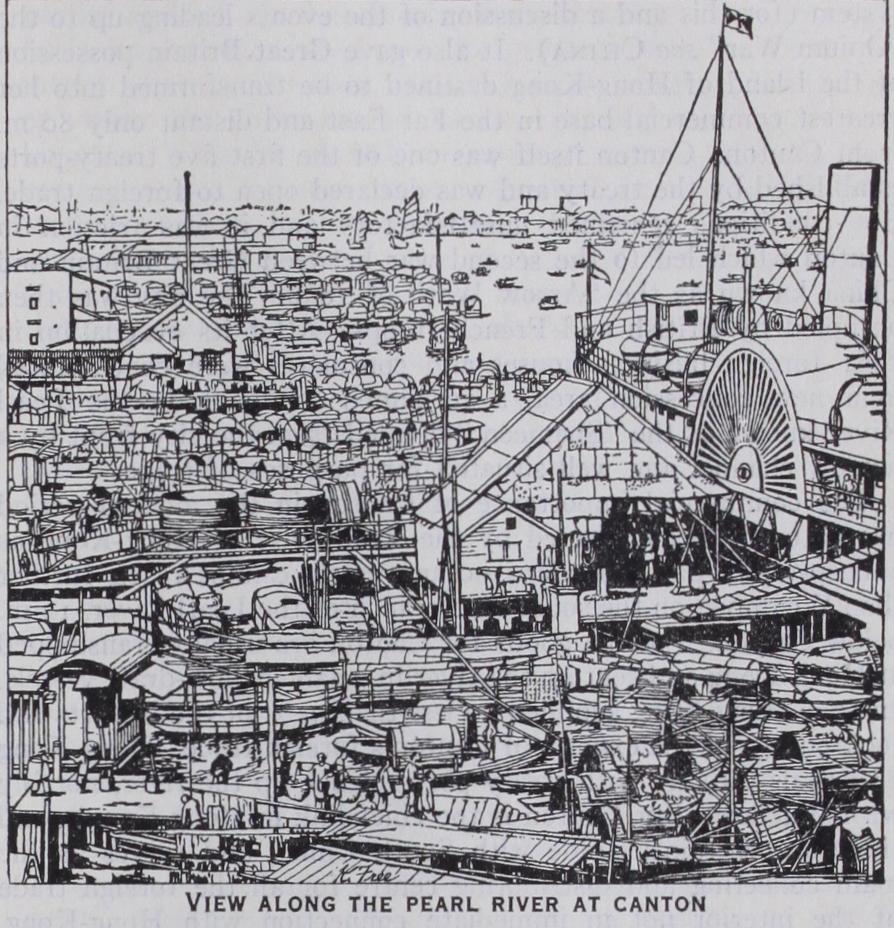
The commercial importance of Canton in the modern period has naturally been affected by the steady rise of Hong-Kong as a deep-water port. Modern ocean vessels cannot reach further than Whampoa on the south-east branch of the Pearl River, 12 m. below Canton. Foreign goods for Canton are usually transhipped at Hong-Kong and sent up the river in small shallow-draft vessels. In 1922 Hong-Kong supplied no less than 94% of the imports and took 99.5% of the exports of Canton's foreign trade. Hong-Kong also deals directly with treaty ports higher up the river, notably with Wuchow. But Canton is the chief link in Hong-Kong's, and therefore Britain's, trade with South China, and serves as the main collecting and distributing centre for all the foreign trade of the interior not in immediate connection with Hong-Kong, especially that of non-treaty ports inaccessible to Hong-Kong in its official status of a "foreign country." The trade of the two ports is in this sense complementary but were Whampoa to be developed successfully as the outpost of Canton the situation would be materially altered.
Canton is becoming an important railway centre. Apart from the completed section of the Canton-Hankow main line (Canton Shiuchow : 14o miles), there is an important railway between Canton and Kowloon, opposite Hong-Kong, of which 891 m. are Chinese and 221 m. British, and a local line to Samshui (32 miles) . Further lines are contemplated to Macao and Amoy. The com pletion of the Canton-Hankow railway will greatly increase Can ton's trade with the Yangtze valley and compete with the coastal traffic.
The Canton delta is devoted to the production of rice and silk. Rice production is however insufficient to feed the vast popula tion and quantities up to six million piculs are imported annually from the Wuhu basin along the Yangtze and from Siam and French Indo-China. The two most important silk-producing regions of China are the Yangtze and Canton deltas and in the amount though not in the quality of production the Canton delta is the greater. Silk is exported in the form of raw silk, which has simply passed through the filatures, rather than of silk yarn or of silk piece-goods. Apart from electricity plants, steam filatures are the chief expression of western industrialism in the Canton delta and these only treat the silk preparatory to spinning. Steam filatures are more important just to the south of Canton than in Canton itself. For industrial requirements Canton, like Shanghai, is dependent on coal coming by sea from the Kaiping coalfield in north China and from the Kyushu fields in south Japan. Coal resources do exist in the hinterland of Canton, in Kwangsi and around Shiuchow on the upper Pei-kiang, but they are as yet undeveloped save for local consumption. It is often held that further industrial development in the Canton delta will have to await the utilization of these upstream coal resources.
In common with the other south China ports (see Amoy) and reflecting its southward aspect, Canton has long been a centre of overseas China emigration which sets especially towards the less densely populated lands of Indo-China and Malaya.
The total trade of Canton coming under the cognizance of the Imperial Maritime Customs amounted in 1925 to Hk. Tls. 201, 720,711, ranking her fifth among Chinese ports, after Shanghai, Dairen, Hankow and Tientsin.
During the last 20 years Canton has played a conspicuous and constructive part in keeping with its traditions and illustrating the Chinese saying that "Everything new originates in Canton." Always restive under the Imperial regime and a source of anxiety to the great emperors of the early Manchu Dynasty, Canton be came the centre of the active revolutionary propaganda which pro duced the downfall of the dynasty in 1911. The principal parts were played by Cantonese, many of them, notably Dr. Sun Yat Sen, trained in the United States, with which Canton has long had intimate contact. In the subsequent Civil Wars Canton be came the centre of opposition to the Northern Militarists and the seat of the southern Government in opposition to that of Peking. It produced the Kuomintang or People's Party which, under Dr. Sun's leadership, developed an ambitious programme of recon struction and became the rallying point of the nationalist cause. After many vicissitudes, it was from Canton that the nationalist armies, professing these principles, advanced northwards by the historic Cheling Pass route, already described, to the conquest of Hankow and the lower Yangtze in 1926-27. The present Nanking Government is the direct outcome of the movements focussed in Canton and is based on the principles defined by Dr. Sun Yat Sen.
Canton has also been deeply involved both in the disturbances arising out of intense Communist propaganda, which at times have threatened to break up the Kuomintang, and in the struggle against the treaty rights possessed by foreign powers. It took the lead in the organization of strong labour unions of a western type. Chiefly through their agency was organized in 1923 a remarkable boycott against Hong-Kong, by which the trade of this sea-port was almost paralyzed for months.
Especially in the development of municipal government has Canton been conspicuously active. The local administration con sists of the mayor and a council appointed by the provincial government to represent various classes : merchants, scholars, the professions and labourers. It is generally admitted that, notwith standing the political disturbances, real progress towards an effi cient local government has been made. The outward appearance of the city has been largely transformed. Broad boulevards occupy the sites of the old city walls, destroyed in 1921, thousands of ancestral graves outside have been transferred to distant hills, and new suburbs, connected with the city by trackless trolley lines, have taken their place. Wide streets have been driven through congested areas, public parks created, and a new Bund, similar in character to that of Shanghai or Hankow, has come into existence on the water front. The programme includes a new system of docks, bridges over the Pearl River, deepening of water-channels and, not least, active development of Whampoa as an outport with a dredged channel to the sea.
Canton claims to be the most progressive city in China. The extent to which in the future it will identify itself with the interests of the country as a whole may turn to a considerable extent on the linguistic question. Canton is the centre of the most important of the non-mandarin language zones of south east China and the Cantonese "dialect" is spoken by some 15 to 20 millions of people, but it is significant that at the National Educational Conference of 1921 the Cantonese delegates, in com mon with those from the other coastal provinces, gave their adhesion to the principle that Mandarin should be taught in all primary schools and recognized as the lingua franca of China. The population of Canton is estimated at about 900,00o.
(P. M. R.)