
CAPE COLONY, or, officially, the "Province of the Cape of Good Hope," consists of the southernmost part of Africa, and is one of the four provinces which constitute the Union of South Africa. Its area is 276.966 sq.m., i.e., 59% of the total area of the Union. It is bounded by the Atlantic and Indian oceans, and by Natal, Basutoland, the Orange Free State, the Transvaal, the Bechuanaland Protectorate, and South-West Africa, the boundary following, for the greater part of its length, the course of rivers and escarpments.
The boundary between the Great Karroo and the second sub region is indefinite and largely a matter of climatic gradation. This second area, the south-eastern region, includes the country to the north-east of Graaff Reinet, which lies between the Sneeuw berg, Stormberg, Drakensberg and the coastal belt. It is built very largely of Karroo rocks, and consists of a series of great terraces, due to the greater resistance of outcrops of sandstones and dolerites. In East Griqualand, large masses of intrusive, basic rocks, having a considerable petrological range, give rise to the Ingeli mountains (over 7,00o ft.), Mt. Currie and Insizwa. At Port St. Johns a horst of Table mountain sandstone is cut across by the Umzimvubu river, which forms a deep canon.
The Coast Belt varies considerably in width, and consists of a terrace, which may reach an elevation of 700 to 1,00o feet. It slopes gently seaward, and may end in cliffs, 400 or 500 ft. high, as at Knysna and Mossel bay, or dip gently to a line of sand dunes. The coast belt can be traced northward to beyond the Orange river, where it merges into the Namib. South of the Oli fants river, between the great escarpment and the sea, there occur mountain groups, formed of Table mountain sandstone, resting comparatively undisturbed on the worn down edges of the older rocks, e.g., Piquetberg, Cape peninsula, etc. Along the western side of the latter, granites and Malmesburg slates and grits (Trans vaal system) are well exposed. The same sandstones, still but little disturbed, forms part of the coastal lands between False bay and Cape Infanta. East of Knysna the coastal terrace, which is well developed about George, where it is clearly a plain of marine denudation, becomes very narrow. North-eastward from Algoa bay the coast lands are formed of Karroo rocks, except for the horst of Table mountain sandstone at St. Johns. (For coast line, see SOUTH AFRICA.) Drainage.—The great escarpment is a major water parting. The interior plateau is drained by the Orange and its tributaries (see ORANGE RIVER). In the escarpment rises a number of streams, which flow across the Karroo and the Folded Belt to the sea. Most of these receive insufficient alimentation during the dry season to maintain their flow, and become a series of pools along channels, lined with accumulations of sand, mud or gravel. Between the Albany district and the Ceres Karroo are the remains of a post-Cretaceous plain, with an elevation of about 2,500 feet. This has been much eroded. The rivers of the folded area flow for long stretches in wide valleys, parallel with the strike of the beds, and then, in short sections, escape across the ranges, by means of "poorts," or steep, narrow and rugged valleys, such as the poorts of the Gamka, Gouritz, etc. In the south-eastern region the rivers alternate with long, gently graded sections, with many meanders and cut-offs, and shorter, tumultuous reaches, where they drop to a lower terrace over the outcrops of dolerites and sandstones. Their volume is more constant than that of the Karroo rivers, though it is liable to much diminution in the winters.
Owing to the low rainfall, and the high evaporation, which, from a.free water surface is 97 in. per annum at Kimberley, there are no lakes. The nearest approach is a number of "vleis," or shal low pools, the areas of which vary considerably with the seasons, and "pans," or shallow hollows, which contain water after rain, but soon dry up, often leaving an incrustation of salt.
Winter rains, April to September, predominate in a comparatively narrow strip of territory near the south-west coasts. A line, drawn through places having 5o% of their rain in the winter, would run from the west coast, just south of Walvis bay to near Swellen dam, and then, turning eastward would pass somewhere near Oudtshoorn, and reach the coast a little to the north-east of Port Elizabeth. Within the region is a district, between George and Humansdorp, which receives a fairly plentiful rainfall, about 4oin., well distributed through the year. This is the only im portant forest area of Cape Colony.
Near the coast frosts are almost unknown, and the tempera ture ranges are comparatively small. Inland they are much greater, owing to the altitude, and to the clearness and dryness of the air. Snow is seen on Table mountain about once in six or seven years, but on the mountains in the north-east of the Colony, it is of yearly occurrence.
Within the south-western region are the evergreen forests be tween George and Humansdorp, on the seaward slopes of the Outeniqua, Langkloof and Zitzikamma ranges. Among the more important timber trees are the yellow woods (Podocarpus elongates, and P. Thunbergii), the former growing to a height of i 30f t., stinkwood (Ocotea bullata) and black ironwood (Olea lauri folio). Climbing plants are abundant. In addition to the indige nous trees, oaks, pines, gums and wattles have been introduced into the Colony. They are grown in plantations, though oak is chiefly used for lining the streets of such towns as Stellenbosch, George, etc. Owing to its rapid growth, its wood is much softer than European oak.
Along the west coast, north of the Olifants river, the climate becomes increasingly dry. There is no continuous covering of vegetation, and only xerophyllous types can exist. Desert grasses and succulents are found, and low acacia bushes grow along the dry river beds.
Except just after rains, the Karroo, and the adjacent western portion of the inner plateau, appear almost desert. Trees grow only near the river beds, and are represented by species of small acacia, etc. Almost everywhere succulent forms—aloes, euphor bias, mesembryanthemums are dominant. In places, small bushes, I to 3 ft. high, manage to maintain themselves. On the upper Karroo the various shrublets of the family Compositae become important.
After the rains tuberous and bulbous plants and annuals come into bloom, but in a few weeks the Karroo relapses to its arid condition. In some areas the prickly pear, introduced by man, has covered the hillside.
In the South African Steppe and Forest Area are included the high country in the north-east of the Colony, and the coastlands beyond Algoa bay. This is largely a grassland area. The higher lands are pure steppe, in which Themeda triandra is dominant. Other common grasses are Andropogon amplectens, A. schirensis, Heteropogon contortus, etc. Between the great escarpment and the coast belt, i.e., approximately between 6,000 and i,000ft., Savannah is the characteristic association. The grasses include Themeda triandra, Eragrostis plans, Sporobolus indices, Andro pogon amplectens and A. schoenanthus. The trees consist chiefly of acacias—A. ca ff ra, A. karroo, A. Benthami and Zizyphus mucronata, Ehretia hottentotica, etc. On the drier slopes succu lents become dominant, and include Aloe ferox, A. Bainsii, Euphorbia grandidens, E. ingens, etc. On mountain-slopes, facing between south-east and south-west, patches of forest occur up to to about 6,000 feet. Among the more important trees are the yellowwoods (Podocarpus elongata, P. latifolia), ironwood (Olea laurifolia), lemonwood (Xymalos monospora), Celtis kraussiana, etc. Along the coast belt, i.e., below i,000ft., where frost is rare or absent, the country was originally covered, from about East London to Natal, with bush or forest, which has tropical affini ties. It consisted of low trees 2o-3oft. high. Here are to be found Rhus longifolia, Mimusops cafira (red milkwood), Albizzia fasti giate (flat crown), Millettia ca$ra (umzimbiti). Very character istic are the palm, Hyphaene crinita, and Strelitzia augusta (wild banana). In these woods are many climbing plants, such as Rhoicissus capensis (wild grape), Cassine natalensis (Natal cherry), etc.
Fauna.—The fauna is very varied, but some of the wild ani mals common in the early days of the Colony have been extermi nated (e.g., quagga and blaauwbok), and others (e.g., the lion, rhinoceros, giraffe) driven beyond the confines of the Cape. Other game have been so reduced in numbers as to require special pro tection. This class includes the elephant (now found only in the Knysna and neighbouring forest regions), buffalo and zebra (strictly preserved, and confined to much the same regions as the elephant), eland, oribi, koodoo, haartcbeest and other kinds of antelope and gnu. The leopard is not protected, but lingers in the mountainous districts. Cheetahs are also found, including a rare woolly variety peculiar to the Karroo. Both the leopards and cheetahs are commonly spoken of in South Africa as tigers. Other Carnivora more or less common to the colony are the spotted hyena, aard-wolf (Proteles), silver jackal, Cape hunting dog (Octocyon) and various kinds of wild cats. Of ungulates, besides a few hundred of rare varieties, there are the springbuck, of which great herds still wander on the open veld, the steinbok, a small and beautiful animal which is sometimes coursed like a hare, the klipspringer or "chamois of South Africa," common in the moun tains, the wart-hog and the dassie or rock rabbit. There are two or three varieties of hares, and a species of jerboa and several genera of mongooses. The English rabbit has been introduced into Rob ben island, but is excluded from the mainland. The ant-bear or aardvark, with very long snout, tongue and ears, is found on the Karroo, where it makes inroads on the ant-heaps which dot the plain. There are also various species of pangolins, of arboreal habit, which live on ants. Baboons are found in the mountains and forests, otters in the rivers. Of reptiles there are the crocodile, confined to the Transkei rivers, several kinds of snakes, including the cobra di capello and puff adder, numerous lizards and various tortoises, including the leopard tortoise, the largest of the conti nental land forms. Of birds the ostrich may still be found wild in some regions. The great kori bustard is sometimes as much as 5ft. high. Other game birds include the francolin, quail, guinea-fowl, sand-grouse, snipe, wild duck, wild goose, widgeon, teal, plover and rail. Birds of prey include the bearded vulture, aasvogel and several varieties of eagles, hawks, falcons and owls. Cranes, storks, flamingoes and pelicans are found in large variety.
Parrots are rarely seen. The greater number of birds belong to the order Passeres; starlings, weavers and larks are very common, the Cape canary, long-tailed sugar bird, pipits and wagtails are fairly numerous. The English starling is stated to be the only European bird to have thoroughly established itself in the colony.
The Cape sparrow has completely acclimatized itself to town life and prevented the English sparrow obtaining a footing.
Large toads and frogs are common, as are scorpions, tarantula spiders, butterflies, hornets and stinging ants. The most interesting of the endemic insectivora is the "golden mole" (Chrysochloris), so called from the brilliant yellow lustre of its fur. There are not many varieties of freshwater fish, the commonest being the baba or cat-fish and the yellow fish. Both are of large size, the baba weighing as much as 7olb. The smallest variety is the culper or burrowing perch. In some of the vleis and streams in which the water is intermittent the fish preserve life by burrowing into the ooze. Trout have been introduced into several rivers and have be come acclimatized. Of sea fish there are more than 4o edible var ieties. The snock, the steenbrass and geelbeck are common in the estuaries and bays. Seals and sharks are also common in the waters of the Cape. Whales visit the coast for the purpose of calving.
Of the domestic animals, sheep, cattle and dogs were possessed by the natives when the country was discovered by Europeans. The various farm animals introduced by the whites have thriven well.
The native Bantu population (1921) was 1,640,162, of whom 124,572 are classed as urban. The Bantu, in their spread to the south-west, were arrested by Europeans along the Great Fish river, which may still be regarded as the limit of any important native population. The Transkei territories, between the Kei river and Natal, contain a native population of about 900,00o. In recent years large numbers of natives have been attracted, perhaps beyond their natural climatic limit, to the area about Cape Town, by the freer social atmosphere than exists in the other provinces of South Africa. The number of natives living in Cape Town in 1921, is given as 4,68o, but the present number is probably con siderably in excess of this, and has caused much anxiety to the city authorities, on account of housing difficulties. Many natives are also employed in Port Elizabeth and East London.
The Asiatics, amounting to 7,963, include Mohammedan Indian traders, Parsees and Syrians. Grouped by the Census under the heading "Mixed or Coloured" are Bushmen, Hottentots, Griquas, Korannas, Namaques, Cape Malays and Cape Coloureds. To gether they amount to 484,252. The pure Bushmen and Hotten tots probably total no more than a few thousand. The Griquas are a Dutch-Hottentot cross. Many of them settled about Kok stad in Griqualand East. The Cape Malays were originally intro duced as slaves by the Dutch. There are still considerable num bers in Cape Town, where they play an important part in the fishing industry. The greater part of this mixed group is formed by Cape Coloureds, who represent mixtures in varying pro portions of Dutch, Hottentot, Malay, Negro and Bantu blood. The distribution of the coloured people is complementary to that of the natives. They occur in greatest numbers in and about Cape Town, and through the Folded and Coastal Belts to Port Eliza beth. They are found, however, throughout the Colony, and pro vide most of the unskilled and semi-skilled labour in town and country, though of late they have been experiencing considerable native competition in the labour markets.
Owing to the arid and mountainous nature of the interior, the population of Cape Colony is largely concentrated near the coast, though the diamond mines of Kimberley have given rise to a distinct centre of density. Inland the population is denser in the better watered eastern districts. In 1921 the density of rural population for the Colony as a whole was Europeans 1.06, non Europeans 6.51 per square mile. In the districts of Gordonia and Fraserburg the total population, all races included, fell below one person to the square mile.
Most of the wheat produced in South Africa is grown in Cape Colony, chiefly about Queenstown, in the Eastern province, and in the south-west, especially about Malmesbury. The yield per acre is low. Flour milling is an important industry in the Cape district and in Port Elizabeth. Oats and barley are grown fairly generally for green forage, as well as for grain, but nowhere on a large scale. Viticulture flourishes in the south-western area of winter rainfall. The districts especially concerned are the Paarl, Wor cester and Stellenbosch, while large quantities of vines are culti vated also in the Malmesbury, Cape, Robertson, Tulbagh, Mon tagu and Caledon districts. Altogether there are 54,405 ac. under vines. The wines are mostly of the sweet and heavy types, but efforts are being made to produce lighter wines. The quality has been improved in recent years. Brandy is also made in con siderable quantities. Grapes are grown for table purposes, and many are converted into raisins, of which there is a growing ex port, which increased from 1,830,531 lb. in 1903-04 to 15,641,352 in 1921-22. The same area produces large quantities of peaches, apricots, pears, plums, etc. Some of these are marketed fresh, and others are dried. The growth of citrus fruit is increasing, and is more widely spread through the southern districts and about Port Elizabeth and East London. There is a considerable production of pineapples in Albany district. At Port Elizabeth, Cape Town, and about Paarl and Worcester, factories hive been established for canning fruit. Olive cultivation has probably passed the experi mental stage, but as yet the production is insignificant.
The cultivation of tobacco is increasing. The country about Oudtshoorn, George, Swellendam and the Piquetberg grows a medium to heavy type of Virginian tobacco. Turkish tobaccos for cigarettes are grown about Stellenbosch, the Paarl, Wellington and Tulbagh.
Much of Cape Colony is devoted to the pastoral industry. Ac cording to the 1922 Census the number of cattle in the country was 2,976,1 68. Many of these are of the old Afrikander breed, which was especially valued for transport purposes. Since the Boer War much progress has been made, and the Colony possesses good herds of pedigree and cross-bred stock—the most popular imported breeds appear to be Frieslands and Shorthorns, though most of the well known British breeds are represented. The cattle are concentrated very largely in the eastern area. There is a dis tinct falling off of numbers to the west of Port Elizabeth, though dairying is being developed in connection with the irrigated lands further west, and in the wheat area, north of Cape Town. There are very few cattle in the Karroo districts, such as Beaufort West, Fraserburg, etc. The ox is still used very largely for transport purposes, where the country is not too dry to support him.
The flock of woolled sheep numbered 13,784,728, and consisted mostly of merinos and crossbreeds. In addition there were over 4,000,000 of fthe original hairy, fat-tailed breed. Practically all the wool clip is sent overseas. In 1922 the Colony exported over 71,000,000 lb. of wool. Most of the clip is sent to brokers at the principal ports, who undertake its sale. Annual wool sales, how ever, are held at some inland towns, such as Caledon, Swellendam, Riversdale.
The official returns show 2,054,500 Angora goats and over 4,000,000 other goats. The yield of mohair was over 8,000,000 lb., most of which is sold to the Bradford market. Goats are bred principally in the dry Karroo and in the native areas, while the main sheep area lies somewhat further east, where grass is more plentiful.
Horses do well where sheep thrive, though horse sickness may take a heavy toll at irregular intervals. The horse is used almost entirely for riding and driving. The Cape Colony horse has some of the characteristics of the thoroughbred. He usually has a fine head and good shoulders, but is light in the hind quarters. Owing to insufficient feeding in the winter months, and in time of drought, he is generally undersized. Recently a heavier type of horse has been used to some extent for farm work in the growing areas. In 1922 Cape Colony possessed 431,588 horses. In the drier areas the horse is often replaced by the donkey. The chief area for donkey breeding is Bechuanaland and the adjoining regions; Vry burg is the largest market for them. The donkey is also used in the Karroo and the southern districts, where a span of 16 to 20 is often seen harnessed to the large four-wheeled wagon, which they pull along at about 1-1 m. per hour. The number of donkeys in 1922 was 435,911. Mules, of which there were 78,800, are of a good type. They are more resistant than horses to horse sickness, though they are not immune from it.
Ostrich farming, which was so profitable up to 1913, has fallen on evil days. In that year over 1,o00,000 lb. of feathers were ex ported, but in 1925 the export was only 269,528 lb. The number of birds has fallen from 756,923 in 1913 to 204,388 in 1924, since when there has probably been a further decline. The breeding of ostriches was associated with the growing of lucerne under irri gation. The birds were most numerous about Oudtshoorn, Ladi smith, Robertson and Montagu. The lucerne fields are now being used for intensive dairy work, or are being replaced by tobacco and fruit cultivation.
Parts of the great stretches of heather lands in the "South western Region" offer opportunities for beekeeping. As yet the industry is in its infancy, though in 1921 the Colony produced 2 79, lb. of honey. The prospects of any place for development in this direction depend largely on the species of heaths found in the locality. Those about Albertinia appear to be quite suitable.
Cape Colony, like South Africa as a whole, is deficient in tim ber. The Knysna forests are exploited and yield yellowwoods for building purposes and furniture making, and, after being impreg nated with creosote, for railway sleepers. Other woods obtained from the same area are stinkwood, a rare heavy wood, much in demand for furniture making, and ironwood and white pear (Apodytes dimidiata) for wagon making. The patches of forest, which occur on the hill slopes in the east of the country, have been mostly denuded of their valuable timber. The trees are of the same species as about Knysna, except that stinkwood rarely occurs, but sneezewood (Ptaeroxylon utile) is fairly common, and is very useful for making fencing posts. In the Transkei terri tories considerable patches of forest remain, owing largely to their inaccessibility. A considerable amount of tree planting is being done by the Government and by private individuals; 113,721 ac. are shown by the census returns to be under indig enous forests or plantations. Even so, large quantities of timber have to be imported from overseas.
The fishing industry is still in the early stages of development. The coast is deficient in small harbours, which might serve as bases for fishing smacks. At present most of the fishing is done from rowing boats, or from a few large trawlers. There are con siderable possibilities for improvement in the methods of catch ing, curing and distributing fish. There is no lack of good fishing grounds, where stationary species, such as the silverfish, red stumpnose, etc., and migratory types, such as the geelbek, kabel jauw, mackerel, etc., may be caught. Soles occur very abundantly on the Agulhas banks. In the colder waters along the west coast a species of crawfish is plentiful, and has given rise to an impor tant industry. In 1922 there were ten canning companies at work, and over 14,000,000 crawfish were caught. In 1925 crawfish to the value of £234,637 was exported, almost wholly to France. A whaling industry is also based in Cape Town. In 1922 over 1,000 whales were captured, and whale oil, valued at was exported. The supply of whales is, however, liable to severe fluctuations. (See CETACEA.) Mining.—The chief mineral wealth of Cape Colony consists of diamonds which occur in "pipes," filled in with "blue ground," or kimberlite, a basic, eruptive material. Such are the occurrences at Kimberley. Diamonds, of a better quality, are found also in alluvial gravels, which are worked in the Barkly West district. The production of diamonds has been liable to much fluctuation. It is now controlled by an agreement, which fixes the quota to be marketed by each of the four great producers—De Beers, South-West Africa, Premier and Jagersfontein.
Copper was formerly mined in Namaqualand with much profit, but in 1919 the two principal companies had to close down. The future of this industry depends on the exploitation of low grade ore. Smelting was re-commenced in 1922. Tin has been worked at Kuils river, 16 m. from Cape Town. It occurred in lodes tra versing the granite, and in alluvial deposits. Near Prieska are in exhaustible supplies of crocidolite, or blue asbestos, which occurs in a belt, from 4 to 20 m. wide, running from 3o m. S. of the Orange river to the Bechuanaland border, a distance of 25o miles. The fibre is short, and rarely exceeds 2 inches. Its value on the London market ranges up to £25 per ton. At present it is neces sary to haul the mineral by road for an average distance of ioo m., which proves a handicap to development. The production of coal in the Molteno and Indwe areas has practically ceased.
Manufactures and Trade.—In 1921-22, 3,028 factories were recorded. Of these 916 were concerned with the production of food and drink, such as creameries, breweries, jam-making, f ruit canning ; 379 dealt with textiles, boots and clothing, as for in stance the large boot factories at Port Elizabeth. The making of vehicles gave rise to 368 factories. In nearly every town there is at least one wagon-making establishment, while the lighter two or f our wheeled "buggy" or "spider" is also of local provenance. Building and contracting, including brick, tile and cement making, account for 265 enterprises, and the metals and engineering for 292.
These industries employ 23,557 Europeans at an average wage of £219 per annum, and 37,554 coloured people at an average wage of £63.
The exports of the Colony (see SOUTH AFRICA) consist largely of diamonds, wool, mohair, hides and skins, fruit and wines. The chief imports are textiles, foods, whiskey, hardware and machinery, timber and coal. Much of trade, done in the country, is connected with the transit of goods to and from the inland provinces of the Union.
Education.—Education, other than higher, that is, university education, is subject to the provincial administrator, directed by the Provincial Education Department, at the head of which is the superintendent-general. Most schools for white children are controlled by school boards, and those for non-European children by religious organizations. The department fixes salaries, lays down syllabuses, grants loans for building and inspects the schools. It will also grant bursaries to meet the travelling and hostel ex penses of suitable rural scholars to enable them to attend sec ondary schools, and so to equalize opportunity, as far as possible, between urban and rural children. Two-thirds of the members of the school board are elected by ratepayers, and one-third are nominated by the Government, or by the municipal or divisional council. Boards have powers to establish and maintain schools, to control their finances, and to enforce attendance by children be tween the ages of seven and 16. Each school is usually managed by a committee, elected by the parents or nominated by the board. The committee's duty is to supervise the school and select the teachers.
The cost of teachers' salaries, buildings and equipment is de frayed almost entirely by provincial revenue funds. Up to and including Standard VI., education is free for Europeans and non Europeans, with the exception of some special high schools in tended for the more advanced scholars.
Cape Colony has the following schools:-338 farm schools, which give primary education at centres where it is not possible to obtain an average attendance of ten pupils; primary schools; 84 high schools; and 98 secondary schools. Above these are the training schools and colleges, in which 1,5oo students are being trained for the teaching profession. There are also special schools for the blind and for deaf mutes; and for the teaching of art, music, domestic science. Fif teen industrial schools give a vocational training to the children of poor parents, and 16 part time, mainly evening, schools cater for those children who would otherwise have escaped the educational net.
The educational needs of the natives have been met by the establishment of 1,60o schools, and those of coloured children by over 400. There are also training schools, accommodating 1,700 native and 30o coloured scholars, who are being trained as teachers.
Religion.—Among the Christian denominations, the Dutch Churches have the greatest number of white adherents. Next comes the Church of the Province of South Africa (English Church), with 126,634. Then follow the Methodist Churches, 40,482; Church of Rome, 24,760; Presbyterian Church, The Hebrew congregation is numbered at 21,242. Of the non European peoples 1,002,450 are returned as heathens. The next most important body, numerically, is the Methodist denomina tion, with a membership of 353,603. It is followed by Anglicans, 232,193; adherents of Dutch Churches 167,800; Congregational ists, 111,306; Presbyterians, 81,823 ; Lutherans, 67,087 ; Moham medans, 24,434; and Roman Catholics, 22,533. South Africa forms a province of the English Church, the seat of the arch bishop being at Cape Town. Cape Colony is divided into the fol lowing dioceses : Cape Town, George, Grahamstown, St. Johns, Kimberley and Kuruman. The Dutch churches in Cape Colony are ruled by a Synod, which has the highest legislative judicial and administrative authority. The Synod divides the country into Church circles for purposes of administration.
Press.—About 15o newspapers, in English or Dutch, are pub lished in the Colony. The chief English papers are the Cape Times and Cape Argus, published in Cape Town; the Diamond Fields Ad vertiser, published in Kimberley; and the Eastern Province Herald, published in Port Elizabeth. Onsland and Het Dagblad are Dutch publications. There are also five native newspapers.
See SOUTH AFRICA for geology, communications, posts and telegraphs, trade, law and justice, revenue, standard time, weights and measures, etc.
BIBLIOGRAPHY.-A Guide to Botanical Survey Work (Pretoria, Bibliography.-A Guide to Botanical Survey Work (Pretoria, 1922) ; A. W. Rogers, The Geological Structure of the Union (Pretoria, 1925) ; A. Du Toit, The Geology of South Africa (5926) ; Official Year Book of South Africa; Census Reports; and books cited under SOUTH AFRICA. (R. U. S.) The South African Dutch.—In 1652 the Dutch East India Company (q.v.) formed a naval station at Table Bay; and this was converted subsequently into a colony. Although the soil and climate of the Cape were proved quite early to be suitable for European colonization, it was not easy for the company to find emigrants in Holland. The directors, therefore, had recourse to the public orphanage and to foreign exiles. From 1685 onwards they sent out parties of orphan girls in their outward-bound ships, as opportunity offered; and they obtained at least ISo excellent settlers from among the French protestants driven from France by the revocation of the Edict of Nantes, 1685 (q.v.). Concur rently the company sent out an equal number of Dutch emi grants ; and all necessary measures were taken to secure the rapid absorption of the Huguenots by the Dutch. As no special effort to secure fresh emigrants was made of ter 1688, the population of the settlement in 1691 may be regarded as the parent stock of the colony. It was composed of (I) soldiers, sailors, and other discharged servants of the company; (2) Dutch families or indi viduals, the majority of whom were sent out concurrently with the Huguenots; (3) Dutch orphan girls; and (4) the Huguenots. The number of permanent settlers of both sexes and all ages, ac cording to the census, was approximately 1,000, of whom two thirds were Dutch, one-sixth French, a small fraction Swedish, Danish, or Belgian, and one-seventh Low German and almost iden tical in racial characteristics with the Dutch. At the same time there was a non-European imported population of 5o free Asiatics and Central Africans, with their wives and some 6o or 7o children, and 386 slaves, men, women, and children. Apart from the pre dominance of the Dutch element, this parent stock is noticeable as being composed largely of settlers who had emigrated in circum stances tending to weaken the natural ties of kinship and pride of race that bind the average emigrant to his mother country. The illiterateness of the Dutch population whom the company left in Cape Colony at the close of the 18th century, and their abandon ment of the language of Holland for the Taal (q.v.), a meagre patois limited to a few hundred words, may be attributed to the illiberal and inefficient system of administration under which they lived; but the intense devotion to the country of their adop tion, and the deep distrust of European civilization, which they afterwards manifested in so marked a degree, must be connected with the character and circumstances of the parent stock. In 1795 Cape Colony was drawn suddenly within the orbit of the years' contest between France and England for maritime and commercial supremacy, which had been renewed in 1793 by the republic's declaration of war against England and Holland.

British Temporary Occupation.—With the arrival of Ad miral Elphinstone's ships at False bay, the southern inlet of the Cape peninsula, the history of the colony is merged for a time in the main current of world-events. It will suffice, therefore, to recall the dates which bridge the interval betwen 1795 and 1806, when the period of British rule began. From 1795 to 1803 Great Britain held the Cape in the name of the prince of Orange, who, after the seizure of Holland by the French and the consequent constitution of the Batavian republic, had taken refuge in Eng land. During this temporary British occupation the company's restrictions upon trade were removed. Under the Treaty of Amiens, 1802 (q.v.) the colony was restored to Holland; and, while it was under the direct administration of the Dutch govern ment (1803-6), many necessary reforms were effected. The peace of Amiens lasted barely a year; and on the resumption of hostilities the command of the sea passed to England by the de struction of the combined fleets of France and Spain at Trafalgar (Oct. 21, 1805). Three months later (Jan. 19, 1806) a British force, under Sir David Baird, took possession of Cape Colony— Holland being then a dependency of France—in the name of the King of England. The possession of the colony thus gained by conquest was ratified, on the downfall of Napoleon in 1814, by in ternational agreement and by Holland's formal cession of the territory to Great Britain.
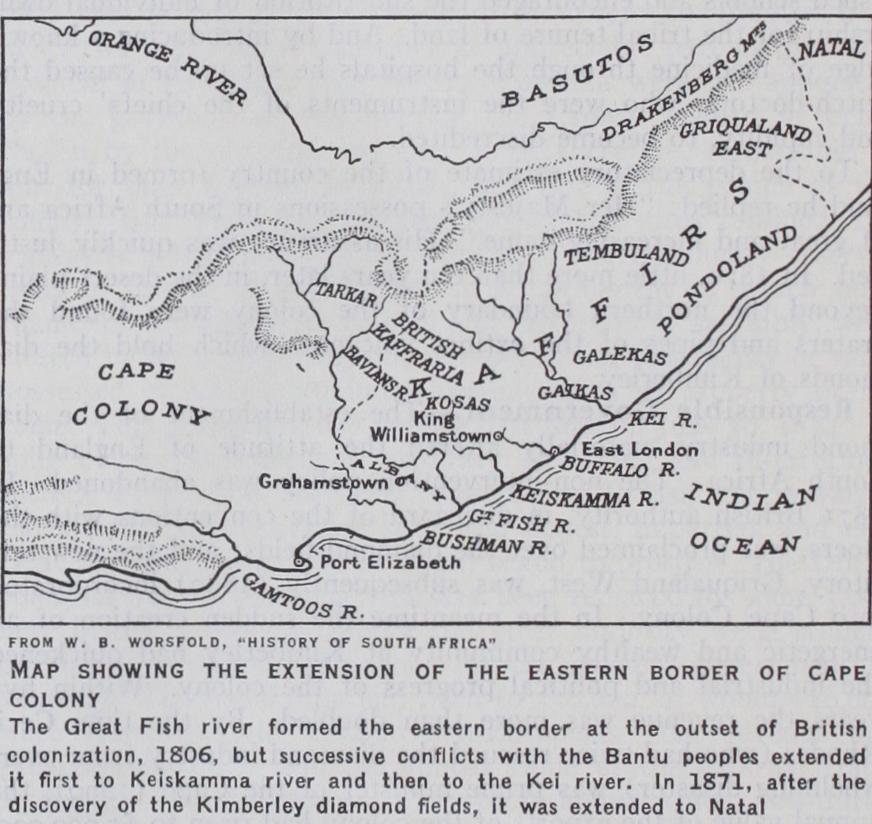
Under British Rule.—In 1806, when British rule began, the colony had a total population of 73,633, composed of 26,72o Europeans, 17,6S7 Hottentots, and 29,256 persons returned as slaves. In Cape Town there were some 17,000 people, of whom 6,000 were European. The rest of the inhabitants were scattered over a belt of coastlands extending for some soo miles from the Cape to the Fish river, and similar in its relationship to the plains and high plateaux of the interior, and in its general physical features, to the Tell of north-west Africa. The annual value of the goods imported was rather more than f 100,00o, and that of the produce exported rather less than f 6o,000. While the resistance of the indigenous Hottentots and Bushmen of the colony had been overcome, outside its boundaries the Bantu peoples had in creased in numbers and drawn nearer to the zone of European oc cupation. The military tribes, who had established themselves in the fertile littoral east of the great mountain ranges, confronted the European colonists on the further bank of the Fish river. The industrial tribes, to whom, as being weaker in arms, the inhospitable deserts and steppes to the west of the ranges had fallen, were less advanced in their southward progress. The former, whose Central African blood had been mingled with that of the Asiatic settlers on the east coast of the Continent, were destined to dispute the possession of South Africa with the Eu ropeans in the long series of wars which have given a sinister familiarity to the words Kaffir, Zulu, Basuto, and Matabele. They were then a mass of cruel and untamed humanity, ready whenever opportunity offered to break over the eastern frontier of the colony and engulf its lonely homesteads in fire and rapine. A century later the area of European occupation, or control, un der the British Crown extended from the Cape to the Belgian Congo; the European population numbered over a million, and their external trade, of the annual value of L75,000,000, was larger per head of (European) population than that of any other British state overseas. And within this area the non-European peoples, five or six times as numerous as the European, had been brought under European administration. Up to 1835 Cape Colony con tained the whole, and from that date up to the foundation of Johannesburg in 1886, approximately two-thirds, of the European population of South Africa. The governors of the colony from 1847 (Sir Henry Pottinger) to 1901 (Lord Milner) were also high commissioners in South Africa, and as such concerned with the sub-continent as a whole. The history of Cape Colony in the century, therefore, is often hardly distinguishable from that of South Africa as a whole; and it is related in this sense under the title SouTII AFRICA, UNION OF. The account following is limited accordingly to what may be called its internal, or domestic, development.
"The reasons for which we abandoned our lands and home steads, our country and kindred, were the following : "I. The continual depredations and robberies of the Kaffirs, and their arrogance and overbearing conduct ; and the fact that, in spite of the fine promises made to us by our government, we, nevertheless, received no compensation for the property of which we were despoiled.
"2. The shameful and unjust proceedings with reference to the freedom of our slaves; and yet it is not so much their freedom that drove us to such lengths, as their being placed on an equal footing with Christians, contrary to the laws of God and the natural distinction of race and religion, so that it was intolerable for any decent Christian to bow down beneath such a yoke; wherefore we rather withdrew in order thus to preserve our doc trines in purity." The population thus withdrawn numbered from 7,000 to 1 o,000 persons. The epic of the V oertrekkers is to be found under the title SOUTH AFRICA, UNION OF. It will suffice to add that the communities to which they gave birth, the Transvaal and Orange Free State, were recognized by the British government as (inter nally) independent republics respectively under the Sand River (1852) and Bloemfontein (1854) conventions. Natal was occu pied also by the Boers ; but there, on account of its maritime sit uation and earlier occupation by Englishmen, British authority, established in 1843, was maintained; and during the years 48 it was administered as a part of Cape Colony.
To the depreciatory estimate of the country formed in Eng land he replied : "Her Majesty's possessions in South Africa are of great and increasing value." His assurance was quickly justi fied. In 187o, little more than ten years later, in the desert plains beyond the northern boundary of the colony were found the craters and pipes of the extinct volcanoes which hold the dia monds of Kimberley.
The Retrocession of the Transvaal.—On Dec. 16, 188o, the Transvaal Boers rose in arms. The British were heavily defeated at Majuba Hill (Feb. 26, 1881), and on March 26 peace was made on the assurance that the republic, under British suzerainty, would be restored within six months. President Brand had in f ormed the Cabinet that he could no longer hold back the Free State burghers from joining the Transvaal insurgents, and the Dutch in Cape Colony had declared openly their sympathy with their kinsmen. The retrocession was in direct conflict with the advice which Frere had given to the British government up to June 1879, when the Transvaal was removed from his jurisdiction and placed under Lord Wolseley, and subsequently in connection with affairs in Cape Colony. Frere held, and advised the colonial secretary, that although the expediency of the annexation was questionable, British authority, once established, must be main tained. Apart from the obligations incurred to the natives, and to 'In a letter of June, 1902, to Sir George Arthur. "Life of Lord Wolseley," by Gen. Sir F. Maurice and Sir George Arthur, p. 131.
the non-Boer European population which had settled in the coun try since the annexation because British rule had been established, and in the belief that it would continue, the problem of the Trans vaal was part of the larger problem of South Africa. Reliance on mere force, he wrote, would be useless; the Boers must be won by a prompt and generous measure of self-government, such as he had proposed when visiting the Transvaal (March 15–May 6, 1879). Either reliance on mere force, or the withdrawal of Brit ish authority, would strain to the breaking point the loyalty of the Dutch in Cape Colony.
There was a side of the Bond which appealed to Rhodes, who, born of a land-owning and farming stock, in all his large industrial and financial enterprises never neglected the interests of the coun try population. In 1883 the Farmers' Protection Association had been amalgamated to the Bond, for Hofmeyr, who was also in terested in the development of the country districts, sought the co-operation of the more progressive British farmers in his plans for the improvement of the agriculture of the colony. Apart from this, Rhodes and Hofmeyr found common ground in the desire that South African ideas should prevail in the administration of South Africa. Rhodes never wavered in his loyalty to the British connection; but he recognized the faultiness of a system under which the cardinal questions of South African administration were left to be decided by the House of Commons, a body unfamiliar with the country and its peoples, whose judgment was often warped by irrelevant considerations of English party politics. In this sense he advocated "the elimination of the Imperial factor." Hofmeyr probably never ceased to desire Dutch supremacy in South Africa, whether under the British or a republican flag. But there was much useful work which each desired to accom plish, that could be accomplished in common, and yet leave each of them free to choose the path—republican or imperial—by which the final goal of South African unity was to be attained. In 1890 Rhodes, with Bond support, became prime minister of the colony; and the Rhodes-Hofmeyr alliance, tending materially to draw together the Dutch and British colonists, worked well until Rhodes's complicity in the Jameson raid (Dec. 29, Jan. 2, 1896) brought about its violent disruption in 1896. At the time Joseph Chamberlain (q.v.), who a few months before had become colonial secretary, was preparing to press President Kruger to grant the franchise to the British population whom the gold industry had brought into the Transvaal. The reaction in Cape Colony against Rhodes, and in favour of Kruger, which followed the raid, materially increased the difficulty of his task. In spite of the prompt and full reparation made by the British Government to the Transvaal, the Bond went back to the policy of 1881; and in view of the increasing seriousness of the situation a man of exceptional ability, Alfred (afterwards Lord) Milner (q.v.), was appointed governor of the Cape and high commis sioner in 1897. In the year following the Sprigg ministry, which in 1896 had succeeded the Rhodes ministry, came into conflict with the Bond. It was replaced (Oct. 17) by a ministry, pledged at the hustings to prevent British intervention in the Transvaal, in which Mr. Philip Schreiner was prime minister.
As it was, on the outbreak of hostilities (Oct. I I) between the Boer Republic and Great Britain, five districts in the north-west of the colony went over to the Free State, and nine-tenths of the Dutch farmers in Bechuanaland joined the Transvaal. Four months later Milner wrote to the secretary of state (Jan. 16, 1900) : "Not less than I 0,00o of those now fighting against us in South Africa, and probably somewhat more, either are, or till quite recently were, subjects of the Queen." (For the history of this contest, in which the presages of Grey and Frere were lamentably fulfilled, see SOUTH AFRICAN WAR and SOUTH