
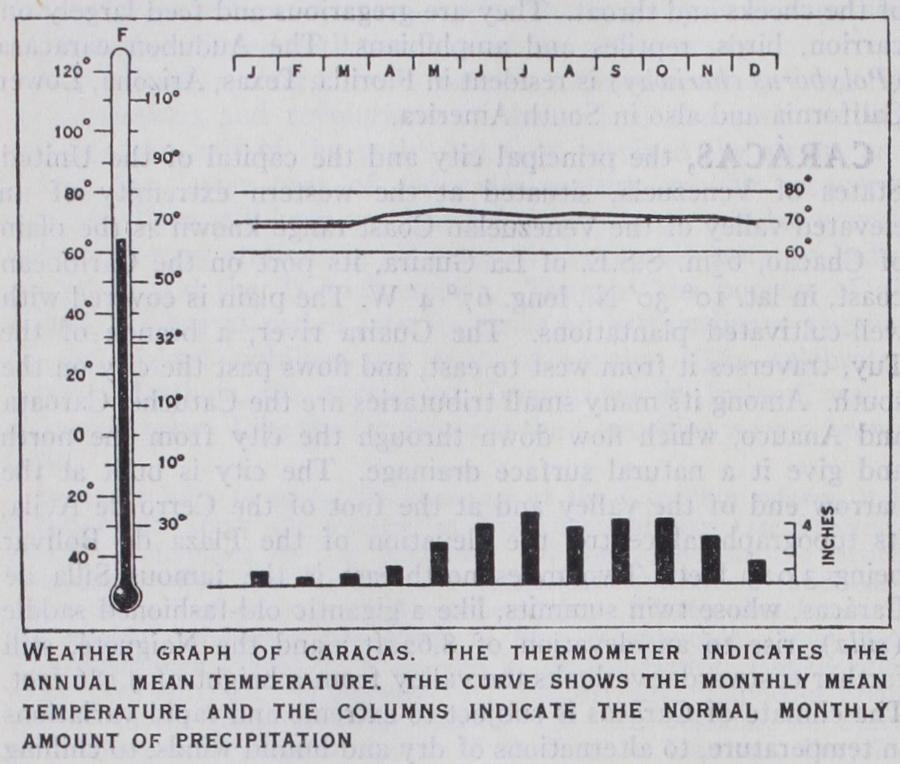
CARACAS, the principal city and the capital of the United States of Venezuela, situated at the western extremity of an elevated valley of the Venezuelan Coast range known as the plain of Chacao, 61m. S.S.E. of La Guaira, its port on the Caribbean coast, in lat. 1o° 3o' N., long. 67° 4' W. The plain is covered with well-cultivated plantations. The Guaira river, a branch of the Tuy, traverses it from west to east, and flows past the city on the south. Among its many small tributaries are the Catuche, Caroata and Anauco, which flow down through the city from the north and give it a natural surface drainage. The city is built at the narrow end of the valley and at the foot of the Cerro de Avila, its topographical centre, the elevation of the Plaza de Bolivar being 3,025 feet. Two miles north-east is the famous Silla de Caracas, whose twin summits, like a gigantic old-fashioned saddle (silla), rise to an elevation of 8,6 2 2f t. ; and the Naiguete, still farther eastward, overlooks the valley from a height of 9,186 feet. The climate of Caracas is subject to extreme and rapid variations in temperature, to alternations of dry and humid winds, to chilling night mists brought up from the coast by the westerly winds, and to other influences productive of malaria, catarrh, fevers, bilious disorders and rheumatism. The maximum and minimum tempera tures range from 84° to 48° F, the annual mean being about 66°, and the daily variation is often as much as 15°. The city is built with its streets running between the cardinal points of the com pass. Two intersecting central streets also divide the city into four sections, in each of which the streets are methodically named and numbered, as North 3rd, or West 2nd, etc., according to direction and location. This method of numeration dates from the time of Guzman Blanco, but the common people adhere to the names bestowed upon the city squares in earlier times. There are several handsome squares and public gardens, adorned with stat ues, trees and shrubbery. The principal square is the Plaza de Bolivar, the conventional centre of the city, in which stands a bronze equestrian statue of Bolivar, and on which face the cathedral, archbishop's residence, Casa Amarilla, the national li brary, general post office and other public offices. The Independen cia park, formerly called Calvario park, which occupies a hill on the west side of the city, is the largest and most attractive of the public gardens. On the outskirts there is the famous "Paraiso" drive. Among the public edifices are the capitol, which occupies a whole square, the university, the cathedral, pantheon, masonic temple, national library, and a number of large churches. The city is generously provided with all the modern public services. The principal water supply is derived from the Macarao river, I 5m. distant. Railway connection with the port of La Guaira was opened in 1883 by means of a line 23m. long. Another line (the Gran Ferrocarril de Venezuela) passes through the mountains to Valencia, IIIm. distant, and two short lines run to neighbouring villages. The archbishop of Venezuela resides in Caracas and has ecclesiastical jurisdiction over the dioceses of Ciudad Bolivar, Calabozo, Barquisimeto, Merida, Maracaibo, Valencia, Coro, Cumana and San Cristobal. There are now some manufactures of note.
Caracas was founded in 1567 by Diego de Losada under the pious title of Santiago de Leon de Caracas, and has been succes sively capital of the province of Caracas, of the captaincy-general of Caracas and Venezuela, and of the republic of Venezuela. It is also one of the two chief cities, or capitals, of the Federal district. It was the birthplace of Simon Bolivar, and claims the distinction of being the first colony in South America to overthrow Spanish colonial authority. The city was almost entirely destroyed by the great earthquake of 1812. In the war of independence it was repeatedly subjected to pillage and slaughter by both parties in the strife, and did not recover its losses for many years. In 1810 its population was estimated at 5o,00o; 71 years later the census of 1881 gave it only 55,638, but in 1926 the population had risen to