Home >> Encyclopedia-britannica-volume-4-part-2-brain-casting >> Caracalla to Carlstadt >> Caravan

Caravan

Loading


CARAVAN, a word of Persian origin (more correctly Kara wan), adopted into the later Arabic vocabulary. (I) A covered cart, drawn by horse or motor power, used for living purposes, chiefly by gypsies and holiday makers. (2) A body of traders travelling together for greater security against robbers (and in particular against Bedouins, Kurds, Tatars and the like, whose grazing grounds the proposed route may traverse) and for mutual assistance in the matter of provisions, water and so forth. In Arabia proper the name caravan is rarely employed in speech and never in writing, strictly Arabic words such as Rikb ("assem bled riders") or Qifita ("wayfaring band") being in ordinary use.

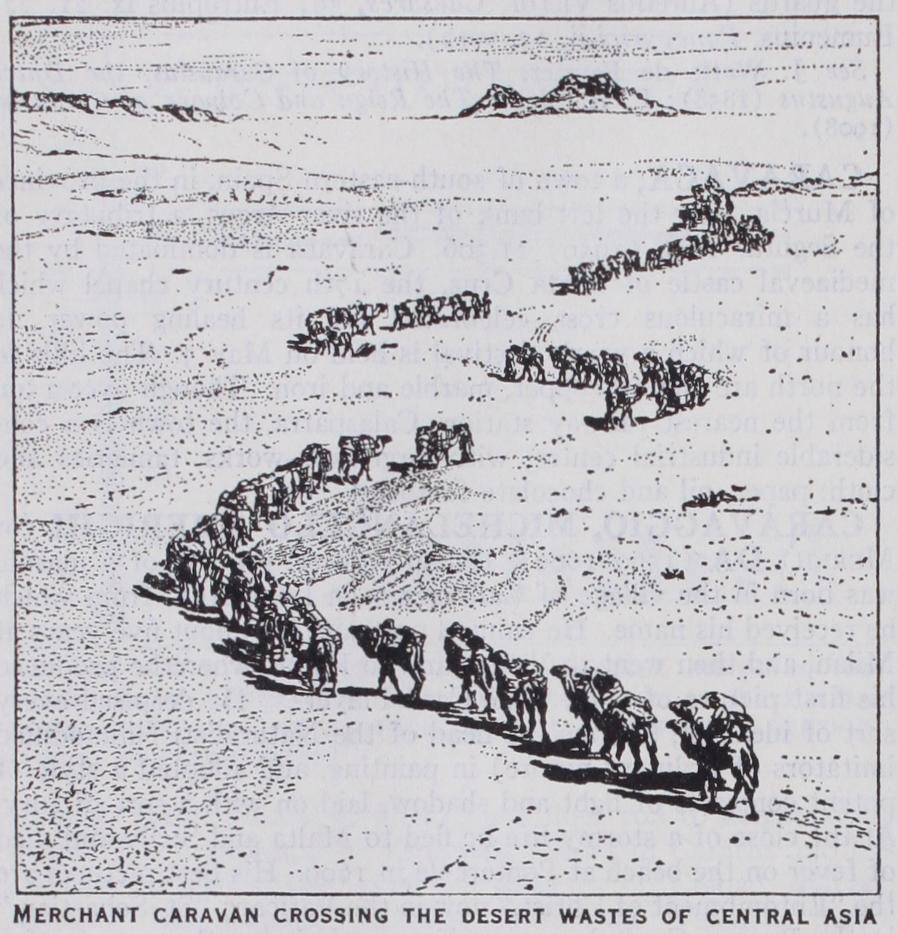
The precautions of the caravan are due to the absence of settled government, inns and roads. Strings of camels are generally employed for the transport of heavy goods, especially where the track, like that between Damascus and Baghdad, for example, lies across level, sandy and arid districts. The camels are harnessed in strings of 5o or more at a time, a hair-rope connecting the rear of one beast with the head of another; the leader is gaily decorated with parti-coloured trappings, tassels and bells; an unladen ass precedes the file, for guidance.

Where the route is rocky and steep, as between Damascus and Aleppo, mules, or even asses, are used for burdens. The wealthier members ride, where possible, on horseback. Every man carries arms; but these are in truth more for show than for use, and are commonly flung away in the presence of any serious robber attack.

Should greater peril than usual be anticipated, the protection of a company of soldiers is habitually pre-engaged,—an expensive, and ordinarily a useless adjunct. A leader or director, called Karawan-Bashi (headman), or, out of compliment, Karawan Seraskier (general), but most often simply Ra'is (chief), is be fore starting appointed by common consent. His duties are those of general manager, spokesman, arbitrator and so forth; his re muneration is indefinite. But in the matter of sales or purchases, either on the way or at the destination, each member of the cara van acts for himself. The number of camels or mules in a single caravan varies from 4o or so up to 600 and more; sometimes, as on the reopening of a long-closed route, it reaches 1,000.
Caravan

Caravan Seasons.

The ordinary caravan seasons are the months of spring, early summer and later autumn. Friday, in accordance with a recommendation made in the Koran itself, is the favourite day for setting out, the most auspicious hour being that immediately following noonday prayer. The first day's march never does more than just clear the starting-point. Subsequently each day's route is divided into two stages,—from 3 or 4 A.M. to about I o in the forenoon, and from between 2 and 3 P.M. till 6 or even 8 in the evening. Thus the time passed daily on the road averages from io to i 2 hours, and, as the ordinary pace of a laden camel does not exceed 2m. an hour, that of a mule being 2/, a distance varying from 23 to 28m. is covered every march ing day. But prolonged halts of two, three, four and even more days often occur. The hours of halt, start and movement, the precise lines of route, and the selection or avoidance of particular localities are determined by common consent. But if, as some times happens, the services of a professional guide, or those of a military officer have been engaged, his decisions are final. While the caravan is on its way, the five stated daily prayers are, within certain limits, anticipated, deferred or curtailed, so as the better to coincide with the regular and necessary halts,—a practice authorized by orthodox Mohammedan custom and tradition.

Two caravans are mentioned in Genesis xxxvii. ; the route on which they were passing seems to have coincided with that nowa days travelled by Syrian caravans on their way to Egypt. Allu sions to caravans may be found in Job, in Isaiah and the Psalms.

Pilgrims to Mecca.

The yearly pilgrim-bands, bound from various quarters of the Mohammedan world to their common destination, Mecca, are sometimes, but inaccurately, styled by European writers caravans ; their proper designation is Hajj, a collective word for pilgrimages and pilgrims. The two principal pilgrim-caravans start yearly, the one from Damascus, or, to speak more exactly, from Mozarib, a village station three days' journey to the south of the Syrian capital, the other from Cairo in Egypt. This latter was formerly joined on its route, near Akaba of the Red Sea, by the North African Hajj, which, how ever, now goes from Egypt by sea from Suez; the former gathers up bands from Anatolia, Kurdistan, Mesopotamia and Syria. Since 1908, the Syrian and Egyptian Hajj have been able to travel by the railway from Damascus to the Hejaz. Besides these a third, but smaller, Hajj of Persians, chiefly sets out from Suk-esh Sheiukh, in the neighbourhood of Meshed Ali, on the lower Euphrates; a fourth of negroes, Nubians, etc. unites at Yambu on the Hejaz coast, whither they have crossed from Kosseir in Upper Egypt ; a fifth, of Indians and Malays, centres at Jidda ; a sixth and seventh of southern or eastern Arabs arrive, the former from Yemen, the latter from Nejd.

The Syrian Hajj is headed by the pasha of Damascus either in person or by a vicarious official of high rank, and is further accompanied by the Sorrah Amir or "Guardian of the Purse," a Turkish officer from Constantinople. The Egyptian company is commanded by an amir or ruler, appointed by the Cairene gov ernment, and is accompanied by the famous "Mahmal," or sacred pavilion. The other bands above mentioned have each their own amir, besides their mekowwams or agents, whose business it is to see after provisions, water and the like, and are not seldom en cumbered with a numerous retinue of servants and other attend ants. Lastly, a considerable force of soldiery accompanies both the Syrian and the Egyptian Hajj.

Bedouins and Pilgrims.

No guides properly so-called attend these pilgrim-caravans, the routes followed being invariably the same, and well known. But Bedouin bands generally offer them selves by way of escort, and not seldom designedly lead their clients into the dangers from which they bargain to keep them safe. This they are the readier to do because, in addition to the personal luxuries with which many of the pilgrims provide them selves for the journey, a large amount of wealth, both in mer chandise and coins, is habitually to be found among the travellers, who, in accordance with Mohammedan tradition, consider it not merely lawful but praiseworthy to unite mercantile speculation with religious duty. Nor has any one, the pasha himself or the amir and the military, when present, excepted, any acknowledged authority or general control in the pilgrim-caravans ; nor is there any orderly subdivision of management or service. The pilgrims do, indeed, often coalesce in companies among themselves for mutual help, but necessity, circumstance or caprice governs all details, and thus it happens that numbers, sometimes as many as a third of the entire Hajj, yearly perish by their own negligence or by misfortune,—dying, some of thirst, others of fatigue and sickness, others at the hand of robbers on the way.

The numbers which compose these pilgrim caravans are much exaggerated by popular rumour; yet it is certain that the Syrian and Egyptian sometimes amount to 5,000 each, with 25.000 or 30,00o camels in train. Large supplies of food and water have to be carried, the more so at times when the pilgrim season, following as it does the Mohammedan calendar, which is lunar, falls for years together in the very hottest season. Hence, too, the journey is usually accomplished by night marches, the hours being from 3 to 4 P.M. to 6 or 7 A.M. of the following day. Torches are lighted on the road, the pace is slower than that of an ordinary caravan, and does not exceed 2m. an hour.

See MECCA and MOHAMMEDAN RELIGION.

route, hajj, syrian, days, caravans, mohammedan and damascus