
CARIBBEAN SEA, an arm of the Atlantic ocean bounded by the islands of the West Indies on the east and north, by Vene zuela, Colombia, Panama and Costa Rica on the south, and by Nicaragua, Honduras, Guatemala, British Honduras and Mexico on the west. It is about 400m. wide at its narrowest point, along the Windward isles at its easternmost boundary, about loom. wide at its widest between Panama and Cuba, and approximately I,5oom. long, with a total area of about 7,500 square miles. The Caribbean was discovered by Columbus on his first voyage, and was extensively explored by him on his subsequent journeys. On his fifth and last voyage he skirted its western shores from Hon duras to Venezuela in a search for the "strait" to the China seas. ' The opening of the Panama canal (q.v.) has converted the Caribbean sea into one of the great ship highways of the world, but for 400 years prior to this the Caribbean was the busiest route of travel, transport and battles in the western hemisphere. The Isthmus of Panama, some 5om. wide, early became the route for transhipment of the treasures of the Spanish colonies of the Orient and of South America, and the convoys of Spanish mer chant ships became the objects of raids by pirates, freebooters and buccaneers.. The mainland bordering the Caribbean came to be called the "Spanish Main," and the fortified cities on its shores were the centre of Spanish colonial trade and the objects of raids by English, French and Dutch warships, privateers and pirates. An immense treasure passed across the Caribbean, for not only the estimated £1,500,000,000 of silver taken from Peru, but vir tually all the traffic from (and to) Buenos Aires was carried over land across the Andes to Lima and by ships up the Pacific coast to Panama, there transhipped and thence by convoys of galleons to Spain. In later years the trade of the Caribbean colonies of Spain drifted into the hands of the English, and beginning with the capture of the island of Jamaica (q.v.) in 1655 (in the course of a raid ordered by Oliver Cromwell against the Spanish colony on the island of Santo Domingo), British outposts began to ap pear on the islands and mainland.
The strategic importance of the Caribbean region has been in creasingly emphasized since the opening of the Panama canal. From its earliest history, however, it has been in the balance of diplomatic and commercial struggle, although seldom itself the prize or object of wars. During the slavery era, the islands pro duced an immense wealth of sugar and other plantation products, and during the earlier struggles for Canada, the French deliber ately chose to hold their West Indian islands and to leave the bleak wastes of Canada to the British. Cuba (q.v.) has been the object of intrigue and controversy from the first sign of the weakening of Spain's hold upon her colonies of the New World, but was left to be the very last foothold of Spain. France, England and the United States all frankly sought occasions to annex the "gem of Antilles." Cuba's independence in the end was directly due to the fact that in the declaration of war against Spain on April 19, 1898, the United States Congress expressly stated that it would under no circumstances take over the sovereignty of Cuba, a pledge car ried out to the letter, in spite of a two years' intervention early in the republican life of Cuba.
The British control of the Caribbean was from the first due largely to naval strength and commercial pre-eminence. By the end of the 16th century English ships were the predominating merchantmen between all Europe and the West Indies and the Spanish Main, and following the capture of Jamaica in there began the establishment of British colonies on certain islands and on three well-defined regions on the mainland, Belize (q.v), the Mosquito coast of Nicaragua, and in what is now British Guiana (q.v.). The break-up of the Spanish empire at the begin ning of the 19th century, and the abolition of slavery in the half century that followed, left the Caribbean islands relatively in significant for a time, as commercial units, but their strategic im portance remained. Indeed, Great Britain, from the very begin ning of her political control in the region, was obviously conscious of the importance of this factor, even in the years when the com mercial side was apparently overwhelming. The possession of Jamaica, Trinidad and other islands gave Great Britain a pre dominant position in the Caribbean sea, and during the years of Spanish decadence, no rival at all held any other strategic position there.
In 1849, the discovery of gold in California, newly acquired by the United States as a result of the Mexican War, created a de mand for short and comfortable transport from the Atlantic sea board to the Pacific. As a substitute for the long trek across the plains, fast packets on the Atlantic and others on the Pacific be gan to offer comfortable journeys, with land transport facilities across the Isthmus of Panama and also across Nicaragua, via the San Juan river and Lake Nicaragua and with only short land jour neys around the rapids in the river and across the 12 miles from Lake Nicaragua to the Pacific. Thither was drawn commercial at tention in the United States. Talk of an isthmian canal became more active than at any time in the previous 400 years, and the position of Great Britain in the Caribbean became a subject of American observation and negotiation. In the Clayton-Bulwer Treaty, signed in Washington on April 19, 1850, by John M. Clay ton, secretary of State of the United States and Sir Henry Bulwer, H.M. minister in Washington, the British holdings in Belize were not discussed, but the treaty as signed and ratified provided (as finally interpreted) that the British withdraw the Mosquito pro tectorate, and that the United States and Great Britain agree, as a principle, that neither would obtain or maintain any exclusive control over any ship canal to be built through the isthmus.
The construction of the canal proved impossible on these terms, owing to public opinion in the United States on the matter, and this treaty was finally replaced by the Hay-Pauncefote Treaty of Nov. 18, 190I, signed by John Hay, secretary of State of the United States, and Lord Pauncefote, H.M. special ambassador in Washington. It was there provided that the United States should build and fortify the canal, but should make no discrimination as to tolls and facilities in favour of American ships as against British ships. The canal was finally completed in 1914 and opened to traffic in 1920.
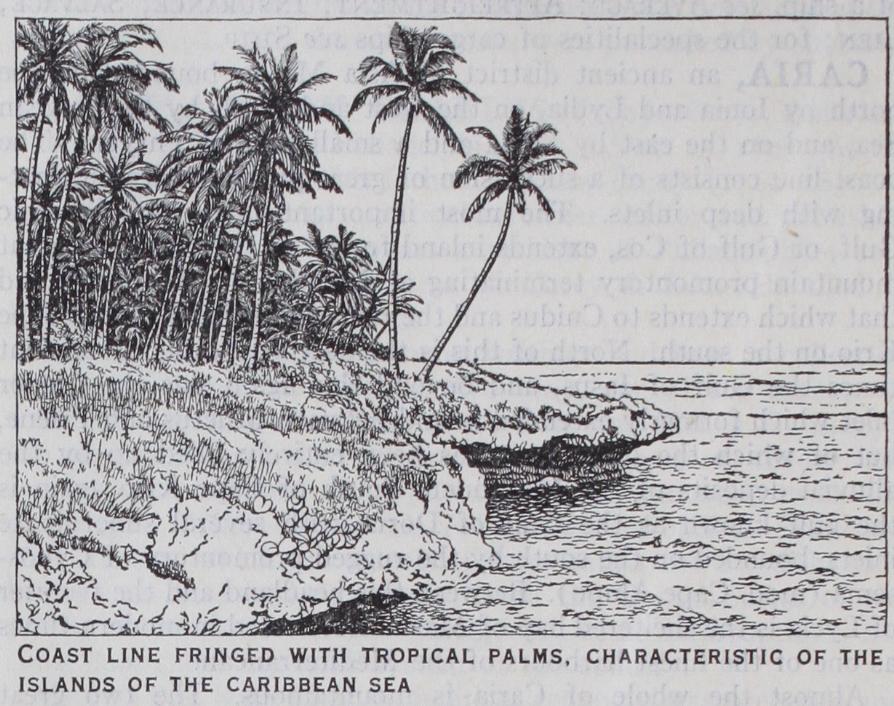
The possession and fortification of the Panama canal has, as a much-quoted phrase expresses it, extended the southern border of the United States to the canal. In addition, the Spanish-Ameri can War, while it left Cuba a free and independent country, re served, under the Platt amendment, the right of supervision over foreign treaties and alliances made by Cuba, and gave to the United States naval bases at Bahia Honda on the northern and Guantanamo bay on the southern coast of the island. By these provisions, the United States stepped into strategic control of Cuba, the true "key" position of the whole Caribbean area. At the same time, the acquisition of Porto Rico placed the United States in the second most important strategic spot in the Carib bean, a position consolidated completely with the purchase of the Danish West Indies or Virgin islands (q.v.) in 1916, as St. Thomas, the largest of these islands, holds the key position on the Anegada passage, the shortest route from Europe to the Panama canal.
The strategy of the Caribbean sea is linked with that of the Gulf of Mexico, and the comparison with the Mediterranean sea is instinctive. The Mediterranean, however, is controlled by Gi braltar, the Bosporus and Suez, and the Caribbean has but one position comparable to any of these—the Panama canal as com pared with that of Suez. On the other hand, in place of the single strategic entry of the Strait of Gibraltar, there are a hundred pos sible entries into the Caribbean and the Gulf of Mexico, half a dozen of them of prime importance. Commencing with the Straits of Florida (with the Yucatan channel completing the access to the Caribbean) there are, in addition, the Windward passage around the eastern point of Cuba, the Mena passage between Haiti and Porto Rico, the Anegada passage eastward of St. Thomas, the routes between Martinique and Santa Lucia, and that north of Trinidad. Between all the Windward isles, indeed, passage is easy though unimportant.
The strategic importance of the Caribbean positions is due, however, primarily to the fact that the control of the northern passages must be held by the United States to ensure access to the canal and defence of her coast-line around the Gulf of Mexico. With the chief positions on Cuba and Porto Rico in the hands of the United States, the question of strategy virtually disappears, but their loss in case of war would quickly change the whole strategic problem. With Cuba allied in war so closely as it is with the United States, the Straits of Florida become virtually an in land means of communication, and the resources of the continent stand behind the naval base at Guantanamo bay on the southern side of Cuba. Thus Guantanamo bay takes precedence as a mili tary position over Jamaica, because it is based on a continent in stead of on an island, yet before Spain lost Cuba, the possession of Jamaica by Great Britain, a great naval power, made any ports and naval bases that the British might build and supply on the island of Jamaica of vastly greater military importance than any thing Spain, a weak power, might build in Cuba.
In recent years, two little Dutch islands, Curacao and Aruba, off the coast of Venezuela, have acquired a new naval importance that greatly increases the strategic value of the British positions on Trinidad and in British Guiana: this is due to the location of great storage of oil from Venezuela in the refineries of important British, Dutch and American companies on these two Dutch islands. The United States has no actual or potential base on the islands or mainland of northern South America so that the stra tegic importance of Curacao and of the port of Cartagena in Colombia are enhanced both for this reason and for their supply of oil, Cartagena now having oil coming via a loom. pipe-line from the interior to loading stations close to the Colombian sea-coast. These two positions were, moreover, of considerable importance since earliest times, the one, Cartagena, as a Spanish fortified city with an excellent harbour for the small Spanish merchantships and warships, and Curacao as one of the few literally perfect har bours of the world, and the rendezvous of the pirates and buc caneers of the early colonial period.
The Panama canal is of course the dominating strategic spot of the entire Caribbean region. The possession of this outstand ing position by the United States has thus been the result of the developments following the Spanish-American War of 1898, prior to which time the only important base in the entire re gion that was in the hands of the United States was Key West. The British domination of the Caribbean was shared at once with the United States on the conclusion of the Spanish-American War and its terms of peace, and relinquished to her on her acquisition of the Canal Zone and the construction of the canal and its de fences. The importance of the Hay-Pauncefote Treaty must not be overlooked in this connection, however, as without that vol untary cession of her right to build the canal in conjunction with the United States, Great Britain might still be in strategic control of many of the key positions of the Caribbean.
The United States had, however, been gradually growing in a consciousness of the importance of the Caribbean region to her na tional safety. The development of routes to the Pacific coast after 1849, mentioned above, was the first of many steps. That was fol lowed by the effort to limit British possessions on the islands and the littoral of the Caribbean in 1850, and was manifested almost violently in the controversy with Great Britain over the arbitration of the boundary between British Guiana and Venezuela in 1896. In the years since the Hay-Pauncefote Treaty, the so-called "doc trine of the paramount interest" of the United States in the region of the Caribbean has become one of the most vigorous offsprings of the Monroe Doctrine (q.v.).
The dominating position of the United States in the Caribbean region has been accepted there with relatively little protest, al though it was challenged by Mexico in 1927, when the Govern ment of President Calles gave moral and financial support to the movement of the Liberal revolutionists in Nicaragua (q.v.).
The policy of paramount interest in the Caribbean has resulted from time to time in direct intervention by American official ele ments in the life of the islands and smaller continental republics. The financial and military interventions in the Dominican repub lic (q.v.) in 1907 and 1911 and in Haiti (q.v.) in 1915, all of which were undertaken on the ground that had the United States failed to act European Governments might have sought to do so, are the outstanding examples. The two interventions in Nicaragua, 1912-25 and in 1927, the landing of marines in Honduras in 1924, and the purchase of the Danish West Indies (Virgin island: [q.v]) in 1917 are among the other examples. The incidents surrounding the separation of Panama (q.v.) from Colombia, in cluding the settlement of the Colombian claims for damages for the revolution by the payment of $25,000,000 by vote of the United States Congress in 1921, furnish additional indications of this policy. The statements made at that time by President Roose velt furnish the text for much of the trenchant literature on the subject of American predominance in the Caribbean.
The value of the holdings of any nation in the Caribbean region has been so greatly enhanced by the building of the Panama canal that the questions of strategy and paramount interest are in no sense the sole determinants of desirability. The growth of the traffic through the Panama Canal began, before 1927 (when the Nicaraguan difficulties caused new official enunciations of it) to bring forward the question of the possible building of. a second canal, through Nicaragua, to which the United States holds option by treaty. In his Minneapolis address, Charles Hughes, while secretary of State, declared : "So far as the region of the Caribbean sea is concerned, if there were no Monroe Doctrine, one would have to be created for it. • • • By building the Panama canal we have not only established a new and convenient highway of commerce, but we have created new exigencies and new conditions of strategy and defence. It is for us to protect that highway. It may also be necessary for us at some time to build another canal between the Atlantic and Pacific oceans and to protect that." In general, the policy of the United States toward the countries of the Caribbean (chiefly manifested in the smaller and more turbulent republics of the islands and of Central America) has been to encourage their development into good neighbours for the canal, to assist them in economic and financial matters, and where trouble threatens, to forestall this well in advance of its becoming a crisis. Landings of American marines have invariably been in relatively small numbers, and on the ground of protection of American lives and property, the only ground on which the President of the United States as commander-in-chief of the army and navy can use the armed forces abroad without specific authori zation of Congress. The officers and crews of the so-called "special service" squadron of a dozen small cruisers and gunboats based at the Panama canal make periodic friendly visits to the ports and capitals of the Central American and Caribbean countries, and the admiral of the United States fleet appears similarly at times in these capitals, while fully accredited ministers are posted in every country, whereas other World Powers maintain only legations accredited to two or more of the countries. These minis ters, appealed to in time of crisis, aid in solving problems brought to their attention and furnish or invite professional aid from the United States in more complicated difficulties.
The system has been declared to be paternalistic, but the stand ing of the United States officials is always maintained in the most rigorous etiquette, and the position of decision and the immense power wielded by these representatives of Washington are entirely the gift of the countries themselves, although it should be added that the situation is not frowned upon by the Department of State. The whole state of balance in the Caribbean, with military posi tion, naval strength and political "paramount interest" in the hands of the United States, furnishes not only a definite protec tion to the United States and her sister republics in the region, but renders the Panama canal safe from surprise and largely so from any real danger to its communications in time of war. The strategic as well as the commercial importance of a second canal, and the political value of such a construction in Nicaragua, unite in making this development, with its vast increase in the im portance of all the elements considered, a not unlikely extension of the future history of the Caribbean region.
T. Mahan, The Interest of America in Sea power (1906) ; Stephen Bonsai, The American Mediterranean (1912). Cf. also, Charles Evans Hughes, "Observations on the Monroe Doc trine," an address before the American Bar Association, August 30, 1923 ; and Wallace Thompson, "The Origins of the Doctrine of the Paramount Interest of the United States in the Region of the Carib bean Sea," an address before the Academy of Political and Social Science, Philadelphia, reprinted in the Annals of the Academy, July, 1927. See also Theodore Roosevelt, Fear God and Take Your Own Part. The subject has not been developed, and source material remains to be studied in Foreign Relations of the United States at periods of crises and in the unpublished files of the Department of State in Washington. A summary of some of the diplomatic developments is contained in John Bassett Moore, Digest of International Law (1906) . A large literature of newspaper and magazine articles and pamphlets has sprung up in the course of discussions of the activities of the United States in Central America, some of which are mentioned in the bibliographies under the articles CENTRAL AMERICA, MONROE DOCTRINE and PANAMA CANAL. (W. THO.)