CARRIAGE, a vehicle which is designed for animal traction and is provided with accommodation for the driver and those travelling. A carriage may have seats for the passengers only, such as when it is driven by one or more mounted postilions. A trotting sulky, used for racing, is an example of a conveyance which has a seat for the driver only.
The earliest type of vehicle was the sledge, having no wheels and mounted on runners. From the sledge was evolved the rude cart with wheels made of wooden discs, used for agricultural and other purposes for many cen turies with few modifications. Such carts are still to be seen in Spain, Portugal and Mexico drawn by a pair of yoked oxen.
The requirements of war and hunting had a marked effect on the general design of the vehicle, for as early as 5 500 B.C. the Egyptian two-wheeled chariot had reached a high state of per fection. These chariots, and those of the Assyrians, Greeks and Romans may be regarded as the first carriages, since they were made for carrying man, rather than as a means for helping him to move his belongings more easily. The chariot was without seats or springs, the horses were yoked to a central pole, but the wheels had spokes and the various parts were well finished and often elaborately decorated. The chariot was entered from behind, an exception being the British chariot which had a front entrance and also a seat, a pattern developed by the Romans for dispatch riding and civil uses.
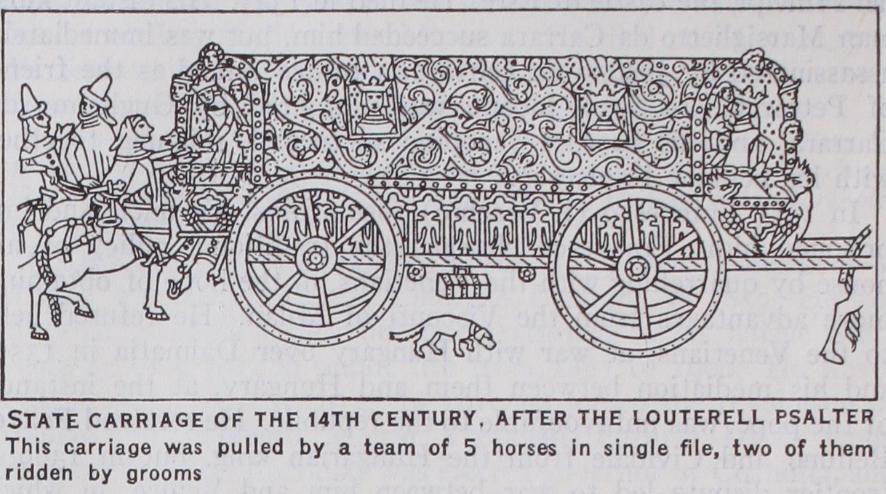
Early Types of Four-wheeled Wagons.—Equally important as the chariot, from the historical standpoint, was the f our wheeled Grecian agricultural wagon. The Romans adopted this wagon and many were used for carrying baggage. They also used the reda which came from Hungary. These wagons, modified and made more luxurious, were utilized for carrying persons of rank, a practice copied, perhaps, from the Persian triumphal cars. The evolution of the vehicle has consisted of improvements as much in the design of the under-carriage and suspension of the body as in the body itself. The wagon which had a direct influ ence on the design of the first coaches had its front and hind axles connected by long wooden poles, later called the perch. The front of this perch was inserted into a transom, a piece of timber lying directly above and parallel with the front axle. The back of the perch was held between the upper and lower portions of the hind axle. Above the transom and hind axles respectively further cross pieces were mounted, on which any type of body could be built by joining these cross pieces with longitudinal poles and planks to form a floor. Uprights were inserted at the ends of the cross pieces allowing body sides to be erected. The front of the perch was not fastened to the front axle as at the rear, because it was necessary that the front axle should be able to turn about its centre. For this purpose a pin was inserted right through the tran som and front axle. In modern times when trees are cut down the logs are carted away on a vehicle fundamentally the same as that just described.
A.D. 300 to 135o was largely a period of stagnation. The war chariot had gone out of use. The two-wheeled cart was used for husbandry, and, as a decorated car, occasionally for ceremonial purposes, while the f our-wheeled wagon was still employed in agriculture and for carrying goods of various kinds. The roads made by the Romans had fallen into disuse and riding in any sort of vehicle, instead of on horseback, was denounced as unmanly.
The contemporary horse litter was a bed or couch mounted on poles harnessed to a horse at either end. The litter was provided with a cover or tilt supported on a wooden framework. The first coach bodies were similar to the litter, but later had f our corner posts supporting a canopy which took the place of the tilt, while the door was merely an apron hung on a cross bar. Such was the coach used by Queen Elizabeth. The next step was the suspension of the body on leather braces and the building in of the roof as part of the structure of the body, a type of coach used by Charles II. Carriage building may now be con sidered as an established industry ; hackney carriages appeared early in the 17th century and stage coaches towards the latter half of the same century. About 166o the coach body was panelled and had a hinged door, while in 166g Pepys mentions in his diary that his coach had glass windows and that experiments were being made with steel springs. These were first introduced between the body and the ends of the leather suspension braces.

Improved craftsmanship was now in evidence. The f our-wheeled chariot appeared in
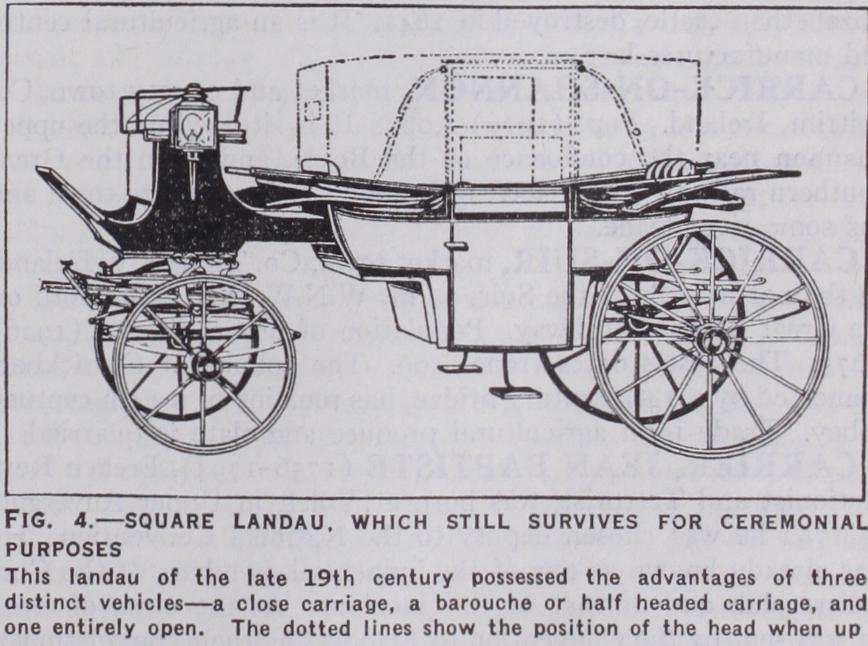
The body was similar to the sedan chair (introduced in 1634 into England from France) in outline and had a single seat, whereas the coach had two seats facing one another. The post chaise was like the chariot but driven by postilions. By the end of the 18th century the landau, which became very popular, was coming into use. This was similar to the coach but with the upper quarters made to open and fold back in opposite directions. There was also the barouche which had a folding head to the back seat only. Amongst two-wheeled carriages were the curricle provided with a pole and yoke, recalling the harnessing of the ancient chariot, and also various types of gigs, both varieties being self-driving car riages, showing that a new pastime had been inaugurated. Another self-driving carriage was the high perch phaeton which afforded much material for contemporary caricaturists. Between 1700 and i 800 the small elbow spring had given place to larger whip springs which formed the connection between the hind axle and the upper ends of the braces. Later the C spring was used, but still the perch under-carriage was maintained in all its essential features, as in the days before steel springs or braces were used. Wheels had iron tyres both mounted as separate pieces or as a continuous hoop. In 1792 the Collinge axle was invented which carried two or three months' supply of oil instead of a day's grease, as with the old type of axle.
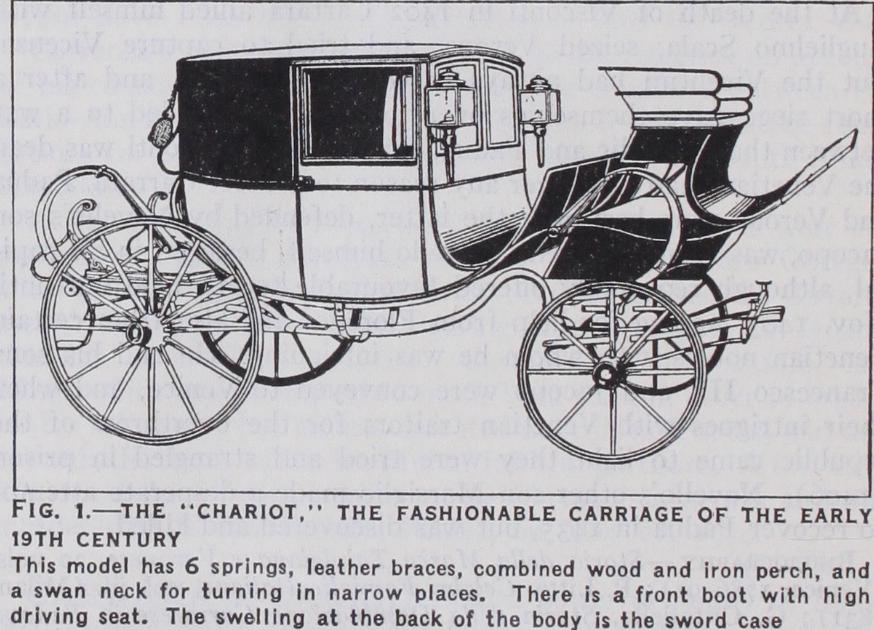
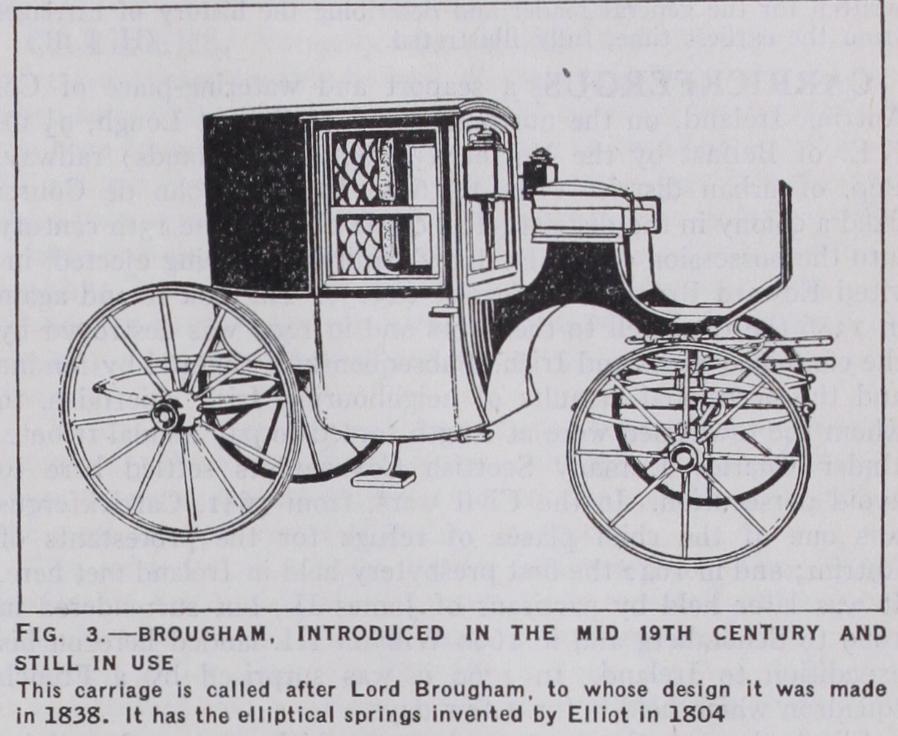
The increasing use of vehicles drew attention to the bad state of the roads, but improvements in this direction were slow. The first mails had been carried by coach in 1786. A much larger number of stage coaches were running and private carriages from now until the establishment of railways were being much used for long journeys as well as for town work (Figs. I and 2) . In 1804 the elliptic spring was invented which allowed a rigidly made body to be connected directly to the axles, so that the perch was no longer required, although the traditional type of under-carriage was improved by the addition in 1818 of an under-spring to the existing C springs and fitted to the best class of carriages. In 1838 the brougham was introduced, the idea being to provide a compact closed carriage which could be drawn by one horse. By 185o various patterns of both two- and four-wheeled dog carts had appeared, as well as wagonettes which had longitudinal vis-à-vis seats. From the middle until the end of the 19th century the railway was performing the work of the carriages formerly used for extended travelling. (Figs. 3 and 4.) Carriages were designed to give greater ease of access, and being unencumbered with travelling equipment, more attention could be given to elegance and the reduction of weight. Various sizes of pony phaetons appeared between 185o and 186o; then about 187o the victoria phaeton, which was essentially a park carriage, came into fashion. For the next thirty years no new styles of carriages were invented. Within a few years of the inception of the motor car the building of horse carriages fell away rapidly, the trade adapting itself to the construction of motor bodywork.
Although European styles were adopted in the United States, a distinctive type of vehicle began to be built about 186o. Extreme lightness of construction was the leading characteristic. The slender under-carriage consisted of comparatively high wheels, with the axles connected by a thin perch. The American industry developed into the largest in the world and a considerable number of buggies and other types were exported to South America, Australia and other countries.
BIBLIOGRAPHY.-John Philipson, M. Inst. M.E., The Art and Craft Bibliography.-John Philipson, M. Inst. M.E., The Art and Craft of Coachbuilding (1897). A well arranged and illustrated concise text book for the student, dealing with the design and construction of modern horsed carriages; Ralph Straus, Carriages and Coaches (1912) , written for the general reader and describing the history of carriages from the earliest time, fully illustrated. (H. J. B.)
