
CASPIAN LANGUAGES, the designation of one division of the Iranian group of Indo-European languages, a division com prising (a) Mazandarani, (b) Gilaki, (c) Talishi, (d) Tat and (e) Samnani. Mazandarani has been a literary tongue since the middle ages and is used in poetry.
There is an oblique case having many duties. It is marked in the different languages thus: In Mazandarani this case usually marks the accusative, some times the genitive case. In Gilaki and Talishi it usually marks the dative and in the former it is also occasionally used as a locative mark.
The comparison of adjectives is similar to that of modern Persian. The suffix -tar or -ter is used. (Cf. Persian bihtar, better.) Numerals.—These in most of the Caspian languages, follow the Persian forms fairly closely. In Talishi they are (I) i, (2) do, (3) sa, (4) chi, (5) penj, (6) shash, (7) haft, (8) hesht, (9) nav, (10) da.
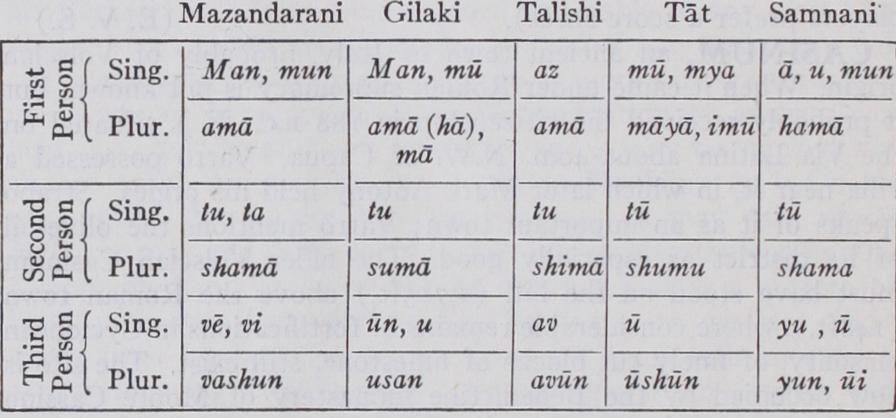
Pronouns.—The pronouns are very similar to those of modern Persian, as will be seen from the following : The languages also make use of suffixed pronouns.
Adverbs, conjugations, prepositions and postpositions are not declined. Many of them are almost identical in form with Iranian and modern Persian forms and betray extensive borrow ings.