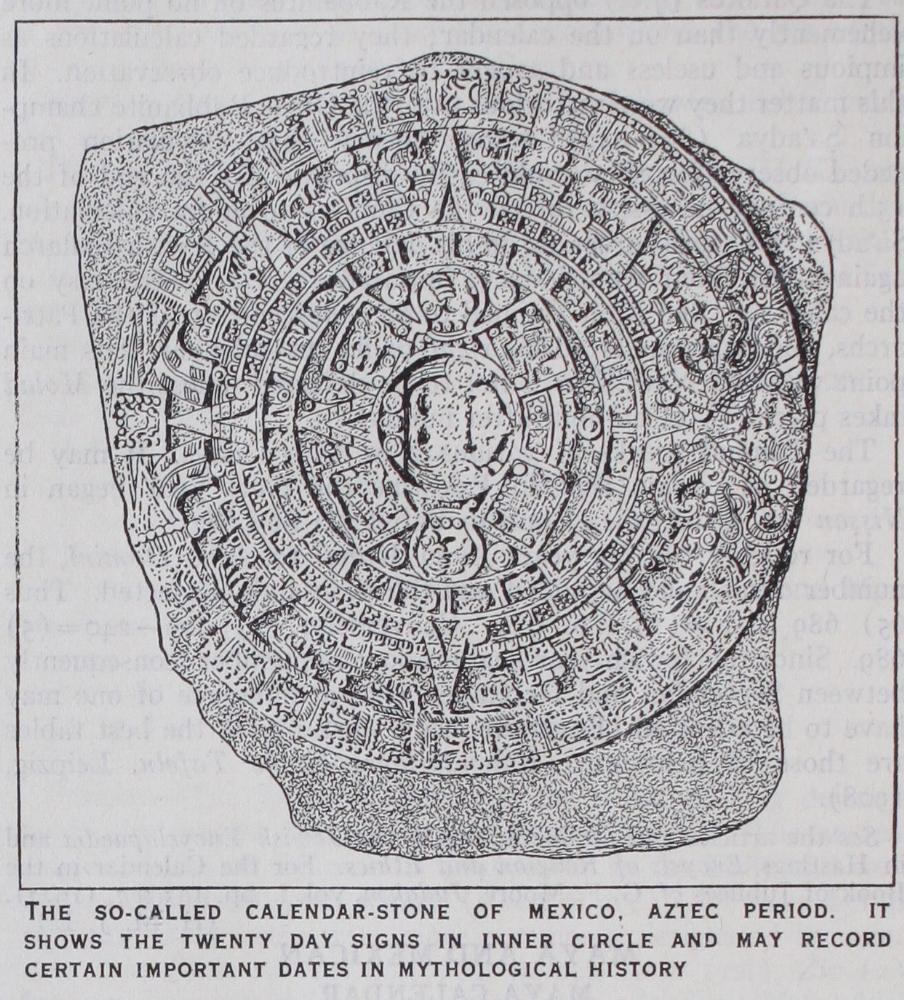
MAYA AND MEXICAN MAYA CALENDAR As this was the basis of the Mexican and allied calendars, it is here treated first. It appears at first sight very complex, but is fairly simple and is admirable from its symmetrical complete ness.
Every Maya date is expressed by two numbers and two names, forming a group of four ; e.g., 4 Ahau 8 Cumhu, or 9 Imix 19 Zip. This statement is similar to such a European date as Wed., Aug. 24, the 4 Ahau or 9 Imix being parallel to the Wednesday, as it gives the position in a gigantic week of 26o days, while the 8 Cumhu or 19 Zip is parallel to Aug. 24. But while in the Euro pean calendar Aug. 24 will fall on a Wednesday four times in 28 years and at unequal intervals therein, the Maya 4 Ahau or 9 Imix will not again occur on 8 Cumhu or 19 Zip until after the lapse of 52 years exactly, so there is no ambiguity. This period of 52 years is called the calendar round.
The Maya had a year of 365 days which was invariable, there being no leap year. This was divided into 18 months of 20 days each, together with five supplementary days at the end. The month names are, Pop, Uo, Zip, Zota, Tzec, Xul, Yaxkin, Mol, Chen, Yax, Zac, Ceh, Mac, Kankin, Muan, Pax, Kayab, Cumhu, together with the supplementary days, Uayeb. Within the month the days are numbered from o to 19 inclusive, instead of from I to 20, and similarly with Uayeb. Hence 8 Cumhu is what European usage would call the 9th of Cumhu. They also had a series of day names commencing with Imix as in the following table, the order of reading being down each column : Falls in month on the days Imix Cimi Chuen Cib 4 9 14 19 Ik Manik Eb Caban 5 10 15 o Akbal Lamat Ben Eznab i 6 ix 16 Kan Muluc Ix Cauac 2 7 17 Chicchan Oc Men Ahau 3 8 13 18 This series of day names, like the European week, ran on con tinuously through the months and years without any interrup tion. But as there were 20 days in the month it followed that if any day name, such as Akbal, fell on the day 1 in the first month of any year, it must fall on the day i of each month throughout that year, and also on i Uayeb. But the five days of Uayeb would use up five of the 20 names, so that in the next year the day i of each month would have the day name Lamat, in the year after it would have Ben. in the next year Eznab, and in the next year Akbal again, the day name returning to the same month-day every four years. Hence each day name has only four possible month-days to fall on, as in above table. The Maya also had a series of 13 day numbers from r to 13 in clusive. These also formed a continuous series like our weeks and ran on uninterruptedly throughout the years and months. But each year contained 28 of these 13-day periods and one day more, so that the year ended with the same day number with which it began, and therefore the next year began with the next day number. Hence each month-day would each year have a day number one larger than in the year before, until the 13 numbers were exhausted, and the same day number returned. Combining this with the five-day progression of the day names, it results that only after 52 years (4 times 13) will the same day number and day name fall upon the same day of the same month. Again, as 20 and 13 have no common measure it follows that a day name will only have the same day number once in 26o days. This 26o-day period commencing with 1 Imix is called the Tonalamatl, which was the Aztec name for it. The Maya name is unknown. It was of great importance for ceremonial and magical purposes.
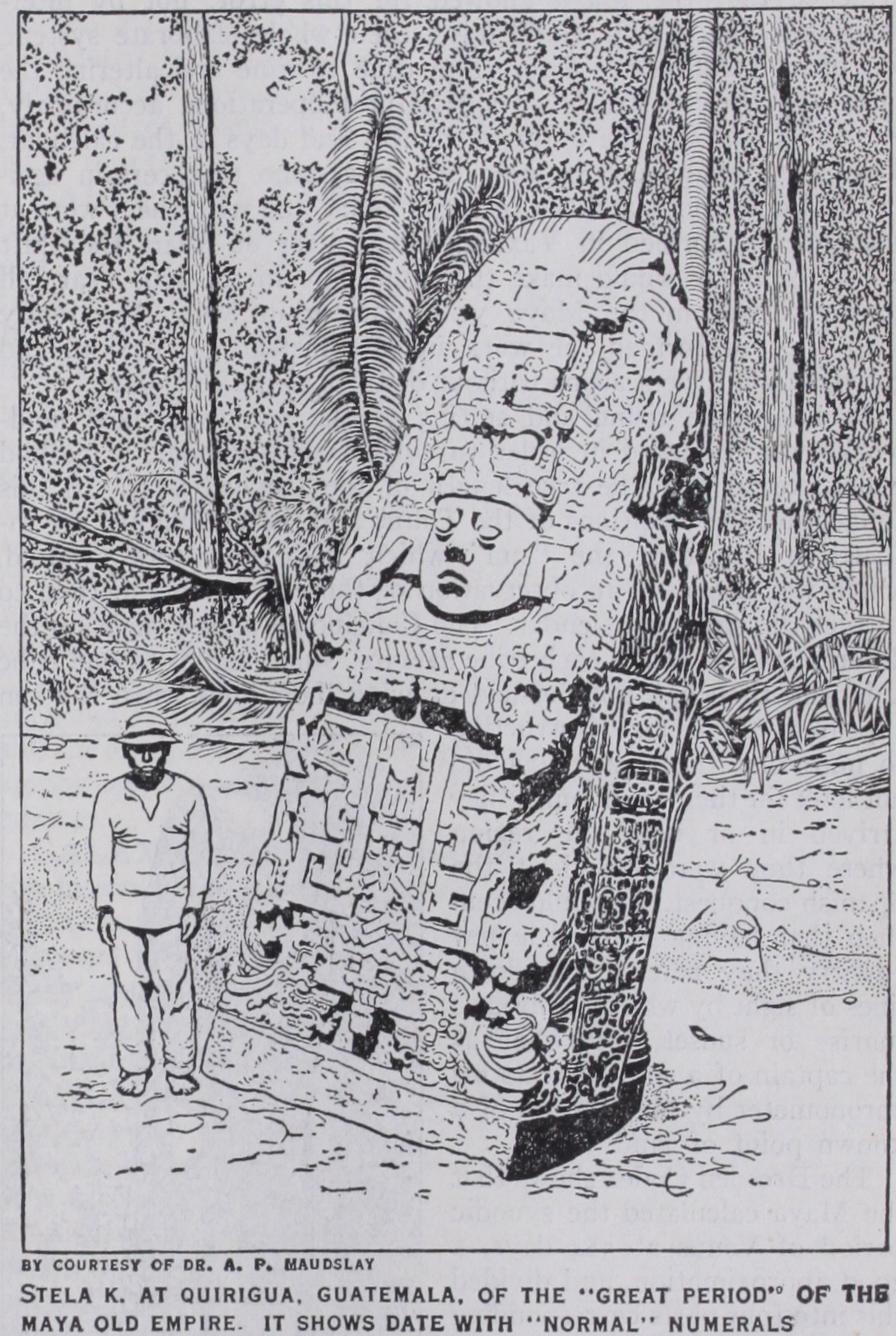
Probably the rising and setting of the sun over fixed land marks was observed in order to correct the calendar, a method which would give the true length of the tropical year. In this connection the traditions of the Toltec and the Cakchiquel are in structive regarding the "sun" which their ancestors awaited, which was probably an observation of the sun by this method to correct the shifting calendar. The Cakchiquel annals mention the different places where each tribe saw its "sun," and as to one tribe it is said they had not finished drawing their lines when the sun appeared. It is also instructive to note that the Cakchiquel did not look for their "sun" until they arrived in or near the region where they were found at the Spanish conquest. It would seem then that having reached a new country they had to lay down lines of sight by which to observe sunrise or sunset, somewhat as the captain of a ship corrects his chronometer by observation of a known point of land.
The Dresden Codex shows that the Maya calculated the synodic period of Venus at 584 days, a good approximation, and divided this into four parts corresponding to the invisibility at inferior con junction, visibility as morning star, invisibility at superior con junction, and visibility as evening star. Dr. John E. Teeple makes it probable that they recognized the small error of this Venus table and applied a correction to it.
The Dresden Codex also shows that they had made a close ap proximation to the true length of the lunar month. This lunar table was used for calculating eclipses.
The synodic period of Mars was calculated and probably that of Jupiter ; Saturn and Mercury are doubtful. Teeple shows that the supplementary series in the inscriptions contain a lunar count. A supplementary series only occurs in connection with an initial series (see CHRONOLOGY), though not all initial series have them. They show the length of the lunar month, that is whether it is of 29 or 3o days, the number of days elapsed of the lunar month, and the number of the lunar month in a series of five or six lunar months. Attempts have been made to correlate this with the sets of five and six lunar months into which the Dresden Codex eclipse table is divided, but so far this has not worked out satisfactorily in all cases.