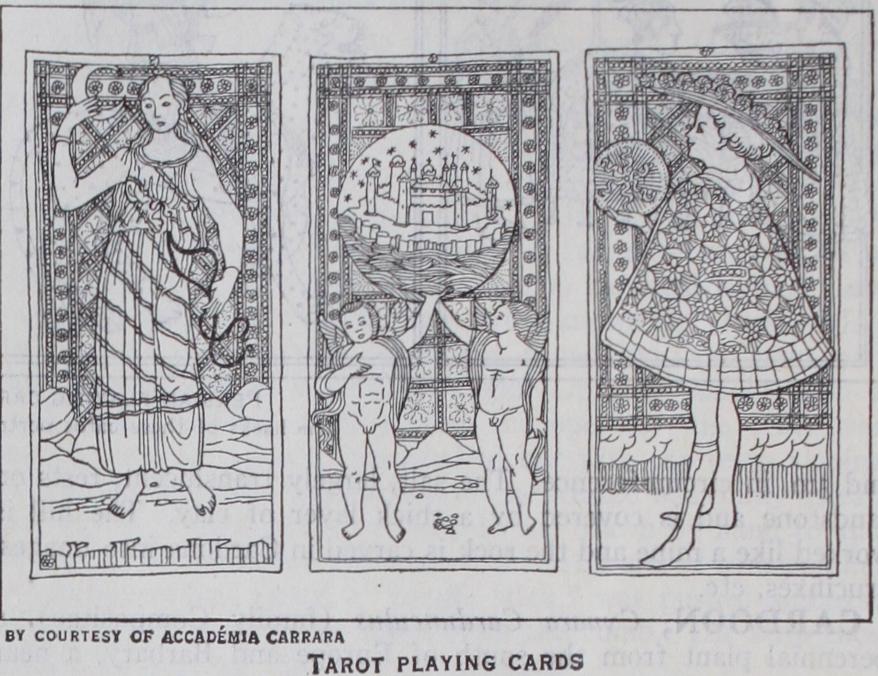
CARDS, PLAYING. As is the case with all very ancient pastimes, the origin of playing-cards is obscure; the widely taken view is that they come from Asia. In the Chinese dictionary, Ching-tsze-tung (1678), it is said that cards were invented in the reign of Seun-ho, A.D. II 20, for the amusement of his con cubines. There is a tradition that cards have existed in India from time immemorial—very ancient ones, round in form, are pre served in museums—and that they were invented by the Brah mans. Their invention has also been assigned to the Egyptians, with whom they were said to have had a religious meaning, and to the Arabs.
The time and manner of the introduction of cards into Europe are matters of dispute. The 38th canon of the council of Wor cester (1240) is often quoted as evidence of cards having been known in England in the middle of the 13th century; but the games de rege et regina there mentioned are now thought to have been a kind of mumming exhibition (Strutt says chess). No queen is found in the earliest European cards. In the wardrobe accounts of Edward I. (1278), Walter Stourton is paid 8s. 5d. ad opus regis ad ludendum ad quatuor reges, a passage which has been thought to refer to cards, but it is now supposed to mean chess, which may have been called the "game of four kings," as was the case in India (chaturanga). If cards were generally known in Europe as early as 1278, it is very remarkable that Petrarch, in his dialogue that treats of gaming, never once mentions them; and that, though Boccaccio, Chaucer and other writers of that time notice various games, there is not a single passage in them that can be fairly construed to refer to cards. Passages have been quoted from various works, of or relative to this period, but modern research leads to the supposition that the word rendered cards has often been mistranslated or interpolated. An early mention of a distinct series of playing-cards is the entry of Charles or Charbot Poupart, treasurer of the household of Charles VI. of France, in his book of accounts for 1392 or 1393, which runs thus : Donne a Jacquemin Gringonneur, peintre, pour trois jeux de cartes, a or et a diverses couleurs, ornes de plusieurs devises, pour porter devers le Seigneur Roi, pour son abatement, cinquante-six sols parisis. This, of course, refers only to the painting of a set or pack of cards, which were evidently already well known. A safe conclusion with regard to their introduction is that, though they may possibly have been known to a few persons in Europe about the middle of the 14th century, they did not come into general use until about a half-century later. Whence they came is another question that has not yet been answered satisfactorily. If we may believe the evidence of Covelluzzo of Viterbo (15th century) cards were introduced into Italy from Arabia. On the authority of a chronicle of one of his ancestors he writes: "In the year 1379 was brought into Viterbo the game of cards, which comes from the country of the Saracens, and is with them called naib." The Crusaders, who were inveterate gamblers, may have been the instruments of their introduction (see Istoria della citta di Viterbo, by F. Bussi, Rome, 1743). According to other authori ties, cards came first to Spain from Africa with the Moors, and it is significant that, to this day, playing cards are called in Spain naipes (probably a corruption of the Arabic Nabi, prophet). Taken in connection with the statement of Covelluzzo, this fact would seem to prove the wide popularity of the game of naib, or cards, among the Arab tribes.
Towards the end of the Li th century cards seem to have be come common, for in an edict of the provost of Paris, 1397, work ing-people are forbidden to play at tennis, bowls, dice, cards or nine-pins on working days. From an omission of any mention of cards in an ordinance of Charles V. in 1369, forbidding certain other games, it may be reasonably concluded that cards became popular in France between that date and the end of the century. In Italy it is possible that they were generally known at a some what earlier date. In the 15th century they were often the object of the attacks of the clergy. In 1423 St. Bernardino of Siena preached a celebrated sermon against them at Bologna, in which, like the English Puritans of ter him, he attributed their invention to the devil. Cards in Germany are referred to in a manuscript of Nuremberg about 1384, which illustrates the rapid spread of the new game throughout Europe. In form the earliest, cards were generally rectangular or square, though sometimes circular.
Not long after their introduction, cards began to be used for other purposes than gaming. In 1509 a Franciscan friar, Thomas Murner, published an exposition of logic in the form of a pack of cards, and a pack invented in 1651 by Baptist Pendleton pur ported to convey a knowledge of grammar. These were soon fol lowed by packs teaching geography and heraldry, the whole class being called "scientiall cards." Politics followed, and in England satirical and historical sets appeared, one of them designed to reveal the plots of the Popish agitators. The first mention of cards in the New World is found in the letters of Herrera, a com panion of Cortes, who describes the interest manifested by the Aztecs in the card games of the Spanish soldiers.
Early in the 15th century the making of cards had become a regular trade in Germany, whence they were sent to other coun tries. Cards were also manufactured in Italy at least as early as 1425, and in England before 1463 ; for by an act of parliament of 3 Edw. IV. the importation of playing-cards is forbidden, in con sequence, it is said, of the complaints of manufacturers that im portation obstructed their busi ness. No cards of undoubted English manufacture of so early a date have been discovered; and there is reason to believe , notwithstanding the act of Ed ward IV., that the chief supplies came from France or the Nether lands. In the reign of Elizabeth the importation of cards was a monopoly ; but from the time of James I. most of the cards used in this country were of home manufacture. A duty was first levied on cards in the reign of James I. ; since when they have always been taxed.
It has been much disputed whether the earliest cards were printed from wood-blocks. If so, it would appear that the art of wood-engraving, which led to that of printing, may have been developed through the demand for the multiplication of imple ments of play. The belief that the early card-makers or card painters of Ulm, Nuremberg and Augsburg, from about were also wood-engravers, is founded on the assumption that the cards of that period were printed from wood-blocks. It is, how ever, clear that the earliest cards were executed by hand, like those designed for Charles VI. Many of the earliest wood-cuts were coloured by means of a stencil, so it would seem that at the time wood-engraving was first introduced, the art of depicting and colouring figures by means of stencil plates was well known.
It is undecided whether the earliest cards were of the kind now common, called numeral cards, or whether they were taroccici or tarots, which are still used in some parts of France, Germany and Italy, but the probability is that the tarots were the earlier. A pack of tarots consists of seventy-eight cards, four suits of nu meral cards and twenty-two emblematic cards, called atutti or atouts (= trumps). Each suit consists of fourteen cards, ten of which are the pip cards, and four court (or more properly coat) cards, viz., king, queen, chevalier and valet. The atouts are num bered from i to 2 I ; the unnumbered card, called the f on, has no positive value, but augments that of the other atouts.
The marks of the suits on the earliest cards (German) are hearts, bells, leaves and acorns. No ace corresponding to the earliest known pack has been discovered; but other packs of about the same date have aces, and it seems unlikely that the suits commenced with the deuces.
Next in antiquity to the marks mentioned are swords, batons, cups and money. These are the most common on Italian cards of the late 15th century, and are used both in Italy and in Spain. French cards of the 16th century bear the marks still in use in France and England, viz., cceur, tre fle, pique and carreau.
The French tre fle, though so named from its resemblance to the trefoil leaf, was in all probability copied from the acorn; and the pique similarly from the leaf (griin) of the German suits, while its name is derived from the sword of the Italian suits. It is not derived from its resemblance to a pike head, as commonly sup posed. In England the French marks are used, and are named— hearts, clubs (corresponding to tre fle, the French symbol being joined to the Italian name, bastoni), spades (corresponding to the French pique, but having the Italian name, spade=swords) and diamonds (carreaux) . The confusion of names and symbols Chat to accounts for thus: "If cards were actually known in Italy and Spain in the latter part of the 14th century, it is not unlikely that the game was introduced into this country by some of the English soldiers who had served, under Hawkwood and other free captains, in the wars of Italy and Spain. However this may be, it seems certain that the earliest cards commonly used in this country were of the same kind, with respect to the marks of the suits, as those used in Italy and Spain." About the last quarter of the i 5th century packs with animals, flowers and human figures, for marks of the suits, were engraved upon copper; and later, numerous variations appeared, dictated by the caprice of individual card-makers; but they never came into general use.
The court cards of the early packs were king, chevalier and knave. The Italians were probably the first to substitute a queen for the chevalier, who in French cards is altogether superseded by the queen. French court cards had fanciful names.