THE CATHEDRAL History of the Building.—The old city surrounds the pre cincts of the cathedral. The Romano-British church of basilica form, occupied by St. Augustine, was largely rebuilt by Archbishop Odo, c. 95o; after other hazards it was destroyed by fire in 1067. Archbishop Lanfranc, taking up his office in 107o, undertook the building of an entirely new church, but under Anselm (c. Imo) Prior Ernulf rebuilt the eastern part, and his successor Conrad carried on the work. A fire destroyed much of this part of the building in 1174, and from that year the architect, William of Sens, took up the work of rebuilding until 1178, when another William, commonly distinguished as the Englishman, carried on the work and completed it in 1184. In 1376 Archbishop Sudbury entered upon the construction of a new nave, and Prior Chillenden continued this under Archbishop Courtenay. The building of the central tower was undertaken c. 1495 by Prior Goldstone.
This Perpendicular tower is the most notable fea ture of the exterior. It rises in two storeys to a height of 235 ft. from the ground, and is known variously as Bell Harry tower or as the Angel steeple from the gilded figure of an angel which formerly adorned the summit. The Perpendicular nave is flanked at the west front by towers, whose massive buttresses, rising in tiers, enhance by contrast the beautiful effect of the straight lines of Bell Harry tower. The south-western tower is an original Per pendicular structure by Prior Goldstone, while the north-western was copied from it in
replacing a Norman tower which had carried a spire until 1705 and had become unsafe. The south east transept exhibits Norman work; the projecting chapel east of this is known as Anselm's tower. It contains a Decorated win dow (1336), a style not common in the cathedral. The cathedral terminates eastward in a graceful apsidal form, with the final addi tion of the circular eastern chapel built by William the English man, and known as the Corona or Becket's Crown. St. Andrew's tower or chapel on the north side, corresponding to Anselm's on the south, is the work of Ernulf. From this point westward the various monastic buildings adjoin the cathedral on the north side.
An unusual feature of the interior is its separation into two parts which represent the two main periods of building. In most English Cathedrals the choir is separated from the nave by a screen; at Canterbury the separation is further marked by a broad flight of steps leading up to the screen, the choir floor (but not its roof) being much higher than that of the nave. Chillenden, in rebuilding the nave, retained only the lower parts of some of the early Norman walls of Lanfranc and the piers of the central tower arches. These piers were encased or altered on Perpen dicular lines. In the choir, the late 12th-century work of the two Williams, the notable features are its great length, the fine orna mentation and the use of arches both round and pointed, a re markable illustration of the transition between the Norman and Early English styles ; the prolific use of dark marble in the shafts and mouldings strongly contrasting with the prevailing light stone; and, finally, the graceful incurve of the main arcades and walls at the eastern end of the choir where it joins the chapel of the Trinity. From the altar eastward the floor of the church is raised again above that of the choir. The choir screen was built by Prior de Estria, c. 1300. There are several tombs of archbishops in the choir. The south-east transept serves as the chapel of the King's school and exhibits the work of William of Sens in alteration of that of Ernulf.
Behind the altar is Trinity Chapel, in the centre of which stood the celebrated shrine of St. 'Thomas of Canterbury. The priory owed its chief fame to the murder of Archbishop Becket (117o) in the church, his canoniza tion as St. Thomas of Canterbury, and the pilgrimages of the Christian world to his shrine. Miracles were almost immediately said to be worked at his grave in the crypt and at the well in which his garments had been washed ; and from the time when Henry II. did his penance for the murder in the church, and the battle of Alnwick was gained over the Scots a few days afterwards—it was supposed as a result—the fame of the martyr's power and the . popularity of his worship became established in England. On the rebuilding of the cathedral after the fire in
a magnificent shrine was erected for him in Trinity Chapel, which was built for the purpose, and became thronged for three centuries by pilgrims and worshippers of all classes. Henceforward the interests of the city became bound up in those of the cathedral, and were shown in the large number of hostels for the accommodation of pilgrims, and of shops ; for trade has ever been associated with pilgrimages. The poet Chaucer, writing in the r4th century, gives an admirable picture of the pilgrimages, with the manners of a party of pilgrims, leisurely enjoying the journey and telling stories on the road. The English language preserved two words originating in these cus toms--"a canterbury," or a "canterbury tale," a phrase used for a fiction, and a "canter," short for a "canterbury gallop," an allu sion to the easy pace at which these pilgrimages were performed. The shrine with its vast collected wealth was destroyed, and every reminiscence connected with it as far as possible effaced, by King Henry VIII.'s commissioners in 1538. But some of the beautiful old windows of stained glass, illustrating the miracles wrought in connection with the saint, are preserved.
Close to the site of the shrine is the fine tomb of Edward the Black Prince, with a remarkable portrait effigy, and above it his helmet and shield. In this chapel is the tomb of Henry IV. The Corona, at the extreme east of the church, contains the marble chair in which the archbishops are enthroned. Though called St. Augustine's, it dates probably from c. 1200. The western part of the crypt, beneath the choir, is the work of Ernulf, and perhaps incorporates some of Lanfranc's work. The chapel of St. John or St. Gabriel, beneath Anselm's tower, is still used for service, in which the French language is used; it was devoted to this purpose in 1561, on behalf of French Protestant refugees, who were also permitted to carry on their trade as weavers in the crypt. The eastern and loftier part of the crypt, with its apsidal termination, is the work of William the Englishman. Here for some time lay the body of Becket, and here the celebrated penance of Henry II. was performed.
The ornate Christchurch gateway, built by Prior Goldstone in 1517, gives entrance to the monastic build ings at the south-west. Their remains include the Norman ruins of the infirmary, the fine two-storeyed treasury and the lavatory tower, Norman in the lower part and Perpendicular in the upper. The cloisters, containing some rich Norman work, were very largely rebuilt by Prior Chillenden. The upper part of the chapter house is also his work, but the lower is by Prior de Estria. The library is modern. The site of the New Hall of the monastery is covered by modern buildings of King's school, but the Norman entry-stair is preserved—a magnificent example of the style, with highly ornate arcading.
The principal dimensions of the cathedral are : length (outside) 522 f t., nave 178 ft., choir 180 ft. The nave is 71 ft. in breadth and 8o ft. in height.
The archbishop of Canterbury is pri mate of all England ; the ecclesiastical province of Canterbury covers England south of Cheshire and Yorkshire ; and the diocese covers a great part of Kent with a small part of Sussex.
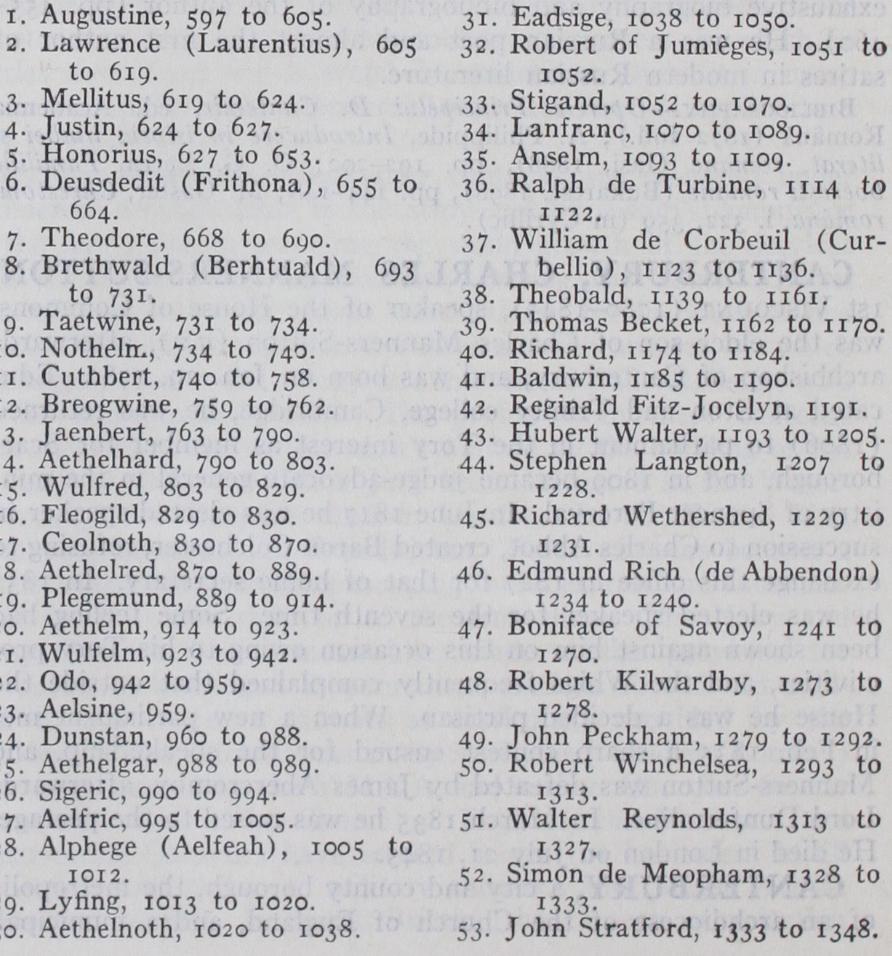
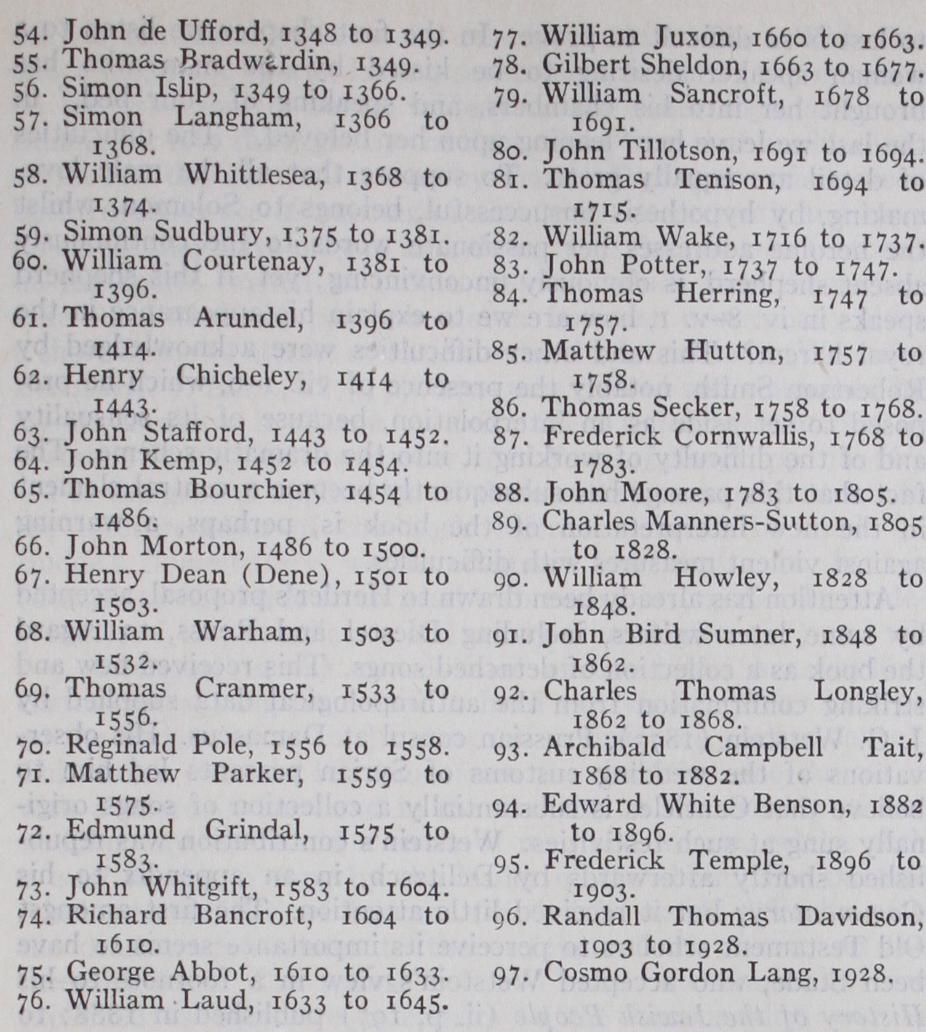
The following is a list of archbishops of Canterbury: The archbishop has a seat at Lambeth Palace, London. There are fragments in Palace Street of the old archbishop's palace which have been incorporated with a modern palace.
The most important re ligious foundation, apart from the cathedral, was the Benedictine abbey of St. Augustine, named after its founder in spite of his dedicating it to St. Peter and St. Paul. This was erected on a site granted by King Aethelbert outside his capital, in a tract called Longport. The site is now occupied by St. Augustine's Missionary College, founded in 1844. Some remnants are preserved, the prin cipal being the entrance gateway (1300), with the cemetery gate and the guest hall, now the refectory. The scanty ruins of St. Pancras' chapel are of great interest, and embody Roman mate rial. The chapel is said to have received its dedication from St. Augustine on account of the special association of St. Pancras with children, and in connection with the famous story of St. Gregory, whose attention was first attracted to Britain when he saw the fair-faced children of the Angles who had been brought to Rome, and termed them "not Angles but angels." There were lesser houses of many religious orders in Canter bury, but only two, those of the Dominicans and the Franciscans, both in St. Peter's Street, have left notable remains. The Domini can refectory is used as a chapel. Among the many churches, St. Martin's, Longport, was the scene of the earliest work of Augus tine in Canterbury, and had seen Christian service before his ar rival. There are Norman, Early English and later portions ; and the font may be in part pre-Norman, while there are traces of Roman masonry. St. Mildred's church exhibits Early English and Perpendicular work, and the use of Roman material is again visible here. St. Paul's is Early English; St. Dunstan's, St. Peter's and Holy Cross are mainly Decorated and Perpendicular. The village of Harbledown, on the hill west of Canterbury on the London road, has many associations with the ecclesiastical life of Canter bury, being mentioned by Chaucer in his pilgrimage under the name, appropriate ,to its site, of "Bob up and down." The alms houses, which occupy the site of Lanfranc's hospital for lepers, include an ancient hall and a chapel in which the west door and northern nave arcade are Norman. Among the numerous charita ble institutions in Canterbury several are the descendants of medi aeval ecclesiastical foundations.
The old city walls may be traced, and the public walk called the Dane John (derived probably from donjon) follows the summit of an artificial mound within the lines.
Only the massive turreted west gate, of the late 14th century, re mains out of the former six city gates. The site of the castle is not far from the Dane John, and enough remains of the Norman keep to show its strength and great size. The guildhall, in High Street, is early 18th century. A modern statue of a muse com memorates the poet Christopher Marlowe (1564-1593) a native of the city. The King's school, adjacent to the cathedral, devel oped out of the early teaching furnished by the monastery. It was refounded in 1541 by Henry VIII., whence its name, and is still connected with the ecclesiastical foundation, the dean and chapter being its governors. Canterbury has considerable agriculture trade, tanneries and brickworks. The parliamentary borough re turns one member. Area of county borough, 3,975 acres.
See A. P. Stanley, Historical Memorials of Canterbury (London,
; J. Brent, Canterbury in the Olden Time (Canterbury, 1879) ; J. W. Legg and W. H. St. J. Hope, Inventories of Christchurch, Canter bury (London, 1902) ; Victoria County History, Kent; G. R. Stirling Taylor, The Story of Canterbury (Mediaeval Town Series, 1912).
