
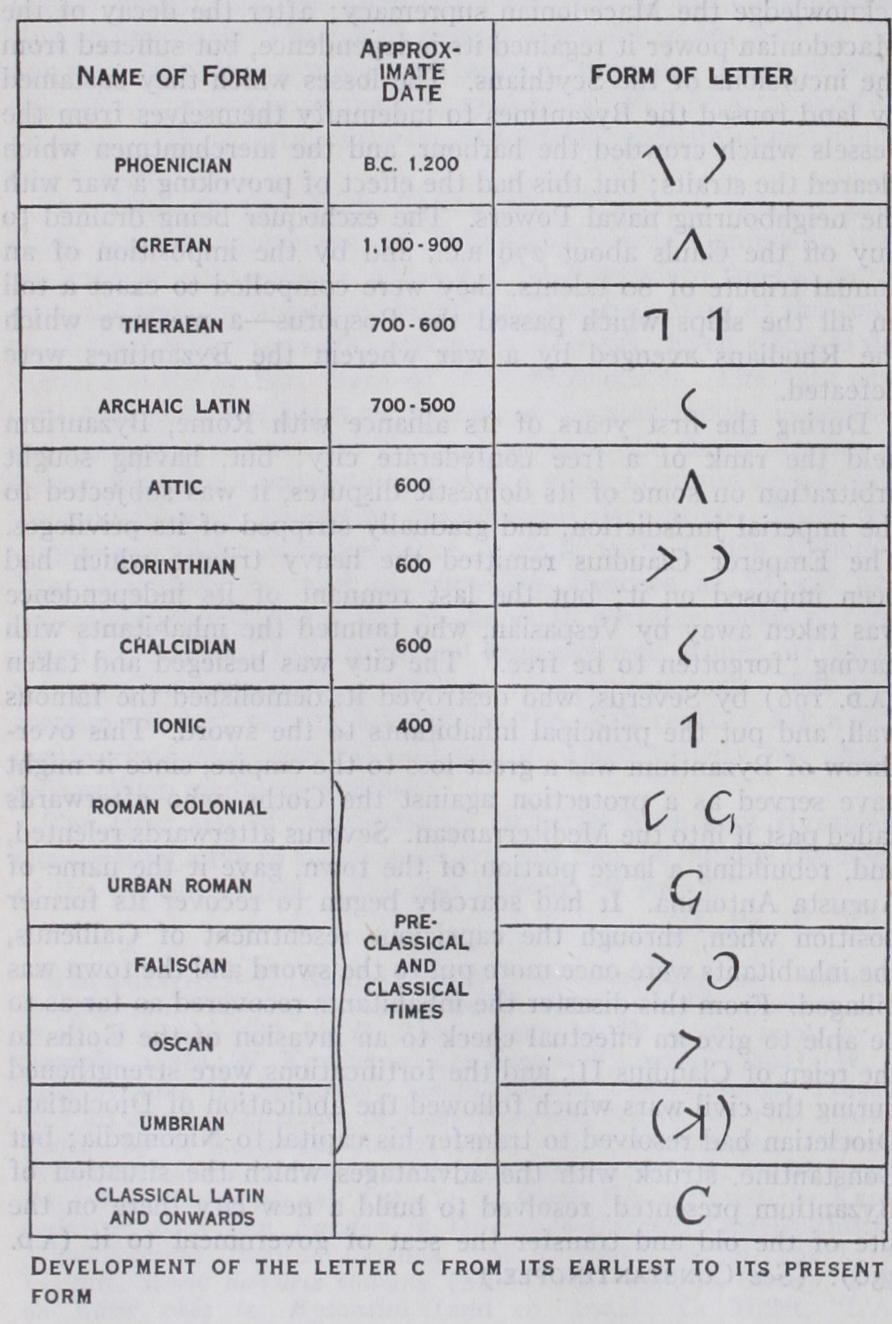
THE LETTER C. The third letter of the alphabet, corresponds to Semitic ' gimel, and Greek r. gamma. Greek forms were r, (, A, <. From the last derived the round form C, which occurs at Corinth and in the Chalcidic alphabet. Both < and C are found in the early Latin alphabet, as well as in Etruscan. The rounded form survived and became general, and the shape of the letter has since altered but little. In certain mediaeval forms of writing the minuscule letter tended to become pointed, e.g., O.
Roman cursive forms are shown in the illustration below.
The sound represented by the letter in Semitic and in Greek was the voiced velar stop, represented in English by the "hard" g. In the Latin alphabet it came to repre sent the unvoiced velar stop, and was for some time, it appears, used for both the voiced and unvoiced sounds. This change must in all probability be due to Etruscan influence, for the voiced stops apparently did not exist in the Etruscan language, with the result that the third letter of the alphabet, as taken over by the Etruscans in Asia Minor from a source which was also that of the Greek alphabet, was used for the corresponding unvoiced sound. An early Latin inscription exists in which the word RECEI occurs, the letter being still employed to represent the voiced sound. Finally a new symbol G was used for the voiced sound, and C displaced K as the representative of the unvoiced stop.
In modern English the letter represents two separate sounds (I) the unvoiced velar stop as in the Latin alphabet, and (2) the un voiced sibilant, identical with the sound represented by s in certain positions. The letter represents the sibilant when preceding either of the front vowels, e and i (e.g., in receive, cider) ; in all other cases (except before h) the velar (e.g., call, come, clear, crumb, epic). This is due to the palatalization of the velar in early mediaeval times before the front vowel, the stages of sound change being k > ki > t > is > s. The letter c was applied by French orthographists in the 12th century to represent the sound is in English, and this sound developed into the simpler sibilant s. Gradually the use of the letter c to represent the velar before front vowels (for example in the Middle English cyng) gave way to that of k, ambiguity being thus as far as possible avoided. C takes the place of s in words such as mice, advice, in which s would represent a voiced sibilant (identical with the sound of z), and in words such as practice merely as a means of grammatical distinction.
Before k the letter is often redundant (e.g., in thick, clock, etc.) . The combination ch represents a double unvoiced palatal (tJ), as in church.
In music, C is the name of the third note of the musical alpha bet, this note being at the same time one which has always occupied a peculiarly distinctive position, in that it is the key note of what used to be called, from the fact that it contains no accidentals, the "natural scale." Thus on the pianoforte it consists entirely of white notes and hence has come to be regarded as the simplest and most fundamental of all keys. C is further one of the three notes (F and G being the others) which have served for centuries, in conjunction with the appropriate signs, to indicate the clefs. (See CLEF.)